Bonds and Debentures Explained: Can They Beat Your FD Now That 10-Year Yields Are Near 7.36%?
Bonds and Debentures Explained: Can They Beat Your FD Now That 10-Year Yields Are Near 7.36%?
Government bond yields have climbed to about 7.36%, and many corporate bonds can now be bought for ₹10,000. Here is how bonds and debentures work, what each credit rating pays, how they are taxed, and the risks FD savers often miss.
- Face value
- ₹10,000
- Coupon
- 7% a year
- Term
- 5 years
Your fixed deposit is about to mature, and the renewal rate looks thin. Then an app notification offers a “secure 9.5% bond” from a finance company you have vaguely heard of, for just ₹10,000. Is it a better FD? A trap? Something in between? Millions of Indian savers are now facing that question, because bonds that were once sold only to institutions in lots of ₹10 lakh can now be bought on a phone.
Bonds and debentures can be an excellent part of a portfolio. They can also lose money in ways FDs almost never do. The difference lies in four things: who is borrowing your money, how long you lend it, what happens to its price when interest rates change, and how the returns are taxed. This guide explains each, with real numbers from October 2026.
Quick Summary
Bonds and debentures are loans you make to governments or companies in return for fixed interest; they can pay more than FDs, but only by taking on more risk. India’s 10-year government bond yielded about 7.36% on 16 October 2026, according to Trading Economics. Indicative yields for AAA-rated PSU bonds were 7% to 7.5% earlier this year, rising to 11.5% to 13% or more for BBB-rated issuers. Unlike bank FDs, corporate bonds have no DICGC insurance, their prices fall when rates rise, and interest is taxed at your slab rate. Start with government and top-rated bonds.
What We Know
- SEBI cut the minimum face value of privately placed debt securities from ₹1 lakh to ₹10,000 in July 2024, for plain interest-paying bonds.
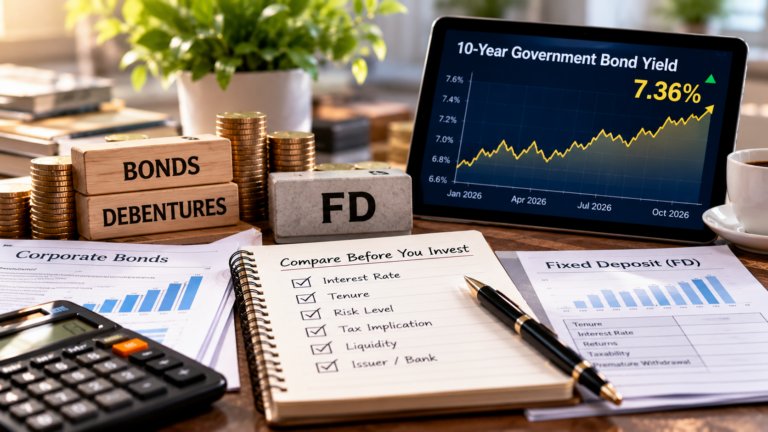
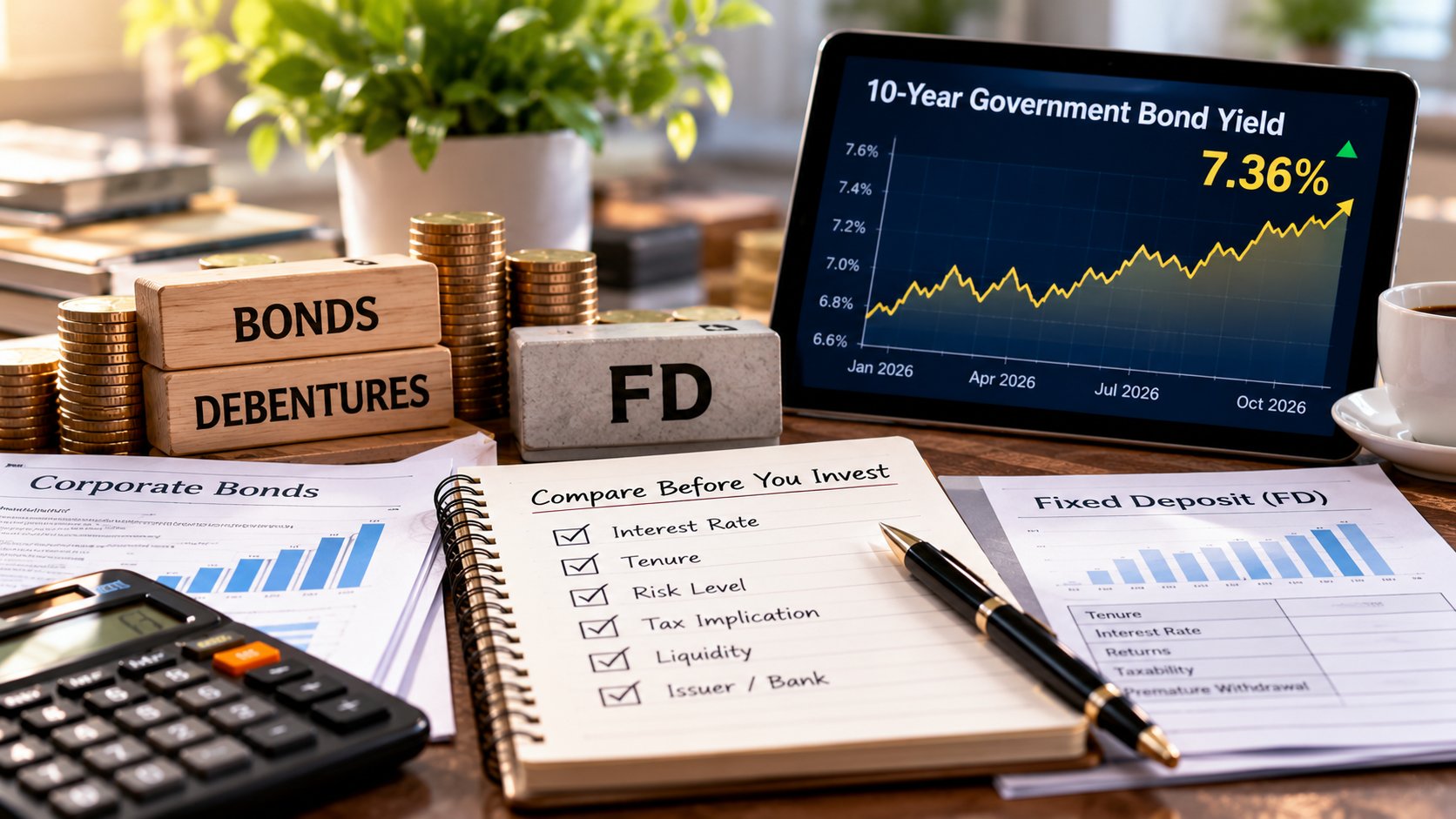
- The 10-year G-sec yield was about 7.36% on 16 October 2026, up 0.86 points in a year.
- The RBI raised the repo rate to 5.50% on 7 October 2026.
- Since 23 July 2024, gains on unlisted bonds and debentures are taxed at slab rates regardless of holding period.
- Listed bonds held over 12 months qualify for long-term capital gains at 12.5%.
What Is Still Unclear
- Whether the RBI will raise rates again in December, pushing bond prices lower.
- How far corporate bond yields have moved since mid-2026, as published rating-wise yields lag the market.
- How actively retail investors will trade on online bond platforms when they need to sell early.
- Whether more issuers will use the ₹10,000 face value for public retail issues.
Bond or Debenture: Is There Really a Difference?
Both are IOUs. When you buy a bond or debenture, you lend money to the issuer. In return you receive interest, called the coupon, at fixed intervals, and your principal back on the maturity date. The terms are used loosely in India, but there is a useful distinction.
Bonds usually refer to debt issued by governments, PSUs and large institutions: central government securities, state development loans, PSU bonds and tax-free bonds. Debentures, usually sold as non-convertible debentures or NCDs, are issued by companies, including NBFCs, housing finance firms and manufacturers. NCDs can be secured, backed by specific assets, or unsecured, ranking behind secured lenders if the company fails.
Secured, unsecured, senior and subordinated
Where your debenture ranks matters if things go wrong. Secured NCDs give holders a claim on specific assets, such as a loan book or property, before unsecured creditors. Senior bonds are repaid ahead of subordinated ones. Bank Tier 2 bonds and perpetual bonds are subordinated by design and can absorb losses in a crisis, which is why they pay more than the same bank’s deposits. Two bonds from the same company can carry very different risks depending on these terms, so read the offer document, not just the issuer’s name.
Four words every bond buyer must know
Face value is the amount the bond will repay at maturity, such as ₹10,000. Coupon is the fixed interest rate on that face value. Price is what the bond trades for today, which can be above or below face value. Yield to maturity is the annual return you earn if you buy at today’s price and hold to maturity; it is the number to compare with an FD rate, not the coupon.
Why a 7% Bond Can Pay 7% or 13%: Credit Ratings Decoded
The single biggest driver of a bond’s yield is the borrower’s credit quality. Rating agencies grade issuers from AAA, the safest, to D, in default. Lower ratings must pay more to attract lenders, because the risk of not being repaid is higher. The extra yield over a government bond of similar maturity is called the credit spread.
- AAAHighest safetySpread of 10 to 60 basis points for PSUs; suitable as an FD alternative for most savers
- AAHigh safetySpread of about 100 to 260 basis points; diversify across several issuers
- AAdequate safetySpread of about 260 to 460 basis points; small amounts only, for experienced investors
- BBBModerate safetyLowest investment grade; spread of 460 to 640 basis points or more
- BB to DSpeculative to defaultHigh risk of losing interest or principal; not suitable for fixed-income savings
The Price Risk Most FD Savers Never See
An FD’s value never changes on paper. A bond’s does. When market interest rates rise, existing bonds paying lower coupons become less attractive, so their prices fall. When rates fall, prices rise. The longer the bond’s remaining life, the bigger the swing. This is called interest rate risk, and it matters right now because yields have been rising.
If you hold a bond to maturity and the issuer pays, these swings do not matter: you get every coupon and your ₹10,000 back. They matter if you need to sell early, because you would sell at the market price. A 10-year bond bought at 7% is worth about ₹8,716 if yields jump to 9%, a 12.8% paper loss. A 2-year bond falls only to ₹9,648.
Liquidity: can you actually sell?
Many corporate bonds trade rarely. Even if a bond is listed on an exchange, there may be no buyer at a fair price on the day you want to sell. Government securities are the most liquid. Treat most corporate bonds as money you can leave invested until maturity.
A simple bond ladder
One way to manage both price risk and liquidity is a ladder: instead of buying one 5-year bond, spread the money across bonds maturing in 1, 2, 3, 4 and 5 years. Each year one bond matures, giving you cash to spend or reinvest at the rates then available. If rates rise, the maturing money is reinvested at the higher yield; if rates fall, the longer bonds lock in today’s yield. With ₹5 lakh, that could mean ₹1 lakh in each of five high-quality bonds.
Bonds Against FDs and Other Options
The fairest comparison is on post-tax return, risk and access to your money. Coupon income from bonds and FD interest are both taxed at your slab rate. The table compares the main fixed-income options available to Indian retail investors.
| Option | Indicative yield | Safety | Liquidity | Minimum |
|---|---|---|---|---|
| Large bank FD | 6.25% to 7.00% | DICGC cover up to ₹5 lakh | Premature exit with penalty | Low, varies by bank |
| Small finance bank FD | 7.50% to 8.50% | DICGC cover up to ₹5 lakh | Premature exit with penalty | Low, varies by bank |
| Government securities | About 7.36% for 10 years | Sovereign | Most liquid bonds | ₹10,000 via RBI Retail Direct |
| AAA PSU bonds | 7.0% to 7.5% | Very high, not insured | Moderate | Often ₹10,000 or more |
| AA corporate NCDs | 8.0% to 9.5% | High, not insured | Low to moderate | Often ₹10,000 or more |
| A and BBB NCDs | 9.5% to 13%+ | Moderate to lower | Low | Often ₹10,000 or more |
FD and corporate bond yields are indicative ranges for Q2 2026 from Bondscanner; G-sec yield is for 16 October 2026. Rates change frequently.
How Bonds and Debentures Are Taxed
Tax can change the answer. The Budget of July 2024 changed several rules for debt investments, Zerodha noted in its summary.
Interest
Coupon interest is added to your income and taxed at your slab rate, the same as FD interest. Check whether tax is deducted at source on the bond you hold; rules differ by instrument and have changed in recent years.
Capital gains
If you sell a listed bond after more than 12 months, the gain is long-term and taxed at 12.5% without indexation. Within 12 months, it is taxed at your slab rate. For unlisted bonds and debentures, and market-linked debentures, gains are taxed at slab rates regardless of how long you held them, for transfers from 23 July 2024.
Special bonds
Section 54EC capital gains bonds, issued by entities such as REC and PFC, let you save tax on long-term capital gains from property by investing up to ₹50 lakh for five years, at a coupon of 5.25% that is itself taxable. Older tax-free bonds, still traded on exchanges, pay interest that is exempt from tax, which makes them attractive to high-bracket investors who can find them at a reasonable price.
- Oct 2022SEBI cuts private bond face value to ₹1 lakh
- Jul 2024SEBI allows ₹10,000 face value for plain bonds
- 23 Jul 2024Unlisted bond gains taxed at slab rates
- 7 Oct 2026RBI raises repo rate to 5.50%
- 16 Oct 202610-year G-sec yield at about 7.36%
How to Buy a Bond, Step by Step
Retail investors now have several routes. Government securities can be bought directly through the RBI Retail Direct platform. Corporate bonds are sold through SEBI-registered online bond platforms, stockbrokers and public issues of NCDs. You need a demat account for most listed bonds.
- Step 1Check the ratingPrefer AAA and AA; read the rating rationale
- Step 2Compare the YTMUse yield to maturity, not the coupon
- Step 3Match the maturityPick a term you can hold to, often 1 to 5 years
- Step 4Check securitySecured or unsecured; senior or subordinated
Red flags
Be cautious if a platform or seller promises “guaranteed” returns on a corporate bond, if the yield is far above similar ratings, if the issuer’s rating has recently been cut, or if the bond is unlisted and sold through informal channels. Use SEBI-registered intermediaries only.
Or let a fund do the work
Investors who prefer not to pick individual bonds can use debt mutual funds or target maturity funds, which hold many bonds and can be sold on any working day. Since April 2023, gains on most debt funds are taxed at slab rates, so the tax advantage they once had over FDs has largely gone. Their benefits are diversification, professional credit assessment and easier exit, against an expense ratio and no fixed maturity value for most open-ended funds.
- Keep most fixed-income money in AAA, G-secs and FDs
- Limit any single corporate issuer to 5% to 10% of the portfolio
- Match maturity to when you need the money
- Compare post-tax yield with your FD option
- Prefer listed, rated bonds in demat form
- Read the offer document’s security and ranking terms
- Buy through SEBI-registered platforms or brokers
- Expect price falls if rates rise further
Frequently Asked Questions
What is the difference between a bond and a debenture?
Both are loans to an issuer in return for interest. In India, “bonds” usually refers to government and PSU debt, while “debentures” or NCDs are typically issued by companies and may be secured or unsecured.
Are corporate bonds safer than fixed deposits?
No. Bank FDs are insured by DICGC up to ₹5 lakh per bank. Corporate bonds have no such cover, and their safety depends on the issuer’s credit quality.
What is the minimum investment in bonds in India?
Many privately placed bonds can now be issued at a face value of ₹10,000 after SEBI’s July 2024 change. Government securities can also be bought in small amounts through RBI Retail Direct.
How is interest on bonds taxed?
Coupon interest is taxed at your income tax slab rate, the same as FD interest. Check whether TDS applies to your bond.
What is the capital gains tax on listed bonds?
Listed bonds sold after more than 12 months are taxed at 12.5% without indexation. Gains on unlisted bonds and debentures are taxed at slab rates regardless of holding period.
Why do bond prices fall when interest rates rise?
Because new bonds pay higher coupons, existing lower-coupon bonds become less attractive, so their price falls until their yield matches the market. Longer bonds fall more.
What does a AAA rating mean?
It is the highest credit rating, indicating the strongest ability to repay. AAA bonds pay the lowest yields among corporate bonds because they carry the least credit risk.
What is a 54EC bond?
A bond that lets you save tax on long-term capital gains from property by investing up to ₹50 lakh for five years. The interest, 5.25% a year, is taxable.
The Short Version
Bonds and debentures are loans you make to governments or companies for fixed interest. With the 10-year G-sec yield near 7.36% and many bonds available from ₹10,000, high-quality bonds can beat FDs after tax. But corporate bonds are not insured, lower ratings pay more because they carry real default risk, and prices fall when rates rise. Interest is taxed at slab rates; listed bonds held over 12 months pay 12.5% on gains. Start with G-secs and AAA bonds, hold to maturity, and diversify.