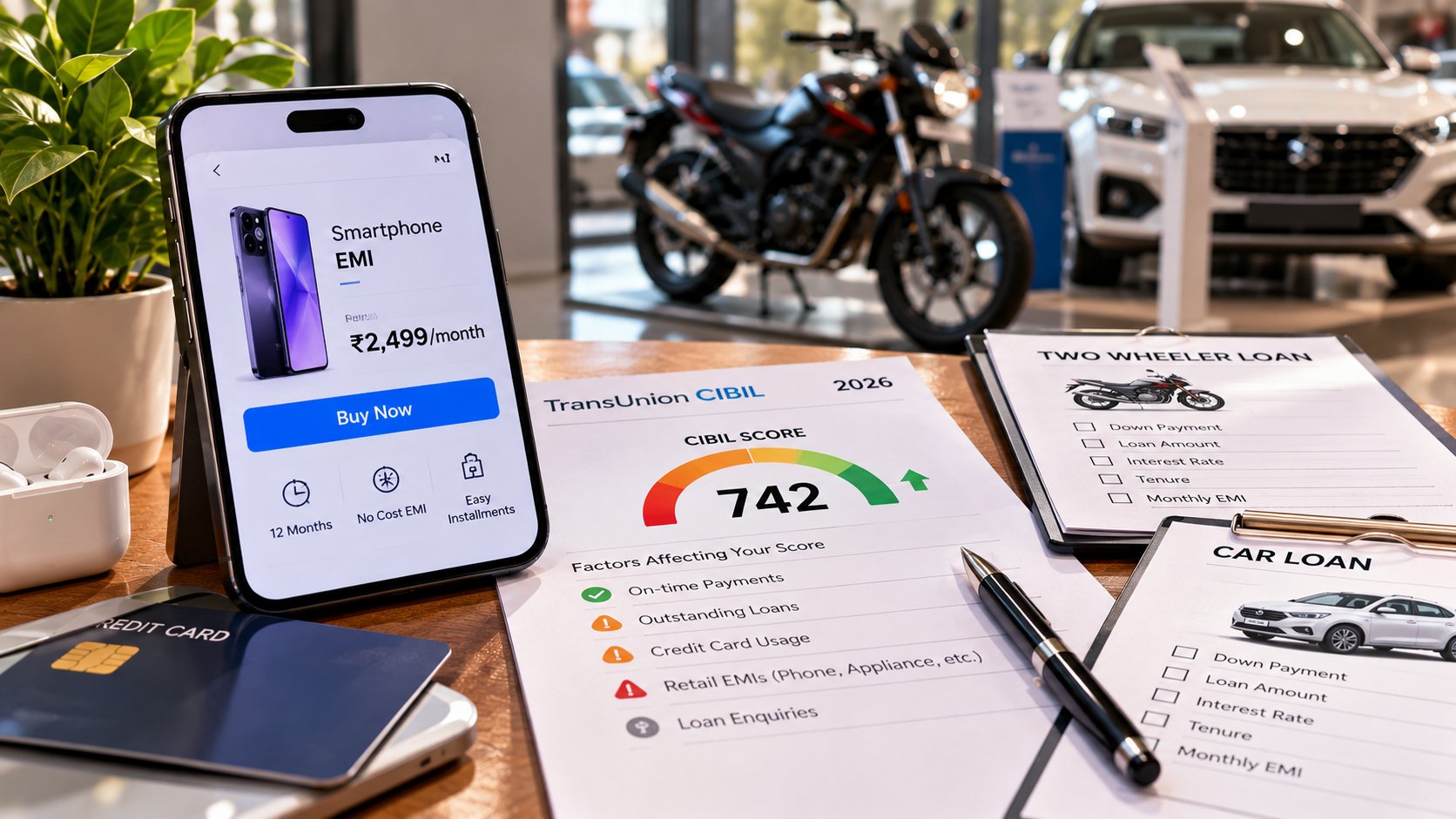
Is Your Phone EMI Paving the Way to a Bike or Car Loan? What TransUnion CIBIL's 2026 Data Shows
Is Your Phone EMI Paving the Way to a Bike or Car Loan? What TransUnion CIBIL’s 2026 Data Shows
TransUnion CIBIL’s new Shifting Gears 2026 report finds more two-wheeler and car buyers arriving with a credit history, often first built on phone and consumer durable loans. That credit ladder is quietly supporting India’s vehicle sales boom, and it carries risks borrowers should understand.
A 21-year-old in a small town buys a ₹20,000 phone on a 12-month EMI at a mobile shop. A year later, with every instalment paid, a finance company approves her for a scooter. Three years on, with both loans repaid, her record helps her qualify for a small car loan. None of these steps looks remarkable on its own. Together, they describe how millions of Indians are now climbing into vehicle ownership.
New data from TransUnion CIBIL suggests this credit ladder is becoming one of the forces behind India’s vehicle market. Fewer two-wheeler buyers are borrowing for the first time; more arrive with a history, often built on phone and appliance loans. Car buyers, in turn, are increasingly graduating from two-wheeler loans. This article explains what the numbers show, what they do not, and how borrowers can climb the ladder without slipping.
Quick Summary
Smartphone and consumer durable loans are not directly paying for cars and bikes, but they are building the credit histories that make vehicle loans possible. TransUnion CIBIL’s Shifting Gears 2026 report found 43% of two-wheeler borrowers in the first half of 2026 had an established credit history, up from 27% in 2019. Its chief executive said many first used consumer durable or phone financing. And 11% of car loans went to borrowers upgrading from two-wheeler loans. Vehicle retail rose 31.82% in September, FADA reported, though that partly reflects a weak base.
What We Know
- TransUnion CIBIL released Shifting Gears 2026: Credit Drives Today’s Mobility on 13 October.
- Established-credit borrowers rose to 43% of two-wheeler loans in H1 2026, from 27% in H1 2019.
- 68% of people who took two-wheeler loans in H2 2022 had taken another credit product by H2 2025.
- About half of consumer durable loans are for smartphones, Business Standard reported, citing The Economic Times.
- The RBI has proposed tightly limited rules for remotely restricting loan-financed phones after default.
What Is Still Unclear
- Exactly what share of bike and car borrowers first borrowed for a phone; the report gives no separate figure.
- Whether phone loans cause later vehicle purchases, or simply show who is ready to borrow.
- When the RBI’s draft on device locking will be finalised, and in what form.
- How October’s festive sales will compare against a high base.
A Vehicle Boom Built on Credit
India’s vehicle market is in a strong phase. The Federation of Automobile Dealers Associations reported 25,36,920 vehicles retailed in September 2026, up 31.82% from a year earlier, including 17,90,188 two-wheelers, up 33.08%, and 4,27,213 passenger vehicles, up 32.10%. FADA’s president cautioned that the figure is flattered by a weak September 2025, when buyers waited for the GST cut that took effect on 22 September that year. Underlying growth was about 17% in the first five months of FY27.
Behind those sales is credit. TransUnion CIBIL’s report shows the number of active two-wheeler loan borrowers nearly doubled, from 1.7 crore in June 2019 to 3.3 crore in June 2026. Two-wheeler loans outstanding rose 3.2 times to ₹1.76 lakh crore. Active car loan borrowers rose 1.7 times to 2.5 crore. In rural areas, loans to people upgrading from two-wheelers to cars grew 15% a year since 2019, almost twice the 8% for auto loans overall.
Crucially, repayment has improved even as lending grew. Two-wheeler loans 90 or more days overdue fell from 2.7% to 1.4%, and car loans from 1.45% to 0.5%, according to the report. Lenders are lending more, and to people who are paying back.
For vehicle makers and dealers, this matters directly. A larger pool of borrowers with clean credit records means more customers who can be approved quickly at the showroom, which is why manufacturers and dealers work closely with finance partners, especially during the festive season. FADA said 75.57% of dealers expect growth in October, the first clean comparison since the GST cut, though rising vehicle prices and inventory of about 43 to 45 days were concerns.
Why NBFCs dominate the bottom rungs
Non-bank finance companies hold 73% of two-wheeler loans and 37% of car loans, according to the report. They are also the main lenders for phones and appliances at the point of sale. That gives them a head start: a company that financed a customer’s phone already knows how she repaid, and can offer her a scooter loan with more confidence than a bank seeing her for the first time. For lenders, the phone loan is partly a customer acquisition tool.
How a Phone Loan Becomes a Credit Passport
To lend safely, banks and finance companies want to see how a borrower has repaid before. A person with no credit history is hard to judge, so lenders charge more, ask for larger down payments, or say no. A small loan repaid on time changes that. It creates a credit file and a score, which lenders read as evidence of discipline.
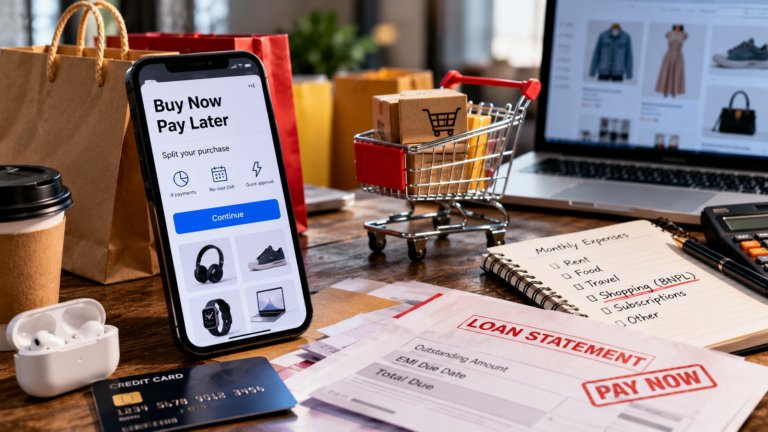
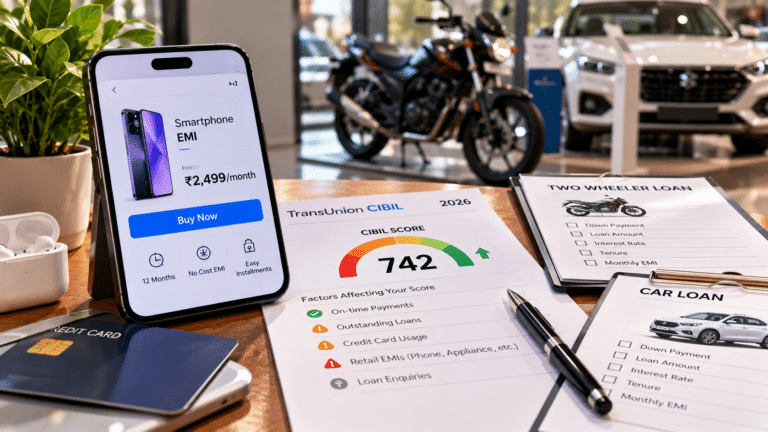
Smartphone loans are often the first rung. They are small, quick to approve at the point of sale, and frequently offered as “no-cost EMI”. Business Standard, citing The Economic Times, reported that about half of all consumer durable loans are for smartphones, because people replace phones more often and buy them for several family members. Lenders named in that report included Bajaj Finance, HDB Financial Services, DMI Finance and Cholamandalam Finance.
- Months 0 to 12Phone or appliance EMISmall loan, often ₹10,000 to ₹30,000, creates a credit file
- Year 1 to 3Two-wheeler loanLenders see a repayment record and approve more easily
- Year 1 to 3 afterMore products68% add another credit product within 3 years
- LaterCar loan11% of car loans go to two-wheeler graduates
The time ranges above are illustrative of the pattern the data describes, not fixed rules. Speaking about the report, TransUnion CIBIL’s Bhavesh Jain said six out of every ten two-wheeler loans now go to established credit borrowers, and that many had first used consumer durable or phone financing. The report itself does not publish a separate figure for smartphone loans.
What the data does not prove
It is tempting to say phone loans cause vehicle purchases. The data does not show that. People who buy phones on EMI may simply be the same people whose incomes are rising and who would have bought a scooter anyway. What the report does show is that lenders increasingly prefer borrowers with a track record, and that the share of two-wheeler loans going to established borrowers has risen sharply. Phone and appliance loans are one of the most common ways young and rural Indians build that record, which is why the link matters.
The ladder in numbers
What Happens After the Bike Loan
The ladder does not stop at a scooter. TransUnion CIBIL tracked people who took a two-wheeler loan in the second half of 2022. By the second half of 2025, 68% had taken at least one more credit product. Among those aged 18 to 35, it was 71%. The most common next step was another consumer durable loan.
Car loans are getting bigger too. The average sanctioned passenger vehicle loan reached ₹8.2 lakh in the first half of 2026, up 49% since 2019, and the average tenure stretched by five months to 62 months. Bhavesh Jain said car ownership is “increasingly being shaped by a combination of aspiration and affordability”, with buyers choosing higher-value, feature-rich vehicles.
The Risks on the Way Up
A credit ladder works only if each rung is repaid. Problems tend to start when loans overlap: a phone EMI still running when the bike loan begins, then a personal loan for a wedding or travel, then a car. Each is affordable alone. Together they can squeeze a modest income.
Smartphone loan defaults and the device-locking debate
Smartphone loans have their own stress points. In late 2025, Business Standard, citing The Economic Times, reported that debt collection firm DPDZero saw a 20% month-on-month rise in people not repaying phone loans after the RBI stopped lenders remotely locking borrowers’ phones. In May 2026, the RBI issued revised draft directions that would allow limited restrictions only on phones financed by the loan itself, and only after at least 90 days past due, a 21-day notice from 60 days past due and a further 7-day cure period. Even then, calls, internet, emergency SOS and government alerts could not be blocked, according to an analysis by Vinod Kothari Consultants. The rules are not final.
| Stage | Typical loan | Who usually lends | What it builds | Main risk |
|---|---|---|---|---|
| Phone EMI | ₹10,000 to ₹30,000, 6 to 12 months | Consumer finance NBFCs, card issuers | First credit file and score | Missed small EMIs hurt a thin file |
| Appliance EMI | Similar, at point of sale | Consumer finance NBFCs | Repayment record | Stacking several small EMIs |
| Two-wheeler loan | Often under ₹1.5 lakh, 1 to 3 years | NBFCs, 73% of market | Secured loan history | Repossession on default |
| Personal loan | Over ₹50,000 for 21% of 2W borrowers | Banks, NBFCs, fintechs | Unsecured credit record | Higher rates; easy to overborrow |
| Car loan | Average ₹8.2 lakh, 62 months | Banks 63%, NBFCs 37% | Large secured loan | Long tenure on a depreciating asset |
Loan sizes for phone and two-wheeler loans in the table are typical ranges for illustration; other figures are from the CIBIL report. Bank share of car loans is derived from the 37% NBFC share.
Climbing the Ladder Without Slipping
The simplest rule is to let one loan finish before the next begins, especially early in your credit life. Each loan repaid in full strengthens your file more than several running at once.
- Treat every EMI, even ₹1,000, as a loan on your report
- Check your credit report once a year from each bureau
- Let one loan close before starting the next where you can
- Keep total EMIs under about 30% to 40% of take-home pay
- Put at least 10% to 20% down on any vehicle
- Keep car loans to 5 years or less where possible
- Ask for the annual rate, not just the EMI, on “no-cost” offers
- Collect the NOC and close hypothecation after the last EMI
- Jun 20191.7 crore active two-wheeler borrowers; 2W 90+ day delinquency 2.7%
- 22 Sep 2025GST on small cars and two-wheelers cut, lowering prices
- Nov 2025Reports of rising smartphone loan defaults after locking stopped
- 21 May 2026RBI revised draft on restricting financed devices after 90 days past due
- Jun 20263.3 crore active two-wheeler borrowers; delinquency 1.4%
- Sep 2026Vehicle retail up 31.82%, two-wheelers up 33.08%
- 13 Oct 2026CIBIL publishes Shifting Gears 2026
Frequently Asked Questions
Does a mobile phone EMI improve my CIBIL score?
It can. Phone loans are usually reported to credit bureaus, so paying every EMI on time builds a positive history. Missing payments can lower your score, especially if it is your only loan.
Can a phone loan help me get a bike loan?
A repaid phone loan gives lenders a track record. TransUnion CIBIL found 43% of two-wheeler borrowers in H1 2026 had an established credit history, and many had first used consumer durable or phone financing.
What is TransUnion CIBIL’s Shifting Gears 2026 report?
A study of vehicle loans released on 13 October 2026. It covers two-wheeler and car lending trends, borrower profiles, loan sizes and repayment from 2019 to 2026.
How many car loans go to first-time borrowers?
37% of passenger vehicle loan originations in H1 2026 went to first-time car borrowers, and 11% to borrowers upgrading from two-wheeler loans, according to the report.
What is the average car loan amount in India in 2026?
₹8.2 lakh in H1 2026, up 49% from 2019, with an average tenure of 62 months, according to TransUnion CIBIL.
Can lenders lock my phone if I miss EMIs?
Not currently. The RBI stopped remote locking and in May 2026 proposed draft rules allowing limited restrictions only on financed phones after 90 days past due, with notices and a cure period. The rules are not final.
Is a no-cost EMI really free?
Often the interest is offset by a discount or built into the price, and processing fees may apply. It is still a loan reported to credit bureaus.
How many loans can I have at once safely?
There is no fixed number. A common guide is to keep total EMIs under about 30% to 40% of take-home pay, and to avoid starting a new loan while several others are still running.
The Short Version
Smartphone loans are not paying for India’s cars and bikes, but they are building the credit histories that make vehicle loans easier. TransUnion CIBIL’s Shifting Gears 2026 report shows 43% of two-wheeler borrowers now have an established credit history, up from 27% in 2019, and 11% of car loans go to two-wheeler graduates. Vehicle credit has grown fast while defaults have fallen. The ladder works when each loan is repaid before the next. Stacked, small EMIs can quietly stretch an income.