Income Tax, Then Capital Gains Tax, Then GST: How Many Times Is One Rupee Taxed in India, and Is It Really 68%?
Personal Finance · Tax Explainer
Income Tax, Then Capital Gains Tax, Then GST: How Many Times Is One Rupee Taxed in India, and Is It Really 68%?
A widely shared post on X adds three tax rates on salary, shares and a car to reach 68%. The same journey, worked out step by step, comes to about 40% on a top-slab rupee and far less for most salaried households.
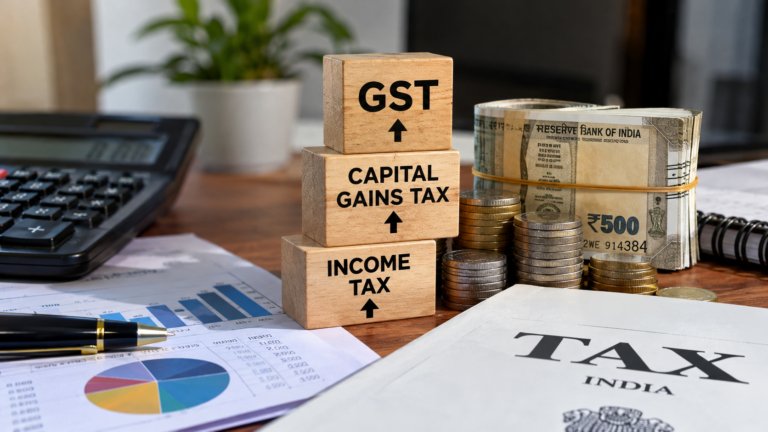
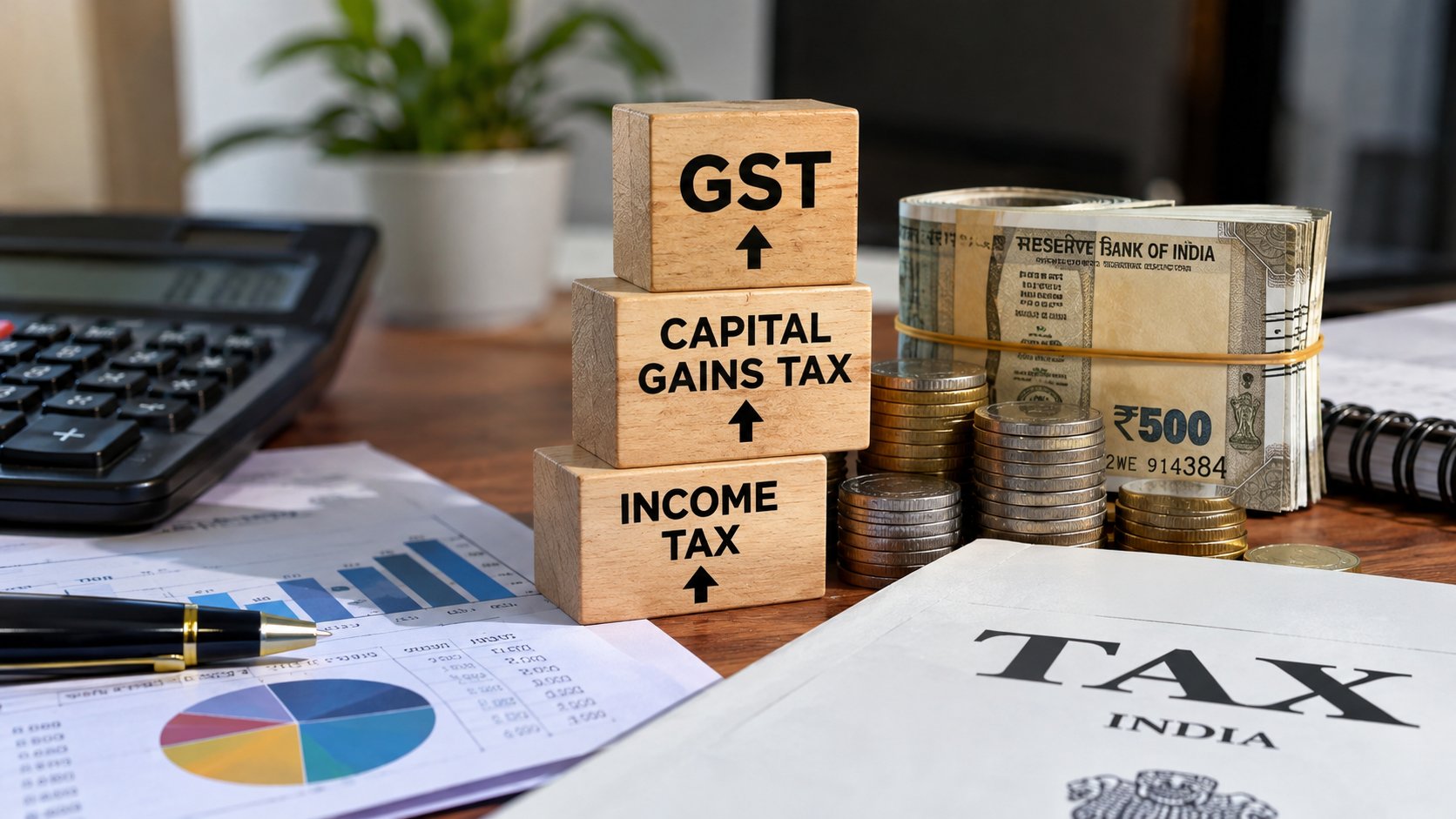
The salary lands with tax already deducted. Some of it goes into shares, and the profit is taxed when you sell. What remains buys a car, and the invoice carries GST. By the third payment, the feeling is hard to shake: the same money keeps getting taxed.
That feeling is the subject of a post on X that has drawn more than 2 lakh views. The frustration behind it is widely shared. The headline number in it does not survive a calculator, and the gap between the two is where the useful part of this story sits.
Quick Summary
One rupee of salary can meet three taxes on its way to a showroom, but each applies to a different amount, so the rates cannot be added. On ₹100 earned in the top slab, total tax across all three stages is about ₹43, or roughly 40%, not 68%. For a ₹25 lakh salary the combined figure in our illustration is close to 19%. It is not double taxation in law, though the fairness question is a live one.
What We Know
These points are confirmed from the post itself and from tax rules in force for the financial year 2026-27.
- A post from a verified X account lists three payments: 30% tax on salary, 20% short-term capital gains tax on stock market profit, and 18% GST on a car. It totals them as 68%.
- The post asks how many times tax must be paid on the same amount. It has gathered about 4,100 likes, 736 reposts, 441 replies and roughly 2.1 lakh views.
- Under the new tax regime, the 30% rate applies only to taxable income above ₹24 lakh. Budget 2026 left the slabs unchanged.
- Short-term capital gains on listed shares are taxed at 20% of the profit. Long-term gains are taxed at 12.5% above ₹1.25 lakh a year.
- Since 22 September 2025, GST on small cars is 18%, on larger cars and SUVs 40%, and on electric cars 5%.
What Is Still Unclear
- Who the author is. Social media pages have described the writer as an Oracle employee. We could not independently confirm the person’s employer or role, so this article does not rely on it.
- The author’s actual numbers. The post gives rates, not amounts. The salary, the size of the investment gain and the car’s price are not stated.
- Whether 68% was meant literally. The post ends on a laughing emoji, and it may be a rhetorical total. Many readers have nonetheless repeated it as a real tax rate.
- Any official response. We found no statement from the Finance Ministry or the tax department addressing this post.
Three Tollbooths, One Rupee: Where Each Tax Actually Bites
The post describes a real route that money takes in a salaried household. What it leaves out is that every tollbooth on that route measures something different. One measures what you earned. One measures what your investment gained. One measures what you spent.
The GST leg hides a second subtlety. The 18% is added to the car’s pre-tax value, so it forms a smaller share of the cheque you write. On a price of ₹118, the tax is ₹18, which is 15.25% of what leaves your account. Quoting 18% of the full amount paid overstates it.
Why the three percentages cannot be added
Here is the error that most people repeating the figure make. A percentage means nothing without its base. Thirty per cent of income, twenty per cent of a profit and eighteen per cent of a price are three different quantities. Adding them is like adding kilometres to kilograms.
The capital gains leg shows this most clearly. If you invest ₹70 and sell at ₹77, the tax is 20% of the ₹7 profit. That is ₹1.40. It is not 20% of ₹77, and it is certainly not 20% of the original salary. The profit is also new income that did not exist on payday, which is why it is treated as a fresh taxable event.
Following ₹100 From Payslip to Car Keys
To test the 68% claim on its own terms, take the harshest case: a rupee earned entirely in the 30% slab. Assume it is invested, earns a 10% short-term profit and is then spent in full on a small car taxed at 18%. Cess is left out here so the rates match the post exactly.
- Salary: ₹100 earned, ₹30 income tax, ₹70 in hand.
- Shares: ₹70 invested grows to ₹77. Tax on the ₹7 gain at 20% is ₹1.40. Cash now ₹75.60.
- Car: ₹75.60 paid to the dealer. GST inside that price is ₹11.53, and the car itself is worth ₹64.07 before tax.
So the worst-case answer to the post’s question is roughly 40 paise in the rupee, not 68. That is still a large number. It is also the figure for the very last rupee of a high earner, which is a long way from what a typical salaried household pays overall.
Change one assumption and the total moves. Had the shares been held for more than 12 months, the ₹7 gain would face the 12.5% long-term rate, or no tax at all if the year’s gains stayed within the ₹1.25 lakh exemption. The choice of car matters even more, because the GST rate ranges from 5% to 40%.
The 30% Slab Is Not a 30% Tax Bill
The first number in the post does much of the damage. Being in the 30% slab does not mean losing 30% of your salary. India’s slabs are marginal, which means each slice of income is taxed at its own rate and only the top slice meets the top rate.
Under the new regime, a salaried person pays no income tax on up to ₹12.75 lakh a year, after the ₹75,000 standard deduction and the Section 87A rebate. Above that level, the average rate climbs slowly.
| Taxable income slice | Rate | Tax on that slice | Running total |
|---|---|---|---|
| Up to ₹4 lakh | Nil | ₹0 | ₹0 |
| ₹4 lakh to ₹8 lakh | 5% | ₹20,000 | ₹20,000 |
| ₹8 lakh to ₹12 lakh | 10% | ₹40,000 | ₹60,000 |
| ₹12 lakh to ₹16 lakh | 15% | ₹60,000 | ₹1,20,000 |
| ₹16 lakh to ₹20 lakh | 20% | ₹80,000 | ₹2,00,000 |
| ₹20 lakh to ₹24 lakh | 25% | ₹1,00,000 | ₹3,00,000 |
| Above ₹24 lakh | 30% | 30% of the excess | ₹3,00,000 plus |
Is It Double Taxation? What the Term Covers
In tax law, double taxation usually means the same income being taxed twice, either in two countries or in the hands of the same person. India has treaties to prevent the first kind. The sequence in the post does not fit either description, because each levy has its own trigger.
| Tax | What triggers it | What it is charged on | Rate in the post | Collected by |
|---|---|---|---|---|
| Income tax | Earning a salary | Taxable income, slab by slab | 30% (top slab only) | Centre |
| Short-term capital gains | Selling listed shares within 12 months at a profit | The profit alone | 20% | Centre |
| Long-term capital gains | Selling after 12 months at a profit | Profit above ₹1.25 lakh a year | 12.5% (not in post) | Centre |
| Securities transaction tax | Buying or selling on an exchange | Trade value, 0.1% on delivery | Not in post | Centre |
| GST on a car | Buying the vehicle | Value of the car | 18% (small cars) | Centre and state |
| Road tax and registration | Registering the vehicle | Vehicle price, by state rules | Not in post | State |
Almost every large economy runs this layered design: a tax on income, a tax on gains, and a VAT or GST on spending. India is not unusual in having all three.
Where the complaint has more force
There are places where the overlap is closer to the everyday meaning of the phrase. A company pays corporate tax on its profit, and shareholders then pay tax at slab rates on dividends from that same profit. Securities transaction tax is paid on trades and cannot be claimed as a deduction against capital gains. And because GST is charged on the price, a salaried buyer pays it out of income that has already been taxed.
The post also leaves out several costs that a car buyer does meet. State road tax and registration are charged at the time of purchase, motor insurance premiums carry GST, and fuel is taxed through central excise and state VAT every time the tank is filled. A full accounting of what it costs to own a car would therefore sit above the GST-only figures used here, though still far from 68%.
None of this makes the 68% figure right. It does explain why the post struck a nerve despite the arithmetic.
The Fairness Question Both Sides Keep Returning To
Whether the overall burden on salaried middle-class families is fair is a matter of policy judgment, not arithmetic. The arguments on each side are well rehearsed, and both rest on facts worth knowing.
Scale adds context. Net direct tax collections reached ₹23.40 lakh crore in FY 2025-26, up about 5% on the previous year, according to CBDT figures reported in May 2026. Individuals and other non-corporate taxpayers supplied more than half of that. Supporters of further relief point to this share, while others note that it partly reflects rising incomes and wider compliance.
Readers will weigh these differently. What the figures do settle is that the debate is better argued with the real rate, around 19% for the household above, than with one that is three and a half times larger.
How the Three Rates Reached Today’s Levels
Each number in the post is recent. All three were set or reset within the past 27 months.
| Car type | Before 22 Sept 2025 | Now | Change |
|---|---|---|---|
| Small petrol, CNG or LPG car | 29% | 18% | 11 points lower |
| Small diesel car | 31% | 18% | 13 points lower |
| Mid-size car | 45% | 40% | 5 points lower |
| Large car | 48% | 40% | 8 points lower |
| SUV | 50% | 40% | 10 points lower |
| Electric car | 5% | 5% | No change |
What a Salaried Taxpayer Can Do Within the Rules
The structure of the three taxes is fixed by law, but how much each one takes depends partly on choices. These are general points, not personal advice.
Frequently Asked Questions
Is paying income tax, capital gains tax and GST on the same money double taxation?
Not in the legal sense. Each tax is triggered by a different event: earning income, making an investment profit, and buying goods or services. The money does pass through three tax points, so the combined burden is real, but the three rates apply to different amounts and cannot simply be added together.
Does a salaried person in India really pay 68% tax?
No. Adding 30%, 20% and 18% gives 68%, but each rate applies to a different base. On ₹100 earned in the top slab, with a 10% short-term gain and an 18% GST car, total tax is about ₹42.93 out of ₹107 earned, or roughly 40%. For a household on ₹25 lakh a year, our illustration works out to about 19%.
How much income tax does a salaried person pay under the new regime in FY 2026-27?
Under the new regime, salary up to ₹12.75 lakh carries no income tax after the ₹75,000 standard deduction and the Section 87A rebate. Above that, slab rates run from 5% to 30%, with the 30% rate applying only to taxable income above ₹24 lakh. A 4% cess is added to the tax.
Is short-term capital gains tax charged on the full amount invested?
No. The 20% short-term capital gains tax on listed shares applies only to the profit, not to the amount you invested. If you invest ₹70 and sell at ₹77, tax is 20% of the ₹7 gain, which is ₹1.40, plus cess.
What is the GST rate on cars in India now?
Since 22 September 2025, small cars are taxed at 18%, larger cars and SUVs at 40%, and electric cars at 5%, with no separate compensation cess. Small cars are petrol, CNG or LPG models up to 1200cc and diesel models up to 1500cc, in both cases up to 4 metres long.
How can I legally reduce tax on stock market profits?
Holding listed shares or equity funds for more than 12 months moves the gain to the long-term rate of 12.5%, and the first ₹1.25 lakh of such gains in a financial year is exempt. Losses can also be set off against gains under the rules. Check your own position with a tax professional.
Do other countries tax income and spending separately?
Yes. Most large economies levy an income tax along with a consumption tax such as VAT or GST, and many also tax investment gains. The debate in India is less about the existence of several taxes and more about rates, exemptions and the quality of public services received in return.
Is GST charged on top of income tax when I buy something?
GST is charged on the price of goods and services regardless of where the money came from. Because purchases are normally made from post-tax income, the two taxes stack in practice, but GST is calculated on the purchase value, not on your income.
The Short Version
A rupee of salary can be taxed when it is earned, when its investment profit is booked and when it is spent. Those are three events with three different bases, so 30%, 20% and 18% do not add up to 68%. Worked through, the top-slab rupee loses about 40%, and a ₹25 lakh household in our example pays close to 19% across all three. Whether that is a fair price for the public services received is a legitimate debate, and it is one best held with the correct number.