RBI Rate Hike in October 2026? What a Higher Repo Rate Could Mean for Your Home Loan EMI, FD Returns and Savings
- RBI Policy
- Home Loans
- Fixed Deposits
RBI Rate Hike in October 2026? What a Higher Repo Rate Could Mean for Your Home Loan EMI, FD Returns and Savings
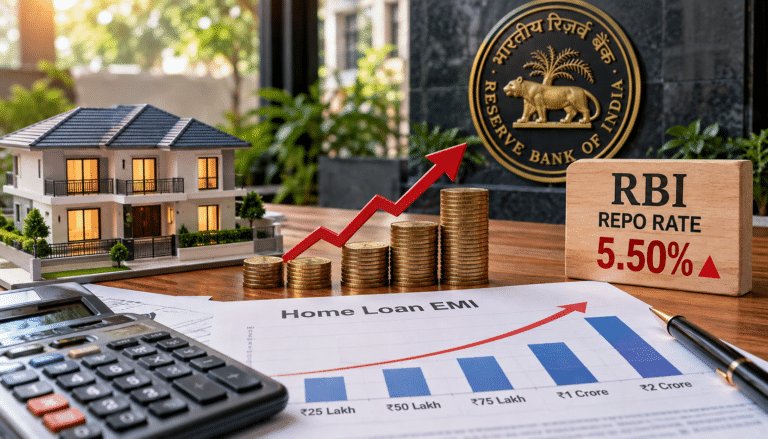
The repo rate stands at 5.25% ahead of the October 5 to 7 policy meeting. A majority of economists polled by Reuters expect a 25 basis point increase to 5.50%, which would be the first hike since 2023.
For almost two years, Indian borrowers have only heard one kind of RBI news: rates going down or staying put. That streak may end next Wednesday. Inflation has crept above target for three straight months, the rupee has been under pressure, and the US Federal Reserve has started raising rates again. Together, those forces have turned the October policy into a live meeting, and the household question is simple: what would a hike actually cost you, and what could it earn you?
The Short Version Before the Big Announcement
What We Know
- The repo rate is 5.25%, with the SDF at 5.00% and the MSF and Bank Rate at 5.50%.
- The MPC kept rates unchanged with a neutral stance in August, its fourth straight pause.
- CPI inflation rose to 4.82% in August, the third month in a row above the 4% target.
- The MPC meets October 5 to 7, 2026, and announces its decision on October 7.
- In a Reuters poll, 38 of 61 economists expect a 25 bps hike to 5.50%.
- Home loan rates at several banks started from around 7% in mid-September 2026.
What Is Still Unclear
- Whether the MPC hikes in October or waits until December for more data.
- The size of any move: 25 bps is the consensus, but views differ on what follows.
- Whether the stance changes from neutral, which would signal the path ahead.
- How quickly, and by how much, individual banks pass a hike to loans and deposits.
- How crude oil prices and the rupee move between now and the announcement.
From Rate Cuts to a Possible U-Turn: How We Got Here
The current debate only makes sense against the backdrop of what happened before it. The RBI spent most of 2025 cutting rates, then switched to a long pause. Here is the path, step by step.
- February to December 2025The RBI cuts the repo rate by a cumulative 125 basis points, from 6.50% to 5.25%.
- February to August 2026Four consecutive pauses at 5.25%, all with a neutral stance. In April, the MPC cited a supply shock from West Asia as a reason to wait and watch.
- August 2026Retail inflation reaches 4.82%, staying above the 4% target for a third month.
- September 2026The US Federal Reserve raises its target range by 25 bps to 3.75% to 4.00%, narrowing the rate gap with India. The rupee trades near record lows, down around 6.5% for the year.
- Late September 2026Polls show a majority of economists now expect a hike. Nomura puts the odds of an October move at 60%; HSBC and Nomura both expect hikes in October and December.
- October 7, 2026The MPC announces its decision. Any change to the repo rate applies from that day.
Why Inflation Is Suddenly Back at the Centre of the Table
The RBI targets 4% inflation, with a tolerance band of 2% to 6%. Being above 4% is not a breach, but persistence matters. Several economists now warn that inflation could approach or cross the 6% upper limit in October and November, driven by food and fuel prices. Some also note that price pressures are spreading beyond a few volatile items, which is the kind of signal central banks watch most closely.
Inflation versus the RBI’s comfort zone
The rupee and the Fed add a second layer of pressure
When US rates rise and Indian rates do not, the return gap that draws foreign money into India shrinks. That can weaken the rupee, which in turn makes imported oil and goods more expensive and feeds back into inflation. A rate hike is one of the tools that can slow that loop. Some economists argue this is a key reason the RBI may find it harder to keep waiting.
Even the hawkish forecasts describe a shallow cycle. Reuters poll medians point to rates peaking at 5.75% and staying there until at least mid-2028. That is a very different picture from the 2022 to 2023 cycle, when the repo rate rose by 250 basis points.
The Rupee-and-Paise Test: What a Hike Does to Your Home Loan EMI
Most new floating-rate home loans from banks are linked to an external benchmark, usually the repo rate. When the repo rate rises, the lender’s repo-linked lending rate rises by the same amount, and your loan rate follows at the next reset date in your agreement. The examples below assume a borrower currently paying 7.50% per annum on a 20-year loan, with the full increase passed on.
Monthly EMI on a ₹50 lakh, 20-year home loan
| Loan amount (20 years) | EMI at 7.50% | EMI at 7.75% | Extra per month | EMI at 8.00% | Extra per month |
|---|---|---|---|---|---|
| ₹30 lakh | ₹24,168 | ₹24,628 | +₹461 | ₹25,093 | +₹925 |
| ₹50 lakh | ₹40,280 | ₹41,047 | +₹768 | ₹41,822 | +₹1,542 |
| ₹75 lakh | ₹60,419 | ₹61,571 | +₹1,152 | ₹62,733 | +₹2,314 |
| ₹1 crore | ₹80,559 | ₹82,095 | +₹1,536 | ₹83,644 | +₹3,085 |
A ₹768 monthly increase on a ₹50 lakh loan sounds modest. Across the full 20 years, if the higher rate stayed in place, it would add roughly ₹1.8 lakh in total payments. A 0.50 percentage point rise would add about ₹3.7 lakh.
The hidden twist: your bank may stretch the tenure instead
Many lenders keep the EMI the same and quietly add months to the loan. That feels painless, but it is usually the costlier route. On the same ₹50 lakh loan, holding the EMI at ₹40,280:
- A move to 7.75% stretches the loan by about 11 months and adds roughly ₹4.6 lakh in total interest.
- A move to 8.00% stretches it by about 25 months and adds roughly ₹9.9 lakh in total interest.
Under RBI rules for floating-rate loans, when your rate resets, the lender must tell you how it affects your EMI and tenure. You can choose a higher EMI, a longer tenure, or both, and lenders must also offer an option to switch to a fixed rate, subject to their policy and charges. If your bank extends the tenure by default, you can ask for an EMI increase instead.
Does every borrower feel it the same way?
- Repo-linked (EBLR) bank loans: move fully, at the next reset date in your agreement, often every three months.
- MCLR-linked loans: move more slowly and not always by the full amount, because MCLR depends on the bank’s own funding costs.
- Housing finance company loans: usually priced off the lender’s own benchmark rate, so timing and size of changes vary.
- Fixed-rate loans: unaffected during the fixed period, though many are fixed only for the first few years.
The Flip Side Savers Have Been Waiting For: FD Returns
A rate hike is not bad news for everyone. Banks need deposits to fund strong loan growth, and when the policy rate rises, deposit rates often follow. The catch is that there is no automatic link. Banks reprice FDs on their own schedule, and the change applies only to new deposits and renewals. An FD you booked last month keeps its rate until maturity.
The number most FD articles skip: your real return
FD interest is fully taxable at your slab rate. The table below shows what a ₹5 lakh, 3-year cumulative FD earns at different rates for a saver in the 30% slab, using quarterly compounding and August 2026 inflation of 4.82% as the reference point.
| Quoted FD rate | Effective yearly yield | Maturity value (3 yrs) | Post-tax yield (30% slab) | Real return vs 4.82% inflation |
|---|---|---|---|---|
| 6.50% | 6.66% | ₹6,06,704 | 4.66% | -0.16% |
| 6.75% | 6.92% | ₹6,11,196 | 4.85% | +0.03% |
| 7.00% | 7.19% | ₹6,15,720 | 5.03% | +0.21% |
| 7.25% | 7.45% | ₹6,20,273 | 5.21% | +0.39% |
The takeaway is sobering. For a high-income saver, even a quarter-point higher FD rate mostly helps keep pace with inflation rather than build real wealth. For a senior citizen in a low tax slab, the same increase goes much further, because far less of it is lost to tax.
Higher headline rates often come from small finance banks. DICGC insures deposits only up to ₹5 lakh per depositor per bank, including interest. Anything above that in a single bank is uninsured, so the extra return comes with extra risk.
Should you rush, wait, or split?
No one can promise that banks will raise FD rates on October 8, or by how much. One practical approach some savers use is laddering: splitting money across deposits of different tenures, so that part of it renews at whatever rates prevail later. It does not raise returns by itself, but it reduces the risk of locking everything in at the wrong moment.
Three Outcomes on October 7, and What Each Could Mean for You
Pause at 5.25%
Loan EMIs stay as they are for now. FD rates likely stay broadly steady. Attention shifts to the December meeting and whether the RBI’s language hints at a hike later.
Hike to 5.50%
The consensus case. Repo-linked loans rise by 0.25 percentage point at their next reset. Some banks may lift deposit rates in the weeks that follow.
Hike to 5.75% or more
Not the base case in polls. It would signal greater concern about inflation and the rupee, and would roughly double the EMI impact shown in the table above.
Your Money Moves Before and After the Announcement
If you have a home loan
- Check your sanction letter for the benchmark (repo, MCLR or lender rate) and your reset date.
- Look at your current spread over the repo rate. If it is well above what new borrowers are being offered, ask your lender about a conversion to a lower spread.
- If a reset comes, decide actively between a higher EMI and a longer tenure instead of accepting the default.
- Small part-prepayments early in the loan reduce interest far more than the same amount paid later.
If you are a saver or retiree
- Note when your existing FDs mature, since that is when a higher rate can actually reach you.
- Compare rates on the bank’s own rate card, including the exact tenure band and deposit-size band.
- Work out the post-tax return for your slab before comparing an FD with any other option.
- Keep deposits at any single bank within the ₹5 lakh insurance limit if you want them fully covered.
If you are about to borrow
- Do not rush a big decision only to beat the announcement; a 0.25% move changes a ₹50 lakh EMI by under ₹800 a month.
- Compare offers on the spread, processing fee and reset frequency, not just the headline rate.
- Keep a buffer in your budget so that one or two more hikes would not strain your monthly cash flow.
Questions Readers Are Asking Right Now
When will the RBI announce its October 2026 policy decision?
The Monetary Policy Committee meets from October 5 to October 7, 2026. The decision is due on the morning of Wednesday, October 7.
What is the current RBI repo rate?
The repo rate is 5.25%. It was held there at the February, April, June and August 2026 meetings, with a neutral stance. The SDF rate is 5.00% and the MSF rate and Bank Rate are 5.50%.
How much will my home loan EMI rise if the repo rate goes up by 0.25%?
If the full increase is passed on, a ₹50 lakh, 20-year loan moving from 7.50% to 7.75% per annum would see its EMI rise from ₹40,280 to ₹41,047, or ₹768 a month. If the EMI is kept unchanged instead, the tenure would stretch by about 11 months.
When will a repo rate hike show up in my home loan?
For repo-linked floating-rate loans, the change applies at the next reset date written in your loan agreement, which is often quarterly. MCLR-linked loans and housing finance company loans usually move later and less predictably.
Will FD interest rates go up after an RBI rate hike?
Banks often raise deposit rates after a hike, but there is no fixed rule or timeline, and the change applies only to new deposits or renewals. Existing FDs keep their booked rate until maturity.
Should I wait to book an FD until after the October 7 policy?
Nobody can promise that banks will raise rates right away. Some savers split their money, booking part now and part later, so they are not exposed to a single timing decision. Your tax slab and when you need the money matter more than a short wait.
Is my existing fixed-rate home loan affected by a repo rate hike?
A truly fixed-rate loan does not change during its fixed period. Many products sold as fixed are fixed only for the first few years before switching to floating, so check your sanction letter.
How much of my bank deposit is insured?
DICGC insures up to ₹5 lakh per depositor per bank, covering principal and interest together. Amounts above that in one bank are not insured, which matters when chasing higher rates at small finance banks.