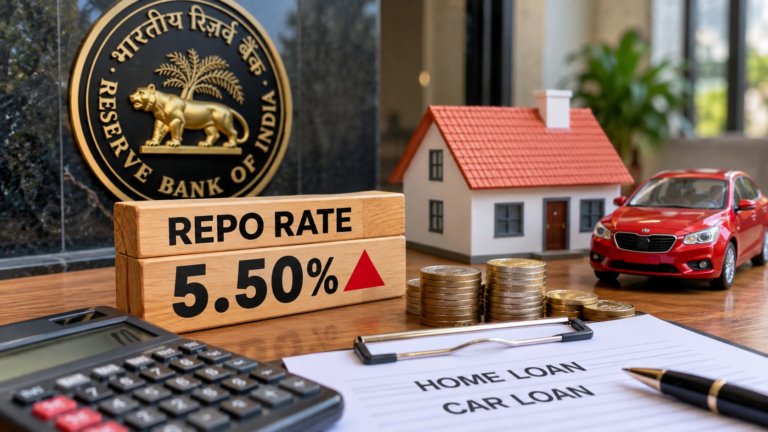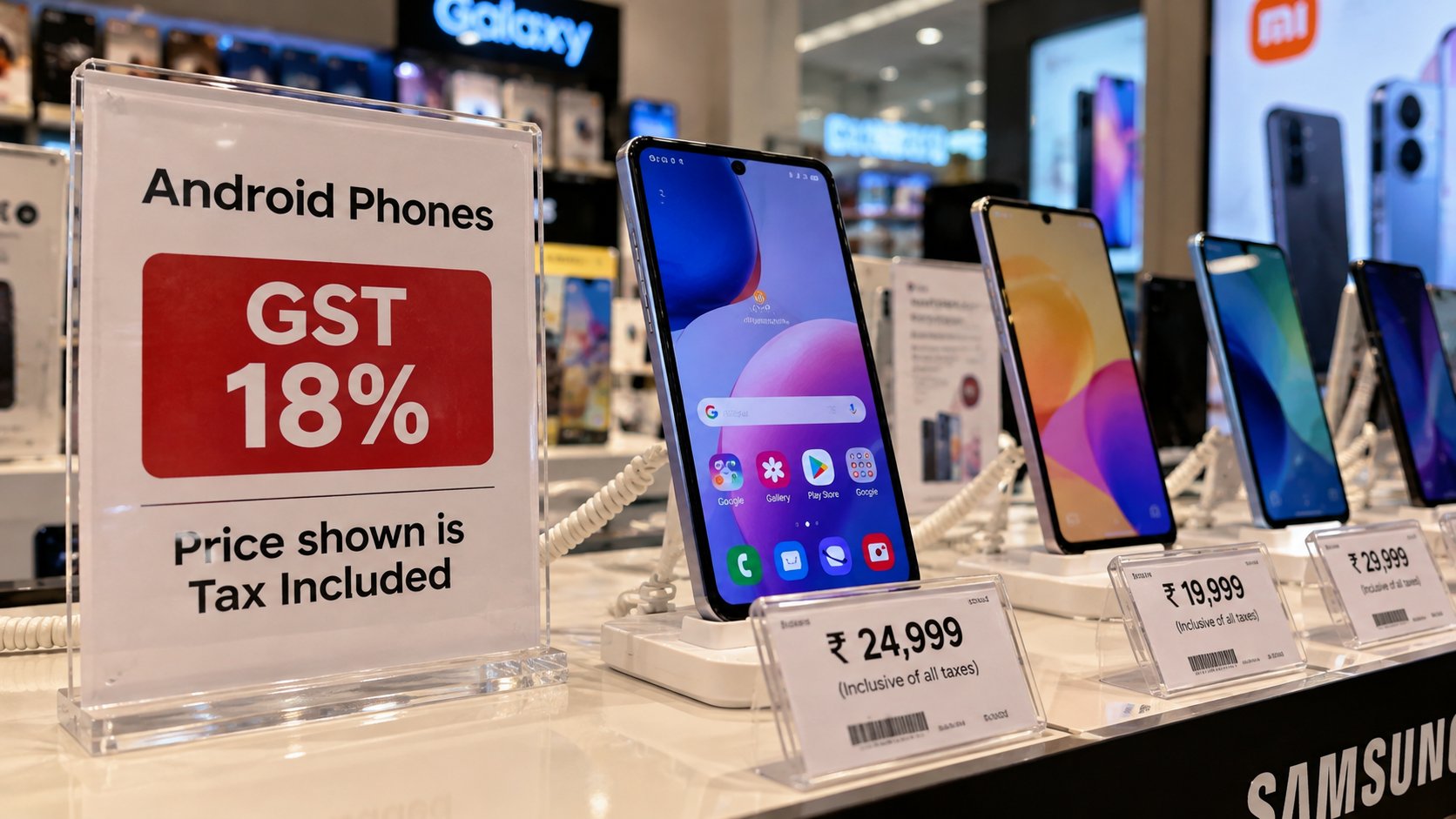
Android Phone GST Cut: Rate Stays at 18% After the Council Meeting, and What "Tax Included" Means for the Price You Pay
Technology · GST · Smartphone Prices
Android Phone GST Cut: Rate Stays at 18% After the Council Meeting, and What “Tax Included” Means for the Price You Pay
The GST Council met on 7 October 2026 and left the tax on mobile phones unchanged, despite an industry request to move it to 5%. About ₹15 of every ₹100 you pay for a phone is GST.
For six weeks, anyone shopping for a mid-range Android phone had a reason to hesitate. Reports said the GST Council might lower the tax on handsets. Messages promising cheaper phones did the rounds, and some buyers put off purchases to see what the meeting would bring.
The meeting has now happened. The rate did not move. What follows explains what was decided, how much tax is already folded into the price on the box, and what the numbers say about buying now against waiting.
Quick Summary
GST on mobile phones is still 18%. Reports on the 57th GST Council meeting of 7 October 2026 say no change was recommended. Phone prices in India are shown inclusive of tax, so GST makes up about 15.25% of what you pay. A cut to 5% would have lowered prices by about 11% if fully passed on, but no such change is scheduled. With handset prices rising on costlier memory chips, waiting for a tax cut is a gamble without a date.
What We Know
These points are drawn from published reports of the Council meeting and from the industry body’s own letter.
- The 57th GST Council meeting was held in New Delhi on 7 October 2026. It had first been scheduled for 12 September.
- The Council did not recommend any change to the 18% GST on mobile phones, according to Digit’s report of 8 October.
- The meeting concentrated on procedure: registration, refunds, input tax credit, penalties and enforcement.
- The India Cellular and Electronics Association wrote to the Finance Minister on 2 September asking for the rate to be cut from 18% to 5%.
- Smartphone shipments fell about 10% year on year in April to June 2026, the steepest June-quarter fall in six years, according to Counterpoint Research.
- Memory chip prices have risen roughly four-fold since September 2025, according to industry data cited by the association.
What Is Still Unclear
- Why the rate was left alone. No official reason has been reported. Business Today had said before the meeting that the Council was likely to review last year’s rate changes before considering new cuts.
- Whether the proposal is deferred or dropped. It is not known if the matter has been sent to a committee of officials or ministers for further study.
- When the Council meets next. No date for the 58th meeting had been announced at the time of writing.
- The source of “changes coming” messages. We found no government notification changing the tax on phones. Any message or listing that suggests a new rate for handsets is not backed by an official order as of 10 October 2026.
The Price on the Box Already Has the Tax Inside
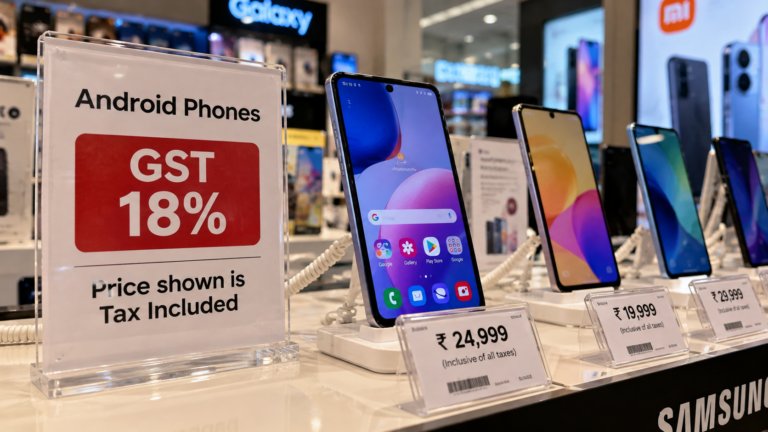
In many countries the shelf price excludes sales tax and the total rises at the till. India works the other way. The maximum retail price printed on a phone box is inclusive of all taxes, and online listings follow the same rule. What you see is what you pay.
That is all “tax included” means. It is not a sign that a tax is being added or removed. It is the standard way prices are displayed, and it would stay the same wording whether the rate were 18%, 12% or 5%.
The tax is worked out on what you actually pay, not on the printed price. If a seller knocks ₹2,000 off a ₹20,000 phone, GST is calculated on the ₹18,000 sale value, and the invoice will show a smaller tax amount. The same 18% applies to feature phones, and to chargers, cases and earphones bought alongside.
The mistake almost everyone makes with 18%
People often work out the tax by taking 18% of the sticker price. On a ₹20,000 phone that gives ₹3,600, which is wrong. The 18% is charged on the pre-tax value, so the tax inside an inclusive price is the price multiplied by 18 and divided by 118. The true figure is ₹3,051.
The same slip inflates expectations about a rate cut. Dropping from 18% to 5% is a 13-point change in the rate, but the shelf price would fall by about 11%, not 13%.
What a Cut Would Have Been Worth, Phone by Phone
Since the proposal has been widely discussed, it helps to know exactly what was at stake. The table shows the price of a phone at two alternative rates, assuming brands and retailers passed on every rupee of the reduction.
| Price today (18%) | GST inside | Price at 12% | You would save | Price at 5% | You would save |
|---|---|---|---|---|---|
| ₹10,000 | ₹1,525 | ₹9,492 | ₹508 | ₹8,898 | ₹1,102 |
| ₹15,000 | ₹2,288 | ₹14,237 | ₹763 | ₹13,347 | ₹1,653 |
| ₹25,000 | ₹3,814 | ₹23,729 | ₹1,271 | ₹22,246 | ₹2,754 |
| ₹50,000 | ₹7,627 | ₹47,458 | ₹2,542 | ₹44,492 | ₹5,508 |
| ₹80,000 | ₹12,203 | ₹75,932 | ₹4,068 | ₹71,186 | ₹8,814 |
| ₹1,00,000 | ₹15,254 | ₹94,915 | ₹5,085 | ₹88,983 | ₹11,017 |
Would the saving have reached your pocket?
Not necessarily in full. A lower tax rate reduces what the seller owes the government. It does not fix the selling price. Trade Brains noted in its analysis that a lower GST would make phones cheaper but the full benefit might not reach consumers. Juris Hour reported that the Council could also examine whether last year’s cuts on other goods were passed on, since some companies raised prices afterwards.
The timing matters too. Brands are absorbing a sharp rise in component costs. A tax cut arriving in the middle of that could be used partly to hold prices steady instead of lowering them.
Why Phone Makers Wanted 5%, and Why Buyers Felt the Pinch
The industry’s case rests on history and on a difficult year. Before GST, excise duty and state VAT on phones together averaged about 6%, the association says. Phones entered GST at 12% in 2017 and moved to 18% in 2020. When the Council overhauled rates in September 2025 and cut tax on televisions and air-conditioners, phones were left where they were.
“Placing mobile phones in the 5% slab is not a concession, it is a correction,” the association’s chairman, Pankaj Mohindroo, wrote in the letter. He added that the burden falls most heavily on rural households, lower-income consumers and first-time smartphone buyers.
There is a manufacturing argument as well. Phones are the largest piece of India’s electronics output: about ₹6.27 lakh crore of production in 2025-26, close to half of the ₹13.11 lakh crore total, according to government data cited by Juris Hour. Much of that growth has come from exports. The association’s concern is that factories built for scale also need a healthy home market, and that weak local demand will limit the next phase of expansion.
The squeeze at the affordable end
This is where Android buyers feel it most, because nearly every phone sold in the budget bands runs Android. The cause is not tax. Memory chips have become far more expensive as data centres built for artificial intelligence absorb supply, and memory is a large share of the cost of a cheap phone.
The association says phones priced below ₹10,000 now make up less than 5% of supply. For a first-time buyer, the entry ticket to a smartphone has moved up sharply in twelve months.
Against that sits the revenue picture. Gross GST collections were ₹22.27 lakh crore in 2025-26, up 8.3%, and July 2026 set a monthly record of ₹2.11 lakh crore, Business Today reported. Supporters of a cut read those figures as room to give relief. States, which share the tax, tend to read them as a reason to protect a rate that is working, at least until a full year of data on the 2025 changes is in.
From 12% to 18% to a Meeting That Changed Nothing
The Council did approve a set of procedural reforms, as reported by Digit. None of them affects what a consumer pays for a handset.
| Decision reported from the 57th meeting | Earlier | Now | Affects phone prices? |
|---|---|---|---|
| GST on mobile phones | 18% | 18% | No change |
| Prosecution threshold | ₹1 crore | ₹5 crore | No |
| Maximum general penalty | ₹25,000 | ₹10,000 | No |
| Optional scheme for small consumer-facing businesses | Not available | Approved in principle, turnover up to ₹5 crore | No |
| Refunds and registration | Manual steps | More system-based processing | No |
If a Cut Is Ever Approved, Here Is How It Would Reach You
A Council decision is a recommendation. It becomes law only when the government notifies it, and the shelf price changes only when brands revise it. Last year’s overhaul shows the sequence and the pace.
Stock already in shops adds a wrinkle. When a rate falls, retailers hold inventory bought at the old tax, and manufacturers usually issue revised price lists or stickers for it. Buyers in 2025 saw some products reprice on the first day and others take a few weeks. A phone would be no different.
The practical lesson is that a real rate change is never a surprise at checkout. It is announced by the Finance Ministry, carries a date, and is reported by every major news outlet. A forwarded message is not evidence of one.
Buy Now or Hold Off? What the Numbers Favour
Waiting for a tax cut has a cost when prices are moving up. The most a 5% rate could save is about 11% of the price. Average handset prices have already risen by about 15% since the end of the June quarter, according to Trade Brains, and entry-level models by far more.
A buyer who delayed a ₹15,000 purchase hoping to save ₹1,653 may now find the same class of phone priced well above that. With no meeting date and no stated plan to revisit the rate, the tax cut is the least predictable part of the equation.
If the question does return, the early signs will be public. Watch for the agenda of the next Council meeting, a reference to the committee of officials that examines rate proposals, or a statement from the Finance Ministry. Until one of those appears, 18% is the working assumption for every handset on sale.
Frequently Asked Questions
Has GST on Android phones been reduced in India?
No. As of 10 October 2026, GST on all mobile phones, including Android phones, remains 18%. Reports on the 57th GST Council meeting held on 7 October 2026 say the Council did not recommend any change to the rate.
What is the GST rate on mobile phones in 2026?
The rate is 18% on smartphones and feature phones, classified under HSN 8517. It has been 18% since 1 April 2020. Before that it was 12% from the launch of GST in July 2017.
What does tax included mean on a phone price?
It means the displayed price already contains GST. In India the maximum retail price is inclusive of all taxes, so nothing is added at checkout. At 18%, GST makes up about 15.25% of the price you pay, which is about ₹3,051 on a ₹20,000 phone.
How much cheaper would a phone be if GST were cut to 5%?
If the full benefit were passed on, the price would fall by about 11%. A ₹15,000 phone would cost about ₹13,347 and a ₹50,000 phone about ₹44,492. A cut to 12% would lower prices by about 5.1%. Neither change has been approved.
Should I wait for a GST cut before buying a smartphone?
There is no announced date for a rate change, and phone prices have been rising because memory chips cost more. If you need a phone now, compare festive offers and buy on the total price. Waiting only makes sense if your current phone works well and you can delay for several months without a firm outcome.
Why did the mobile industry ask for 5% GST on phones?
The India Cellular and Electronics Association argued in a letter dated 2 September 2026 that phones are essential goods, that pre-GST taxes averaged about 6%, and that demand has fallen as entry-level prices rose 35% to 45% in a year. It says a lower rate would revive sales and curb grey-market purchases.
When is the next GST Council meeting?
No date for the 58th meeting had been announced at the time of writing. The Council met on 3 September 2025 and then on 7 October 2026. Any rate change needs a Council recommendation followed by a government notification.
Can I claim GST paid on a mobile phone?
A GST-registered business can generally claim input tax credit on a phone bought for business use, provided the invoice carries its GSTIN. Individual consumers buying for personal use cannot claim the tax back.
The Short Version
The hoped-for GST cut on phones did not happen. The Council met on 7 October 2026 and the rate remains 18%, which works out to about 15.25% of the tax-inclusive price on the box. A move to 5% would have trimmed prices by roughly 11% at best, and no date exists for the question to be reopened. Phone prices are climbing for a different reason, costlier memory, and that pressure is strongest in the budget Android segment. Buyers who need a handset soon are better served by comparing today’s total prices than by waiting on a tax change.