57th GST Council Meeting: No Rate Changes, but Arrest Powers Go and Refunds Speed Up. What 19 Decisions Mean for Businesses and Taxpayers
GSTBusiness and TaxCouncil Meeting
57th GST Council Meeting: No Rate Changes, but Arrest Powers Go and Refunds Speed Up. What 19 Decisions Mean for Businesses and Taxpayers
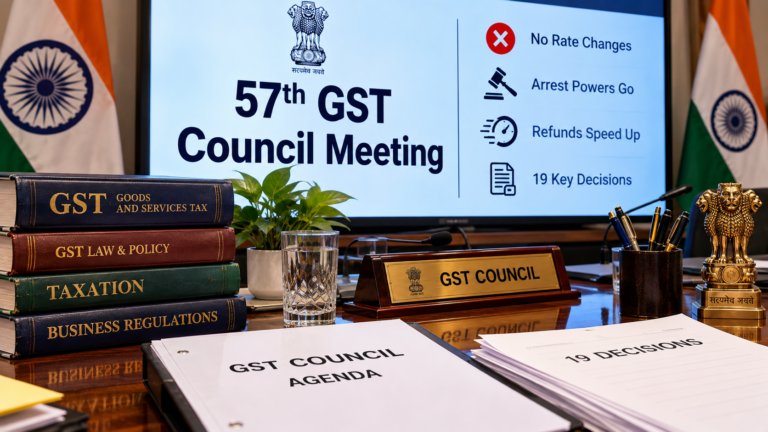
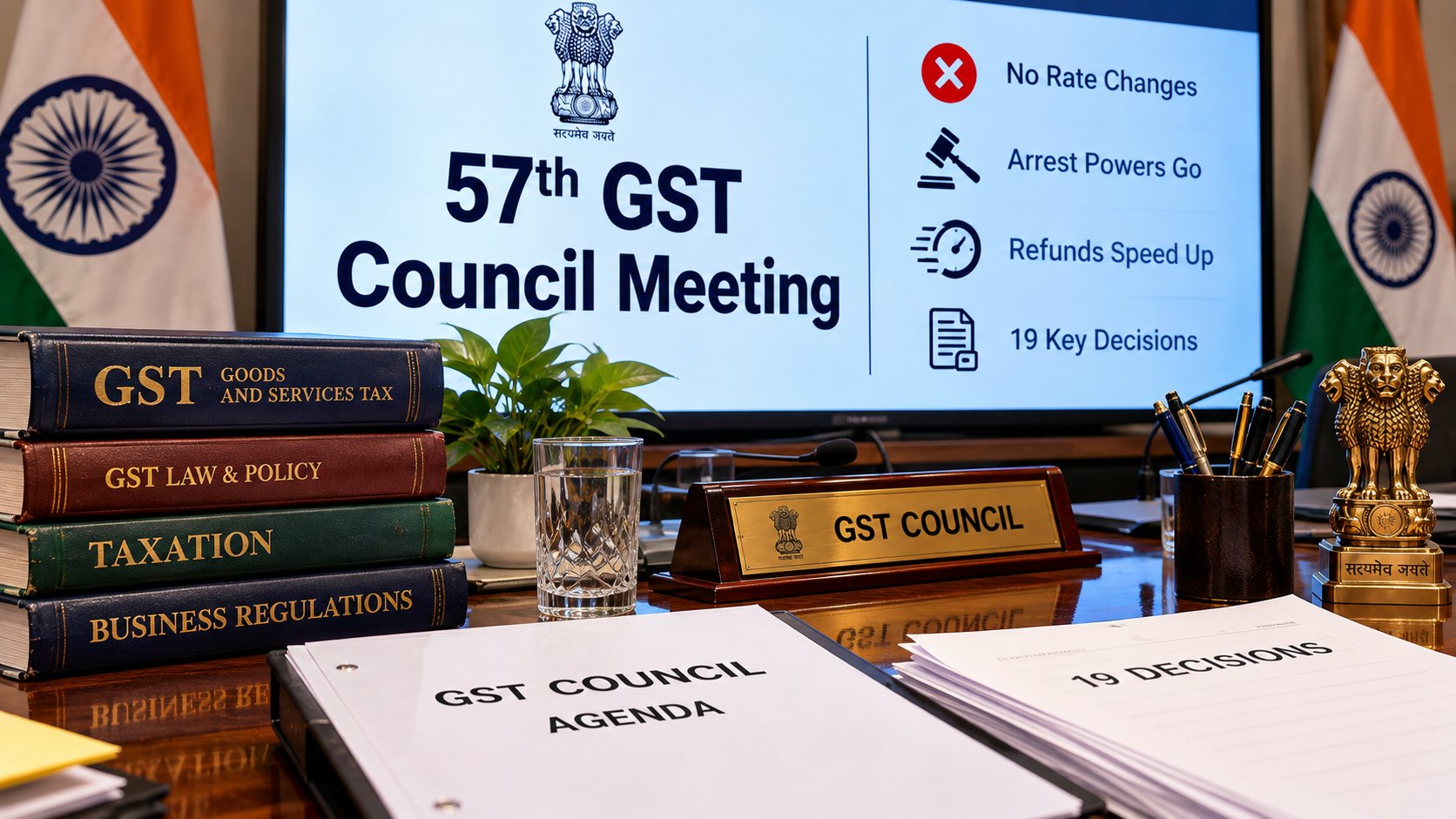
The Council left every tax slab untouched and turned to the machinery of GST instead: registration in three working days, 90% provisional refunds, a ₹5 crore prosecution threshold and wider input tax credit.
Anyone hoping for cheaper goods from this week’s GST Council meeting came away with nothing. Anyone who runs a business came away with a long list. A refund that sat in a queue for weeks may now be paid largely by the system. A registration that needed an officer’s sign-off may arrive in three working days. And the prospect of arrest by a tax officer is set to leave the law altogether.
None of this lowers a price tag, which is why the meeting drew less public attention than last year’s rate overhaul. For the people who file returns, claim credit and move goods across state lines, it may matter more.
Quick Summary
The 57th GST Council meeting made no change to GST rates and recommended reforms in 19 areas. The headline items are automated registration within 3 working days for low-risk applicants, 90% provisional refunds, removal of arrest powers, a prosecution threshold raised from ₹1 crore to ₹5 crore, and input tax credit on employee insurance. Most items are recommendations that still need law amendments or notifications, so few take effect immediately.
Confirmed
What We Know
These points are consistent across published summaries of the Council’s recommendations and reports by Business Standard and IANS.
- The meeting was held in New Delhi on Thursday, 8 October 2026, chaired by Finance Minister Nirmala Sitharaman.
- The existing rate structure was retained. The Finance Ministry said rate changes will be considered once a year, IANS reported.
- Low-risk registration applications are to be approved automatically within three working days.
- About 90% of eligible refund claims are to be sanctioned provisionally through system-based risk checks, and excess cash-ledger balances refunded automatically.
- The Council recommended omitting the arrest provision, raising the prosecution threshold to ₹5 crore and cutting the general penalty to ₹10,000.
- Refunds under the inverted duty structure will cover input services for credit availed from 1 November 2026, and plant and machinery from 1 April 2027.
Open questions
What Is Still Unclear
- When the law will change. Removing arrest powers, raising the prosecution threshold and widening credit all need amendments to the CGST Act and matching state laws. No date for the amending Bill has been reported.
- Start dates for most items. Only the two refund changes carry firm dates. Registration, refund automation and cancellation are to roll out in phases without a published calendar.
- The small-taxpayer scheme. It was approved in principle only. Tax rates, filing frequency and eligibility conditions are not final.
- Protection for buyers when a supplier defaults. A Committee of Officers has three months to study this. Its findings go to the next Council meeting.
- The date of the next meeting. None has been announced.
The full list
All 19 Decisions on One Screen
The recommendations fall into five groups. Enforcement and penalties account for the largest share, followed by refunds and credit. Colours in the grid below match the groups in the bar.
Rates
Why Nothing on the Shelf Gets Cheaper This Time
The Council overhauled rates only thirteen months ago, merging four slabs into two main rates of 5% and 18% with a 40% rate for select goods. Those changes took effect on 22 September 2025. States have wanted a full year of collections data before considering more cuts, and the Finance Ministry has now said that rate changes will be taken up once a year.
That settles, for now, several requests that had been building, including the handset industry’s call to move mobile phones from 18% to 5%. Reports of the outcome say no change was recommended there.
There is fine print. A handful of item-level clarifications and exemptions were recommended, according to TaxGuru’s summary. Psyllium seeds are to carry nil GST. Electric-vehicle passenger transport gets an optional 5% rate with restricted credit. Storage of sowing seeds and coffee curing services are to be exempt. These are narrow fixes, not a change of slab for consumers.
Cash flow
The Refund Queue Is Being Handed to the System
Refund delays are the complaint exporters raise most often, because money stuck with the department is working capital they must borrow elsewhere. The Council’s answer is to take the officer out of the first step for most claims.
Two smaller changes matter in practice. Any excess balance in the electronic cash ledger is to be refunded automatically in full. And the ₹1,000 minimum for a refund will be tested against the total across central, state and integrated tax, so small claims split across heads are no longer rejected.
Two refund doors that were shut are opening
A business has an inverted duty structure when the tax on what it buys is higher than the tax on what it sells. Credit piles up and can be claimed as a refund, but until now only for tax paid on input goods. Tax on input services and on machinery was left stranded.
That exclusion is being lifted in two steps. Credit on input services availed on or after 1 November 2026 becomes refundable. Credit on plant and machinery availed on or after 1 April 2027 follows, for exporters as well, at one-sixtieth of the amount each month. Business Standard reported that pharmaceuticals and consumer goods makers are expected to see better working capital as a result.
Credit
Input Tax Credit Reaches Places It Was Barred From
Section 17(5) of the CGST Act lists purchases on which credit is blocked even when they are plainly business costs. The Council has recommended deleting several entries from that list.
- Health and life insurance for employees, a cost most employers carry.
- Telecom towers and pipelines laid outside factory premises, long disputed in court.
- Free samples, and stock destroyed on shelf-life expiry where the law requires destruction.
- Outdoor catering.
The end of tax on tax for travel and hospitality
The item labelled “no double taxation” deals with businesses that buy a service and resell it in the same line of trade. A travel agent booking a hotel room, or a caterer hiring another caterer, could not take credit for the tax already paid, so tax was charged twice on the same service. Limited credit is now proposed for hotel accommodation up to ₹7,500 per unit per day, restaurant and catering services, and passenger transport.
One question was left open. Buyers sometimes lose credit because a supplier collected GST and never deposited it. A Committee of Officers will examine whether a genuine buyer holding a valid invoice, with goods received and payment made in full, can be protected. It has three months to report.
Enforcement
From Handcuffs to Hearings: The Softer Enforcement Code
The most striking recommendation is the proposal to omit Section 69, the provision that lets GST officers arrest. Alongside it, the monetary threshold for prosecution rises five-fold and the prescribed minimum punishment goes, leaving courts to choose between fine, imprisonment or both.
For smaller disputes the relief is more immediate in spirit. No show cause notice is to be issued where the tax involved is below ₹10,000, and pending notices and appeals under that amount are to be closed on the same basis. Where there is no fraud, a taxpayer who pays tax and interest within 30 or 60 days of an order would face a penalty of 5%.
| Provision | Earlier position | Recommended | Needs |
|---|---|---|---|
| Power of arrest (Section 69) | Available to officers | Omitted | Act amendment |
| Prosecution threshold | ₹1 crore | ₹5 crore | Act amendment |
| Minimum punishment | Prescribed in law | Removed; court’s discretion | Act amendment |
| General penalty (Section 125) | Up to ₹25,000 | Up to ₹10,000 | Act amendment |
| Minimum penalty, non-fraud cases | ₹10,000 | Removed | Act amendment |
| Show cause notice | No monetary floor | None below ₹10,000 of tax | Act amendment |
| Pre-deposit, penalty-only appeals | No separate cap | Capped at ₹40 crore | Act amendment |
| Late fee, turnover up to ₹5 crore | Charged from due date | Waived if filed within the due month | Notification |
| Refund acknowledgment | 15 days | 10 days, then deemed | Rule change |
Trucks should face fewer stops between states
Transporters have long complained of vehicles being stopped in states that have nothing to do with the consignment. Under the recommendation, goods in transit may be intercepted only on specific intelligence, authorised by an officer of at least Joint Commissioner rank, and only in the state where the supplier or the recipient is located. A transit state would have no power to detain. The exception is a consignment moving without an e-way bill or basic documents, which can still be checked anywhere.
Who gains
Which Businesses Feel Each Change First
The effect depends on what you do. The table matches common business types to the decisions most relevant to them and to the earliest known date.
| If you are | The change that matters most | Key figure | Earliest date |
|---|---|---|---|
| An exporter | Provisional refunds; machinery credit refundable | 90% upfront; 1/60 a month | Phased; 1 April 2027 |
| A manufacturer with inverted duty | Input services enter the refund formula | Credit from 1 Nov 2026 | 1 November 2026 |
| A new business | Automated registration | 3 working days | To be notified |
| A small retailer | Optional simple scheme; late fee relief | Turnover up to ₹5 crore | Not finalised |
| An online seller | Register in another state using a marketplace warehouse | Up to ₹2.5 lakh monthly credit passed on | To be notified |
| A transporter | No interception in transit states | Joint Commissioner approval | After Act amendment |
| A travel agent or caterer | Credit for same-line services | Hotel rooms up to ₹7,500 | To be notified |
| An IT or services exporter | Overseas branch billing treated as export | Distinct-person condition dropped | After Act amendment |
Small sellers and closures: less paperwork at both ends
An optional scheme for businesses with turnover up to ₹5 crore that sell only to unregistered customers was approved in principle. The idea is simpler filing for shops and service providers who deal with the public, though the design is not yet final. At the other end of a business’s life, voluntary cancellation of registration is to be accepted automatically once returns are filed and dues paid, first for smaller taxpayers and then for all.
Registration itself is being pared back. About 61% of applications are already approved within three working days without an officer, IANS reported, and the aim is to bring every low-risk applicant into that lane. Amendments to registration details, other than a change of principal place of business, are to be accepted automatically. Registrations suspended for a procedural lapse, such as a missed return or missing bank details, would be restored by the system once the gap is fixed.
Online sellers get a specific fix. A small seller storing goods in a marketplace warehouse in another state has had to show a physical place of business there. A new rule would let the seller declare the operator’s warehouse instead, provided the credit passed on stays within ₹2.5 lakh a month.
Exporters of services get three clarifications
Services supplied through an Indian company’s own overseas branch have been denied export status because the branch is treated as a separate person. That condition is to be dropped. Testing, repair, research and processing done on goods sent by a foreign client would be taxed by the client’s location, so they may qualify as exports. And the rules on receiving export payments in foreign exchange or rupees are to be aligned with Reserve Bank norms.
Calendar
Dates to Mark, and the Ones Still Missing
The order of events matters. Rule changes and circulars can be issued by the government fairly quickly. Changes to the Act need a Bill in Parliament and matching amendments by every state, which is why the enforcement items are likely to arrive later than the procedural ones.
Returns are changing as well, though more quietly. From the April 2027 period, taxpayers are to get a mechanism to correct liability and credit in GSTR-3B so that it lines up with GSTR-1 and the auto-drafted GSTR-2B, after public consultation. E-invoicing is to extend to reverse-charge purchases from unregistered suppliers and to imported services for businesses with turnover of ₹5 crore or more.
Answers
Frequently Asked Questions
What were the key decisions of the 57th GST Council meeting?
The Council kept GST rates unchanged and recommended procedural reforms: automated registration within three working days for low-risk applicants, 90% provisional refunds, automatic cash-ledger refunds, wider input tax credit, removal of GST arrest powers, a ₹5 crore prosecution threshold, a lower general penalty of ₹10,000 and easier rules for exporters and small online sellers.
Were any GST rates changed at the 57th GST Council meeting?
No change was made to the GST slab structure or to headline rates. The Finance Ministry said rate changes will be considered once a year. A small number of item-level clarifications and exemptions were recommended, such as nil GST on psyllium seeds.
When was the 57th GST Council meeting held?
It was held in New Delhi on Thursday, 8 October 2026, chaired by Finance Minister Nirmala Sitharaman, according to Business Standard and TaxGuru. The meeting had earlier been scheduled for 12 September and then for 7 October.
Have GST arrest powers been removed?
The Council has recommended omitting Section 69 of the CGST Act, which gives officers the power to arrest. This needs an amendment to the law by Parliament and state legislatures, so the power remains on the statute book until that amendment is passed and notified.
What is the new prosecution threshold under GST?
The Council recommended raising the monetary threshold for launching prosecution from ₹1 crore to ₹5 crore. It also recommended removing the prescribed minimum punishment so that courts decide the sentence. Both changes require amendments to the Act.
From when can input services be included in inverted duty refunds?
Refund of accumulated credit on input services under the inverted duty structure is proposed for credit availed on or after 1 November 2026. Credit on plant and machinery becomes eligible for credit availed on or after 1 April 2027, refunded at one-sixtieth per month over 60 months.
What is the new simplified GST scheme for small taxpayers?
The Council approved in principle an optional scheme for businesses with turnover up to ₹5 crore that sell only to unregistered customers. Its rates, filing frequency and start date have not been finalised, so small businesses should continue with current filings until it is notified.
Can employers claim ITC on employee health insurance after the 57th GST Council meeting?
The Council recommended removing the block on input tax credit for health and life insurance for employees, along with telecom towers, pipelines outside factory premises, free samples and stock destroyed on expiry. The change needs an amendment to Section 17(5), so credit should be claimed only after it takes effect.
Recap
The Short Version
The 57th GST Council meeting changed no tax rate and a great deal of procedure. Registration is to be approved in three working days for low-risk applicants, 90% of eligible refunds released provisionally, and credit opened up for employee insurance and other blocked items. Arrest powers are to be dropped, prosecution reserved for cases above ₹5 crore and the general penalty cut to ₹10,000. Only two dates are firm: 1 November 2026 for input services refunds and 1 April 2027 for machinery. Everything else waits on amendments and notifications, so businesses should prepare now and act only on notified dates.