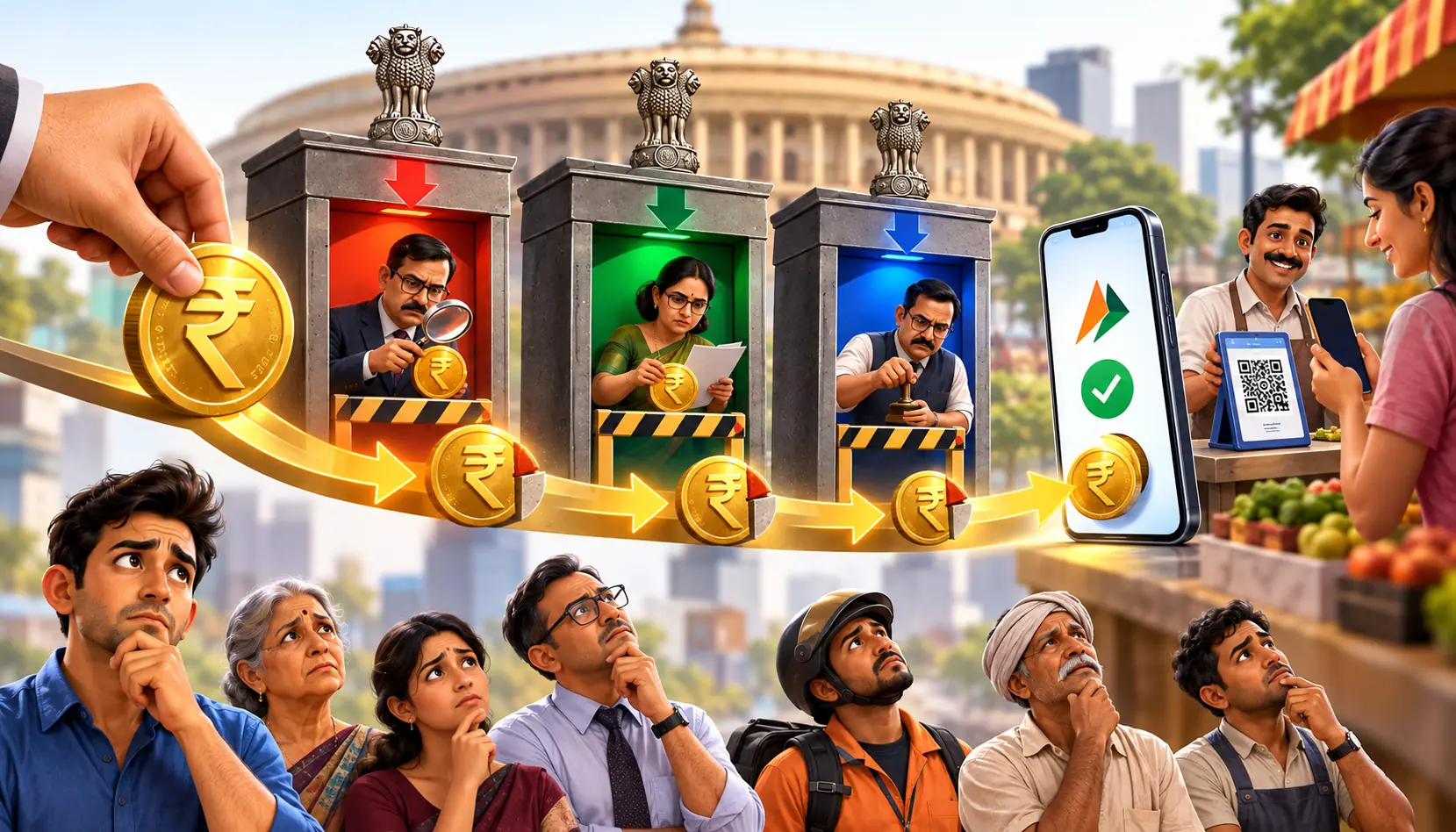
without text on the image about : Is the Same Rupee Taxed Three Times Now, and Who Really Pays the New UPI Charge?
Money · Digital Payments · India · Effective 15 October 2026
Is the Same Rupee Taxed Three Times Now, and Who Really Pays the New UPI Charge?
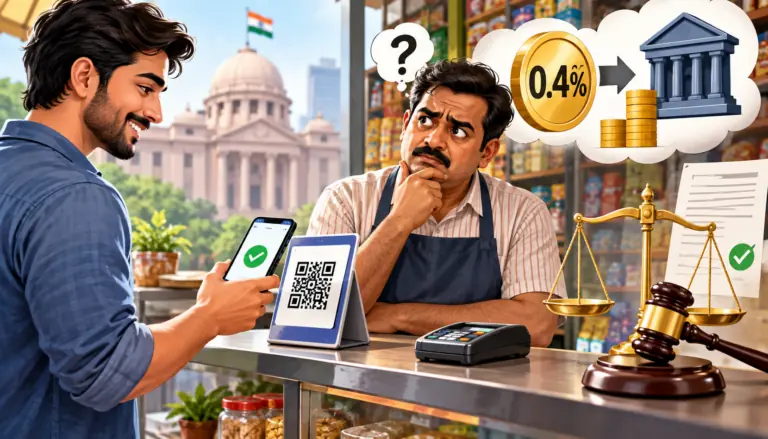
NPCI has fixed a 0.4 percent merchant discount rate on UPI payments above ₹2,000 from 15 October 2026. Consumer-side charges stay banned by law, and payments up to ₹2,000 now have statutory protection.
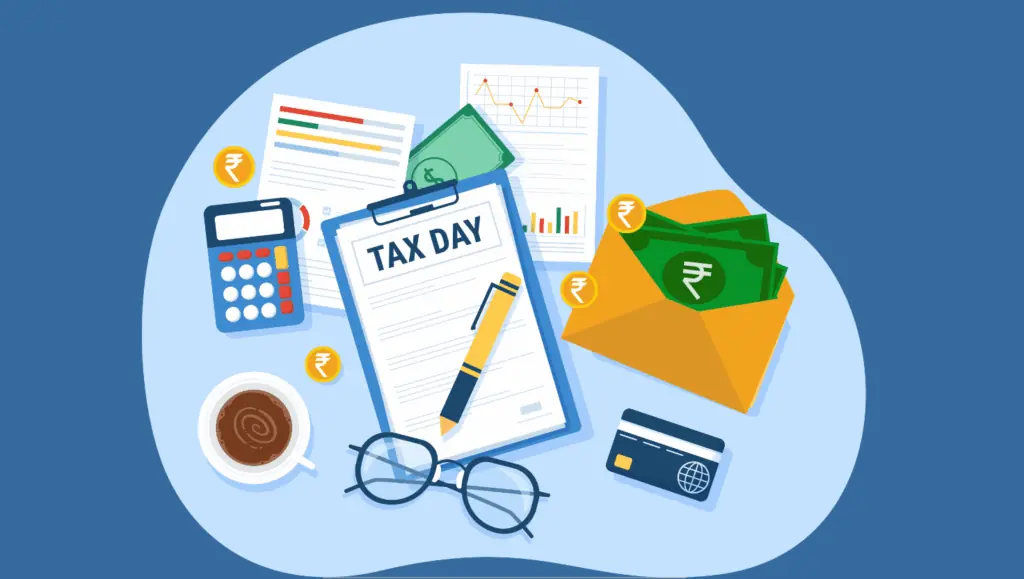
A graphic doing the rounds this week shows three taps draining a single ₹500 note: income tax when you earn, GST when you spend, and a transaction charge when you pay. It lands because it feels true. The third tap, though, is the one worth slowing down on, because the rule that triggered all of this says something close to the opposite of what the poster says.
Quick Summary
From 15 October 2026, the National Payments Corporation of India will allow a 0.4 percent merchant discount rate on person-to-merchant UPI payments above ₹2,000, capped at ₹300. The fee is charged to the merchant’s acquiring side, not to you. Payments up to ₹2,000 and all person-to-person transfers stay free, and a gazette notification dated 14 September now bans banks and payment providers from charging either the payer or the receiver on those protected transactions, directly or indirectly.
What We Know, Confirmed and Dated
Four documents matter here, and all four are from the last five weeks. Parliament passed the Taxation and Other Laws (Amendment) Bill during the Monsoon Session that ended on 13 August 2026, amending Section 10A of the Payment and Settlement Systems Act, 2007 to let the Centre decide which electronic payment modes must stay charge-free. On 14 September the Ministry of Finance issued gazette notification S.O. 5067(E) naming two protected modes: RuPay-powered debit cards, and UPI transactions up to ₹2,000.
On 15 September, NPCI published the rate card itself. A merchant discount rate of 0.4 percent applies to person-to-merchant UPI payments above ₹2,000, capped at ₹300 once the ticket reaches ₹75,000. Railways, telecom, insurance and fuel get a flat ₹5 above ₹2,000 instead. Capital market payments to mutual funds, brokers, securities dealers and investment platforms attract 0.02 percent, also capped at ₹300. Everything takes effect on 15 October 2026.
Three Taps on One Rupee: Which of Them Is Actually a Tax?
Two of the three taps in that poster are taxes in the strict sense. Income tax is a direct levy on what you earn, collected by the Centre. GST is an indirect levy on what you buy, shared between the Centre and states. Both flow into government revenue. The third is not a tax at all. A merchant discount rate is a commercial fee that a merchant pays its acquiring bank for accepting a digital payment, and it is split among private parties who carry the cost of moving the money.
That distinction is not pedantry, because it changes who is liable and who can be billed. A tax reaches your bank account directly through TDS, advance tax or the price sticker on a packet of biscuits. MDR reaches a merchant’s settlement report as a deduction before the money lands. The gazette notification of 14 September goes further and makes the consumer side statutorily untouchable below ₹2,000, wording the ban to cover charges imposed directly or indirectly on the person making or receiving the payment. That second phrase is drafting designed to stop a repackaged fee appearing under another name.
Where the poster has a real point is on cumulative burden, and it is worth stating honestly. A salaried person pays income tax on the gross, GST on most of what remains, and now buys from merchants whose acceptance cost has risen on larger baskets. That last cost can travel back into prices. It is a pass-through argument, not a third tax, and the difference determines what you can do about it.
The Word Doing All the Work: What MDR Really Is
MDR is the oldest idea in card payments. When a shop accepts a card, the acquiring bank pays the shop slightly less than the sale value and keeps the difference, which it then shares with the card issuer and the network. Every participant in the chain has costs, and the MDR is how those costs get funded. Credit cards in India typically carry between 1.5 and 2 percent. Debit card MDR is capped much lower. UPI, uniquely, has carried zero since January 2020.
Zero did not mean free. It meant somebody else paid. The Centre has run an incentive scheme for low-value P2M UPI transactions since FY2021-22 precisely because banks and payment apps were absorbing costs with no revenue line against them. Industry analysis of Reserve Bank cost studies puts the all-in cost of processing a single ₹800 UPI transaction at roughly 0.25 percent of value, spread across four participants who each earn nothing on it.
Follow the ₹5,000: Where the Fee Goes After It Leaves the Till
Take a customer paying ₹5,000 at an electronics counter on 20 October. The customer’s app shows ₹5,000 and debits ₹5,000. Nothing on the screen changes. The change happens after settlement, where the acquiring side deducts 0.4 percent, or ₹20, before the money reaches the merchant’s account. That ₹20 is then divided among the issuer bank, the payment app, the acquirer and the network under the interchange arrangement NPCI sets.
Worked example: a ₹62,000 laptop and a ₹96,000 one
On a ₹62,000 purchase the merchant pays 0.4 percent, which is ₹248. On a ₹96,000 purchase the arithmetic would give ₹384, but the ₹300 cap applies, so the merchant pays ₹300. The cap bites at exactly ₹75,000, because 0.4 percent of ₹75,000 is ₹300. Above that point the effective rate falls the higher the ticket goes: at ₹96,000 the merchant is paying 0.31 percent, and at ₹3,00,000 only 0.10 percent.
The Rate Card, Ticket Size by Ticket Size
The single most useful thing to have in front of you is the lookup grid. The four lanes behave completely differently above ₹2,000, and the gap between them widens as the ticket grows. Note the concessional lane in particular: the flat ₹5 for railways, telecom, insurance and fuel is cheaper than the standard rate at every value where it applies, since 0.4 percent of ₹2,000 is already ₹8.
| Ticket value | Standard P2M at 0.4% | Railways, telecom, insurance, fuel | Capital markets at 0.02% | P2P and exempt small merchants |
|---|---|---|---|---|
| ₹500 | ₹0 | ₹0 | ₹0 | ₹0 |
| ₹1,999 | ₹0 | ₹0 | ₹0 | ₹0 |
| ₹2,001 | ₹8.00 | ₹5 | ₹0.40 | ₹0 |
| ₹5,000 | ₹20 | ₹5 | ₹1 | ₹0 |
| ₹10,000 | ₹40 | ₹5 | ₹2 | ₹0 |
| ₹25,000 | ₹100 | ₹5 | ₹5 | ₹0 |
| ₹75,000 | ₹300 (cap reached) | ₹5 | ₹15 | ₹0 |
| ₹1,00,000 | ₹300 (capped) | ₹5 | ₹20 | ₹0 |
| ₹5,00,000 | ₹300 (capped) | ₹5 | ₹100 | ₹0 |
The capital market lane deserves a second look if you invest through UPI. At 0.02 percent, a ₹25,000 mutual fund purchase costs the platform ₹5. The ₹300 cap in that lane is only reached at ₹15,00,000, which is arithmetic rather than an announced figure, but it tells you the cap is effectively decorative for retail investors. Recurring investments made through UPI AutoPay are exempt entirely.
Which Payment Band Your Purchase Falls Into
Most people will never knowingly cross into a charged band. Well over 95 percent of UPI’s person-to-merchant volume sits at or below ₹2,000, which is the tea, the auto fare, the kirana bill and the chemist. The bands below describe the merchant’s cost, not yours, and they are worth knowing mainly because they predict where a shop might start nudging you toward another payment method.
No MDR
₹8 to ₹20
₹20 to ₹100
₹100 to ₹300
Flat ₹300
The Numbers That Made Free Impossible to Sustain
UPI is no longer a pilot being nursed to scale. In August 2026 it processed 24.51 billion transactions worth ₹29.82 lakh crore, its highest monthly volume on record, according to NPCI data released on 1 September. That works out to 791 million transactions a day and ₹96,205 crore of daily value. Volume rose 22 percent year on year while value rose 20 percent, and value has plateaued just under ₹30 lakh crore since May while volume keeps climbing, which is the signature of ever-smaller tickets.
The Payments Council of India has argued publicly that the MDR is meant to sustain growth rather than create profit pools, funding cybersecurity and infrastructure investment. Whether that holds is a question for the settlement data a year from now. What is not in dispute is that a network handling 791 million payments a day on a zero-revenue model was always going to need a funding answer.
From Zero-MDR to 0.4 Percent: A Six-Year Paper Trail
What Does Not Change for You on 15 October
This is the part the viral graphic gets backwards, so it is worth listing plainly. Nothing in the framework permits an app or a bank to add a line item to your payment. NPCI has explicitly barred UPI apps from imposing platform fees or any other customer-facing charge on UPI transactions, and the 14 September notification hard-codes the sub-₹2,000 protection into statute.
The Real Risk Is Not a Fee, It Is a Price Tag
Here is what people get wrong when they read a merchant-side fee as harmless. NPCI has stated the MDR is to be borne by merchants and not passed to customers, and the statutory ban on indirect charges is aimed squarely at that. But a ban on adding a fee at checkout is not a ban on repricing a product, and card acceptance in India has a long history of exactly this: the quiet surcharge, the discount withdrawn for one payment method, the cash price that is suddenly better.
Watch the ₹25,000 to ₹75,000 band. That is where the merchant’s cost runs from ₹100 to ₹300 on a single sale, large enough for a jeweller, an electronics chain or a travel agent to model it seriously. Retail advisory notes published since the announcement openly discuss steering high-value baskets toward cards, EMI or bank transfer, and testing whether customers can be split into smaller tickets. If you are told at a counter that UPI is unavailable for a large purchase but works fine for a small one, you now know why.
What to do if a merchant tries to add a UPI fee to your bill
A direct or indirect charge on a UPI transaction up to ₹2,000 is prohibited by gazette notification under Section 10A of the PSS Act. Ask for the charge in writing on the invoice, keep the payment reference, and raise it first with your bank or UPI app through its grievance channel, then with the RBI Ombudsman for Digital Transactions if it is not resolved within 30 days.
What Is Still Unclear
Several operational questions were not settled by the announcement, and they matter more to merchants than to consumers.
- GST on the MDR. The Finance Ministry has previously said no GST applied to UPI because no MDR was charged. Once MDR exists, GST on the fee becomes live, and the treatment has not been spelled out publicly.
- Exact merchant category definitions. Which merchant category codes fall into the concessional ₹5 lane, and how the ₹1 lakh monthly P2PM threshold is measured across aggregated or seasonal receipts.
- Refunds, reversals and split captures. Whether MDR is returned on a refunded transaction, and how partial captures are treated, is not in the public summaries.
- The interchange split. How the 0.4 percent divides between issuer, acquirer, app and network has not been published in the coverage so far.
- Acquirer pass-through. Whether banks and aggregators pass on exactly 0.4 percent or add their own platform fees on top of it for merchants.
- Enforcement of the no-surcharge rule. The mechanism for policing merchants who reprice rather than surcharge is not defined.
Jargon Decoder: What the Circular Language Actually Means
| Term | What it means | Why it matters to you |
|---|---|---|
| MDR | Merchant discount rate: the fee a merchant pays for accepting a digital payment. | It is a commercial fee, not a tax. It never appears on your side of the screen. |
| P2M | Person to merchant: you paying a registered business. | The only category the 0.4 percent applies to, and only above ₹2,000. |
| P2P | Person to person: transfers between individuals. | Completely outside the framework at every value. |
| P2PM | A small-merchant category for vendors receiving modest QR volumes. | Vendors under ₹1 lakh a month in QR receipts pay zero MDR. |
| Acquirer | The bank or aggregator that holds the merchant’s account and settles funds. | This is the entity that deducts the MDR before settlement. |
| Interchange | The share of the MDR passed from the acquiring side to the issuing bank. | Determines who profits, which shapes how hard banks push UPI acceptance. |
| UPI AutoPay | Recurring mandates for bills, subscriptions and SIPs. | Exempt from prescribed MDR, so your recurring payments are untouched. |
| Section 10A | The PSS Act provision letting the Centre name charge-free payment modes. | The legal hook that protects sub-₹2,000 UPI and RuPay debit. |
| S.O. 5067(E) | The gazette notification of 14 September 2026. | The document to cite if anyone tries to charge you on a protected payment. |
| Platform fee | An app-level charge separate from MDR. | Explicitly prohibited on UPI transactions under the new framework. |
If You Run a Business, Do These Five Things Before 15 October
- Pull three months of settlement reports and split UPI volume by ticket size. The only number that matters is the share of value sitting above ₹2,000.
- Check whether you qualify as a P2PM merchant at or under ₹1 lakh a month in QR receipts, and confirm your classification with your acquirer in writing.
- Ask your acquiring bank or payment aggregator, in writing, whether it will charge exactly 0.4 percent or add its own fee on top, and how refunds are treated.
- If you sell in the ₹25,000 to ₹75,000 range, model the annual cost. A hundred such sales a month at an average ₹40,000 ticket is about ₹1.92 lakh a year.
- Review your checkout signage. Steering customers with an undisclosed surcharge invites a complaint under the indirect-charge prohibition.
Frequently Asked Questions
Is the same rupee really being taxed three times now?
No. Income tax and GST are taxes collected by government. The UPI merchant discount rate is a commercial fee paid by a merchant to its acquiring bank and shared with the issuer, the app and NPCI. It is not government revenue, and it is not charged to you. The honest version of the complaint is about cumulative cost and possible pass-through into prices, not about a third tax.
Will I be charged for UPI payments above ₹2,000 from 15 October 2026?
No. NPCI has said the MDR is borne by merchants and cannot be passed to customers, and UPI apps are barred from levying platform fees or other customer-facing charges. You will continue to pay the displayed price. What changes is the merchant’s cost of accepting the payment.
How much is the new UPI charge, exactly?
0.4 percent on person-to-merchant payments above ₹2,000, capped at ₹300 for tickets of ₹75,000 and above. Railways, telecom, insurance and fuel attract a flat ₹5 above ₹2,000. Capital market payments to mutual funds, brokers, securities dealers and investment platforms attract 0.02 percent, also capped at ₹300.
Do person-to-person UPI transfers attract any fee?
No. All P2P transactions are outside the framework at every value. Sending money to family, splitting a bill or repaying a friend carries no MDR, regardless of amount. The same applies to every person-to-merchant payment up to ₹2,000.
Are small shopkeepers and street vendors affected?
Not if they fall under the P2PM framework, which covers small vendors receiving up to ₹1 lakh a month through UPI QR payments directly into a bank account. Those merchants pay zero MDR. Since more than 95 percent of P2M volume is at or below ₹2,000 in any case, most small-ticket trade is untouched on both counts.
Will my SIP or mutual fund payment through UPI cost more?
Barely, and not to you. Capital market transactions carry 0.02 percent, so a ₹10,000 instalment costs the platform ₹2 and a ₹1,00,000 purchase costs ₹20. Recurring investments made through UPI AutoPay mandates are exempt from prescribed MDR altogether.
Can a shop add a UPI surcharge to my bill to recover the fee?
A direct or indirect charge on protected transactions is prohibited under the 14 September gazette notification, which covers both the payer and the receiver. Repricing a product is a different matter and harder to police. If you are shown an explicit UPI fee on an invoice, ask for it in writing and escalate through your bank or app first, then the RBI Ombudsman for Digital Transactions.
Why is the government allowing charges on UPI after keeping it free since 2020?
Scale. UPI processed 24.51 billion transactions worth ₹29.82 lakh crore in August 2026 alone, and every participant in that chain carries cost with no revenue against it. The government has said continuous upgrades to cybersecurity, fraud prevention and infrastructure need funding, and that charges were required for market expansion and self-sustainability. Parliament amended Section 10A of the PSS Act in August 2026 to make it legally possible.
The Short Version
From 15 October 2026, merchants pay 0.4 percent on UPI payments above ₹2,000, capped at ₹300, with a flat ₹5 for railways, telecom, insurance and fuel and 0.02 percent for capital markets. You pay nothing extra. Payments up to ₹2,000, all P2P transfers, small P2PM vendors and AutoPay mandates are exempt, and the sub-₹2,000 protection is now written into a gazette notification that bans charges on payer and payee, directly or indirectly. The three-taps poster is wrong about the third tap. The thing to actually watch is whether high-value price tags start moving.