UPI MDR From October 15: Can Merchants Legally Avoid the 0.4% Fee, and Is the Charge Actually Justified?
Digital Payments · UPI Policy · India · Effective 15 October 2026
UPI MDR From October 15: Can Merchants Legally Avoid the 0.4% Fee, and Is the Charge Actually Justified?
NPCI notified a 0.4 per cent merchant discount rate on person-to-merchant UPI payments above Rs 2,000, capped at Rs 300, effective 15 October 2026. Consumers and person-to-person transfers are excluded. This is what the rate card says, who escapes it, and how the arguments on both sides stack up.
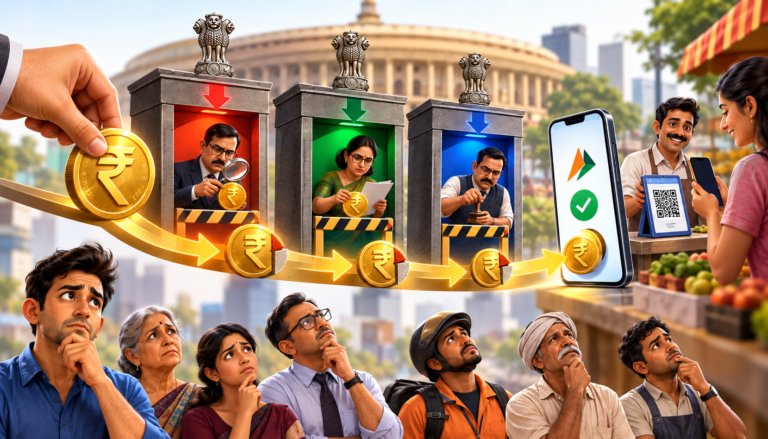
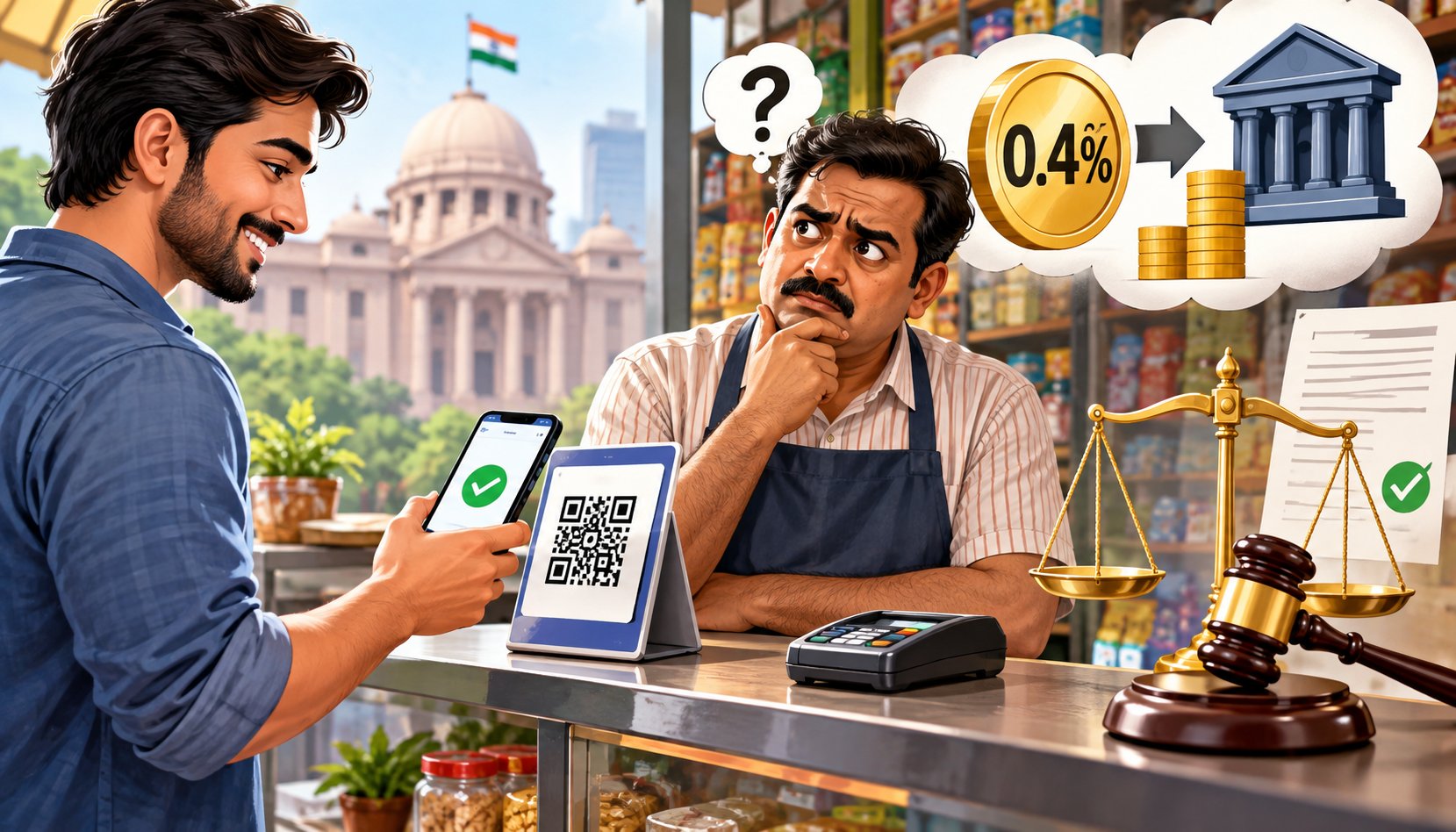
For six years the arithmetic of a UPI payment was beautifully simple. A customer paid Rs 4,000, the merchant received Rs 4,000, and the cost of moving that money sat somewhere out of sight. From 15 October 2026 that changes for a narrow but valuable slice of transactions. The merchant now receives Rs 3,984. The missing Rs 16 is the merchant discount rate, and the argument it has started is not really about Rs 16.
Quick Summary
From 15 October 2026, person-to-merchant UPI payments above Rs 2,000 attract an MDR of 0.4 per cent, capped at Rs 300 on payments of Rs 75,000 and above. Person-to-person transfers, all payments up to Rs 2,000, small vendors classified as P2PM, and UPI AutoPay mandates stay at zero. The Finance Ministry puts the share of merchant transactions left untouched at roughly 96 per cent. Merchants cannot add a UPI surcharge to a bill, and payment apps cannot charge customers a platform fee.
What We Know
The framework arrived in two steps. The Finance Ministry issued a gazette notification on 14 September 2026 under the amended Section 10A of the Payment and Settlement Systems Act, 2007, which the Lok Sabha had cleared in August as part of the Taxation and Other Laws (Amendment) Bill, 2026. NPCI followed on 15 September with the circular that carries the actual rate card. These are the confirmed elements.
- The standard rate is 0.4 per cent on eligible person-to-merchant transactions above Rs 2,000, with a cap of Rs 300 per transaction for payments of Rs 75,000 and above.
- Person-to-person transfers carry no MDR at any value, and person-to-merchant payments of Rs 2,000 or less carry none either.
- Small vendors in the P2PM category, receiving up to Rs 1 lakh a month through UPI QR codes into their own accounts, pay nothing regardless of individual ticket size.
- Railways, telecom, insurance, fuel and certain utility categories pay a flat Rs 5 above Rs 2,000 instead of the percentage rate.
- Capital market payments, covering mutual funds, securities, stockbrokers and dealers, are set at 0.02 per cent with the same Rs 300 cap.
- UPI AutoPay and recurring mandates are outside the MDR framework entirely.
- No part of the MDR goes to the government. It is shared among issuing banks, acquiring banks, payment service providers and UPI apps.
- NPCI is setting up a fund of roughly Rs 700 crore a year to expand acceptance infrastructure in Tier III to Tier VI locations, the north-eastern states, Jammu and Kashmir and Ladakh.
Six Years of Free Rails: How the Zero-MDR Bargain Was Built and Broken
Zero MDR was never a law of nature. It was a policy decision taken in December 2019 and given effect from January 2020, inserting Section 10A into the Payment and Settlement Systems Act so that prescribed electronic modes, UPI and RuPay debit cards among them, could not be charged to merchants. The trade-off was explicit: the government would compensate the ecosystem through an annual incentive scheme instead.
The adoption side of that bargain worked spectacularly. UPI went from 1.78 crore transactions worth Rs 0.07 lakh crore in FY2016-17 to 24,161.69 crore transactions worth about Rs 314 lakh crore in FY2025-26, with the number of live banks rising from 44 to 703. The compensation side did not keep pace. That is the gap this policy is closing.
The Rate Card Decoded: Every Category and What It Actually Costs
Most of the confusion in the first week came from people applying the headline 0.4 per cent to transactions that will never see it. The framework is not one rate. It is six treatments, and which one applies to a business depends on its merchant category code and its classification, not on how large it feels.
| Transaction type | MDR from 15 Oct 2026 | Who bears it | What to verify |
|---|---|---|---|
| P2P transfer | Nil at any value | Nobody | Nothing changes |
| P2M up to Rs 2,000 | Nil | Nobody | 86 per cent of P2M is below Rs 500 |
| P2M above Rs 2,000 | 0.40%, capped Rs 300 | Merchant | Your MCC and acquirer contract |
| P2PM vendor | Nil | Nobody | Inward credit under Rs 1 lakh a month |
| Railways, telecom, insurance, fuel, utilities | Flat Rs 5 above Rs 2,000 | Merchant | Category mapping with the bank |
| Capital markets | 0.02%, capped Rs 300 | Platform or broker | Lump-sum orders, not SIP mandates |
| Education fee collection | Flat or capped programme rate | Institution | Written confirmation of the slab |
| UPI AutoPay and mandates | Nil | Nobody | Covers SIPs, subscriptions, EMIs |
| RuPay credit card on UPI | MCC-based, roughly 0.50% to 1.75% | Merchant | In force since 1 June 2026 |
| Wallet-funded UPI above Rs 2,000 | About 1.1% interchange | Merchant | Unchanged since 2023 |
Where the Money Actually Bites: The Cost Curve by Ticket Size
The Rs 300 cap does something counter-intuitive. Because it bites at Rs 75,000, the effective rate is a flat 0.4 per cent up to that point and then falls away steadily. A jeweller taking a Rs 3 lakh payment pays 0.1 per cent. A furniture shop taking Rs 8,000 pays the full 0.4 per cent. In percentage terms, the burden is heaviest in the middle of the market, not at the top.
Zero MDR
Rs 8 to Rs 40
Rs 40 to Rs 200
Rs 200 to Rs 300
Flat Rs 300 cap
| Ticket value | Standard 0.4% | Effective rate | Flat Rs 5 category | Capital markets 0.02% | P2PM vendor |
|---|---|---|---|---|---|
| Rs 1,500 | Rs 0 | 0.00% | Rs 0 | Rs 0 | Rs 0 |
| Rs 2,500 | Rs 10 | 0.40% | Rs 5 | Rs 0.50 | Rs 0 |
| Rs 5,000 | Rs 20 | 0.40% | Rs 5 | Rs 1 | Rs 0 |
| Rs 20,000 | Rs 80 | 0.40% | Rs 5 | Rs 4 | Rs 0 |
| Rs 50,000 | Rs 200 | 0.40% | Rs 5 | Rs 10 | Rs 0 |
| Rs 75,000 | Rs 300 | 0.40% | Rs 5 | Rs 15 | Rs 0 |
| Rs 3,00,000 | Rs 300 | 0.10% | Rs 5 | Rs 60 | Rs 0 |
Worked example: a mid-sized electronics store
A store in Pune takes 400 UPI payments a month. Of those, 310 are under Rs 2,000 and cost nothing. The remaining 90 average Rs 9,500, giving monthly qualifying value of Rs 8.55 lakh. At 0.4 per cent that is Rs 3,420 a month, or Rs 41,040 a year. Add 18 per cent GST on the fee and the annual cost is roughly Rs 48,427. On a gross margin of 6 per cent, the store needs about Rs 8.07 lakh of additional annual sales to stand still. That is the number worth arguing about, not the Rs 16 on a single bill.
Can It Be Avoided? Five Routes, Ranked From Lawful to Risky
This is the question merchants are actually asking, and the honest answer has two halves. For the overwhelming majority of businesses, there is nothing to avoid because the fee never applies. For the businesses it does touch, several legitimate levers exist, and one popular idea is a genuinely bad one.
The route that is not worth taking
Splitting a Rs 6,000 bill into three payments of Rs 2,000 saves Rs 24 and creates a pattern. A senior finance department official told PTI that transactions will be monitored from 15 October, with high daily volumes attracting particular attention and bank data used for comparison. Separately, merchants cannot add a UPI surcharge to a customer bill, and payment apps are barred from levying platform or hidden fees. A saving of Rs 24 per transaction is not worth an enforcement conversation.
Is It Justified? The Case Built on the Funding Gap
The strongest argument for MDR is not ideological, it is an accounting one. The banking industry and NPCI put the cost of running UPI, covering settlement systems, cloud capacity, fraud detection, cybersecurity and technology upgrades, at roughly Rs 20,000 crore to Rs 20,700 crore a year. Against that, the government’s incentive scheme has never come close. Industry participants have described annual cash losses of Rs 5,000 crore to Rs 6,000 crore on the zero-MDR structure.
A parliamentary panel put the conclusion on the record in March 2026, with the Department of Financial Services submitting that the absence of MDR makes the ecosystem financially unsustainable in the long run. NPCI’s own framework FAQ describes annual budget incentives as bridge funding rather than a permanent measure, arguing that dependence on yearly allocations creates uncertainty and discourages long-term technology investment.
There is also the comparison test. At 0.4 per cent, UPI remains the cheapest electronic acceptance route a merchant has, by a distance.
The Case Against: Thin Margins, Bad Timing and a Question of Who Should Pay
The opposing case is not that the network is free to run. It is about who should fund it. The Retailers Association of India argued that most UPI payments are debit-linked, drawing directly from savings and current accounts, and therefore carry neither the interchange costs nor the credit risk that justify charges on card networks. Its chief executive, Kumar Rajagopalan, said the burden could undo years of progress and that the state already gets a formal, traceable transaction it can tax from every UPI payment.
The margin arithmetic explains the intensity of the reaction. A 0.4 per cent fee sounds trivial until it is expressed as a share of what a business actually keeps.
That is the reasoning behind the letter the All India Consumer Products Distributors Federation wrote to the Prime Minister, and behind the warning from the Confederation of All India Traders that retailers will look at splitting transactions, shifting to bank transfers or quietly repricing unbranded goods. The timing compounds it. A 15 October start lands in the middle of the festive trading season, when ticket sizes are at their annual peak.
There is also the geopolitical subplot. The United States Trade Representative’s 2026 National Trade Estimate report named India’s zero-MDR policy as a trade barrier, arguing it disadvantaged card networks. The opposition seized on the sequencing, with Congress leader Randeep Surjewala calling the levy a betrayal that benefits American companies. The Finance Ministry has rejected the claim, stating that the NPCI guidelines give international credit cards no advantage over RuPay and that MDR is not a tax collected by government but a fee shared within the payments ecosystem.
What Is Still Unclear
Several operational questions had not been settled as of 18 September 2026, and merchants planning for October should treat them as open.
- The precise split of the 0.4 per cent among issuing bank, acquiring bank, payment service provider and UPI app has not been published in full.
- GST treatment has not been separately clarified for UPI MDR. Standard practice on other instruments is 18 per cent on the fee and not on the payment, and bank notices for RuPay credit card on UPI state MDR is exclusive of GST.
- Enforcement mechanics against surcharging are described as monitoring and advisories rather than a published penalty schedule.
- The full list of merchant category codes mapped to the flat Rs 5 slab and to the education programme rate has not been made public in consolidated form.
- How the Rs 1 lakh monthly P2PM threshold is measured across multiple QR codes or multiple accounts held by the same vendor is not spelled out in the public circular.
- Whether the Rs 2,000 threshold and the 0.4 per cent rate are fixed or subject to periodic revision by the steering committee is not stated.
A Practical Checklist Before 15 October
Frequently Asked Questions
Can merchants legally avoid the 0.4 per cent UPI MDR from October 15?
Partly. Staying within the P2PM category by keeping monthly inward UPI credit under Rs 1 lakh, using UPI AutoPay for recurring collections, and confirming eligibility for the flat Rs 5 or 0.02 per cent slabs are all legitimate routes. Deliberately splitting a single bill into sub-Rs 2,000 payments is not advisable, as transactions are being monitored from 15 October and compared with bank data.
Will customers pay any UPI charge after 15 October 2026?
No. MDR is levied on the merchant, not the payer. Person-to-person transfers remain free at every value, payments up to Rs 2,000 are free, and payment apps are expressly barred from charging platform fees or hidden charges to customers. Merchants are not permitted to add a UPI surcharge to a bill either, although indirect effects such as fewer digital-payment discounts are possible.
Which UPI transactions are completely exempt from MDR?
All person-to-person transfers, all person-to-merchant payments of Rs 2,000 or less, payments to P2PM vendors receiving up to Rs 1 lakh a month through QR codes into their own accounts, and UPI AutoPay or recurring mandates of any size. The Finance Ministry estimates around 96 per cent of merchant transactions fall outside the charge entirely.
How much MDR will a merchant pay on a Rs 10,000 UPI payment?
Rs 40 under the standard slab, which is 0.4 per cent. A flat Rs 5 category such as telecom, insurance, railways or fuel would pay Rs 5 on the same payment, and a capital market transaction would pay Rs 2. Above Rs 75,000 the charge is capped at Rs 300, so a Rs 2 lakh payment also costs Rs 300, an effective 0.15 per cent.
Is MDR on UPI a tax collected by the government?
No. The government has stated that no part of the MDR accrues to it. The fee is shared among the participants that process a payment, which includes the issuing bank, the acquiring bank, the payment service provider and the UPI app. GST applies to the fee itself in the usual way for financial services, not to the amount being transferred.
Why was zero MDR on UPI ended after six years?
The funding model stopped adding up. Industry puts the annual cost of running UPI at roughly Rs 20,000 crore, while the government’s compensation peaked at Rs 3,631 crore in FY2023-24 and is allocated at Rs 2,000 crore for FY2026-27. A parliamentary panel recorded the Department of Financial Services describing zero MDR as financially unsustainable in the long run.
Do small shops and street vendors have to pay the new UPI fee?
No, provided they remain in the P2PM category with monthly inward UPI receipts up to Rs 1 lakh. GST registration is not required to qualify, and existing QR codes and soundboxes continue to work without hardware changes. If receipts exceed Rs 1 lakh a month for three consecutive months, the vendor is reclassified as P2M and the 0.4 per cent applies above Rs 2,000.
Does the MDR apply to SIPs, insurance premiums and school fees?
Recurring payments made through UPI AutoPay mandates, including SIPs, subscriptions and insurance EMIs, carry no prescribed MDR. A one-time lump-sum mutual fund or broker payment falls in the capital markets category at 0.02 per cent capped at Rs 300. Insurance premium payments sit in the flat Rs 5 category, and education fee collections follow a designated programme rate rather than the 0.4 per cent slab.
The Short Version
From 15 October 2026, a 0.4 per cent merchant discount rate applies to UPI person-to-merchant payments above Rs 2,000, capped at Rs 300. Consumers pay nothing, person-to-person transfers stay free, small vendors under Rs 1 lakh a month stay free, and roughly 96 per cent of merchant transactions are untouched. It can be avoided legitimately through classification, category and AutoPay routes, and it cannot be avoided by surcharging customers or splitting bills. On justification, the funding gap is real and documented, the rate is the lowest of any electronic instrument, and the fair objection is not that the network costs nothing to run, but that a uniform fee lands hardest on the thinnest margins.