LIC Health Shield 907 vs New Cancer Cover 908: What Each Actually Pays on a Claim — and Who Should Think Twice
LIC Health Shield 907 vs New Cancer Cover 908: What Each Actually Pays on a Claim — and Who Should Think Twice
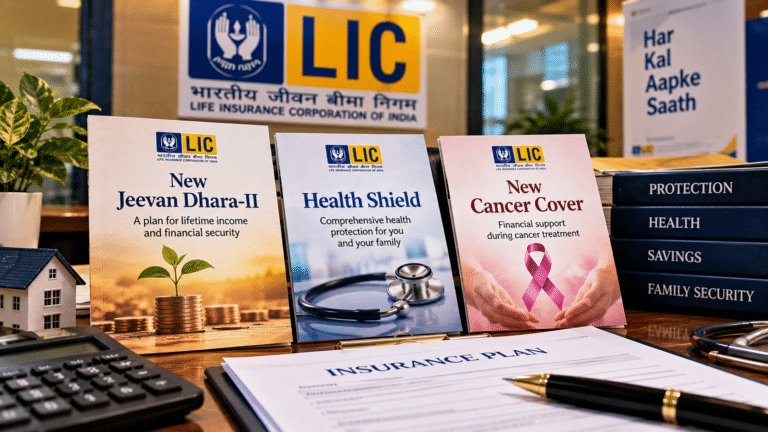
LIC’s two new fixed-benefit health plans open for sale on Monday. One pays cash per hospital day and per surgery for the whole family; the other pays lump sums and a monthly income on a cancer diagnosis. Here is the claim arithmetic, from LIC’s own brochures.
- Daily benefit ₹2,500 to ₹10,000
- Surgery cover 100 × daily benefit
- Family on one policy, 15-year term
- Premium ₹7,195 at 30, ₹5,000 a day
- Early stage pays 25%, major 100%
- Then 1% a month for 10 years
- Cover ₹15 lakh to ₹50 lakh
- Premium ₹4,700 at 20, ₹50 lakh
Suppose your father is admitted for seven days, three of them in intensive care, for a bypass. A standard mediclaim policy pays the hospital, up to its limit. LIC’s Health Shield would do something different: it would send you a fixed amount, regardless of the bill, that you can spend on anything from the hospital’s co-pay to a sibling’s flight home. That is the core idea behind both of LIC’s new health plans, and it is also the reason they are easy to misunderstand.
Health Shield (Plan 907) and New Cancer Cover (Plan 908) go on sale on 19 October 2026 alongside a new pension plan. We covered the launch earlier. This guide goes deeper on the two health plans: what they pay on real claims, what a family will spend on premiums, what the fine print excludes, and how to decide whether either belongs in your cover.
Quick Summary
Both plans pay fixed amounts, not your hospital bill, so they are top-ups to a regular health policy, not replacements. Health Shield pays cash per hospital day, double for ICU, and a lump sum of 20% to 100% of 100 times your daily benefit for major surgery. New Cancer Cover pays 25% of the sum assured on early-stage cancer, 100% on major-stage, and then 1% a month for 10 years, up to 245% in total. Neither returns premiums if you never claim.
What We Know
- Both plans are non-linked, non-participating, pure-risk health plans with premiums guaranteed for the full term.
- Health Shield covers the principal insured, spouse and parents aged 18 to 65, and children from 90 days to 20 years.
- New Cancer Cover is for individuals aged 18 to 65, with a 10- to 15-year term and maximum maturity age of 75.
- Both offer online rebates: 10% on Health Shield, and 7.5% to 10% on New Cancer Cover.
- Neither has maturity, surrender or loan value.
What Is Still Unclear
- How quickly LIC will settle claims, and how large its network hospital list is for Quick Cash.
- Full premium tables for every age; brochures publish sample ages only.
- Whether the older Cancer Cover (Plan 905) will be withdrawn from sale.
- Claim experience, since both products are new.
Fixed Benefit, Not Reimbursement: The One Idea to Grasp
Most Indian health insurance is indemnity cover: the insurer pays the actual hospital bill, up to a limit. Health Shield and New Cancer Cover are benefit plans: they pay a pre-set amount when a defined event happens, whether your bill is ₹50,000 or ₹5 lakh. That has three consequences that matter to buyers.
First, the money is yours to use, which helps with costs mediclaim never covers: lost income, travel, a caregiver, home modifications. Second, the payout can be smaller than the bill, so these plans cannot be your main cover. Third, you can hold them alongside any mediclaim policy and claim both for the same event, because one reimburses and the other pays a fixed benefit.
| Feature | Health Shield 907 | New Cancer Cover 908 | Typical mediclaim |
|---|---|---|---|
| What triggers payment | Hospital stay, surgery, listed illnesses | Cancer diagnosis, early or major stage | Hospital bill |
| Amount paid | Fixed multiples of daily benefit | 25%, 100%, then 1% a month | Actual bill up to limit |
| Who is covered | Self, spouse, parents, children | One individual | Varies |
| Term | 15 years, premiums guaranteed | 10 to 15 years, guaranteed | Usually 1 year, renewable |
| Waiting period | 90 days; 2 years for 23 conditions | 180 days | Varies |
| Money back if no claim | No | No | No |
Health Shield 907: Four Real Claims, Worked Out
Every Health Shield benefit is a multiple of the Initial Daily Benefit you choose, between ₹2,500 and ₹10,000 in steps of ₹500. The brochure sets the rules: 1 × the daily benefit for each 24 hours in a ward, 2 × in ICU, 5 × for a listed day-care procedure, 2.5 × per day for other surgeries, and a surgical sum assured of 100 × the daily benefit, paid at 100%, 60%, 40% or 20% depending on the surgery’s category. We applied them at ₹5,000 a day.
The dengue case shows the plan’s other side. Four ward days earn ₹20,000 of hospital cash, and dengue is one of five illnesses, with malaria, pneumonia, pulmonary TB and hepatitis A, that also earn a medical management lump sum of 2.5 × the daily benefit, ₹12,500. A cataract operation, where it qualifies as a listed day-care procedure, pays 5 ×, but cataract sits on the 2-year waiting list, so it cannot be claimed in the first two years.
The limits that cap the cash
Hospital cash is paid for up to 30 days in the first policy year and 90 days a year after that, with a 900-day lifetime cap per insured. Major surgery is capped at 100% of the surgical sum assured per year and 10 times over the policy’s life, with up to 10 restorations for unrelated procedures. Day care is limited to three a year and 30 in total. A single stay longer than 30 days earns an extra 10 × lump sum, ₹50,000 at ₹5,000 a day.
Your cover grows if you stay healthy
The no-claim benefit adds 10% of the initial daily benefit after every three consecutive claim-free years, with no cap. Over a 15-year term with no claims, a ₹5,000 daily benefit would step up four times.
One catch: the claim-free test applies to the whole policy. A claim by any insured member resets the clock for everyone, so a family policy with young children may not see many step-ups.
What a Family Pays for Health Shield
LIC’s brochure publishes sample yearly premiums at a ₹5,000 daily benefit for an offline purchase. The principal insured pays the main premium; each additional member adds their own.
Premiums stay the same for 15 years, which is the plan’s quiet advantage. Most mediclaim premiums rise as you move into older age bands; here, a 50-year-old locks in today’s rate until 65. Individual life and health insurance premiums have been exempt from GST since 22 September 2025, so the brochure figure is close to what you pay.
New Cancer Cover 908: The 245% Pay-out, Step by Step
New Cancer Cover pays three ways. On a specified early-stage cancer, it pays 25% of the sum assured and waives premiums for three years. On a major-stage cancer, it pays 100% of the sum assured, even if an early-stage claim was paid before, and stops future premiums. It then pays 1% of the sum assured every month for 10 years, even beyond the policy term. The total cannot exceed 245% of the sum assured.
The minimum cover now depends on your age at entry: ₹35 lakh for 18 to 34, ₹30 lakh for 35 to 40, ₹20 lakh for 41 to 50 and ₹15 lakh for 51 to 65. The maximum is ₹50 lakh across all policies under this plan. Under the increasing option, the sum assured rises by 10% of the base on each of the first five anniversaries, to 150%, until a cancer is diagnosed.
- ₹35 LMinimum cover, ages 18 to 34
- ₹30 LMinimum, ages 35 to 40
- ₹20 LMinimum, ages 41 to 50
- ₹15 LMinimum, ages 51 to 65
- ₹50 LMaximum per person
What it costs, and what you get for it
| Entry age | Male, 10 years | Female, 10 years | Male, 15 years | Female, 15 years |
|---|---|---|---|---|
| 20 | ₹4,700 | ₹5,250 | ₹4,950 | ₹6,100 |
| 35 | ₹8,050 | ₹15,200 | ₹9,100 | ₹17,600 |
| 50 | ₹25,400 | ₹37,750 | ₹32,800 | ₹41,600 |
| 60 | ₹73,050 | ₹60,500 | ₹89,150 | ₹66,750 |
| 65 | ₹1,14,150 | ₹75,800 | n/a | n/a |
The table shows LIC’s yearly premiums for ₹50 lakh of level cover, offline, excluding taxes. Two patterns stand out. Women pay more than men until their 50s, likely reflecting higher cancer incidence among younger women, such as breast and cervical cancers; from 60, men pay more. And premiums rise steeply with age: a 60-year-old man pays about 15 times what a 20-year-old does for the same cover.
What changed from the old Cancer Cover 905
The new plan’s minimum entry age falls from 20 to 18; premiums are guaranteed for the full term rather than five years; and the major-stage payout no longer deducts any early-stage claim, which lifts the overall cap from 220% to 245%. The trade-offs are a shorter maximum term, 15 years against 30, and higher minimum cover, ₹15 lakh to ₹35 lakh against ₹10 lakh. Existing holders of Plan 905 keep their policies on their original terms.
The Fine Print Most Buyers Skip
Both brochures are explicit about what they do not cover. These are the exclusions most likely to matter.
The 36-month look-back in both plans makes honest disclosure essential. Any condition you were treated for, or advised about, before buying should be declared on the proposal form. Non-disclosure is the most common reason health claims are rejected, and LIC’s brochures exclude undisclosed pre-existing conditions.
Should Either Plan Be in Your Cover?
These plans fill specific gaps. The ladder below is our suggested order of priorities, not LIC’s recommendation.
- First: ₹5 to 10 lakhA family-floater mediclaim policy. Without one, neither LIC plan protects you from a large hospital bill.
- Then: ₹35 to 50 lakhNew Cancer Cover, if you have a family history of cancer or depend on your own income with little savings.
- Then: ₹2,500 to 5,000 a dayHealth Shield, for income and incidental costs during hospital stays, especially for families with parents aged up to 65.
- Skip ifYour budget only stretches to one policy, or you already have critical-illness or hospital-cash riders that overlap.
- Mediclaim of at least ₹5 lakh already in place
- All conditions in the last 36 months disclosed
- Waiting periods of 90 days, 180 days and 2 years noted
- Online price compared, 7.5% to 10% cheaper
- Daily benefit set at ₹4,000 or more for the rebate
- Cancer cover minimum checked for your age band
- Premium affordable for all 10 to 15 years
- Free-look of 30 days used to read the policy
Frequently Asked Questions
What is LIC Health Shield Plan 907?
A fixed-benefit family health plan that pays a daily hospital cash amount of ₹2,500 to ₹10,000, double in ICU, plus lump sums for major surgery, day-care procedures and some illnesses. It runs for 15 years with guaranteed premiums and goes on sale on 19 October 2026.
What does LIC New Cancer Cover Plan 908 pay?
25% of the sum assured on early-stage cancer, 100% on major-stage cancer, and then 1% of the sum assured every month for 10 years. The total is capped at 245% of the sum assured.
Is LIC Health Shield a replacement for mediclaim?
No. It pays fixed amounts regardless of your bill, so a large hospital bill could exceed what it pays. It works best as a top-up alongside a regular indemnity health policy.
How much does LIC Health Shield cost?
At a ₹5,000 daily benefit, LIC’s brochure shows yearly premiums of ₹7,195 for a 30-year-old man and ₹9,446 at 40, before any online rebate. Adding a 35-year-old spouse costs about ₹6,357 more.
What is the minimum sum assured in LIC New Cancer Cover?
It depends on entry age: ₹35 lakh for 18 to 34, ₹30 lakh for 35 to 40, ₹20 lakh for 41 to 50 and ₹15 lakh for 51 to 65. The maximum is ₹50 lakh.
What is the waiting period in these LIC health plans?
Health Shield has a 90-day waiting period for illness and 2 years for 23 named conditions; accidents are covered from day one. New Cancer Cover has a 180-day waiting period.
Can I claim from LIC Health Shield and my mediclaim for the same hospital stay?
Yes. Health Shield pays a fixed benefit, not a reimbursement, so it can be claimed alongside an indemnity policy that pays the actual bill, subject to each policy’s terms.
Do LIC Health Shield and New Cancer Cover return premiums?
No. Both are pure-risk plans with no maturity benefit, surrender value or loan. If no claim is made, nothing is paid back.
The Short Version
LIC’s Health Shield (Plan 907) and New Cancer Cover (Plan 908) go on sale on 19 October. Health Shield pays fixed cash per hospital day and per surgery for the whole family, for example ₹5.51 lakh on a bypass at a ₹5,000 daily benefit, for about ₹15,800 a year for a couple aged 40 and 35. New Cancer Cover pays up to 245% of a ₹15 lakh to ₹50 lakh sum assured over time. Both have waiting periods and no money back. Buy them as top-ups after a regular mediclaim policy, not instead of one.