Why the Government and LIC Are Keeping 34% of IDBI Bank After the Fairfax Sale — and When They Can Sell
BankingIDBI BankDisinvestment
Why the Government and LIC Are Keeping 34% of IDBI Bank After the Fairfax Sale — and When They Can Sell
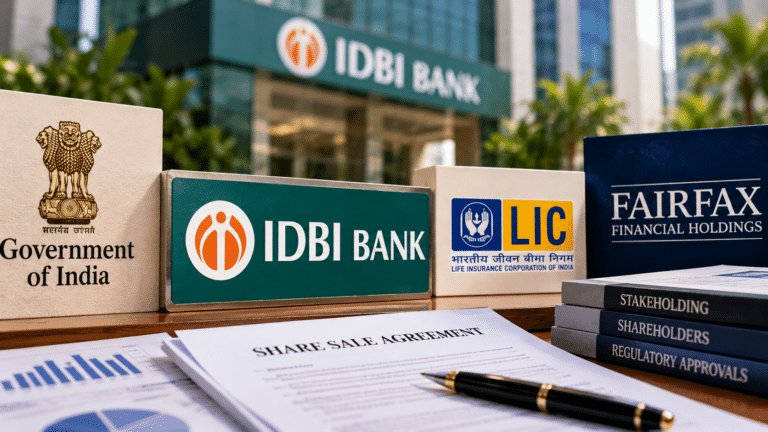
Selling 60.72% to Fairfax leaves the government with 15% and LIC with 19% of IDBI Bank, worth about ₹29,600 crore at the deal price. They give up their board seats but not their money. Here are the rules on when and how those stakes can be sold.
The headline from Wednesday was simple: IDBI Bank sold to Fairfax. The fine print is more interesting. The government and LIC did not walk away. They sold a little over half of what they owned and kept the rest. On paper, after the deal, they will still own more than a third of the bank between them, a holding worth roughly ₹29,600 crore at Fairfax’s own price.
That leaves a set of practical questions. Why keep a stake at all? Will the government and LIC still have a say in how the bank is run? When can they sell what remains, and how? And what does an eventual sale of those shares mean for the IDBI shareholder who bought on the news, or for LIC’s own policyholders and investors? Officials answered some of these at a briefing after the Cabinet decision. This article sets out what they said and what follows from it.
What We Know
- The government sells 30.48% and LIC 30.24% to Fairfax, keeping 15% and 19%.
- The government’s residual 15% may be sold through the open market by the Alternative Mechanism, a group of ministers.
- LIC must bring its stake down to 15% within two years, according to officials quoted by Business Today.
- DIPAM Secretary Arunish Chawla said the government will “get off the board with a new promoter coming in.”
What Is Still Unclear
- Whether Fairfax’s lock-in is three years or five; reports differ.
- When the government will start selling its 15%, and at what price.
- How LIC will sell the 4% it must shed, and whether it will sell below its own cost.
- Whether the combined 34% will be treated as public shareholding for listing rules from completion.
“Strategic Restructuring”, Not a Clean Exit
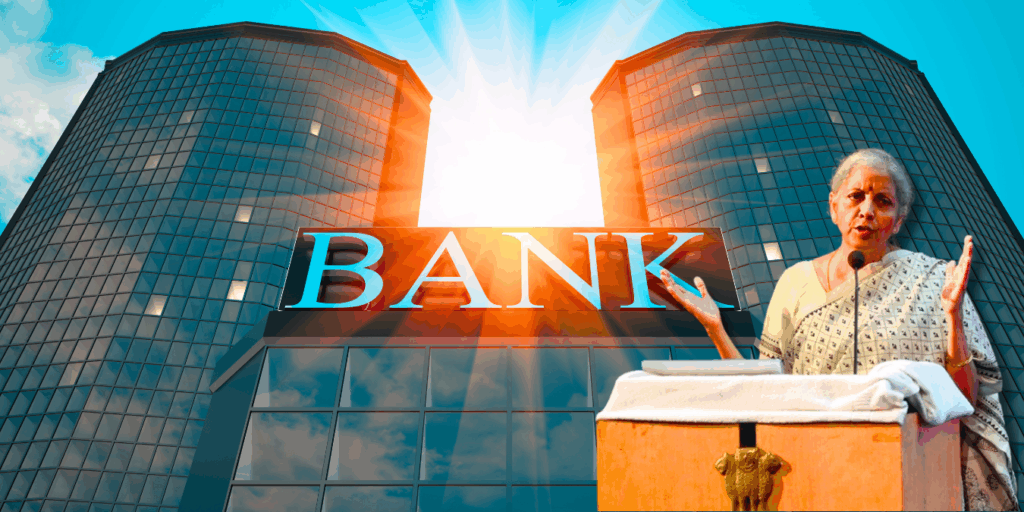
Finance Minister Nirmala Sitharaman framed the deal carefully. It “should not be considered a strategic disinvestment but a strategic restructuring,” she said, according to Business Today. The distinction matters. In a classic strategic sale, such as Air India, the government hands over its entire holding and leaves. Here, control passes to Fairfax, but the state and its largest insurer remain the second and third largest shareholders.
A Finance Ministry official put it plainly: “The government continues to stay invested in IDBI. We still have 15% stakes,” Outlook Business reported. Officials also told employees they need not worry about the change in management, since the government and LIC remain investors. The DIPAM Secretary added that the government would carry “no contingent liability”, meaning it is not on the hook for future losses beyond its shareholding.
Why keep anything at all?
There are three practical reasons. First, selling all 94.72% to one buyer was never the plan; the original 2022 offer was for 60.72%. Second, a retained stake lets the government and LIC share in any rise in value once a private owner runs the bank, which is the same logic used when governments keep minority stakes after privatisations elsewhere. Third, dumping a further 34% on the market at once would depress the price. Holding and selling later, in tranches, is likely to raise more money.
How LIC came to own so much of IDBI
LIC’s large holding is itself a legacy of an earlier rescue. In 2018 and 2019, when IDBI was under RBI’s Prompt Corrective Action framework because of heavy bad loans, LIC bought a controlling stake and the bank was reclassified as a private sector bank in January 2019. The government and LIC then injected capital over the following years as the bank cleaned up its books. RBI lifted the corrective restrictions in March 2021. The sale to Fairfax is, in effect, the exit plan for that rescue, and the retained stakes are how LIC and the government keep a share of the recovery they paid for.
India has used a similar model before. The government once held a large stake in Axis Bank through the Specified Undertaking of the Unit Trust of India, and sold it down over several years through offers for sale on the exchanges rather than in a single transaction. That gradual approach is the most likely template for the government’s 15% in IDBI.
What 34% Is Worth, Stake by Stake
The residual holdings are large in rupee terms. Using a total of about 1,075 crore shares, derived from the deal value and price, the government’s 15% is about 161 crore shares and LIC’s 19% about 204 crore shares. Their value depends on the price used.
The Rules That Govern Each Stake
Each of the three large shareholders comes out of the deal with different obligations. They were set out in the government’s statement and at the DIPAM briefing, as reported, though some details differ between reports.
| Rule | Fairfax, 60.72% | Government, 15% | LIC, 19% |
|---|---|---|---|
| Board role | Promoter; appoints management | No board seat after completion | No board seat after completion |
| Lock-in | 3 years per DIPAM Secretary; 5 years per Business Today | None stated | None stated |
| Required sell-down | To 26% over 15 years after lock-in, per RBI promoter rules as reported | None required; may sell in open market | To 15% within 2 years |
| How it can sell | Gradually, after lock-in | Open market, such as an offer for sale, via Alternative Mechanism | Under LIC’s own investment procedures |
| Classification after changes | Promoter | Non-promoter shareholder | Public shareholder once at 15% |
| Brand obligation | Must keep IDBI name and logo for 3 years | Not applicable | Not applicable |
Why LIC has to sell another 4%
LIC is the odd one out. It must cut its stake from 19% to 15% within two years. Business Today linked the requirement to LIC’s other financial holdings, including LIC Housing Finance, and to RBI’s norms on the share of a bank one entity can hold without being a promoter. Once at 15%, LIC will be classified as a public shareholder of IDBI. At the deal price, the 4% LIC has to sell is worth about ₹3,483 crore.
The lock-in confusion
Reports differ on how long Fairfax must hold its stake. Outlook Business quoted the DIPAM Secretary saying invested capital would be locked in for three years under the share purchase agreement. Business Today and another report described a five-year lock-in, with Fairfax required to keep at least 40% and then reduce to 26% over 15 years. The three-year figure may refer to the agreement and the five-year figure to RBI’s licensing conditions for promoters, but this has not been officially clarified. We report both.
How and When the Residual Stakes Could Be Sold
- 14 Oct 2026Cabinet approves sale; govt and LIC to keep 34%
- This fiscal yearCompletion expected by March 2027, subject to RBI
- Within 2 yearsLIC to cut stake from 19% to 15%
- 3 to 5 yearsFairfax lock-in period, reports differ
DIPAM Secretary Arunish Chawla said the government expects RBI clearances “to come through quickly”. Completion is expected this financial year, which ends on 31 March 2027. Only after that will the clocks on LIC’s two-year sell-down and Fairfax’s lock-in start running, if they are measured from completion; reports tie some deadlines to the signing of the share purchase agreement instead.
What It Means for IDBI Shareholders, LIC and Customers
The retained stakes matter differently depending on who you are. The biggest effect is on the small number of public shareholders, whose stock is currently very thinly traded.
For IDBI shareholders: more supply, more liquidity
Today only about 5.28% of IDBI’s shares are in public hands. Every future sale by the government or LIC adds to that free float. More shares to trade usually means less extreme price swings, but it also means more supply, which can weigh on the price while sales are under way. If LIC sells 4% and the government later sells its 15%, the public float could rise from about 5% to about 24%, as the ownership chart shows.
For LIC policyholders and shareholders
LIC receives about ₹26,335 crore from the sale, pro rata to its stake, and keeps 19%. LIC’s shares rose as much as 2.4% to ₹402.50 on 15 October, Business Today reported. Policyholders’ money is not directly affected; LIC invests across many assets and this is one holding. The key questions for LIC investors are how the sale compares with what LIC originally paid for IDBI, which has not been restated, and how well it times the sale of the remaining stake.
For bank customers: no change
None of this affects deposits, loans or accounts. The bank remains IDBI Bank Limited, regulated by RBI, and Fairfax must keep the IDBI name and logo for three years. The government’s continuing stake does not create a government guarantee for deposits; deposit insurance through DICGC covers up to ₹5 lakh per depositor per bank, as at every bank.
- Public shareholders: watch for the open offer letter and for any offer for sale announcement by the government, which can be priced below the market.
- LIC investors: track LIC’s disclosures on the realised gain or loss from the sale and its plan for the 4% sell-down.
- Customers: carry on as normal and treat unsolicited messages about the sale as suspect.
- Employees: look for formal communication from the bank after completion on any changes to policies.
- Government stake: 15%, about 161 crore shares
- LIC stake: 19% now, 15% within 2 years
- Board seats for govt and LIC: none after completion
- IDBI brand and logo: kept for at least 3 years
- Fairfax lock-in: 3 or 5 years, reports differ
- Completion expected by 31 March 2027
There is a counterweight. Sellers in a hurry rarely get good prices, and neither the government nor LIC is under pressure to sell quickly beyond LIC’s 4%. The government has used offers for sale in many companies and usually prices them at a modest discount to the market to attract bids. If Fairfax improves IDBI’s growth and returns over the next few years, later sales could fetch more than ₹81 a share, which would make keeping 34% the better decision for taxpayers and LIC policyholders alike.
Frequently Asked Questions
How much stake will the government hold in IDBI Bank after the sale?
15%. The government sells 30.48% of its 45.48% holding to Fairfax and keeps the rest. Its residual stake can later be sold through the open market.
How much stake will LIC hold in IDBI Bank?
19% after the sale, down from 49.24%. LIC must reduce this to 15% within two years, after which it will be classified as a public shareholder.
Will the government and LIC have board seats in IDBI Bank?
No. The DIPAM Secretary said the government will get off the board when the new promoter comes in, and officials said neither the government nor LIC will have board-level appointments.
Why is the government keeping a stake in IDBI Bank?
The sale was designed for 60.72% from the start. Keeping 15% lets the government share in any future rise in value and sell later in tranches rather than all at once. The Finance Minister called it “strategic restructuring”.
What is the value of the government and LIC’s remaining IDBI stake?
At Fairfax’s ₹81 a share, the combined 34% is worth about ₹29,609 crore: about ₹13,063 crore for the government and ₹16,546 crore for LIC, by our calculation. At ₹93.62, the combined value is about ₹34,222 crore.
What is the lock-in period for Fairfax in IDBI Bank?
Reports differ. The DIPAM Secretary was quoted as saying three years under the share purchase agreement; other reports describe a five-year lock-in with a later reduction to 26% over 15 years.
Is IDBI Bank still a government bank?
No. IDBI has been classified as a private sector bank since January 2019, and after the sale Fairfax will be its promoter. The government will be a minority shareholder with no board seat.
Will the government sell its remaining 15% in IDBI Bank?
It may. The Alternative Mechanism is authorised to sell the residual stake through the open market, such as an offer for sale, but no timing has been announced.
The Short Version
Selling control of IDBI Bank to Fairfax does not end the state’s involvement. The government keeps 15% and LIC 19%, worth about ₹29,600 crore at the deal price, but both give up their board seats. The government can sell its stake later in the open market; LIC must cut to 15% within two years and then becomes a public shareholder. Fairfax faces a lock-in of three or five years, depending on the report. For customers nothing changes; for shareholders, the main effect is a future supply of shares and a wider free float.