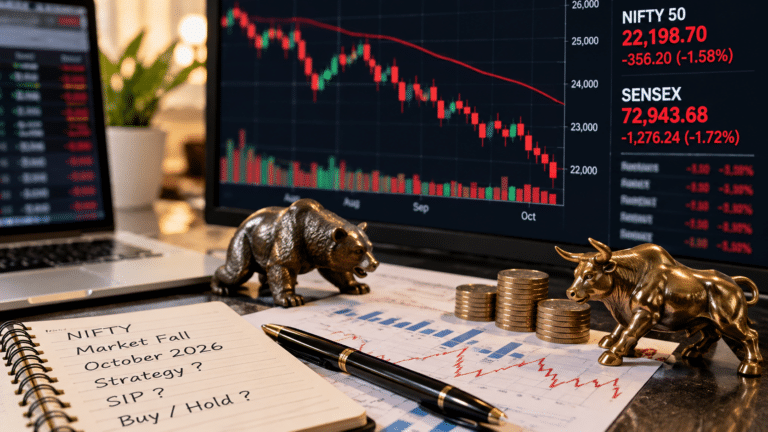
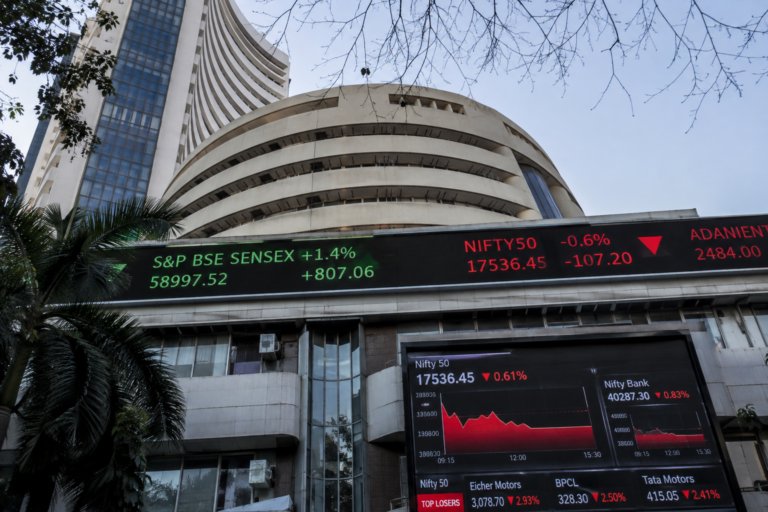
BSE Sensex and NSE Nifty 50 Today: Nifty Touches Its 200-Week Average as September Turns Ugly, So What Happens on 30 September 2026?
Is India’s Bull Run Back on Track — or Is Dalal Street Heading for a Bigger Correction? On Friday, May 8, 2026, as global markets swing on geopolitical cues and domestic earnings season winds down, Indian investors are asking one critical question: where does the market go from here? With the BSE Sensex hovering near 77,800 and the NSE Nifty 50 consolidating around 24,326, India’s equity markets are at a pivotal crossroads — resilient yet range-bound, resilient yet cautious. This exclusive market briefing cuts through the noise with fresh 2026 data, sector performance tables, top stock picks, and actionable recommendations for every type of investor — whether you’re a conservative SIP investor or an aggressive trader hunting alpha.
🔴 Indian Market Overview: Sensex, Nifty & Sentiment Snapshot
India’s benchmark indices entered May 2026 on a cautious yet broadly positive note before retreating into consolidation territory this week. On May 7, 2026, the BSE Sensex slipped 114 points (0.15%) to settle at 77,844.52, while the Nifty 50 barely budged, declining just 4.30 points (0.02%) to close at 24,326.65, suggesting a market in a holding pattern rather than a decisive directional move.
This cautious tone follows a sharply volatile session driven by weekly F&O expiry pressure and profit-booking at elevated levels. Despite supportive global cues — including cooling crude oil prices and optimism around a possible US-Iran diplomatic agreement — markets struggled to hold gains above the key 24,400 resistance on Nifty. The broader market narrative remains one of selective accumulation with heightened vigilance.
📊 Nifty 50 — Today’s Key Levels & Pulse
- Previous Close: 24,326.65
- Key Resistance: 24,400 (critical breakout level for fresh upside)
- Immediate Support: 23,800–24,000 range (lower boundary of 10-session trading corridor)
- Nifty formed a bearish candlestick pattern with shadows in both directions — a classic sign of indecision
- The index remains within its 10-session consolidation range of 23,800–24,400, suggesting the market needs a fresh fundamental catalyst to break out
- Technical structure: Nifty is currently testing the upper band of its recent consolidation range; a decisive close above 24,400 would confirm fresh momentum
- Option chain data at expiry showed heavy put writing near at-the-money strikes — historically a bullish signal for near-term support
- FII vs DII: Foreign outflows continue to be a headwind, with DIIs (Domestic Institutional Investors) providing a crucial cushion
🏦 Bank Nifty — The Market’s Hidden Powerhouse
Bank Nifty has been one of the star performers of 2026. The index touched a fresh all-time high of 60,203 in early 2026 and continues to outperform broader markets. In late April, Bank Nifty fell 2.19% for the week — suggesting profit-booking after a massive rally — before stabilising.
- Key Support Band: 59,500–59,700
- Breakout level: 58,500 (surpassed convincingly)
- All-time high: 60,203 (hit in January 2026)
- Bullish trigger: Aggressive put writing near ATM strikes at weekly expiry signals conviction among options traders
- Outlook for May 8: Range-bound, with 59,500 acting as immediate support; PSU banks (SBI, Bank of Baroda) continue to show relative strength
📈 Investor Sentiment — What Are the Smart Money Players Doing?
Investor sentiment is a tale of two forces: domestic strength vs. foreign exodus. FIIs have pulled a staggering ₹1.92 lakh crore ($20.6 billion) from Indian equities in the first four months of 2026 alone — already surpassing total FII outflows for the entire year 2025 (₹1.66 lakh crore). Yet, the market has not collapsed. Why? Because Domestic Institutional Investors (DIIs), powered by an estimated ₹2 lakh crore in dry powder from mutual funds, have been systematically buying every dip.
Unmesh Sharma, Head of Institutional Equities at HDFC Securities, notes that India’s PE premium to emerging markets has fallen from a peak of 100% to roughly 33% — a level that historically signals a strong entry point for institutional investors.
💰 Key Economic Drivers: The Macro Engine Behind Market Moves
🇮🇳 India GDP Growth — Still the World’s Fastest Major Economy?
India remains one of the few bright spots in a turbulent global economy, but growth is moderating. India’s GDP growth for FY2026-27 is projected at 6.6% — lower than last year’s impressive 7.6% — according to CRISIL Chief Economist Dharmakirti Joshi. The moderation is attributed to the ongoing West Asia crisis, elevated crude oil prices, and global trade disruptions. For FY2026 (April 2025–March 2026), the government’s Economic Survey estimated growth at 7.4%, driven by a double engine of consumption and investment.
GDP Growth Trajectory at a Glance:
- FY2024-25: 7.6%
- FY2025-26 (estimated): 7.4%
- FY2026-27 (projected): 6.6% (CRISIL)
- FY27 forecast (RBI): 6.8%
While this is a moderation, 6.6–6.8% growth still places India among the world’s fastest-growing major economies — a fact not lost on long-term foreign institutional investors.
📉 CPI Inflation — From Hot to Cool
India’s consumer price inflation (CPI) stood at 3.40% in March 2026 — slightly above February’s 3.21% but well within the Reserve Bank of India’s 2–6% tolerance band. Headline CPI in FY2026 (April-December) averaged just 1.7%, driven by a sharp disinflation in food prices, particularly vegetables and pulses, aided by strong farm conditions and government supply-side interventions.
However, CRISIL projects inflation will rise to 5.1% in FY27 due to the West Asia crisis feeding through to crude and energy prices, though even this remains within the RBI’s comfort zone. Crucially, as CRISIL notes, a large part of the inflation spike will be a base effect (since last year was just over 2%). Cooling inflation = improved real purchasing power = sustained consumption demand — a critical support for corporate earnings.
🏛️ RBI Repo Rate — Where Does Monetary Policy Stand?
The RBI held the repo rate at 5.25% in its April 2026 (60th MPC) meeting — maintaining a neutral stance. This follows two consecutive cuts — a 25 bps cut in February 2026 (from 5.50% to 5.25%) and another 25 bps reduction in December 2025.
RBI Repo Rate Journey:
| MPC Meeting | Repo Rate | Change | Stance |
|---|---|---|---|
| December 2025 (58th MPC) | 5.50% | -0.25% | Neutral |
| February 2026 (59th MPC) | 5.25% | -0.25% | Neutral |
| April 2026 (60th MPC) | 5.25% | No Change | Neutral |
| Next MPC (June 3-5, 2026) | TBD | Rate cut possible | Neutral |
The RBI’s neutral stance and declining rates are a tailwind for rate-sensitive sectors — banking, real estate, and NBFCs are the primary beneficiaries. A further rate cut in June 2026 remains on the table if crude stabilises and inflation stays benign.
📊 BSE Sensex vs. NSE Nifty 50 — May 2026 Comparative Analysis
| Parameter | BSE Sensex | NSE Nifty 50 |
|---|---|---|
| Week ending Apr 30 close | 76,913 | 23,997 |
| May 7 close | 77,844.52 | 24,326.65 |
| Weekly gain (Apr 30 week) | +0.33% | +0.42% |
| Jan 2026 Record High | 85,762 | 26,328 |
| Current vs ATH | -9.3% from peak | -7.6% from peak |
| Bull case target (2026 YE) | 92,400–98,000 | 28,500–29,800 |
| Bear case support | 72,000–74,000 | 22,000–22,500 |
| YTD performance | Range-bound | Range-bound |
| Key resistance | 78,500 | 24,400 |
| Key support | 75,000 | 23,200 |
| Composition | 30 bluechip stocks | 50 large-cap stocks |
| Primary driver May 2026 | Financials + FMCG | Financials + IT |
The Sensex and Nifty both hit all-time highs in early January 2026 (85,762 and 26,328 respectively), before retreating due to the West Asia crisis, FII outflows, and global risk-off sentiment. The current consolidation between 23,800–24,400 on Nifty reflects the market waiting for a fresh trigger — either a US-India trade deal breakthrough, RBI rate cut, or easing of geopolitical tensions.
📰 Latest Market News: What’s Moving Dalal Street Today?
🔥 Top News Items & Their Market Impact
1. West Asia Crisis Escalates — Crude Oil Spike
The ongoing geopolitical tensions in West Asia are the biggest macro risk for Indian markets in 2026. With crude threatening $100/barrel levels, India’s import bill swells, the rupee faces pressure, and inflation risks build. This is the primary reason CRISIL downgraded the FY27 GDP forecast from 7.6% to 6.6%. Market impact: Bearish for oil marketing companies (HPCL, BPCL), bullish for domestic energy alternatives like Adani Green.
2. FII Outflows Hit Record ₹1.92 Lakh Crore in 2026
Foreign Portfolio Investors have pulled a record ₹1.92 lakh crore in just four months of 2026 — surpassing the entire 2025 sell-off level of ₹1.66 lakh crore. Drivers: rising US bond yields, a strong dollar, and geopolitical risk premium. Market impact: Pressure on large-cap index heavyweights like Reliance, HDFC Bank, Infosys.
3. India-US Trade Deal Optimism Sparks FII Buying
In April 2026, progress on the India-US trade deal (reducing effective tariffs from 50% to 18%) triggered a sharp ₹5,426 crore FII buying spree in a single session. Market impact: Strongly bullish for export-oriented sectors — IT, pharma, textiles. The deal, if finalized, could be a game-changer for FII sentiment.
4. RBI Holds Repo Rate at 5.25% — June Cut Possible
The RBI maintained rates in April, but signalled openness to a June 2026 cut if macro conditions improve. Market impact: Bullish for banks, NBFCs, real estate, and rate-sensitive stocks like Bajaj Finance.
5. Q4 FY26 Earnings Season — Mixed But Mostly Positive
The Q4 FY26 earnings season brought several surprises. Wockhardt delivered a spectacular turnaround (PAT of ₹166 cr vs. loss of ₹25 cr), Tata Technologies reported 8.1% profit growth, and CAMS posted a 7.64% jump. Meanwhile, Tata Chemicals disappointed with a ₹2,132 crore loss (including goodwill impairment), dragging sentiment in specialty chemicals.
6. India’s Manufacturing Exports Boost on Currency Depreciation
The weakening rupee — while a concern for importers — is creating a competitive advantage for India’s manufacturing exporters. HDFC Securities highlights this as a key emerging theme, particularly in the EMS (Electronics Manufacturing Services) sector.
🌍 Foreign Indices That Influenced Indian Markets
| Index | Country | Recent Trend | Impact on India |
|---|---|---|---|
| S&P 500 | USA | Volatile; AI-led tech rally | FII flows, global risk appetite |
| NASDAQ Composite | USA | AI/tech driven recovery | IT sector sentiment |
| Dow Jones (DJIA) | USA | Rangebound near highs | Broader sentiment gauge |
| Nikkei 225 | Japan | Strong YTD performance | Positive EM sentiment |
| Hang Seng | Hong Kong | Weak amid China slowdown | Comparative EM flows |
| MSCI EM Index | Global | FII reallocation benchmark | Direct FPI flow determinant |
| Brent Crude | Global | Near $100/barrel | Input costs, inflation, rupee |
| US 10-Year Bond Yield | USA | Elevated (4.5%+) | Drives FII outflows from India |
| Dollar Index (DXY) | Global | Strong | Pressures rupee, FII outflows |
| Shanghai Composite | China | Weak recovery | Relative attractiveness of India |
A high US 10-year yield and a strong dollar are the two most significant foreign market variables currently weighing on Indian equities. When the DXY rises, emerging market currencies including the rupee weaken, triggering further FPI outflows. Conversely, any cooling of US bond yields or dollar weakness could reignite a powerful FII-driven rally in Indian markets.
🏆 Top 10 Stocks to Buy on NSE/BSE in 2026
| # | Stock | Sector | CMP (Approx.) | Target Upside | P/E / Valuation | Dividend Yield | Key Trigger |
|---|---|---|---|---|---|---|---|
| 1 | SBI | Banking (PSU) | ₹820–₹1,110 | +55–60% | Low P/E vs. peers | 2.5% | Credit growth, clean balance sheet, rate cuts |
| 2 | Reliance Industries | Conglomerate | ₹2,890 | +48% | Moderate P/E | 0.4% | Jio 5G, green energy, retail expansion |
| 3 | TCS | IT | ₹3,980 | +38% | Premium P/E ~28x | 1.5% | AI services demand, US-India trade deal |
| 4 | HDFC Bank | Banking (Pvt) | ₹1,920 | +40% | Fair P/E ~20x | 1.2% | Margin recovery, DII accumulation |
| 5 | Infosys | IT | ₹1,580 | +30% | P/E ~24x | ~2.8% | AI transformation deals, margin expansion |
| 6 | Tata Motors | Auto (EV) | ₹745 | +52% | Growth-adjusted PEG | Low | EV volume ramp, JLR recovery |
| 7 | Bajaj Finance | NBFC | ₹7,200 | +35% | Premium valuations | Low | Rate cuts, credit growth, AUM expansion |
| 8 | Bharti Airtel | Telecom | ₹1,820 | +28% | Fair P/E | ~0.5% | ARPU expansion, 5G monetisation |
| 9 | Adani Green Energy | Renewables | ₹1,650 | +45% | High growth P/E | Nil | India’s clean energy mandate, capacity addition |
| 10 | Wipro | IT | ₹468 | +32% | Moderate P/E ~22x | ~0.2% | AI consulting, restructuring benefits |
⚠️ Disclaimer: These are analytical perspectives based on available research and expert commentary — not SEBI-registered financial advice. Always consult a certified financial advisor before investing.
📈 Today’s Top 10 Gainers & Top 10 Losers (Recent Session — May 5–7, 2026)
🟢 Top 10 Gainers
| # | Stock | Gain | Catalyst |
|---|---|---|---|
| 1 | Wockhardt | +8.10% to +12.55% intraday | Q4 FY26 PAT ₹166 cr — dramatic turnaround from ₹25 cr loss |
| 2 | Tata Technologies | +10% | Q4 FY26 PAT ₹204 cr, +8.1% YoY; dividend declared |
| 3 | CAMS | +7.64% | Strong quarterly earnings beat |
| 4 | Gabriel India | +5–6% | Better-than-expected Q4 results, auto component demand |
| 5 | Kwality Wall’s | +8.91% | Q4 FY26 results beat; summer season demand |
| 6 | Mahindra & Mahindra | +3.36% | SUV volume growth, EV pipeline momentum |
| 7 | Dabur India | +3–4% | Rural FMCG recovery, portfolio premiumisation |
| 8 | Adani Green Energy | +2–3% | Renewable capacity commissioning update |
| 9 | UltraTech Cement | +1.75% | Infrastructure spending tailwind, volume uptick |
| 10 | Nestle India | +1.43% | Defensive buying, FMCG resilience |
🔴 Top 10 Losers
| # | Stock | Loss | Catalyst |
|---|---|---|---|
| 1 | KEI Industries | -7% | Q4 FY26 PAT ₹93 cr — beat YoY but below elevated street estimates |
| 2 | Aarti Industries | -5.03% | Q4 FY26 PAT ₹137 cr — modest +3% QoQ disappointed market |
| 3 | Tata Chemicals | -1.16% | Q4 FY26 loss of ₹2,132 cr including ₹1,837 cr goodwill impairment |
| 4 | Bajaj Finance | -1.40% | NBFC sector pressure amid FII outflows |
| 5 | Jio Financial Services | -1.70% | Sector rotation away from financials |
| 6 | ICICI Bank | -1.54% | Profit-booking after strong rally |
| 7 | Coal India | -1.54% | Energy transition concerns, ESG-driven selling |
| 8 | Eternal | -1.54% | Broad consumer discretionary weakness |
| 9 | SBI Life Insurance | -1–2% | Insurance sector regulatory uncertainty |
| 10 | Paytm (One97 Comm.) | -1–2% | Continued profitability concerns, competitive pressure |
🏭 Sector Performance India 2026 — Who’s Leading, Who’s Lagging?
| Sector | 2026 YTD Trend | Key Catalyst | Risk |
|---|---|---|---|
| Banking & Financials | ✅ Outperformer | RBI rate cuts, credit growth, DII buying | FII selling pressure, credit quality |
| IT & Technology | ⚠️ Under Pressure | US-India trade deal, AI demand recovery | Trump tariff uncertainty, dollar |
| Pharma & Healthcare | ✅ Defensive strength | Rising exports ($30.5B target), PLI schemes | US FDA risks, API import dependency on China |
| Defence & Aerospace | 🚀 Top Performer (10%+) | India defence indigenisation, government orders | Execution risk |
| Renewables/Green Energy | 🚀 Top Performer | India’s 500 GW renewable target by 2030 | Regulatory, land acquisition |
| Auto & EV | ✅ Recovery | EV volume growth, urban consumption | Crude, supply chain |
| Real Estate | ✅ Strong | Rate cuts, urban housing demand | Inventory, interest rate sensitivity |
| FMCG/Consumer Goods | ⚖️ Mixed | Rural recovery, moderated inflation | Urban slowdown, competition |
| Metals & Commodities | ✅ Positive | China demand pickup, PLI for steel | Commodity cycle risk, global slowdown |
| Specialty Chemicals | ❌ Weak | Earnings disappointments in Q4 FY26 | Global demand slowdown, margins |
Banking has been the standout story — Bank Nifty hitting all-time highs despite overall market consolidation speaks to the sector’s fundamental strength. IT, by contrast, has faced a 2026 selloff due to US tariff headwinds and the global AI investment cycle disrupting traditional services revenues. However, HDFC Securities sees IT and manufacturing exports as an emerging comeback theme in H2 2026.
Pharma is a structural winner — India targets $30.5 billion in pharmaceutical exports for FY2026, with 10% revenue CAGR over a decade. The PLI (Production Linked Incentive) scheme is accelerating capacity creation in APIs and specialty drugs.
💼 Stock Recommendations for Today — Actionable Insights for May 8, 2026
🟢 Strong Buy — For Long-Term Investors (Low Risk Appetite)
1. SBI (State Bank of India)
- Rationale: Largest PSU bank with a clean balance sheet, growing credit book, and massive distribution network. With the RBI in a rate-cut cycle, SBI’s net interest margins will expand over the next 6–12 months.
- CMP: ₹820–₹1,110 | Target: ₹1,300+ (12-month)
- Trigger: Rate cut, PSU banking sector re-rating, government capex channelling
- Risk: Low | P/E: Among lowest in banking sector
2. TCS (Tata Consultancy Services)
- Rationale: India’s most valuable IT company and a structural beneficiary of the global digital transformation wave. AI-enabled services revenues are growing rapidly.
- CMP: ₹3,980 | Target: ₹5,500 (12-month)
- Trigger: India-US trade deal, AI consulting deals, strong dollar revenue
- Risk: Low–Medium | Dividend yield: 1.5%
3. Nestle India
- Rationale: Defensive FMCG play with consistent earnings, strong brand moat, and rural expansion story. India’s rising middle class is a structural demand driver.
- Trigger: Rural FMCG recovery, premiumisation trend, consistent dividend payer
- Risk: Low | Dividend Yield: 1.8%
🟡 Buy on Dips — For Medium Risk Investors
4. HDFC Bank
- Rationale: India’s largest private bank by assets, currently undergoing a margin recovery post-HDFC merger integration. DII accumulation at current levels signals institutional conviction.
- CMP: ₹1,920 | Target: ₹2,700 (12-month)
- Risk: Medium | P/E: 20x (reasonable for quality)
5. Reliance Industries
- Rationale: A diversified giant straddling oil & gas, retail, telecom, and green energy — Reliance is essentially a bet on India’s entire growth story. Jio’s 5G monetisation and green energy investments are multi-decade value creators.
- CMP: ₹2,890 | Target: ₹4,200 (12–18 months)
- Risk: Medium | P/E: Blended 25–28x
6. Tata Motors
- Rationale: India’s EV story packaged in a single stock. With Tiago EV, Nexon EV, and the upcoming premium EV pipeline, Tata Motors is capturing the fastest-growing automotive segment. JLR (Jaguar Land Rover) recovery in premium SUVs adds international revenue diversification.
- Risk: Medium–High | PEG: Favourable given growth rate
🔴 High Risk / High Reward — For Aggressive Investors
7. Adani Green Energy
- Rationale: India is targeting 500 GW of renewable capacity by 2030 — Adani Green is the infrastructure backbone of that ambition. Capacity additions are on track, and government policy support is unwavering.
- Risk: High | Upside potential: 40–45%
8. Tata Technologies
- Rationale: Just delivered Q4 FY26 PAT growth of 8.1% YoY, declared dividends, and is riding the engineering software and automotive tech transformation wave globally.
- Risk: Medium–High | Recent momentum: +10% post-results
🌈 Diversified Portfolio Suggestion for 2026
| Risk Profile | Allocation Strategy |
|---|---|
| Conservative | 40% SBI + 30% TCS + 20% Nestle + 10% Bharti Airtel |
| Moderate | 25% HDFC Bank + 20% Reliance + 20% Infosys + 15% Tata Motors + 20% Adani Green |
| Aggressive | 20% Tata Motors + 25% Adani Green + 20% Tata Tech + 20% Bajaj Finance + 15% small-cap defence |
🌐 Global Triggers to Watch This Week
- US-Iran nuclear diplomacy: Any ceasefire or deal could crash crude oil prices overnight — instantly bullish for India’s markets, inflation, and rupee
- US Federal Reserve commentary: Any dovish signal from the Fed would weaken the dollar, reduce US bond yields, and reignite FII flows into emerging markets like India
- India-US trade deal progress: Already triggered ₹5,426 crore FII buying in one session in April — further progress could be a major upside catalyst
- RBI June MPC meeting (June 3-5, 2026): A potential 25 bps rate cut would be a strong tailwind for rate-sensitive sectors
- Q1 FY27 earnings guidance: Companies providing strong revenue guidance will attract re-rating; watch IT majors’ early commentary
🎯 Final Thought: Key Takeaways for the Savvy Indian Investor
India’s stock market in May 2026 is a fascinating paradox — structurally strong, yet tactically cautious. The BSE Sensex and Nifty 50 have retreated from their January 2026 all-time highs but remain fundamentally backed by a GDP growth trajectory of 6.6–7.4%, declining CPI inflation (3.4% in March 2026), and a repo rate at a multi-year low of 5.25%.
The record FII exodus of ₹1.92 lakh crore — the largest in Indian market history — is alarming on the surface, but the resilience of Dalal Street in the face of this selling is a powerful testament to the maturity and depth of domestic investor participation. As HDFC Securities’ Varun Lohchab points out, the 40% median correction in mid and small caps has created the best valuation entry points seen in two years — a classic “time correction” that makes stocks cheaper every passing month without a price crash.
The playbook for 2026 is clear:
- Buy quality large-caps (SBI, HDFC Bank, TCS, Reliance) on dips with a 12–18 month horizon
- Favour rate-sensitive sectors as the RBI eases — banking, NBFCs, real estate
- Build exposure to structural themes — renewables, defence, EV, and manufacturing exports
- Maintain 10–15% cash for redeployment on sharp corrections triggered by geopolitical events
- Watch the rupee — a stabilisation or appreciation of the INR will be the clearest signal that FII flows are returning
The Indian growth story isn’t just intact — it’s being built on deeper, broader foundations than ever before. Patient, disciplined investors who navigate this phase of volatility with clarity and conviction will be the ones celebrating new Sensex highs — likely at 92,000–98,000 — before the year is out.
Did this analysis help you plan your investments? Drop your thoughts in the comments below, share this with your investing circle, and subscribe for daily Dalal Street briefings that keep you ahead of the curve — every single trading day! 🚀📊
⚠️ Disclaimer: This article is for informational and educational purposes only and does not constitute financial advice. The Indian stock market is subject to market risks. Please read all scheme-related documents carefully and consult a SEBI-registered investment advisor before making any investment decisions. Past performance is not indicative of future results.