Can Sensex and Nifty Hold the IT-Fuelled 1.6% Rally as GIFT Nifty Flashes Red?
Your Monday morning edge — fresh data, sharp analysis, and actionable stock picks for Indian investors navigating a volatile but opportunity-rich 2026.
📊 Market Overview: Where Do Indian Indices Stand Today?
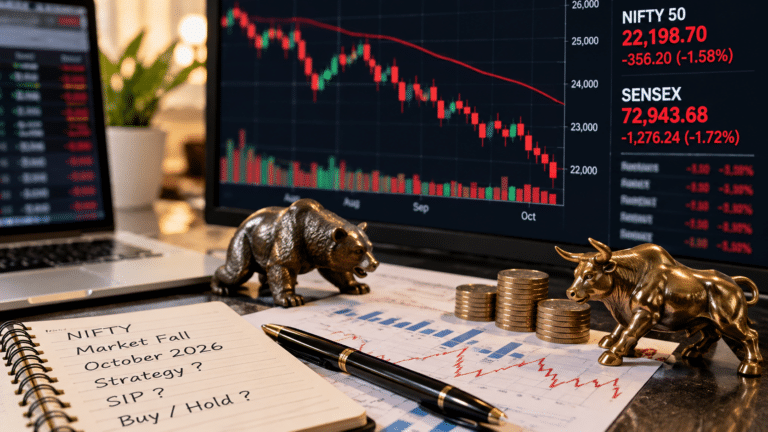
Indian equity benchmarks enter the trading week of May 18, 2026, carrying the weight of a turbulent fortnight. The BSE Sensex closed the previous week at ₹75,237.99, having shed approximately 290 points over the week, while the NSE Nifty 50 ended at 23,643.50, down 532.65 points across the five-day stretch. The week’s mood was largely negative, with 33 out of 50 Nifty stocks recording declines in the final session of the previous week. What makes this particularly striking is the broader macro context: Indian equities have now fallen 10–12% year-to-date in 2026, starkly underperforming global peers like the Nasdaq (+12.8% YTD) and the Dow Jones (+3% YTD).
🏦 Bank Nifty: A Bright Spot in the Storm
Despite broader index weakness, the Nifty Bank index has been a standout performer in 2026. It touched a fresh all-time high of 60,203 earlier in May and closed at 60,150.95, rallying 439.40 points in a single session. The banking benchmark has formed higher lows for four consecutive sessions, trading comfortably above its 10-day Exponential Moving Average (DEMA), which signals robust bullish momentum in private and PSU banking stocks. Analysts at Samco Securities describe this as a “decisive breakout from prolonged consolidation,” opening targets toward the 63,000–67,000 zone by year-end.
😰 Investor Sentiment: Cautiously Watchful
Overall sentiment for Monday, May 18, is neutral-to-cautious. Foreign Institutional Investors (FIIs) continue to be net sellers in 2026, contributing to India’s weight in the MSCI Emerging Markets Index declining from a peak of 21% in September 2024 to 12% in May 2026. Domestic Institutional Investors (DIIs), however, have been providing consistent support. The sentiment pivot will likely depend on today’s global cues, upcoming RBI commentary, and Q4 FY26 earnings from key blue-chip companies.
🇮🇳 Key Economic Drivers: The Macro Engine Behind Market Moves
India’s GDP Growth Trajectory
India’s economic growth story remains structurally intact even as market returns disappoint in the short run. The RBI has projected FY26 real GDP growth at 7.4%, up from the previous year’s estimate, supported by a strong services sector and revival in manufacturing activity. For FY27, the RBI projects GDP growth at 6.8%, maintaining a neutral monetary policy stance. With Q4 FY25 GDP coming in at 8.2%, India remains the fastest-growing major economy globally — a fundamental that long-term investors cannot ignore.
📉 CPI Inflation: Benign, But Not Complacent
One of the most bullish macro signals of 2026 is India’s inflation trajectory. The RBI has revised its FY26 CPI inflation forecast to just 2.1%, one of the lowest readings in years. Q4 inflation (January–March 2026) came in at 3.2%, well within the RBI’s 2–6% comfort band. Looking ahead, however, the central bank has flagged that FY27 Q1 inflation could rise back to 4%, with Q2 touching 4.2%, driven by geopolitical tensions, volatile crude prices, and potential adverse weather events. Retail investors should note that a benign inflation environment supports corporate earnings margin expansion — a key tailwind for consumer goods, auto, and financial stocks.
🏦 RBI Repo Rate: On Hold, But Liquidity Active
The Monetary Policy Committee (MPC) kept the repo rate unchanged at 5.25% in its most recent meeting, with the weighted average call rate (WACR) hovering near 5.24%. This marks continuity in the RBI’s neutral stance as it balances growth support with inflation management. Notably, the RBI conducted a ₹1 trillion 7-day Variable Rate Repo (VRR) auction in mid-May to manage evolving liquidity conditions in the banking system, reflecting proactive liquidity management. For equity markets, an unchanged rate environment with system-level liquidity infusion is a mild positive — it keeps borrowing costs stable and supports credit growth in the banking sector.
💡 Key Takeaway: India’s macro fundamentals — 7.4% GDP growth, sub-2.5% CPI inflation, and stable interest rates — form a solid foundation for patient investors. Near-term market volatility is largely driven by global headwinds and FII outflows, not domestic economic deterioration.
📈 Nifty 50 Today — Point-by-Point Breakdown
Here’s a granular look at where the Nifty 50 stands and what it means for traders on May 18, 2026:
- Last Closing Level: 23,643.50 (Friday, May 15, 2026) — down 532.65 points week-on-week
- Intraday High (May 14): Nifty closed at 23,689.60, up 277 points or +1.18% in a single session, driven by metals, pharma, and telecom buying
- Key Support Levels: 23,500 (immediate), 23,000 (strong psychological support), and 22,500 (critical floor)
- Key Resistance Levels: 24,000 (short-term), 25,000 (medium-term psychological barrier), and 27,500–27,600 (medium-term bullish target)
- Market Breadth: On May 15 closing, only 17 advances vs. 33 declines in Nifty 50 components — indicating broad-based selling pressure
- FII Outflows: Persistent net selling through 2026, weakening overall index momentum
- DII Support: Domestic flows continue to cushion sharp falls, limiting downside
- Sectoral Leaders: Metals, banking, pharma, and telecom are leading; IT and auto are lagging
- Technical Bias: Nifty remains below its 50-day and 200-day moving averages — indicating a medium-term bearish trend but with pockets of accumulation
- Outlook for Monday: Watch global cues from Friday’s US market dip; a flat-to-marginally-negative opening is expected. Any bounce above 23,800 would signal short-term reversal
🔍 BSE Sensex vs. NSE Nifty 50: May 2026 Trend Comparison
| Parameter | BSE Sensex | NSE Nifty 50 |
|---|---|---|
| Last Close (May 15) | ₹75,237.99 | 23,643.50 |
| Week-on-Week Change | ↓ 290.20 points | ↓ 532.65 points |
| YTD Performance (2026) | ↓ 10–12% | ↓ 10–12% |
| 52-Week High | 86,000 (Dec 2025) | 26,284 (Dec 2025) |
| 52-Week Low | 74,500 (recent) | 23,400 (recent) |
| No. of Stocks | 30 large-caps | 50 large-caps |
| Intraday Recovery (May 14) | ↑ Strong | ↑ +1.18% (277 pts) |
| Key Support | 74,000 | 23,000 |
| Bullish YE Target | 85,000–88,000 | 27,000–30,000 |
| FII Impact | High | High |
| DII Cushion | Strong | Strong |
| Sector Composition Bias | Financials + Energy heavy | Broader diversification |
📰 Latest Market News: What’s Moving Indian Markets Right Now?
🌍 Global Headwinds and Indian Market Impact
- US Markets Dipped on May 15: The S&P 500 fell 1.2%, Dow Jones declined 1.1%, and Nasdaq dropped 1.5% on Friday, driven by rising oil prices and bond yield concerns (30-year Treasury at 2007 highs) — this sets a cautious tone for Indian markets on Monday morning
- RBI’s ₹1 Trillion VRR Auction: The central bank’s liquidity management move signals tightening overnight conditions; WACR settled at 5.24%, near the policy repo rate of 5.25% — keeping banking sector margins in focus
- India Underperforms Global Peers: With major markets flat-to-higher and India down 10–12% YTD, FII allocation decisions are increasingly a key variable. India’s MSCI weight at 12% vs. a 21% peak highlights the scale of reallocation
- Nifty Bank All-Time High: The banking index’s historic breakout above 60,000 is the single most bullish domestic signal; private banks like HDFC Bank, ICICI Bank, and Axis Bank are driving this rally
- Geopolitical Tensions: India-Pakistan tensions and global crude price volatility remain tail risks. Energy and defence stocks continue to attract safe-haven buying
- IT Sector Under Pressure: Nifty IT has underperformed since February 2026, and stocks like Infosys, TCS, and Tech Mahindra remain in the red as US tech spending caution persists
- Auto Sector Correction: Nifty Auto has corrected 15% from peaks, with M&M and Eicher Motors featuring among recent top losers, as rural demand concerns and EV transition costs weigh
- Metals & Pharma Rally: Hindalco, Adani Enterprises, Tata Steel, and Cipla have been consistent gainers in recent sessions, driven by commodity price recovery and Q4 earnings strength
🌐 Foreign Indices That Influenced Indian Markets
Global market movements have a direct and immediate correlation with Nifty and Sensex, especially through FII flows and risk appetite. Here’s how key foreign indices are positioned as of mid-May 2026:
🏆 Top 10 Gainers & Losers (May 13–14, 2026 Session)
📈 Top 10 Gainers
📉 Top 10 Losers
🏭 Sector Performance India 2026: Who’s Leading, Who’s Lagging?
| Sector | YTD 2026 Performance | Key Driver | Key Risk | Stocks to Watch |
|---|---|---|---|---|
| 🏦 Banking (Nifty Bank) | ✅ Strong — ATH at 60,203 | Rate stability, credit growth revival, PSU bank recapitalization | Asset quality in microfinance | HDFC Bank, ICICI Bank, SBI |
| ⚙️ Metals (Nifty Metal) | ✅ Outperforming | Global commodity price recovery, China demand revival | Tariff risks, currency volatility | Hindalco, Tata Steel, JSW Steel |
| 💊 Pharma (Nifty Pharma) | ✅ Resilient | US generic drug approvals, domestic formulation growth | USFDA compliance, pricing pressure | Cipla, Sun Pharma, Dr. Reddy’s |
| ⚡ Energy (Nifty Energy) | ✅ Stable/Positive | PSU capex, renewables push, crude oil volatility | Global oil price swings | ONGC, NTPC, Power Grid |
| 🛡️ Defence/Infra | ✅ Strong Performer | Record order books, government capex, Make in India | Execution delays | BEL, HAL, L&T |
| 💻 IT (Nifty IT) | ❌ Underperforming since Feb 2026 | — | US discretionary spend cuts, AI disruption fears | TCS, Infosys, Wipro (selective) |
| 🚗 Auto (Nifty Auto) | ❌ 15% correction | — | EV transition cost, rural slowdown, export headwinds | Selective: Maruti, Hero MotoCorp |
| 🏠 Real Estate (Nifty Realty) | ❌ 15% correction | — | Rising mortgage rates, unsold inventory | DLF (long-term), Godrej Properties |
| 🛒 FMCG (Nifty FMCG) | ⚖️ Flat/Cautious | Benign inflation supports margins | Urban demand moderation | ITC, HUL, Asian Paints |
| 📡 Telecom | ✅ Positive | ARPU growth, 5G monetization, subscriber gains | Spectrum debt, regulatory uncertainty | Bharti Airtel |
💼 Top 10 Stocks to Buy on NSE/BSE for 2026
These recommendations are based on current valuations, earnings trajectory, sector triggers, and risk-adjusted return potential for Indian investors in 2026.
1. 🏦 HDFC Bank (NSE: HDFCBANK)
Strong deposit growth post-HDFC merger integration, improving NIM trajectory, robust retail loan book, and attractive valuation at 2.5x Price-to-Book. Dividend yield 1.2%. Key trigger: sustained credit growth + NIM recovery. Best suited for conservative to moderate investors.
2. 💊 Cipla (NSE: CIPLA)
Trading at a P/E of 28x — reasonable for a pharma major with a strong US generics pipeline and domestic branded formulations. Recent FDA approvals and Q4 beats make it a compelling pick. Dividend yield 0.6%. Trigger: USFDA clearances + specialty drug launches.
3. ⚙️ Hindalco Industries (NSE: HINDALCO)
Trading at a P/E of 12x — deeply undervalued relative to its Novelis business. Aluminium prices recovering globally; domestic capacity expansion on track. Dividend yield 0.8%. Trigger: Q4 beat + China demand recovery. Suited for moderate-to-aggressive investors.
4. 📡 Bharti Airtel (NSE: BHARTIARTL)
India’s best telecom play with ARPU rising quarter-on-quarter. 5G monetization is beginning to show up in numbers. P/E 35x but justified given growth trajectory. Dividend yield 0.5%. Trigger: 5G enterprise deals + Africa subscriber growth.
5. 🏗️ Larsen & Toubro (NSE: LT)
The infrastructure and engineering giant is a direct beneficiary of government capital expenditure. Order book near all-time highs. P/E 30x, PEG ratio 1.1x — fairly valued for the growth on offer. Dividend yield 1.0%. Trigger: mega infrastructure project execution.
6. 🛡️ Bharat Electronics Limited/BEL (NSE: BEL)
India’s defence indigenisation wave is a decade-long structural theme. BEL’s order book gives 3+ years of revenue visibility. P/E 35x, but justified by defence capex supercycle. Trigger: new defence contracts, export orders. For growth-oriented investors.
7. 🏚️ State Bank of India (NSE: SBIN)
Trading at just 1.3x Book Value, SBI offers the best risk-reward among PSU banks. NPA cycle has peaked, credit growth is robust, and the government ownership backstop limits downside. Dividend yield 2.5%. Trigger: Q4 earnings beat + credit offtake.
8. ⛽ ONGC (NSE: ONGC)
Trading at a trailing P/E of 8x — among the cheapest large-caps on the NSE. Dividend yield of 4%+ makes it a high-income pick. Benefits from crude oil volatility and domestic gas price deregulation. Trigger: crude above $80/bbl.
9. 🚂 IRCTC (NSE: IRCTC)
A monopoly in Indian rail ticketing and catering. P/E 31x, but with zero-capex model, high ROE (49%), and growing travel demand post-pandemic. Dividend yield 1.6%. Trigger: railway network expansion, tourism boom.
10. 🌿 ITC Limited (NSE: ITC)
A diversified conglomerate transitioning from tobacco to FMCG, hotels, and agribusiness. P/E 25x, dividend yield 3%+. Resilient earnings even in slowdown scenarios. Trigger: FMCG business value unlocking, hotel demerger upside.
📋 Stock Recommendations for Today (Monday, May 18, 2026)
Given Friday’s weak US close and cautious Asian market cues expected, today’s strategy should be selective and defensive. Here are actionable recommendations:
- Buy on Dips — HDFC Bank: Any dip toward ₹1,780–1,800 is a strong accumulation zone. Bank Nifty’s all-time high validates the sector’s strength. Stop-loss: ₹1,750. Target: ₹1,950 in 3 months
- Buy — Cipla: Consolidating near ₹1,340–1,365 after gains. Fresh US FDA approval news is a near-term catalyst. Stop-loss: ₹1,300. Target: ₹1,500
- Avoid/Book Profits — IT Stocks (TCS, Infosys): Global tech selloff and US BFSI slowdown continue to weigh. Avoid fresh entries; wait for Nifty IT to stabilize above 35,000
- Hold — BEL: Defence capex theme intact; don’t book premature profits. Add more on dips below ₹310
- Avoid — Auto Sector: M&M and Bajaj Auto continue to face headwinds. Wait for Q1 FY27 demand data before re-entering
- Swing Trade — Tata Steel: Metal momentum is strong. Entry near ₹218–222, stop-loss ₹210, target ₹240 in 4–6 weeks
- SIP Mode — SBI: Don’t time this one — systematic investment makes more sense. Valuations remain attractive at 1.3x book
- Watch — Bharti Airtel: Building a base near ₹1,800. Any breakout above ₹1,850 with volume is a buy signal; target ₹2,000+
🎯 Diversified Portfolio Suggestion: For Every Risk Appetite
🟢 Conservative Portfolio (Low Risk — Capital Preservation + Steady Income)
| Stock | Allocation | Rationale |
|---|---|---|
| SBI | 20% | High dividend, low P/B, government-backed |
| ONGC | 15% | 4%+ dividend yield, commodity hedge |
| ITC | 15% | Stable FMCG income, 3%+ dividend |
| HDFC Bank | 25% | India’s safest private bank pick |
| Bharti Airtel | 15% | Defensive telecom monopoly |
| L&T | 10% | Infrastructure — long-term structural growth |
🟡 Moderate Portfolio (Balanced Risk — Growth + Stability)
| Stock | Allocation | Rationale |
|---|---|---|
| HDFC Bank | 20% | Core banking exposure |
| Cipla | 15% | Pharma with US upside catalyst |
| Bharti Airtel | 15% | Telecom + 5G growth |
| Hindalco | 15% | Metals — high upside with managed risk |
| L&T | 15% | Infra exposure |
| IRCTC | 10% | Monopoly model, high ROCE |
| BEL | 10% | Defence sector structural theme |
🔴 Aggressive Portfolio (High Risk — Maximum Capital Appreciation)
| Stock | Allocation | Rationale |
|---|---|---|
| Hindalco | 20% | Commodity supercycle play |
| Adani Enterprises | 15% | High-beta, infrastructure + green energy |
| BEL | 15% | Defence capex supercycle |
| Tata Steel | 15% | Global metals rally beneficiary |
| JSW Steel | 15% | Domestic infra demand play |
| Adani Ports SEZ | 10% | Port capacity expansion |
| Small-Cap Basket | 10% | Waaree Renewables, Shakti Pumps (solar/clean energy) |
💡 Final Thought: What Really Matters for Indian Investors in 2026?
The Indian stock market in 2026 presents a paradox worth understanding deeply. On one hand, you have a 7.4% GDP growth economy, CPI inflation at a multi-year low of 2.1%, a banking sector touching all-time highs, and a government with record infrastructure spending. On the other hand, benchmark indices are down 10–12% YTD, FIIs are pulling money out, the IT sector is under pressure, and global markets are increasingly outpacing India.
This divergence is not a reason to panic — it is a reason to be selective. The era of buying any Nifty stock and making returns is over. The winners of 2026–2027 will be in banking, metals, defence, pharma, and telecom — sectors tied to India’s domestic capex cycle, not the whims of US tech valuations.
Key takeaways for every Indian investor reading this today:
- The Nifty Bank all-time high above 60,000 is the most important domestic signal — private sector banking health is robust
- RBI’s repo rate at 5.25% with a neutral stance means no rate shocks; borrow, invest, and grow with confidence
- Avoid chasing IT and Auto in the near term — wait for evidence of demand recovery and earnings stabilization
- SIP in quality large-caps like HDFC Bank, Cipla, Airtel, and ITC remains the most reliable strategy in volatile markets
- Global cues matter enormously — watch the S&P 500, Nasdaq, and US bond yields for direction on FII flows
- The structural India story (FY27+ GDP target of 6.8%+) remains intact — any significant dip is an accumulation opportunity for patient capital
India’s market correction in 2026 isn’t a crisis — it is a reset to more sustainable valuations, clearing the path for the next meaningful rally. Those who invest wisely today, with discipline and diversification, stand to reap the benefits when FII flows return and earnings acceleration resumes in H2 FY27.
⚠️ Disclaimer: This article is for educational and informational purposes only. It does not constitute financial advice. Please consult a SEBI-registered investment advisor before making any investment decisions. All market data referenced is based on publicly available sources including NSE India, BSE, RBI, and leading financial news outlets as of mid-May 2026.