How Fibe's App Loan Really Works — and What It Costs Beyond the "Instant" Promise
Personal loans · Digital lending · India 2026
Loan on Aadhaar Card in 2026: How Fibe’s App Loan Really Works — and What It Costs Beyond the “Instant” Promise
Aadhaar does not get you a loan. It verifies who you are for an unsecured personal loan that is approved on your income and credit record, and priced from 14% to 18% a year plus fees on Fibe’s own pages.
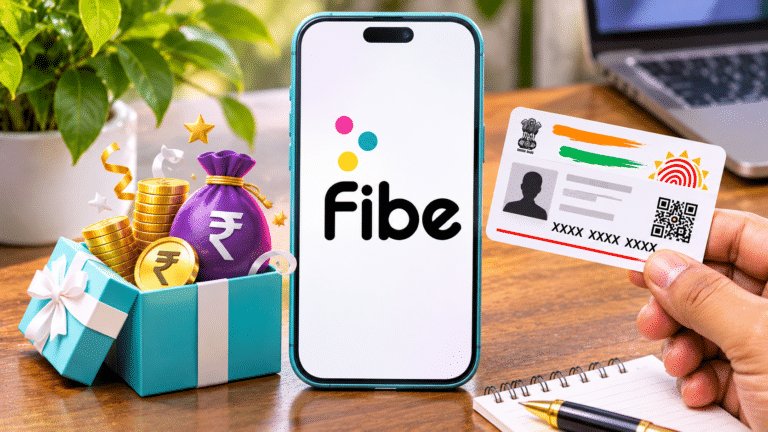
Search “loan on Aadhaar card” and you will find dozens of apps promising money in minutes with nothing but your 12-digit number. Fibe, the app formerly known as EarlySalary, is one of the better known. The idea is attractive when you need ₹50,000 before payday. But the phrase is misleading. Fibe’s own page says Aadhaar is used for verification only, is not collateral, and does not establish your income or ability to repay. What you are actually applying for is an unsecured personal loan, and its cost depends on things Aadhaar says nothing about.
What Fibe actually publishes about its loans
Two Fibe-related pages, both visible in November 2026, describe the same product slightly differently. Bajaj Finserv Markets’ Fibe listing, updated on 14 October 2026, says rates start at 14% a year, with loans of ₹50,000 to ₹5 lakh over 3 to 36 months. Fibe’s own blog on Aadhaar-verified loans says rates start at 18% a year on reducing balance, with loans up to ₹10 lakh over 6 to 36 months.
- 14% / 18%Starting interest rate on Bajaj Markets listing and Fibe’s blog
- ₹5 L / ₹10 LMaximum loan cited on the two pages
- 21 to 55Age range for salaried applicants, per Bajaj Markets listing
- ₹15,000 to ₹20,000Minimum monthly income cited across Fibe pages
- 0.1%Stamp duty on the loan amount, per Fibe’s blog
- NilForeclosure and prepayment charges on both pages
The differences matter. Neither page publishes a maximum interest rate, and both say the rate depends on your profile. Fibe’s blog notes that loans are offered through “RBI-registered lending partners” and that the FIBE trademark belongs to Social Worth Technologies Limited, licensed to Earlysalary Services Private Limited. The lender named in your loan agreement and KFS is the entity you actually owe money to.
Why Aadhaar alone cannot get you a loan
Aadhaar’s role in lending is identity and address verification through e-KYC. It replaces photocopies and branch visits. It tells a lender who you are, not whether you can repay. That is why every serious app, including Fibe, still asks for income proof and checks your credit report.
- What Aadhaar doesConfirms your identity and address digitally, often through an OTP to your linked mobile. Speeds up KYC from days to minutes. Helps link your bank account and e-mandate for repayment.
- What Aadhaar cannot doProve your salary, show your repayment history or act as security. Fibe’s blog says PAN may also be required, along with bank statements or salary slips, a selfie, and sometimes additional address proof.
What borrowers get wrong: treating “Aadhaar loan” as a special scheme with special terms. It is not a government scheme and carries no subsidy or guarantee. It is a regular unsecured personal loan, often more expensive than a bank’s, packaged with fast digital KYC.
From download to disbursal, step by step
Fibe’s blog describes six stages. Approval is not automatic at any of them; the blog states it depends on Fibe’s and its lending partner’s policies.
- RegisterSign up with your mobile number and verify it by OTP.
- Share detailsEnter personal, employment and income information for an eligibility check.
- Pick amount and tenureChoose within your offer, from ₹10,000 up to the limit shown.
- Complete e-KYCVerify Aadhaar, add PAN, a selfie and income documents.
- Read the KFSReview the Key Fact Statement, APR and agreement before accepting.
- Receive fundsMoney is credited directly to your verified bank account.
The blog’s meta description says “instantly”, but the body gives no specific disbursal time. Treat speed as a goal rather than a guarantee; extra verification can add hours or days.
How much EMI can your salary really carry?
Lenders judge affordability with a measure called FOIR, the fixed obligation to income ratio: the share of your monthly take-home pay already committed to EMIs. Many lenders cap total EMIs, including the new one, at around 40% to 50% of net income, though each sets its own limit.
A salary of ₹30,000, worked through. Suppose you take home ₹30,000 a month and already pay a ₹5,000 EMI on a phone or bike. At a 50% FOIR, total EMIs can reach ₹15,000, leaving ₹10,000 for a new loan. At 18% over two years, that supports a loan of about ₹2 lakh, our calculation. A stricter 40% cap leaves only ₹7,000 of headroom, which supports roughly ₹1.4 lakh.
Being eligible for that amount is not the same as being comfortable repaying it. Rent, school fees and emergencies still have to come out of the remaining ₹15,000 to ₹18,000. Borrow the smallest amount that solves the problem, and pick the shortest tenure whose EMI you can pay every month without strain.
A longer tenure lowers the EMI but raises total interest. On ₹1 lakh at 18%, stretching from 12 to 36 months cuts the EMI sharply but roughly triples the interest paid, so the “affordable EMI” can end up being the more expensive loan.
The interest bill at four possible rates
Because the final rate depends on your profile, it helps to see how much the same loan costs across a realistic range. The figures below are for ₹1 lakh over two years on reducing-balance EMIs, our calculation using standard loan arithmetic. The 24% and 30% rows are illustrative; Fibe does not publish an upper limit.
Our calculation, reducing balance, before processing fee, GST and stamp duty. 14% and 18% are Fibe’s published starting rates; higher rates are illustrative only.
The gap between the best and worst case is about ₹19,000 on the same ₹1 lakh. This is why the rate you are offered, not the advertised starting rate, should drive the decision.
Headline rate vs the true annual cost
A processing fee is usually deducted before the money reaches you, but EMIs are calculated on the full amount. That raises the real cost, which the Key Fact Statement must show as the Annual Percentage Rate. Short loans are hit hardest, because the fee is spread over fewer months.
Our calculation with a 2% processing fee plus 18% GST deducted at disbursal. Stamp duty of 0.1% would add slightly more.
A ₹50,000 loan, worked through. At 18% for 12 months, the EMI is ₹4,584 and you repay ₹55,008. A 2% processing fee of ₹1,000 plus ₹180 GST is deducted upfront, so you receive ₹48,820. Your total cost is ₹6,188 for the use of ₹48,820, an APR of about 22.63%, our calculation. Add stamp duty of ₹50.
The same arithmetic applies to every app. If the APR in your KFS is far above the headline rate, ask which fees are included, and do not accept until you understand each line.
The fees that appear only when something goes wrong
Fibe’s blog lists its charges. Most borrowers never pay the penalty lines, but a single bounced EMI can trigger two charges at once: the bounce fee and a late fee.
Rupees. Processing and stamp duty from Fibe’s blog; penalty fees per instance. Late fee is ₹500 or 3% of the overdue EMI, whichever is higher, plus taxes.
On the positive side, both Fibe pages say there are no foreclosure or prepayment charges. If you can repay early, doing so cuts the interest you owe.
RBI’s rules that protect app borrowers
The Reserve Bank of India (Digital Lending) Directions, 2025, issued on 8 May 2025, consolidated earlier rules for loans taken through apps. Several provisions give borrowers practical protection, whichever app they use.
| Protection | What the rule says | What to check | Red flag if missing |
|---|---|---|---|
| Key Fact Statement | KFS with APR and all fees before you accept | APR, total repayment, every charge | No KFS or no APR shown |
| Direct disbursal | Money goes from lender to your bank account | Credit from the named lender | Money via a third-party wallet |
| Cooling-off period | Exit early by repaying principal and proportionate APR | Number of days in the KFS | No exit option disclosed |
| DLA directory | RBI lists digital lending apps reported by regulated lenders | App name on RBI’s directory | App not listed, no lender named |
| Data limits | Only need-based data, with consent | Permissions requested | Demands contacts or photo gallery |
| Grievance officer | Named officer on app and website | Contact details before borrowing | No complaint route at all |
Where to complain if things go wrong
Start with the lender’s grievance officer named in the app and on its website. If the complaint is not resolved, escalate to the RBI Integrated Ombudsman through its online complaint portal. Suspected illegal lending or harassment can be reported on RBI’s Sachet portal. Recovery harassment, such as threats or calls to your contacts, is prohibited under fair practices rules.
How app lending rules have tightened
- RBI issues its first digital lending guidelines after complaints about predatory apps.
- Key Fact Statement with APR becomes mandatory for retail loans.
- RBI issues the Digital Lending Directions, 2025.
- RBI begins publishing its directory of reported lending apps.
- Latest update of the Fibe listing on Bajaj Finserv Markets.
Before you tap “Get loan”: cheaper options to check
An app loan is the price of speed and convenience. If you have time, check whether something cheaper fits. A salary advance from your employer may cost nothing. A loan against a fixed deposit, an LIC policy or gold is usually cheaper than an unsecured app loan, because it is backed by security. Your own bank may also offer a pre-approved personal loan at a lower rate than you expect.
And if the money is for something that can wait, the cheapest option is not to borrow. Taking a second app loan to repay the first is a warning sign of a debt spiral; if that is where you are, talk to the lender about restructuring before taking on more.
Ten red flags to watch on any loan app
- No lender name, or no RBI-registered entity shown
- App not on RBI’s digital lending app directory
- Any fee demanded before disbursal
- Requests for contacts, photos or SMS access
- No KFS or APR before acceptance
- Money routed through a wallet or third party
- Tenures of 7 to 30 days with heavy fees
- Countdown timers or “offer ends today” pressure
- Threats to message your family or contacts
- No named grievance officer or complaint route
Questions borrowers search for most
Can I get a loan using only my Aadhaar card?
No. Aadhaar verifies identity and address. Lenders still assess income, credit history and repayment capacity, and usually ask for PAN and income proof.
What is Fibe’s personal loan interest rate?
Fibe pages give starting rates of 14% and 18% a year on reducing balance. The rate offered depends on your profile, and no maximum is published.
What documents does Fibe need besides Aadhaar?
Fibe’s pages mention PAN, bank statements or salary slips, a selfie, and sometimes additional address proof.
Who is eligible for a Fibe loan?
Salaried Indian residents, with age ranges of 19 or 21 to 55 and minimum monthly income of ₹15,000 to ₹20,000 depending on the page and city. Approval is subject to the lender’s credit policy.
What is the processing fee on a Fibe loan?
Fibe’s blog says it starts at 2% of the loan amount plus GST, with stamp duty of 0.1%.
Are there foreclosure charges on Fibe loans?
Fibe’s pages say foreclosure and prepayment charges are nil.
How do I check if a loan app is genuine?
Check that it names an RBI-registered lender, appears on RBI’s digital lending app directory, gives a KFS with APR, and credits money directly to your bank account.
What happens if I miss a Fibe EMI?
Fibe lists a ₹500 bounce charge and a late fee of ₹500 or 3% of the overdue EMI, whichever is higher, plus taxes. Missed payments can also hurt your credit score.
The short version for a busy reader
There is no loan on Aadhaar alone. Apps such as Fibe use Aadhaar for fast e-KYC, then approve an unsecured personal loan based on your salary and credit record. Fibe’s pages cite rates from 14% to 18% a year, a 2% fee plus GST, and no foreclosure charges. On ₹50,000 for a year at 18%, the true APR is about 22.63%. Read the KFS, check the app on RBI’s directory, compare cheaper secured options and never pay fees before disbursal.