EPFO Launches Full Online KYC & e-Nomination Update Without Visiting Office — Millions of Inactive Accounts Could Be Reactivated by July
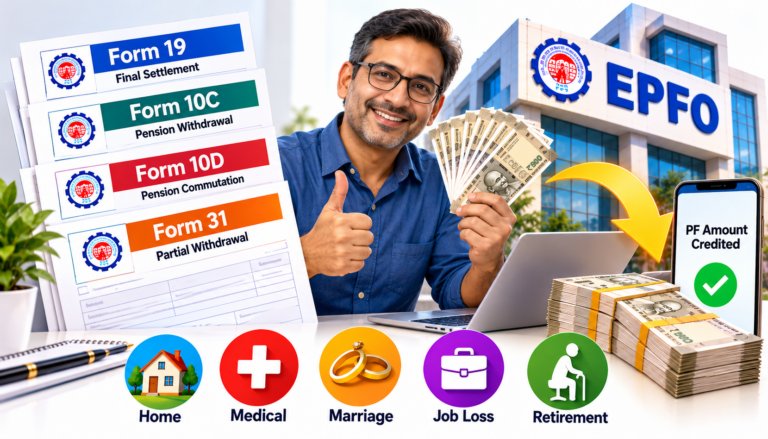
If you have an old EPF account sitting dormant because your KYC wasn’t updated or your nomination details were never filed — this news could change everything for you. The Employees’ Provident Fund Organisation (EPFO) has officially rolled out a fully digital process that allows members to complete KYC verification and update their e-Nomination entirely online, without stepping foot inside any EPFO regional office. This is one of the most significant reforms in EPFO’s operational history, and if you’re one of the millions of Indian workers whose account has been flagged as inactive or partially active, July 2026 is your window to act.
What Prompted This Move?
EPFO manages retirement savings for over 70 million active subscribers across India, but the organisation has long grappled with a silent crisis — a massive backlog of accounts that are technically valid but functionally frozen. These accounts couldn’t process claims, couldn’t transfer balances, and couldn’t disburse pension benefits, all because of one bottleneck: incomplete KYC and missing nomination details.
For years, updating these details required a physical visit to the EPFO office, submission of paper documents, employer attestation, and weeks of waiting. For migrant workers, daily wage earners, and people in smaller cities like Lucknow, Kanpur, or Varanasi — where regional offices are often overcrowded — this was a genuine hardship. Many simply gave up, leaving their hard-earned provident fund money locked indefinitely.
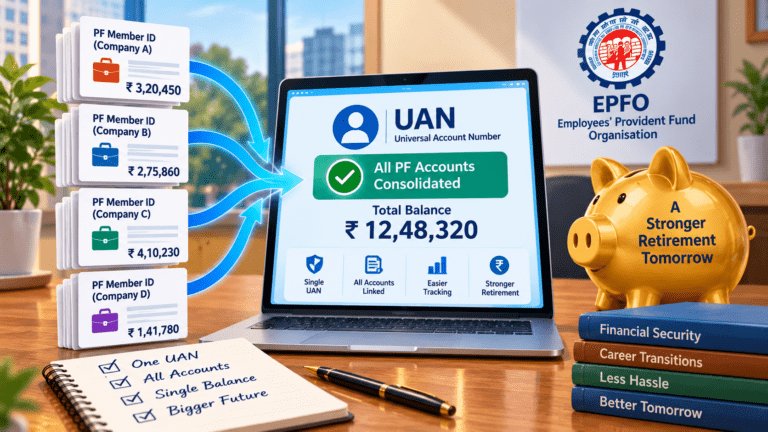
The new digital framework eliminates that friction entirely. EPFO has integrated its Member e-Sewa portal with Aadhaar-based OTP authentication, DigiLocker document verification, and the Unified Mobile Application for New-age Governance (UMANG) app to create an end-to-end online pipeline for both KYC and nomination updates.
What Exactly Is Changing — The Full Picture
Understanding the scope of this update is important before you log in and start clicking buttons. There are two distinct processes that EPFO has now digitised completely.
KYC (Know Your Customer) Update: This involves linking your EPF account with valid identity and address proofs — primarily Aadhaar, PAN, and bank account details. Previously, even if you uploaded documents online, they still required employer digital signature approval or physical verification. Under the new system, Aadhaar-based e-KYC is treated as self-certified and auto-approved in most cases, drastically cutting down the approval timeline from weeks to hours.
e-Nomination: This is the process of officially declaring who will receive your EPF and EPS (Employees’ Pension Scheme) corpus in case of your death. A shocking number of accounts — estimated in the tens of millions — have no nomination on record, which means families of deceased workers often face legal complications and prolonged delays to claim money that rightfully belongs to them. EPFO now allows you to submit your nomination digitally using Aadhaar OTP, upload a scanned family photograph, and complete the entire process from your smartphone or computer.
Both processes are now available on the EPFO Member e-Sewa portal (unifiedportal-mem.epfindia.gov.in) and on the UMANG app, with no employer intervention required for the nomination update specifically.
Why Millions of Accounts Are Tagged “Inactive”
The term “inactive account” in EPFO’s system doesn’t always mean what most people think. An account can be tagged inactive or flagged for restricted services for several reasons — your Aadhaar isn’t seeded with the UAN (Universal Account Number), your PAN isn’t linked, your bank account details are missing or outdated, your date of birth in EPFO records doesn’t match your Aadhaar, or simply because no nomination was ever filed.
Each of these gaps triggers a different level of restriction. Some accounts can’t process partial withdrawals. Others can’t initiate full settlements. Some are completely frozen for online transactions. The July reactivation window being discussed internally within EPFO circles refers to a targeted campaign where the organisation plans to proactively reach out to flagged accounts and prompt members to use the new digital tools to resolve their pending compliance gaps.
If your account falls in this category, you would typically receive an SMS on your registered mobile number, a notification on the UMANG app, or an email from EPFO prompting you to log in and resolve the issue. Do not ignore these communications — they are legitimate and time-sensitive.
Step-by-Step: How to Complete KYC Online
Here is a practical walkthrough of the process, based on the current Member e-Sewa portal interface.
Step 1 — Log in to the EPFO Member Portal. Visit unifiedportal-mem.epfindia.gov.in and log in using your UAN and password. If you’ve forgotten your password, you can reset it using your Aadhaar-linked mobile number via OTP.
Step 2 — Navigate to KYC Section. Under the “Manage” tab in the top navigation bar, select “KYC.” You’ll see a list of document types including Aadhaar, PAN, bank account, passport, driving licence, and ration card.
Step 3 — Enter and Verify Aadhaar. Select Aadhaar, enter your 12-digit Aadhaar number, and click “Save.” The system will send an OTP to your Aadhaar-registered mobile. Enter this OTP to complete e-KYC. Once verified, your Aadhaar status will show as “Verified” with a green checkmark, typically within minutes.
Step 4 — Link PAN. Enter your PAN number and click “Save.” PAN verification is done through the Income Tax Department’s backend API and usually completes within 24 to 48 hours automatically.
Step 5 — Update Bank Account. Enter your bank account number and IFSC code. This step may still require employer approval in some cases, depending on your current employment status. However, for former employees or those with settled accounts, the process has been simplified significantly.
Once all three — Aadhaar, PAN, and bank account — are marked “Verified” or “Approved,” your KYC is considered complete and most restrictions on your account are lifted automatically.
Step-by-Step: How to File e-Nomination Online
Filing your nomination is arguably more important than KYC from a family security standpoint, yet it remains the most neglected step among EPF members.
Step 1 — Log in to the Member Portal using your UAN and password, same as above.
Step 2 — Go to e-Nomination. Under the “Manage” tab, click “e-Nomination.” The system will first ask you to verify your Aadhaar details if not already done.
Step 3 — Enter Family Details. You’ll be prompted to add family member information — name, date of birth, relationship, Aadhaar number (if available), and address. You can add multiple family members and assign percentage shares of the total corpus to each.
Step 4 — Upload Family Photograph. A recent family photograph in JPEG format (size under 100 KB) needs to be uploaded. This is a mandatory requirement under EPFO’s nomination rules.
Step 5 — E-Sign Using Aadhaar OTP. After reviewing all details, you’ll be asked to provide your consent and digitally sign the nomination form using an Aadhaar-based OTP. Enter the OTP received on your Aadhaar-registered mobile, and your nomination is filed instantly.
The entire process takes under 15 minutes if you have your documents and family details handy. Your nomination is reflected in your account immediately after e-signing.
What About Members Without Aadhaar-Linked Mobile Numbers?
This is a legitimate concern, especially for older workers or those who haven’t updated their Aadhaar biometric or mobile linkage. If your mobile number isn’t linked to Aadhaar, the OTP-based authentication won’t work directly.
In such cases, EPFO recommends two alternatives. First, you can visit your nearest Aadhaar enrolment centre (available at post offices and many banks across cities like Lucknow) to update your mobile number in the Aadhaar database — this is a one-time physical step, after which all future EPFO transactions can be done online. Second, EPFO’s common service centres (CSCs) are equipped with biometric devices and can authenticate your identity using fingerprint or iris scan, allowing you to complete the KYC and nomination process on-site without needing a mobile OTP. This hybrid model ensures that even members without smartphones aren’t excluded.
The Employer’s Role Has Diminished — and That’s Deliberate
One of the most frustrating aspects of the old system was the dependency on employers. Your KYC couldn’t get approved without your employer logging in and digitally attesting your documents. This created enormous problems for workers who had changed jobs, whose previous employer had shut down, or whose employer was simply unresponsive.
EPFO has deliberately reduced the employer’s role in the new framework. Aadhaar-based e-KYC is now self-certified by the member, and e-Nomination requires zero employer involvement. PAN and bank account verification are done through government API integrations rather than manual employer approval. This is a structural shift — EPFO is moving toward a member-centric model where your access to your own retirement savings doesn’t depend on the administrative responsiveness of your employer.
Why This Matters for India’s Informal and Semi-Formal Workforce
India has millions of workers who move between formal and informal employment — construction supervisors, contractual staff, retail workers, gig economy participants who were briefly on payroll. Many of these individuals have EPF contributions sitting in accounts they’ve never properly activated or claimed. The digitisation of KYC and nomination is especially powerful for this demographic because it removes the biggest barrier they faced: the need to coordinate with a former employer or travel to an EPFO office in a city they may no longer live in.
For workers in Uttar Pradesh specifically — a state with one of the largest EPF member bases in the country — this update opens access to funds that have been inaccessible for years. The Lucknow, Kanpur, Agra, and Varanasi regional offices of EPFO have historically been among the most burdened in terms of walk-in grievances. Reducing the need for physical visits will not only help members but will free up administrative capacity for cases that genuinely require in-person resolution.
The Broader Context: EPFO’s Digital Transformation Roadmap
This KYC and e-Nomination reform doesn’t exist in isolation. It’s part of EPFO’s broader technology overhaul that has been underway since 2022. The organisation has already launched centralised pension payment systems, upgraded its IT backbone to reduce claim processing time from 20 days to under 3 days for most standard claims, and integrated with the DigiLocker ecosystem for document verification.
The next phase on EPFO’s roadmap reportedly includes auto-transfer of EPF accounts on job change (eliminating the need to manually raise a transfer request), AI-driven grievance resolution, and real-time employer compliance monitoring. The July 2026 reactivation campaign is essentially the member-facing front end of this larger digital push — getting millions of legacy accounts cleaned up and compliant before the next wave of system upgrades goes live.
Common Mistakes to Avoid During This Process
Several members have reported issues during online KYC and e-Nomination that could have been avoided with a little preparation. First, ensure the name on your Aadhaar exactly matches the name in your EPF records — even a minor spelling difference (like “Mohammad” versus “Mohammed”) can cause verification failure. If there’s a mismatch, you’ll need to raise a joint declaration with your employer or approach EPFO’s online grievance portal (EPFiGMS) to correct the name before proceeding.
Second, make sure your UAN is activated. If you’ve never activated your UAN, do so first by visiting the Member Portal and using your member ID, Aadhaar, and date of birth to generate login credentials. Third, avoid uploading blurry or oversized photographs for the nomination — this is the most common reason for e-Nomination processing errors. Finally, after completing both processes, download and save the acknowledgement receipts. These serve as proof of compliance and are useful if you ever need to raise a grievance.
How to Check If Your Account Has Been Reactivated
After completing KYC and e-Nomination, you can verify your account status by logging into the Member Portal and checking the “Profile” section. A fully compliant account will show all KYC documents as “Approved” or “Verified,” e-Nomination status as “Submitted,” and no pending action alerts. You can also check your passbook on the portal or through the UMANG app to confirm that your balance is visible and transactions are active.
If your account remains restricted even after completing the process, EPFO recommends waiting 72 hours for backend systems to sync before raising a grievance. The EPFiGMS portal (epfigms.gov.in) is the official channel for escalating unresolved issues, and response times have reportedly improved significantly over the past year.
A Word on Security and Privacy
Given that this process involves Aadhaar and sensitive financial information, it’s important to use only the official EPFO portal and UMANG app. Do not trust third-party websites, WhatsApp forwards, or agents claiming to help you with KYC for a fee. EPFO never charges for KYC or nomination updates, and the entire process is designed to be completed independently by the member. The Aadhaar OTP is single-use and expires within minutes, making it very secure for authentication purposes. Always log out of the member portal after completing your session, especially on shared devices.
Final Thoughts
The launch of fully online KYC and e-Nomination is not just a convenience upgrade — it’s a fundamental equity issue. Your provident fund is deferred wages that you’ve earned. It belongs to you and to your family. The barriers that kept millions of accounts dormant for years were largely administrative, not legal, and EPFO deserves credit for systematically dismantling them.
If you have an EPF account — active, dormant, or somewhere in between — take 15 minutes this week to log in, check your KYC status, and file your nomination. July 2026 is the target for a mass reactivation push, but don’t wait for a reminder to arrive. Secure your savings and protect your family now.
Disclaimer: This article is based on publicly available EPFO guidelines and portal information as of June 2026. For the most current instructions, always refer to the official EPFO website at epfindia.gov.in or call the EPFO helpdesk at 1800-118-005.