Train Ticket Insurance at Station Counters From 27 October — What 45 Paise Covers and Who Is Still Left Out
Train Ticket Insurance at Station Counters From 27 October — What 45 Paise Covers and Who Is Still Left Out
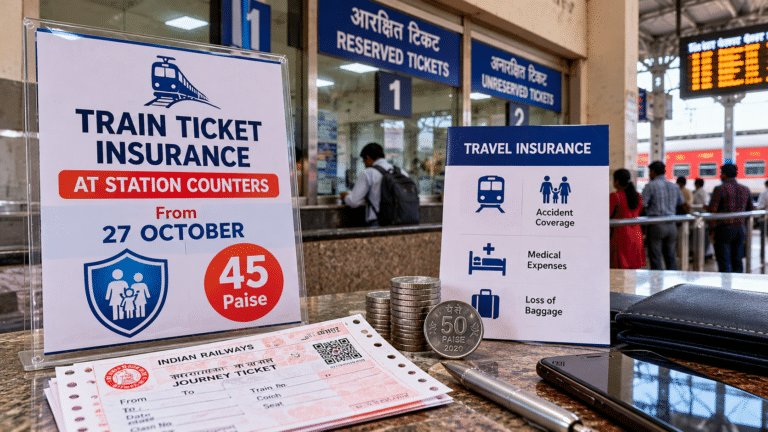
A Supreme Court order of 6 October requires Indian Railways to extend travel insurance to tickets bought at station counters. Online passengers already get up to ₹10 lakh of cover for 45 paise. Here is what counter passengers can expect, what has not been decided and how claims work.
If you book train tickets on the IRCTC app, you have probably ticked or skipped a small box offering travel insurance for under half a rupee. If you buy your ticket at a station window, that box has never existed. For years, the one passenger in ten who still queues at a reservation counter has travelled without the cover available to everyone booking online.
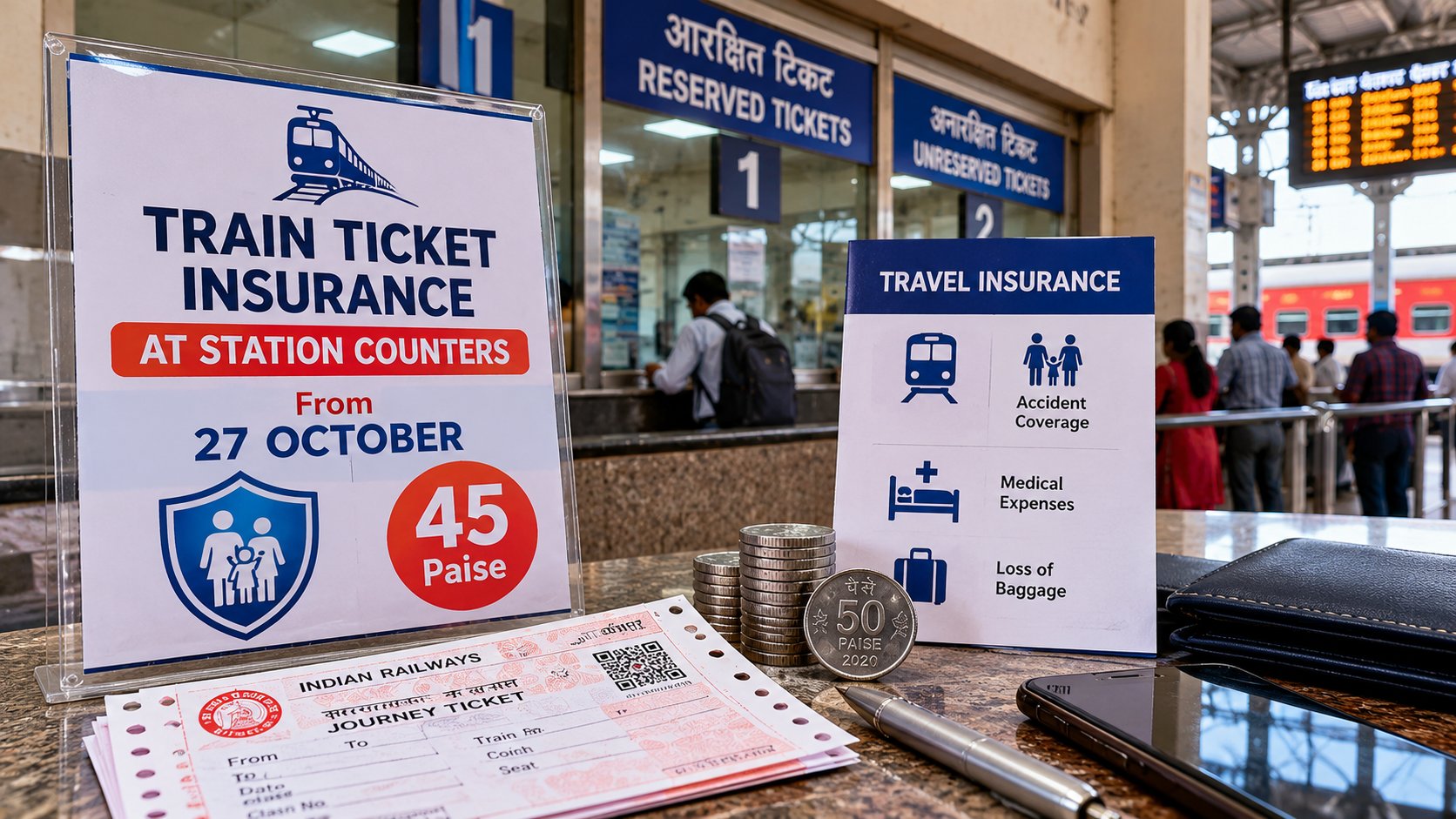
That is about to change. The Supreme Court has directed Indian Railways to extend insurance to all tickets sold over the counter from 27 October 2026. The order is short and firm, but the details that matter to passengers, including the premium, the claim process and exactly which tickets qualify, have not yet been published. This guide explains what is confirmed, what the online scheme already covers, and what to do if the worst happens.
Quick Summary
From 27 October 2026, tickets bought at railway station counters must carry travel insurance, under a Supreme Court order of 6 October. The existing online scheme pays up to ₹10 lakh for death or permanent total disability, up to ₹7.5 lakh for permanent partial disability, up to ₹2 lakh for hospital treatment and up to ₹10,000 to transport mortal remains, for 45 paise per passenger. The counter premium, documents and claim process have not yet been announced. Online, the insurance remains optional. Claims must be filed within four months.
What We Know
- On 6 October 2026, a bench of Justices Ahsanuddin Amanullah and R Mahadevan directed the Railway Board to extend insurance to all tickets sold over the counter at railway stations.
- The deadline is 27 October 2026, and the Railway Board is directly responsible for compliance.
- The order came in safety proceedings linked to the June 2023 Odisha train accident.
- Online, insurance is optional and costs 45 paise per passenger, including taxes.
- Claims under the existing scheme must be made within four months of the incident.
What Is Still Unclear
- The premium for counter tickets, and whether passengers or Railways will pay it.
- Whether counter passengers can opt out, as online passengers can.
- Which insurer will provide counter cover, and how nominees will be recorded.
- Whether unreserved (general) tickets are included.
- Whether online insurance will also become automatic.
Why the Supreme Court Stepped In
The order arose from long-running proceedings on railway safety after the collision near Balasore in Odisha in June 2023, one of India’s deadliest train accidents, which killed nearly 300 people. Business Today reported that the bench expressed concern about the lack of progress despite earlier assurances from authorities, and that the same proceedings also cover track fencing, foot overbridges and the rollout of the Kavach automatic train-protection system.
The court’s reasoning on insurance is about fairness. A passenger who books online can buy cover for 45 paise. A passenger who pays cash at a station, often someone older, poorer or less comfortable with smartphones, cannot. The court directed coverage for “all tickets sold over the counter at railway stations,” putting offline bookings on a par with online ones. It gave the Railway Board two weeks and made it directly responsible if the order is not carried out.
The numbers explain why this was overlooked for so long. Counter sales have shrunk steadily. In July 2026, 89.84% of reserved tickets were booked online, the Free Press Journal reported, citing railway data. But a small share of a very large system is still a lot of people, and they are the passengers least likely to have any other insurance.
What the 45-Paise Policy Actually Pays
The online scheme is a personal accident cover arranged through IRCTC with a general insurer, chosen when booking. It pays fixed amounts for injury or death in a train accident or an “untoward incident” during the journey. The amounts below are maximums. Actual payouts depend on the type of injury and the policy terms, and a claim is paid only if the incident falls within the policy.
To put the price in perspective: for every ₹1 of premium, the maximum death benefit is ₹22.2 lakh. A family of four pays ₹1.80 per journey. Insurance is rarely this cheap because the risk to any single passenger is very small, and the policy is sold in enormous volumes.
What “untoward incident” means
Under the Railways Act, an untoward incident covers events such as a terrorist act, violent attack, robbery or dacoity, rioting, shoot-out or arson in a train or station area, and a passenger accidentally falling from a train. This matters because many railway deaths and injuries are not collisions or derailments. A passenger who falls from a crowded door may be covered; a person hit while crossing tracks is not.
Who Is Covered Now, and Who Will Be From 27 October
The order closes the biggest gap, but not every one. The table below combines the existing online rules, as reported, with what the court has directed. Where something has not been officially clarified, we say so rather than guess.
| Ticket type | Before 27 Oct | From 27 Oct | Premium | Choice |
|---|---|---|---|---|
| Online e-ticket, confirmed | Optional | Optional | 45 paise | Tick at booking |
| Online e-ticket, RAC | Optional | Optional | 45 paise | Tick at booking |
| Online e-ticket, waitlisted | Not covered | Unclear | Not stated | Not stated |
| Reserved counter ticket (PRS) | Not covered | Covered | Not announced | Mandatory, per order |
| Unreserved (general) ticket | Not covered | Unclear | Not stated | Not stated |
| Child travelling without a ticket | Not covered | Unclear | Not stated | Not stated |
The rows for online RAC and waitlisted tickets reflect how the option has generally been offered at booking; check the IRCTC booking page for your ticket. The unreserved category is the big question. The order refers to “all tickets sold over the counter,” and general tickets are sold over counters too, but most reports so far describe the change in terms of reservation counters. Unreserved passengers travel in the most crowded coaches and are the most exposed to falls from doors. If they are included, the reach of the order is far larger than the 10% of reserved tickets sold offline.
Does this insurance replace railway compensation?
No. Travel insurance is separate from the statutory compensation Indian Railways must pay for accidents and untoward incidents under the Railways Act, which is claimed through the Railway Claims Tribunal. That compensation is ₹8 lakh for death, under rules last revised in 2017, Factly reported, with injury amounts from ₹64,000 to ₹8 lakh. Families can pursue both.
Ex gratia relief, the immediate cash the Railways pays the injured and the families of those killed, is a third, separate stream. The Railway Board revised these amounts upward in September 2023, the first revision since 2012 and 2013, PTI reported. Ex gratia is paid quickly and does not depend on having bought insurance.
From 92 Paise to 45 Paise: A Short History of Rail Insurance
IRCTC introduced optional travel insurance for e-ticket passengers in 2016, at a premium of 92 paise. The premium was later cut to 35 paise in 2021, according to Factly, and now stands at 45 paise per passenger including taxes. Throughout, it has been an online-only product, because the booking system collected the premium and passenger details electronically, and counters had no comparable process.
- 2016Optional insurance launched for e-tickets at 92 paise
- 2021Premium cut to 35 paise per passenger
- Jun 2023Odisha collision kills nearly 300 people
- Sep 2023Railway ex gratia relief revised upward
- Jul 202689.84% of reserved tickets booked online
- 6 Oct 2026Supreme Court orders cover for counter tickets
- 27 Oct 2026Deadline: counter tickets to carry insurance
- 16 Nov 2026Next hearing; compliance likely reviewed
The practical challenge for Railways is collecting nominee details. Online, passengers typically receive an SMS and email from the insurer with a link to fill in nominee details. At a counter, passengers fill in a paper requisition form, and there is no standard way to record a nominee or send a policy link. How Railways solves this in under three weeks will shape how easy counter claims are.
How to Claim, Step by Step
The claim process for counter tickets has not been announced. For the existing online scheme, the steps reported by Aaj Tak are below. Expect the counter process to be similar once published.
- Day 0 to 7Inform the insurerUse the details in the policy SMS or email, or the IRCTC booking
- Week 1 to 4Get the railway reportAccident or incident report from railway authorities
- Month 1 to 3Collect documentsMedical, police, ID and bank papers, by claim type
- By month 4Submit the claimWritten claim within 4 months of the incident
- After filingFollow upAnswer queries; keep copies and the claim receipt
The time ranges in the first three steps are practical suggestions to stay well inside the four-month limit, not official service levels. The only firm deadline reported is four months from the incident.
Documents you will need, by type of claim
| Claim type | Maximum payout | Key documents | Who claims | Deadline |
|---|---|---|---|---|
| Death | ₹10 lakh | Claim form, railway accident report, identification report, nominee ID, cancelled cheque | Nominee or legal heir | 4 months |
| Permanent total disability | ₹10 lakh | Railway report, doctor’s report, disability certificate, FIR copy, medical records | Passenger | 4 months |
| Permanent partial disability | Up to ₹7.5 lakh | As above, with the percentage of disability certified | Passenger | 4 months |
| Hospital treatment | Up to ₹2 lakh | Railway report, discharge summary, original bills, receipts, prescriptions, test reports | Passenger | 4 months |
| Mortal remains transport | Up to ₹10,000 | Bills for transport, death documents, railway report | Nominee or family | 4 months |
If no nominee was registered, the insurer may ask for proof of legal heirship or a succession certificate, which can take months to obtain. This is the single biggest cause of delay in death claims, and the easiest to prevent: fill in the nominee link the insurer sends when you book.
When the Policy Will Not Pay
Because the premium is so low, the policy is narrow. It covers accidents and untoward incidents connected to the train journey, not everything that can happen on a trip. Aaj Tak listed these exclusions under the existing scheme.
- Self-inflicted injury, suicide or attempted suicide
- Incidents linked to drugs or intoxication
- Injuries while crossing railway tracks
- Certain risky activities by the passenger
- Incidents outside the policy period
- Not boarding the train, or tickets that cannot be verified
These exclusions follow the same logic as the Railways Act compensation rules, which also exclude self-inflicted injuries and injuries from a passenger’s own unlawful act. Illness during the journey, lost luggage and missed trains are not covered either. For those, a separate travel or health policy is needed.
What Passengers Should Do Before and After 27 October
If you book online, the simplest step is to tick the insurance box on every booking. At 45 paise, there is no financial case for skipping it. Then, when the insurer’s SMS or email arrives, fill in your nominee details. Many passengers never open that link, which is what turns a straightforward claim into a long legal process.
If you buy tickets at a counter, ask the booking clerk from 27 October whether insurance has been applied, and look for it on the printed ticket. Since the counter process has not been published, keep the original ticket and a photo of it. In the event of a claim, the ticket is your proof of travel and, likely, of cover.
- Tick the 45-paise box on every online booking
- Fill in nominee details within 1 to 2 days of booking
- Keep the ticket and PNR for at least 4 months
- From 27 Oct, ask at the counter whether cover is applied
- Note railway helpline numbers before travel
- Inform the insurer within days of any incident
Frequently Asked Questions
Is train ticket insurance mandatory from 27 October 2026?
For tickets bought at railway station counters, the Supreme Court has directed that insurance be provided from 27 October 2026. For online tickets on IRCTC, insurance currently remains optional at 45 paise per passenger.
How much does IRCTC travel insurance cost?
45 paise per passenger, including taxes, for online e-tickets. The premium for counter tickets has not yet been announced.
How much does train travel insurance pay?
Under the existing scheme: up to ₹10 lakh for death or permanent total disability, up to ₹7.5 lakh for permanent partial disability, up to ₹2 lakh for hospital treatment and up to ₹10,000 to transport mortal remains.
Why did the Supreme Court order insurance for counter tickets?
On 6 October 2026, in railway safety proceedings linked to the June 2023 Odisha accident, the court directed coverage for all counter tickets so that offline passengers are not excluded from protection available online.
How do I claim train travel insurance?
Inform the insurer, obtain the railway accident report, gather medical, identity and bank documents, and submit a written claim within four months of the incident. The counter-ticket process has not yet been published.
Are general or unreserved tickets covered?
That has not been officially clarified. The order refers to all tickets sold over the counter, but most reports describe reservation counters. Watch for Railway Board instructions before 27 October.
Is travel insurance separate from railway compensation?
Yes. Statutory compensation of up to ₹8 lakh for death is claimed from the Railway Claims Tribunal, and ex gratia relief is paid by the Railways. Insurance is an additional, separate payout.
What is not covered by train travel insurance?
Exclusions include self-inflicted injury, suicide attempts, drug-related incidents, injuries while crossing tracks, incidents outside the policy period and unverified tickets. Illness, lost luggage and missed trains are not covered.
The Short Version
From 27 October 2026, under a Supreme Court order of 6 October, tickets bought at railway station counters must carry travel insurance, as online tickets already can. The existing cover pays up to ₹10 lakh for death or permanent total disability, ₹7.5 lakh for partial disability, ₹2 lakh for hospital treatment and ₹10,000 for transporting mortal remains, for 45 paise online. The counter premium, claim process and treatment of unreserved tickets are still to be announced. Claims must be filed within four months. Insurance is separate from statutory compensation and ex gratia relief.