ManipalCigna Infinix Review: Is "Unlimited" Health Insurance Worth It — and What Still Has Limits?
ManipalCigna Infinix Review: Is “Unlimited” Health Insurance Worth It — and What Still Has Limits?
ManipalCigna’s new Infinix plan offers a choice of ₹10 lakh or an unlimited sum insured, no maximum entry age and a one-time deductible spread over ten years. The headline cover is genuinely uncapped, but waiting periods, network rules and benefit caps still apply.
- 30-day initial wait
- 36 months for pre-existing diseases
- QuickAccess: listed conditions from day 31
- Unlimited cover from day 1
- No initial waiting period
- Continuity carried over, subject to underwriting
Every health insurance buyer faces the same awkward question: how much cover is enough? ₹10 lakh felt generous a decade ago. Today a cancer course, a transplant or three weeks in intensive care can exceed it, and medical costs in India are rising faster than most salaries. Pick too little and a serious illness can drain savings. Pick too much and you pay for cover you may never use.
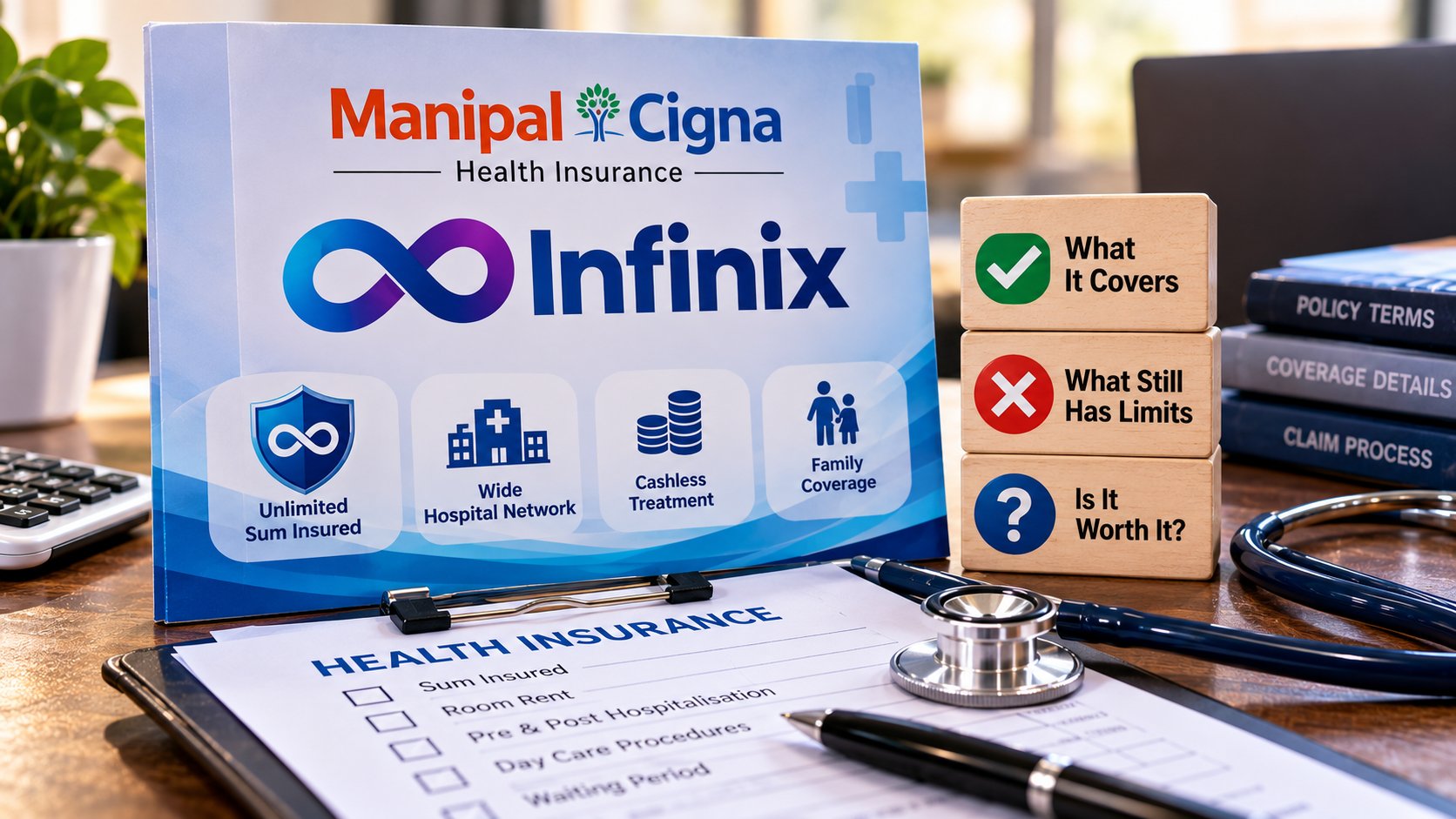
ManipalCigna’s answer, launched in October 2026, is to remove the number entirely. Its new plan, Infinix, offers an unlimited sum insured, alongside a one-time deductible the company calls an industry first. “Unlimited” is a powerful word in insurance marketing, and it deserves careful reading. This review explains what Infinix actually covers, what it costs, where the limits remain, and whether it beats the cheaper alternative many advisers recommend.
Quick Summary
Infinix removes the overall cap on eligible hospitalisation claims if you choose the unlimited option, but it is not unconditional cover. Waiting periods, exclusions, network rules and specific benefit caps, such as ₹1 lakh for medical equipment and ₹50,000 for high-end diagnostics, still apply. ManipalCigna lists an indicative premium of ₹7,389 a year for a 26-year-old on the Core plan with unlimited cover. The unlimited option costs only about 5% to 7% more than ₹10 lakh in the published examples, which makes it worth considering for families and anyone worried about very large bills.
What We Know
- ManipalCigna announced Infinix on 7 October 2026, aimed at Tier 1 and Tier 2 cities, with city-based pricing.
- Buyers choose a ₹10 lakh or unlimited sum insured, with tenures of 1, 2 or 3 years.
- There are two variants: Core for first-time buyers and Now for people moving from existing cover.
- A one-time aggregate deductible of ₹25,000, ₹50,000 or ₹1 lakh is used up once over ten policy years.
- Family floaters cover up to 8 members from 23 eligible relationships, with no maximum entry age.
What Is Still Unclear
- The size of the premium discount for the one-time deductible.
- How the insurer will handle very large claims in practice, since the plan has no claims history yet.
- How premiums for unlimited cover will change at renewal as the pool ages.
- Why published premium examples differ widely for similar ages, beyond city and network choice.
Why “How Much Cover?” Has Become So Hard to Answer
The case for unlimited cover rests on medical inflation. Aon projected India’s medical cost trend for 2026 at 11.5%, ahead of the global average. At that rate, treatment that costs ₹10 lakh today would cost about ₹17 lakh in five years and nearly ₹30 lakh in ten. A cover that looks comfortable at 35 can look thin at 50.
Insurers have tried several fixes. Restoration benefits refill your cover after it is used, but as Business Standard noted, they do not help with a single claim larger than the sum insured: a ₹10 lakh policy with unlimited restoration may still not pay a ₹25 lakh bill. Some plans allow one claim above the sum insured in a lifetime. Infinix goes further by removing the ceiling on the base cover itself.
ManipalCigna’s Vineet Gupta told Business Standard that an unlimited sum insured reduces the need to estimate future cover requirements. That is the real selling point: not that you will claim crores, but that you no longer need to guess correctly 20 years in advance.
Core or Now: Two Doors Into the Same Plan
Infinix comes in two variants. Infinix Core is for first-time buyers. It has a 30-day initial waiting period and a 36-month wait for pre-existing diseases and specified illnesses, which can be cut to 24 months as an option. Its QuickAccess option covers eight listed conditions, including diabetes, obesity and hypothyroidism, from day 31.
Infinix Now is for people who already have health cover and want to upgrade or port. The company says it offers unlimited cover from day one. Waiting periods already served under the old policy carry over, including on the enhanced cover, subject to underwriting. It costs more: ManipalCigna’s indicative premium for a 26-year-old with unlimited cover on the Classic network is ₹7,389 for Core and ₹9,958 for Now.
| Feature | Infinix Core | Core with options | Infinix Now |
|---|---|---|---|
| Initial waiting period | 30 days | 30 days | None |
| Pre-existing diseases | 36 months | 24 months, or day 31 for 8 listed conditions | Continuity carried over |
| Specified illnesses | 36 months | 24 months | Continuity carried over |
| Maternity, first-time | 12 months | 12 months | 12 months |
| Premium, age 26, unlimited | ₹7,389 | Higher, by option | ₹9,958 |
| Best for | New buyers, young and healthy | Those with diabetes or thyroid issues | Upgrading existing cover |
Premiums are ManipalCigna’s indicative figures for a one-year policy, single payment and the Classic network, and are subject to underwriting. Waiting periods are as listed on the product page.
What “Unlimited” Covers, and Where the Caps Hide
The unlimited option removes the overall cap on eligible in-patient claims. ICU charges are paid at actuals, there is no co-payment or disease-wise sub-limit in the base plan, according to Ditto’s review, and hospitalisation of just 2 hours qualifies. Day care, AYUSH treatment, non-medical expenses and road ambulance are all covered up to the sum insured, which on the unlimited option means without an overall ceiling.
But several benefits carry their own fixed limits, whichever option you choose. Unlimited cover also unlocks some extras the ₹10 lakh option does not have, such as home treatment for listed conditions and high-end diagnostics.
The extra time around a hospital stay
Unlimited cover also lengthens the window for expenses before and after hospitalisation. On ₹10 lakh, pre-hospitalisation costs are covered for 60 days and post-hospitalisation for 90 days. On unlimited, those become 90 and 180 days. For a cancer patient with months of follow-up scans and medicines, that difference can matter more than the headline cover.
The One-Time Deductible: A Genuinely New Idea
A deductible is the amount you pay yourself before insurance kicks in. Most health insurance deductibles reset every year: choose ₹1 lakh, and you bear the first ₹1 lakh of claims every year you claim. In exchange, you pay a lower premium. Infinix offers that annual version, with options from ₹1 lakh to ₹10 lakh.
The new option is a one-time aggregate deductible of ₹25,000, ₹50,000 or ₹1 lakh. You bear that amount only once across ten policy years. Once it is used up, later claims are paid in full, and the premium discount continues for the whole decade. ManipalCigna describes this as an industry first. The company has not published the size of the discount.
The one-time deductible suits people who would rather absorb a small, known cost once in exchange for a lower premium every year, and who can afford ₹25,000 to ₹1 lakh from savings. It benefits people who rarely claim the most, since they keep the discount for ten years and may never use the deductible.
What It Costs: Unlimited Is Cheaper Than You Might Expect
The most surprising number is the small gap between ₹10 lakh and unlimited cover. In indicative quotes published by Ditto for a Delhi PIN code, unlimited cover cost between 4.8% and 7.2% more than ₹10 lakh. ManipalCigna’s own blog puts the upgrade at roughly 5% extra premium on Core.
Note that Ditto’s ₹14,176 for a 25-year-old is nearly double ManipalCigna’s own ₹7,389 for a 26-year-old. The difference is likely to reflect city and hospital network choice, since Infinix offers three network tiers, Classic, Premier and Premier+, priced differently. Always get a quote for your own city and network.
Discounts that can bring the price down
According to the product page and Ditto, Infinix offers up to 12.5% off for a three-year policy, 10% for two years, a no-claim discount of up to 7.5% at renewal, 5% for existing ManipalCigna policyholders, 2.5% for standing instructions, and wellness rewards of up to 20% of the premium. NRI and OCI buyers choosing unlimited cover get 25%, according to Ditto.
Unlimited Plan or Base Plus Super Top-Up?
The main alternative to unlimited cover is a combination: a modest base policy plus a super top-up, which pays costs above a set deductible. SecureNow’s Kapil Mehta suggested in Business Standard a ₹20 lakh base policy with a ₹1 crore or ₹5 crore super top-up and a ₹20 lakh deductible. He said some insurers offer ₹5 crore top-ups with a ₹20 lakh deductible at premiums below ₹10,000.
| Approach | Cover for one huge claim | Number of policies | Claims hassle | Watch out for |
|---|---|---|---|---|
| ₹10 lakh base, restoration | Capped at ₹10 lakh | 1 | Simple | Restoration does not help one big bill |
| ₹1 crore base plan | ₹1 crore | 1 | Simple | Fixed ceiling erodes with inflation |
| ₹20 lakh base and ₹5 crore super top-up | ₹5.2 crore | 2 | Two insurers or policies | Different terms and waiting periods |
| Infinix unlimited | No overall cap | 1 | Simple | Benefit caps, network co-pay, new product |
| Infinix ₹10 lakh | Capped at ₹10 lakh | 1 | Simple | No home care or premium diagnostics |
The combination is often cheaper, but it means two policies, two sets of terms and potentially two insurers at claim time. Policybazaar’s Rohan Goel told Business Standard that unlimited cover can make more sense for a family floater than for individuals, because several members share one cover that cannot run out.
Who Should Consider Infinix
- Strong fitFamilies of 3 to 8One floater that cannot be exhausted by several claims in a year
- Strong fitAges 25 to 45, healthyLock in lifelong renewable cover before conditions appear
- Check carefullyAges 60 and overNo entry age limit, but premiums above ₹65,000 for a couple
- Compare firstBudget under ₹10,000Base plus super top-up may give more cover for less
Before buying, check the insurer as well as the product. Ditto reports ManipalCigna’s claim settlement ratio at 92.69%, slightly above an industry average of 92.02%, but also notes an incurred claims ratio well below the industry average and slightly more complaints per 10,000 claims. A lower incurred claims ratio means the insurer paid out a smaller share of premiums as claims.
- Day 1Infinix Now: unlimited cover begins
- Day 31Core: cover starts; QuickAccess conditions covered
- 12 monthsMaternity cover begins for first-time buyers
- 24 to 36 monthsCore: pre-existing and specified illness waits end
- 10 yearsOne-time deductible period and discount run
Before You Sign: A Checklist
Infinix is a well-designed product with a real innovation in its deductible. But a new plan has no claims track record, and the details that decide claims sit in the policy wording, not the brochure. Use this checklist before buying.
- Get quotes for your own city and all 3 network tiers
- Read the network co-pay rules: 10% or 25% outside package
- Check which hospitals near you are in each network
- Compare with a base plus super top-up, cost for cost
- Declare every existing condition honestly
- Consider QuickAccess if you have diabetes or thyroid issues
- Ask the size of the one-time deductible discount
- Use the 30-day free look period to read the wording
Frequently Asked Questions
What is ManipalCigna Infinix?
A retail health insurance plan launched by ManipalCigna in October 2026, offering a choice of ₹10 lakh or unlimited sum insured, in two variants: Core for first-time buyers and Now for those upgrading or porting existing cover.
Is unlimited health insurance really unlimited?
The overall cap on eligible hospitalisation claims is removed, but waiting periods, exclusions, network rules and specific benefit caps, such as ₹1 lakh for medical equipment and ₹50,000 for high-end diagnostics, still apply.
How much does ManipalCigna Infinix cost?
ManipalCigna lists ₹7,389 a year for Core and ₹9,958 for Now, for a 26-year-old with unlimited cover on the Classic network. Ditto’s Delhi quotes range from about ₹14,176 for an individual aged 25 to ₹70,589 for a couple in their sixties.
What is a one-time aggregate deductible?
An amount you pay yourself, ₹25,000, ₹50,000 or ₹1 lakh, only once over ten policy years. After it is used, later claims are paid in full, and the premium discount continues for the decade.
What is the waiting period in ManipalCigna Infinix?
Core has a 30-day initial wait and 36 months for pre-existing diseases and specified illnesses, which can be reduced to 24 months. QuickAccess covers 8 listed conditions from day 31. Now has no initial wait and carries over continuity.
Is there an age limit for ManipalCigna Infinix?
No maximum entry age is listed. Children can be covered from 91 days, and the policy is renewable for life.
Is unlimited cover better than a super top-up?
It is simpler, with one policy and no overall ceiling. A base plan plus super top-up can be cheaper for very high cover but involves two policies. Compare total premiums and terms for your age and city.
Does Infinix cover maternity?
Yes, through New Beginnings, with starting limits of ₹5,000, ₹10,000 or ₹20,000 after a 12-month wait. The benefit grows 100% a year after the second year, up to 10 times the starting amount.
The Short Version
ManipalCigna Infinix, launched in October 2026, lets buyers choose ₹10 lakh or an unlimited sum insured, with no maximum entry age and lifelong renewal. Its standout feature is a one-time deductible of ₹25,000 to ₹1 lakh that applies once over ten years. Unlimited cover costs only about 5% to 7% more than ₹10 lakh in published quotes, but it is not unconditional: waiting periods, network co-pays and specific benefit caps remain. It suits families and long-term planners; budget buyers should compare a base plan with a super top-up.