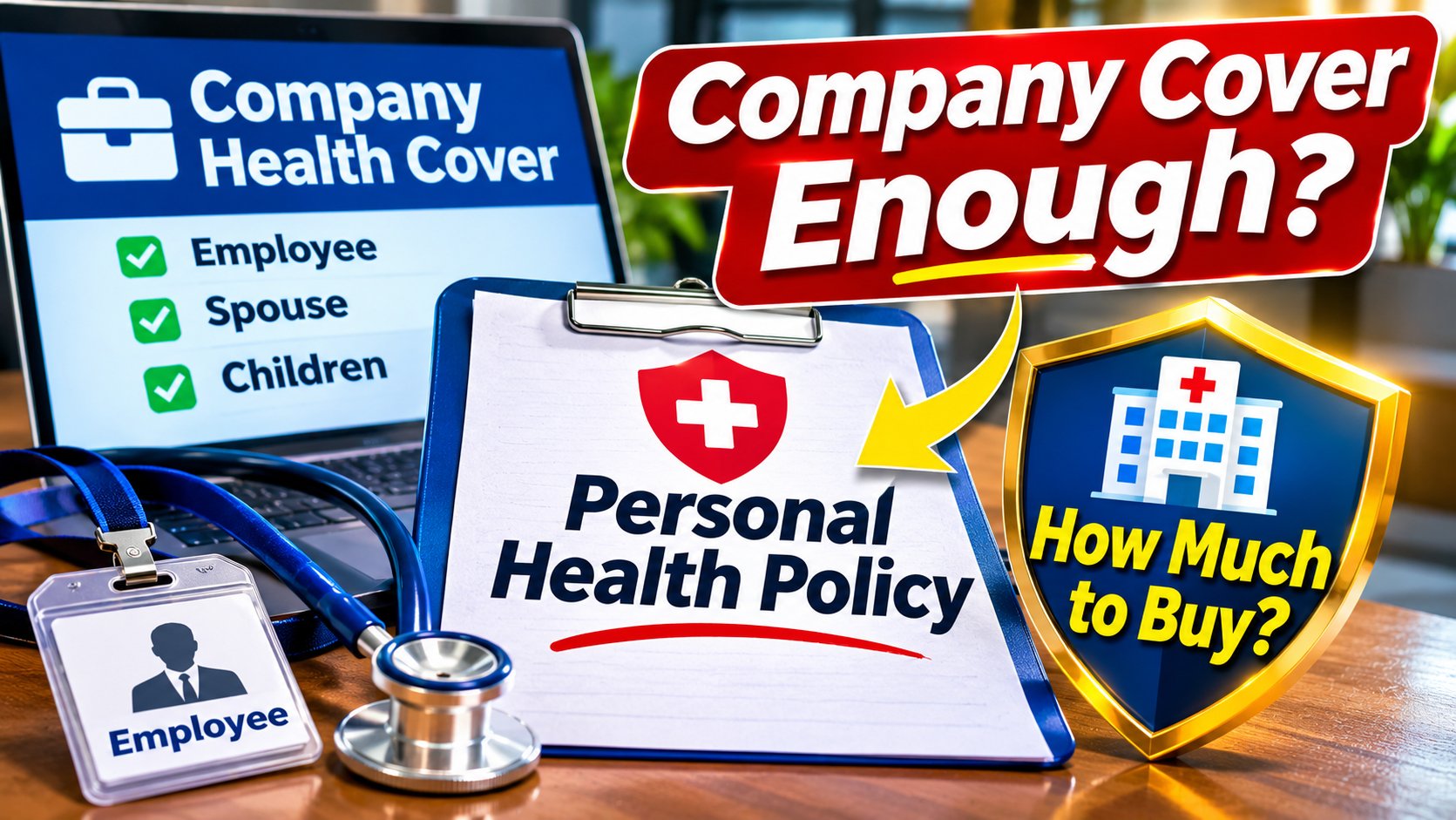
Is Your Company Health Cover Enough? Why Salaried Employees Need a Personal Policy Too — and How Much to Buy
Employer group policies cover nearly half of India’s insured lives, but they end with your job, rarely keep pace with medical costs rising 11.5% a year, and often fall short of serious-illness bills. Here is the case, with numbers, for a personal policy alongside.
You joined the company, HR sent an e-card, and the question of health insurance seemed settled. Most salaried employees think this way, and for routine hospital visits the group policy works well. The trouble starts in the situations nobody plans for: a layoff in the middle of treatment, a cancer diagnosis that costs four times the sum insured, or a retirement party that quietly ends your cover at the age you need it most.
A company health policy is a benefit, not a plan. It belongs to your employer, it is sized for average claims rather than catastrophic ones, and its terms can change every year. This guide sets out what a group cover does well, where it typically fails, how big the gap can get in rupees, and how to fill it at the lowest cost while you are young and healthy enough to qualify.
How Much India Leans on Employer Cover
Employer group policies are the backbone of private health insurance in India. Citing the IRDAI Annual Report 2024-25, Onsurity’s research puts group policies at about 47% of health-insured lives, roughly 27.51 crore people, against about 10% for individual retail policies and 42% under government schemes. Group policies wrote ₹61,435 crore in premium in FY25.
The government’s 2025 household survey shows how far insurance has spread and how much still leaks. According to the MoSPI survey reported by Business Today, 47% of rural and 44% of urban Indians had health insurance in 2025, up from 14% and 19% in 2017-18. Yet the average out-of-pocket spend per hospitalisation, excluding childbirth, was still ₹34,064, and ₹38,688 in urban areas.
Five Ways a Group Cover Can Let You Down
None of these are flaws in group insurance itself. They follow from the fact that the policy is designed and owned by your employer, priced for a workforce, and tied to your employment.
What group cover does well
- Often covers pre-existing diseases from day one
- Usually no or short waiting periods
- Employer typically pays 60% to 70% or more of the premium
- Easy cashless claims through HR and a TPA
Where it typically falls short
- Ends when you resign, are laid off or retire
- Sum insured often fixed for everyone, regardless of family size
- Terms, sub-limits and co-pays can change at each renewal
- Parents may be dropped or face heavy co-payments
- Shared family floater can be exhausted by one big claim
The cover disappears exactly when risk is highest
Job loss, career breaks and retirement are the moments group cover ends, and they often coincide with stress, age or pre-existing illness. Buying an individual policy at 45 or 58, with a diagnosed condition, can mean higher premiums, exclusions, waiting periods of up to three years for pre-existing diseases or outright rejection. The same policy bought at 28 would have finished those waiting periods long before you needed it.
What people often get wrong: many assume they can buy a personal policy “when they leave the job”. By then, any condition diagnosed during employment becomes a pre-existing disease for the new insurer, with fresh waiting periods. The cheapest time to buy is while the group policy still protects you, so the personal policy’s waiting periods run out in the background.
The Inflation Trap in a Fixed Sum Insured
Medical costs rise faster than general prices. Aon’s December 2025 release projects India’s medical trend at 11.5% for 2026, after 13.0% in 2025, against 11.3% for Asia-Pacific and 9.8% globally. India’s general inflation in the same projection is 4.1%. Group covers that stay at ₹3 lakh or ₹5 lakh for years lose purchasing power quickly.
Where the Bills Outgrow the Cover
Most hospitalisations are modest, which is why group covers feel adequate. The problem lies in the tail. Care Health Insurance’s claims analysis, reported by Business Today in February 2026, put early-stage cancer treatment at ₹5 lakh to ₹7 lakh per case and advanced or complex cases at ₹20 lakh to ₹30 lakh, with treatment often spread over several months and several claims. The insurer recommended cover of at least ₹15 lakh to ₹25 lakh. Aon lists cardiovascular disease, gastrointestinal conditions and cancer as the top claim drivers in India.
| Scenario | Typical bill | ₹5 lakh group cover only | Group + ₹10 lakh personal policy | Group + ₹20 lakh super top-up (₹5 lakh deductible) |
|---|---|---|---|---|
| Average hospitalisation | Tens of thousands | Covered | Covered | Covered by group |
| Early-stage cancer | ₹5 to 7 lakh | Up to ₹2 lakh short | Covered | Covered |
| Advanced cancer | ₹20 to 30 lakh | ₹15 to 25 lakh short | ₹5 to 15 lakh short | Covered up to ₹25 lakh total |
| Same illness after leaving the job | ₹5 to 7 lakh | Not covered | Covered by personal policy | Top-up needs a base to cross the deductible |
| Two big claims in one family in a year | ₹10 lakh or more | Floater exhausted | Second policy steps in | Top-up covers above ₹5 lakh |
The table is our illustration using the Care Health cost ranges, not a quote from any insurer. It shows the logic: a personal base policy protects against job loss, while a super top-up protects against size. Many families need both. Super top-ups pay once total claims in a year cross the deductible, so they pair naturally with a group cover of the same amount, but only while that group cover exists.
Worked example (our calculation): Ravi, 32, has a ₹5 lakh group floater covering himself, his wife and child. His wife is diagnosed with early-stage cancer, and the bill reaches ₹7 lakh. The group policy pays ₹5 lakh and Ravi pays ₹2 lakh, before counting room-rent caps or co-pays. Had he held a ₹10 lakh personal policy, the shortfall would be zero. Had he been between jobs, the full ₹7 lakh would have been his.
The Fine Print Hiding in Group Policies
Even while you are employed, a group policy’s headline sum insured can overstate what it actually pays. Employers negotiate these policies to control cost, and the controls show up as conditions that only surface at claim time.
- Room-rent caps: a cap linked to a share of the sum insured can trigger proportionate deductions on the entire bill if you choose a costlier room.
- Co-payments for parents: many employers add parents only with a co-pay, so the family pays a fixed share of every claim.
- Disease-wise sub-limits: fixed ceilings for procedures such as cataract or joint replacement can leave a gap even when sum insured remains.
- Shared floaters: one floater for employee, spouse, children and sometimes parents means one large claim can exhaust it for everyone.
- Annual renegotiation: terms can tighten at any renewal if the employer’s claims experience worsens.
None of these clauses is unusual or hidden, but few employees read the policy document until they need it. A personal policy lets you choose terms, such as no room-rent cap and no co-pay below 60, rather than accepting what was negotiated for the average employee.
What Closing the Gap Costs After Tax Changes
Two changes have made personal cover cheaper for many salaried buyers. Individual health insurance premiums have been exempt from GST since September 22, 2025, removing the 18% that used to sit on top. And under the old tax regime, Section 80D still allows a deduction of up to ₹25,000 for self and family, plus up to ₹50,000 for senior citizen parents.
Illustration (our calculation, not a quote): on a base premium of ₹15,000, the old 18% GST would have added ₹2,700, taking the bill to ₹17,700; today the bill is ₹15,000. For a saver in the 30% slab under the old regime, deducting that ₹15,000 under Section 80D reduces tax by about ₹4,500 before cess. Together, the effective annual cost falls to roughly ₹10,500 against ₹17,700 before the GST change. Under the new regime, which is the default, only the GST saving applies.
Using two policies together at claim time
Holding both policies does not mean double payment, since health insurance pays actual expenses. It does give you a choice. Many people claim from the group policy first and use the personal policy only for any balance, which can preserve the personal policy’s no-claim bonus. If the group cover is exhausted or does not pay a particular item, the personal policy can be used for the remainder, subject to its own terms. Inform both insurers of the other policy when claiming, and keep copies of bills and the settlement letter from the first insurer.
Company Cover and Personal Policy, Side by Side
| Feature | Company group cover | Personal policy | Why it matters |
|---|---|---|---|
| Who owns it | Employer | You | Only you control renewals and terms |
| After job loss or retirement | Ends | Continues | Cover when you are most vulnerable |
| Sum insured | Fixed by HR | Your choice, from ₹5 lakh to ₹1 crore and more | Size it to serious-illness costs |
| Pre-existing diseases | Often covered from day one | Waiting period, often 1 to 3 years | Buy early so waiting ends while employed |
| GST on premium | Paid by employer | Nil for individual policies since September 22, 2025 | Personal cover became cheaper |
| Tax deduction | Employer-paid premium not claimable | Section 80D, old regime only | Up to ₹25,000 for self and family |
| Parents | Sometimes, often with co-pay | Separate policy for parents | Avoids sharing your sum insured |
The migration window most people miss
IRDAI’s framework allows a group member to move to an individual or family policy with the same insurer, carrying waiting-period credits up to the group sum insured, Outlook Money explained in October 2026. It is subject to underwriting, not guaranteed, and experts advise applying at least 30 days, and preferably 30 to 60 days, before the group cover ends. Increasing the sum insured at that point may bring fresh waiting periods.
Migration is a safety net, not a substitute for planning. The insurer may load the premium, and the product on offer may not be the one you would choose. A personal policy bought years earlier avoids depending on that decision at all.
Your Health Cover Across a Career
The right mix changes as life changes. The ages below are indicative, not rules.
- First job, 22 to 28Buy a personal ₹10 lakh base policy while healthy; waiting periods start running.
- Marriage and kids, 28 to 35Move to a family floater; add a super top-up of ₹20 lakh or more.
- Parents turn 60Separate policy for parents rather than relying on the employer’s add-on.
- Job switch, any ageStart migration at least 30 days before exit; never leave a gap.
- Retirement, 58 to 60Personal cover becomes your only cover; renewals continue for life.
How to Build Your Own Layer, Step by Step
- Download your group policy document from HR and note the sum insured, room-rent limit, co-payment and disease sub-limits.
- Buy a personal base policy for yourself or your family, disclosing every existing condition honestly.
- Add a super top-up to raise total cover cheaply, choosing a deductible your base policy can meet.
- Insure parents separately if they are over 60, instead of stretching your own floater.
- When changing jobs, apply for migration or confirm your personal policy is active before the last working day.
A checklist before you buy
Questions Employees Are Asking
Is company health insurance enough?
For routine hospitalisation it often is, but it ends when you leave the job, is usually sized for average claims and may not cover serious illnesses such as advanced cancer, which can cost ₹20 to 30 lakh per case.
What happens to my group health insurance when I leave my job?
It usually ends on your last working day or soon after. You can apply to migrate to an individual policy with the same insurer, ideally at least 30 to 60 days before exit, subject to underwriting.
How much personal health insurance should a salaried person buy?
A common starting point is ₹10 lakh for a family in a city, topped up with a super top-up of ₹20 lakh or more. Care Health recommends at least ₹15 to 25 lakh for serious illnesses such as cancer.
Can I have both group and personal health insurance?
Yes. You can claim from either policy, or use one first and the other for the balance, depending on the policy terms. Many people use group cover first and keep the personal policy’s no-claim benefits intact.
Is there GST on health insurance now?
Individual health insurance premiums have been exempt from GST since September 22, 2025. Employer group policies are treated differently, so check with your insurer or HR.
Can I claim tax benefits on health insurance?
Under the old tax regime, Section 80D allows up to ₹25,000 for self and family, and up to ₹50,000 for senior citizen parents. The new regime does not allow this deduction, and employer-paid group premiums are not claimable.
What is a super top-up health plan?
A policy that pays once your total medical bills in a year cross a set deductible, such as ₹5 lakh. It adds large cover cheaply, but needs another policy or savings to cover the deductible.
When is the best time to buy personal health insurance?
As early as possible, while you are healthy and still covered by your employer. Waiting periods for pre-existing diseases then run out while the group policy protects you.
The Short Version
Company health cover is valuable but conditional: it belongs to your employer, ends with your job, and stays fixed while medical costs rise about 11.5% a year. Serious illnesses such as advanced cancer can cost ₹20 to 30 lakh, far above typical group covers. Buy a personal base policy of ₹10 lakh or more early, add a super top-up for large bills, insure parents separately, and never let a job change leave you without cover.