Post Office RD: Does ₹6,000 a Month Become ₹4.28 Lakh — and How Much Is Actually Interest?
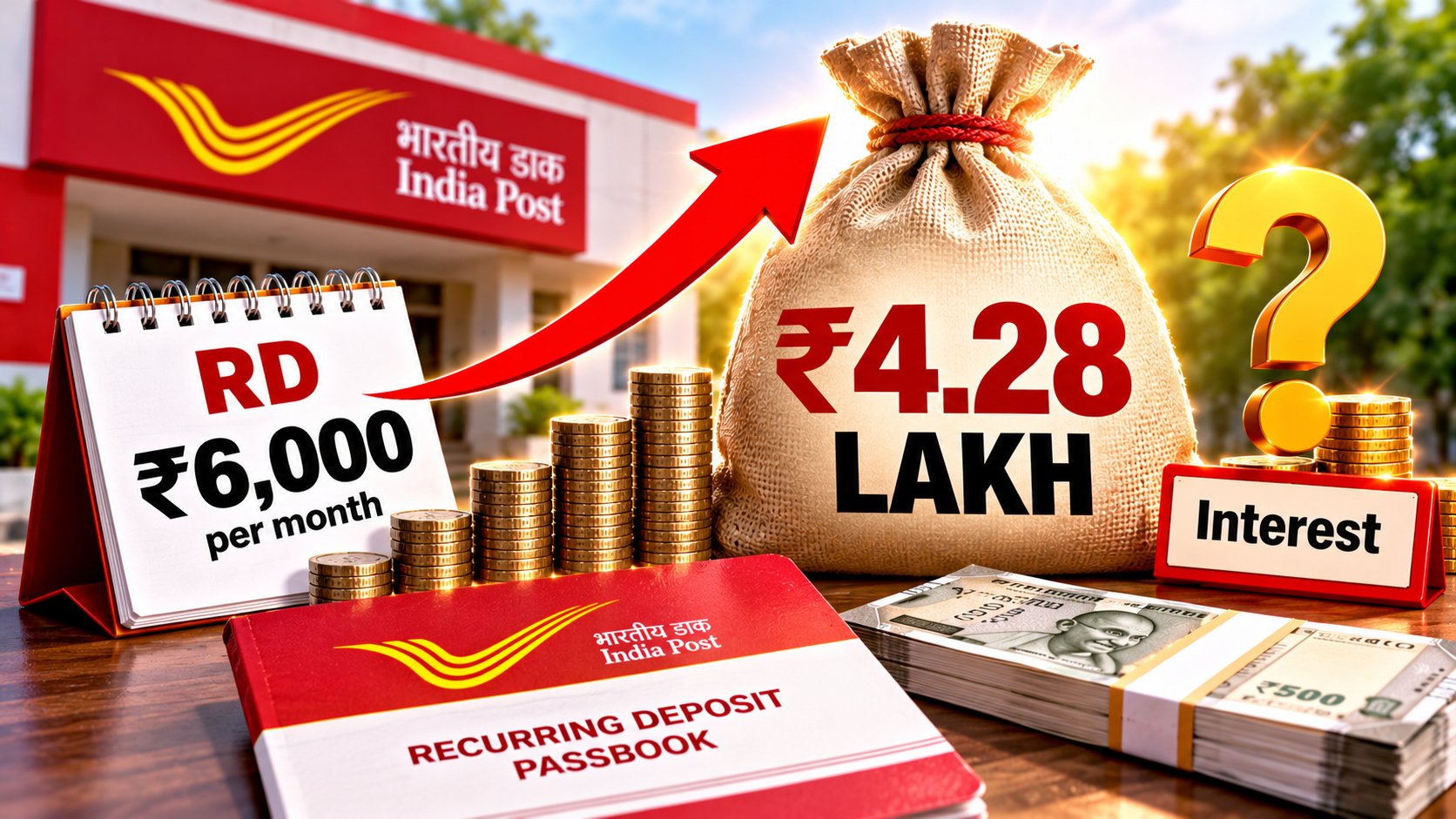
Yes, a ₹6,000 monthly Post Office recurring deposit at 6.7% matures at about ₹4.28 lakh after five years. But this is not a refund or a bonus: ₹3.6 lakh of it is your own money coming back. The real gain is ₹68,195, before tax.
A message doing the rounds promises that a Post Office scheme will “refund ₹4 lakh instead of ₹6,000”. It sounds like a windfall. It is actually the Post Office Recurring Deposit, one of the most ordinary savings products in India, described in the most confusing way possible. You pay ₹6,000 every month for five years, and at the end you get back about ₹4.28 lakh.
That is a perfectly good outcome for a safe, disciplined saver. But it helps to know what you are really getting. Most of the ₹4.28 lakh is your own savings returned to you. The interest, the part the Post Office adds, is ₹68,195. Here is how the number is built, what eats into it, and when an RD is the right choice.
Table of Contents
Quick Summary
₹6,000 a month for 60 months at 6.7% grows to about ₹4,28,195, of which ₹3,60,000 is your own deposits and ₹68,195 is interest. The rate is fixed for the life of an account opened now, compounded quarterly, and backed by the Government of India. Interest is taxable at your slab, missed payments carry a penalty of ₹1 per ₹100, and closing early before maturity cuts the interest sharply. It is a savings habit, not a scheme that multiplies money.
What We Know
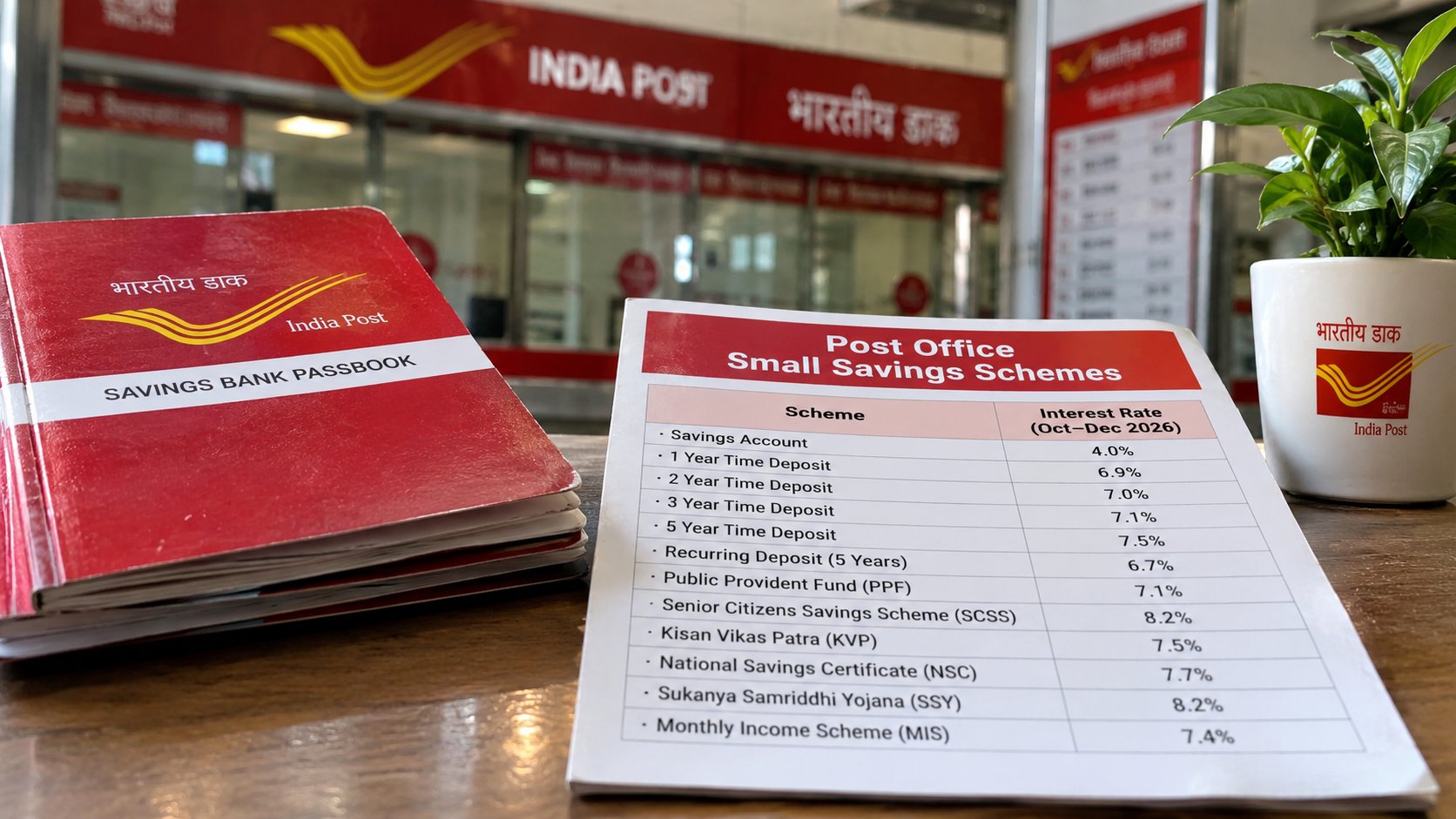
- The Post Office RD pays 6.7% a year for October to December 2026, compounded quarterly, for a 5-year term.
- India Post’s own example shows ₹5,000 a month maturing at ₹3,56,830; ₹6,000 a month scales to about ₹4,28,195.
- A missed instalment costs ₹1 per ₹100, and four consecutive misses discontinue the account unless revived within two months.
- A loan of up to 50% of the balance is available after 12 instalments, at the RD rate plus 2%.
What Is Still Unclear
- The RD rate for accounts opened from January 2027, which the Finance Ministry will announce by the end of December 2026.
- Your personal tax on the interest, which depends on your slab and regime.
- The exact interest paid on premature closure, which depends on the closure date and the savings rate then in force.
- The rate that will apply if you extend the account for another five years after maturity.
Why “Refund” Is the Wrong Word
A refund is money returned that you overpaid. A recurring deposit is a savings account where you commit to depositing a fixed sum every month, and the Post Office pays interest on each instalment from the month it arrives. At maturity you get both back: everything you put in, plus the interest.
The CSR Journal, which reported the ₹6,000 example on 12 October 2026, puts the total deposited at ₹3,60,000, the interest at ₹68,185 and the maturity amount at ₹4,28,185. Our calculation, using the same 6.7% with quarterly compounding, gives ₹4,28,195. The ₹10 difference is rounding. Either way, the “₹4 lakh” is mostly your own money.
Put another way, the interest is about 18.9% of the money you deposit over five years. Because each instalment is invested for a different length of time, the first for 60 months and the last for one, the average rupee earns interest for only about half the term. That is why the gain looks small next to the headline 6.7%.
How the Balance Builds, Year by Year
An RD grows slowly at first, because early on there is little money in the account to earn interest. The interest gap widens each year as the balance gets bigger. Watching the balance against what you have paid in shows why staying the full five years matters.
| After | Total deposited | Balance with interest | Interest so far |
|---|---|---|---|
| 12 months | ₹72,000 | ₹74,652 | ₹2,652 |
| 24 months | ₹1,44,000 | ₹1,54,433 | ₹10,433 |
| 36 months | ₹2,16,000 | ₹2,39,695 | ₹23,695 |
| 48 months | ₹2,88,000 | ₹3,30,815 | ₹42,815 |
| 60 months | ₹3,60,000 | ₹4,28,195 | ₹68,195 |
More than a third of the total interest, ₹25,380, is earned in the fifth year alone. That is the strongest argument against closing early: the best part of the RD comes at the end. The figures above assume the account runs to maturity at 6.7%; an early closure is paid at a lower rate, as explained below.
What Other Monthly Amounts Become
The ₹6,000 figure is just one example. Because the rate is the same for every amount, the maturity value scales in proportion. ₹1,000 a month becomes ₹71,366, and ₹20,000 a month becomes ₹14,27,317. There is no upper limit on Post Office RD deposits, and the minimum is ₹100 a month.
The Rules That Can Shrink Your ₹4.28 Lakh
The maturity figure assumes every instalment arrives on time for 60 months. StableMoney’s summary of the rules sets out what happens when it does not. Deposits are due by a fixed date each month, and a missed instalment attracts a default fee of ₹1 for every ₹100. On a ₹6,000 instalment, that is ₹60 per missed month.
Closing early costs more than it looks
Premature closure is allowed only after three years, and the interest is then paid at the Post Office savings account rate instead of the RD rate. With the savings account at 4%, closing a ₹6,000 RD after 36 months returns roughly ₹2.30 lakh on ₹2.16 lakh deposited, against about ₹2.40 lakh if the same deposits had earned 6.7%. That is close to ₹10,000 of interest lost.
What Tax Does to the Interest
Post Office RD interest is not tax-free. It is added to your income and taxed at your slab rate, and RD deposits do not qualify for any deduction. That changes the real gain considerably, especially for people in higher slabs.
Many savers have no tax to pay at all: under the new regime for tax year 2026-27, the Section 87A rebate makes income up to ₹12 lakh effectively tax-free for residents. For them, the full ₹68,195 is kept. Inflation is a separate cost. With consumer price inflation at 5.54% in September 2026, the RD’s effective annual yield of about 6.87% beats rising prices only modestly before tax, and barely, if at all, for higher-slab savers after tax.
Why Locking in 6.7% Now Matters
Small savings rates are reviewed every quarter by the Finance Ministry. On 30 September 2026, it kept the Post Office RD rate at 6.7% for October to December 2026, along with rates on the Monthly Income Scheme, Senior Citizens’ Savings Scheme, PPF and others. The next decision is due by the end of December.
The key feature for an RD saver is that the rate in force on the day you open the account applies for the whole five-year term. Later changes, up or down, do not affect an existing account. That makes timing relevant. The Reserve Bank raised its repo rate by 25 basis points to 5.50% on 7 October 2026, which could, over time, feed into the rates banks offer. Whether small savings rates follow is a government decision, and nobody can say for certain.
For a saver, the practical point is simple. If 6.7% suits your goal now, opening the account locks it in for five years. Waiting in the hope of a higher rate risks losing months of instalments and interest, and the rate could equally be cut. A rate you know is often worth more than a rate you hope for, especially when the money is meant for a fixed goal.
Is the Post Office RD the Right Pot for You?
An RD is built for a particular kind of saver: someone with a regular income who wants to set aside a fixed sum every month for a goal three to five years away, with no market risk. It is less suited to money you may need soon, or to long-term wealth building where inflation matters more.
Comparisons matter too. In our earlier analysis, SBI’s regular RD for five years paid 6.05%, which on ₹6,000 a month gives about ₹4,20,934, roughly ₹7,261 less than the Post Office. Senior citizens can do better at some banks with higher senior rates, and anyone who might need to stop early may prefer a bank RD with more flexible terms.
Three Savers, Three Reasons to Pick ₹6,000
A ₹6,000 RD makes sense when the number fits the household budget and the goal fits the five-year term. Three common cases show how the same product serves different needs. The figures are the same in every case; what changes is why the saver cares.
The young earner building a first fund
Rohan earns ₹30,000 a month and wants to save 20% of his salary without being tempted to spend it. A ₹6,000 RD takes the money out of his account automatically each month. In five years he will have about ₹4.28 lakh, enough for a down payment on a two-wheeler and an emergency cushion, with no market risk at a time when he is still learning about investing.
The parents planning a school or college bill
Meera and Suresh know their daughter’s college admission fee will fall due in about five years. An RD matched to that date gives them a fixed, known amount on a fixed date. Because the rate is locked in at opening, a future cut in small savings rates does not change their maturity figure.
The household that needs discipline more than return
For families with irregular spending, the main value of an RD is the commitment. The ₹60 default fee and the three-year lock-in work as nudges to keep saving. Higher-return options exist, but many people never invest in them consistently. A modest return that actually accumulates can beat a better return that never gets saved.
Opening the Account, and the 10-Year Option
A Post Office RD can be opened at any post office with a savings account, or online for those who use India Post’s internet or mobile banking. You will typically need identity and address proof, PAN, photographs and the first instalment. Accounts can be single or joint, and can be opened for a minor through a guardian.
At maturity, the account can be extended for another five years on application, StableMoney notes. Extending lets the money keep compounding without a fresh start. If a ₹6,000 RD ran for ten years at 6.7%, ₹7.2 lakh of deposits would grow to about ₹10,25,127. That figure is illustrative: the rate on an extended account depends on the rules in force, so check the exact rate before you extend.
The decision at maturity is worth planning early. If the goal has arrived, take the money. If not, compare the extension rate with other safe options such as a Post Office time deposit or a bank FD at that time, and choose the best fit rather than extending by default.
From Opening to Maturity: Six Milestones
Six Steps to Get the Full Maturity Amount
Frequently Asked Questions
How much will I get if I deposit ₹6,000 a month in a Post Office RD?
About ₹4,28,195 after five years at 6.7%, compounded quarterly. That includes ₹3,60,000 of your own deposits and ₹68,195 of interest, before tax.
What is the Post Office RD interest rate now?
6.7% a year for October to December 2026, compounded quarterly. The rate at opening stays fixed for the account’s five-year term.
Is Post Office RD interest tax-free?
No. Interest is taxable at your slab rate and RD deposits do not qualify for a tax deduction. Savers whose total income falls within the rebate limit may owe no tax.
What happens if I miss an RD instalment?
A default fee of ₹1 per ₹100 applies, ₹60 on a ₹6,000 instalment. Four consecutive misses discontinue the account, which can be revived within two months by paying the dues.
Can I close a Post Office RD early?
Only after three years. Interest is then paid at the Post Office savings account rate, not the RD rate, so you earn noticeably less.
Can I take a loan against a Post Office RD?
Yes. After 12 instalments without default, you can borrow up to 50% of the balance at the RD rate plus 2%, currently 8.7%.
Is there a maximum amount for a Post Office RD?
No. The minimum is ₹100 a month, in multiples of ₹10, and there is no upper limit.
Is Post Office RD better than a bank RD?
For a full five-year term, the Post Office’s 6.7% beat SBI’s 6.05% five-year RD in our earlier comparison. Banks can be better for shorter goals, senior citizen rates or flexibility on early exit.
The Short Version
Depositing ₹6,000 a month in a Post Office RD at 6.7% for five years gives about ₹4.28 lakh. It is not a refund: ₹3.6 lakh is your own money, and ₹68,195 is interest before tax. Pay on time to avoid ₹60 penalties, never plan to close before three years, use the loan facility instead of breaking the account, and account for tax at your slab. It is a safe savings habit, not a money multiplier.