Is Cheap Money Over? What RBI's First Rate Hike Since 2023 Means for Your EMI
Is Cheap Money Over? What RBI’s First Rate Hike Since 2023 Means for Your EMI
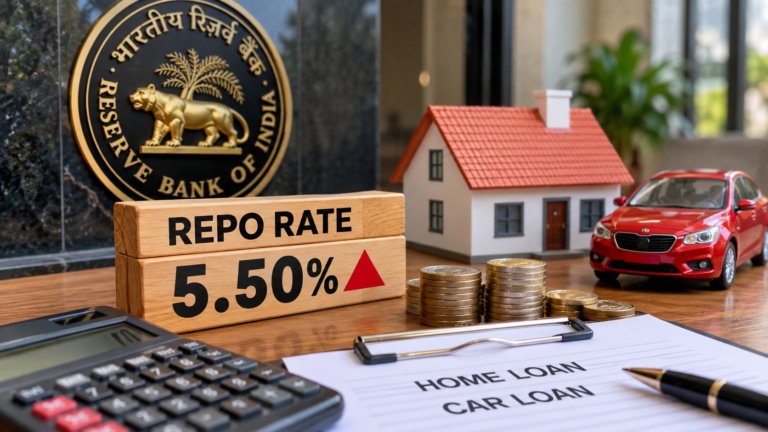
Retail inflation rose to 5.54% in September 2026, its highest this year, two weeks after the Reserve Bank raised the repo rate to 5.50% and said rate cuts are “off the table” for now. SBI has already passed the increase to borrowers. The easing cycle has ended, but loans are still cheaper than they were in early 2025.
For most of 2025, borrowers in India had a good run. The Reserve Bank cut its policy rate four times, by a total of 1.25 percentage points, and home loan EMIs eased. In 2026 the mood changed. Prices of food and fuel climbed, the rupee weakened, and on 7 October the RBI raised rates for the first time in more than three years. On 15 October, SBI raised its loan benchmarks by the same quarter point.
So is the era of cheap money over? The honest answer has two parts. The direction has turned, and the RBI says cuts are off the table for now. But the level is still lower than it was before the 2025 cuts began. What happens next depends on inflation, which is exactly what this article tracks, along with what each borrower and saver can do about it.
Quick Summary
The cutting cycle is over for now, but money is not yet expensive by recent standards. The repo rate is 5.50%, a quarter point above its low but a full point below the 6.50% of January 2025. Inflation rose for five months in a row to 5.54% in September, led by food at 7.74%. The RBI changed its stance to “calibrated tightening” and said its next move can only be a hike or a pause. On a ₹50 lakh, 20-year home loan, the quarter-point rise adds about ₹781 a month.
What We Know
- The RBI raised the repo rate by 25 basis points to 5.50% on 7 October 2026, in a unanimous decision, and changed its stance to “calibrated tightening”.
- CPI inflation was 5.54% in September 2026, up from 4.83% in August, with food inflation at 7.74%.
- SBI raised its EBLR to 8.15% and RLLR to 7.75% from 15 October 2026, and lifted MCLR by 15 basis points on several tenures.
- The RBI raised its FY27 inflation forecast to 5.2% and its growth forecast to 7.1%.
What Is Still Unclear
- Whether the RBI will hike again at its 2 to 4 December meeting or pause.
- How quickly other banks will raise lending rates, and by how much.
- Whether deposit rates will follow; SBI’s chairman has said no deposit rate action is likely for two to three months.
- How long food prices, oil prices and the weak rupee will keep inflation elevated.
From Four Cuts to a Hike in Twenty Months
The rate path tells the story. According to the rate history compiled by Shoonya, the RBI cut the repo rate from 6.50% to 6.25% in February 2025, to 6.00% in April, by half a point to 5.50% in June, and to 5.25% in December 2025. It then held at 5.25% for ten months before raising it back to 5.50% in October 2026.
This is the core of the “is cheap money over?” question. If cheap money means falling rates, yes, that phase has ended. If it means low rates, the answer is more mixed: 5.50% is still a full percentage point below where the cycle began. Borrowers who took loans in 2024 are still paying less than they were then.
Why Inflation Forced the RBI’s Hand
Inflation has climbed steadily through 2026. Official consumer price data, as summarised by Finnovate, show it at 3.48% in April, 3.93% in May, 4.38% in June, 4.45% in July, 4.83% in August and 5.54% in September. That is five straight increases, and September is the highest reading of the year.
Food is doing most of the damage
Food inflation reached 7.74% in September, from 5.97% in August. Onion prices were up 108% from a year earlier, garlic 55% and ginger 63%, while tomato and potato prices were lower. Rural households, who spend more of their budget on food, felt it more: rural inflation was 6.08% against 4.88% in towns and cities.
Oil, the rupee and West Asia
The RBI’s statement, as reported by IIFL, pointed to higher crude oil prices, a weaker rupee that makes imports costlier, and the West Asia conflict as risks. Fuel costs feed into transport and production costs across the economy, which is why a central bank watches them even when headline fuel inflation looks contained. The RBI raised its FY27 inflation forecast to 5.2% from 5.0%, and core inflation to 4.4%.
How a Repo Hike Reaches Your EMI
The repo rate is what the RBI charges banks for short-term money. Most new home loans since October 2019 are linked to an external benchmark, usually the repo rate, so a hike reaches borrowers quickly. SBI moved within eight days.
| SBI benchmark | Before 15 Oct | From 15 Oct | Change |
|---|---|---|---|
| EBLR | 7.90% | 8.15% | +0.25 |
| RLLR | 7.50% | 7.75% | +0.25 |
| MCLR, 3 months | 8.25% | 8.40% | +0.15 |
| MCLR, 6 months | 8.60% | 8.75% | +0.15 |
| MCLR, 1 year | 8.70% | 8.85% | +0.15 |
| MCLR, overnight and 1 month | 7.85% | 7.85% | Unchanged |
Figures are as reported by ETV Bharat. Business Today reported SBI’s revised EBLR-linked home loan rates at 7.50% to 8.80%, depending on the borrower’s profile. Older loans linked to MCLR move more slowly, typically at the reset date set out in the loan agreement, often once a year.
The Money Maths: What 0.25 Points Costs You
A quarter-point rise sounds small, and per month it is. Over the life of a long loan, it adds up. The table below uses a 20-year remaining tenure and a move from 8.00% to 8.25%, roughly what a repo-linked borrower at SBI would see.
| Loan outstanding | EMI at 8.00% | EMI at 8.25% | Extra a month | Extra over 20 years |
|---|---|---|---|---|
| ₹20 lakh | ₹16,729 | ₹17,041 | ₹313 | ₹75,003 |
| ₹30 lakh | ₹25,093 | ₹25,562 | ₹469 | ₹1,12,504 |
| ₹50 lakh | ₹41,822 | ₹42,603 | ₹781 | ₹1,87,507 |
| ₹75 lakh | ₹62,733 | ₹63,905 | ₹1,172 | ₹2,81,260 |
The ₹50 lakh row matches Business Today’s example of about ₹781 more a month. Money Desk calculated the rest using the standard EMI formula; your bank’s figures may differ slightly with rounding and reset timing.
The comparison also puts the hike in proportion. A borrower whose rate fell by a full percentage point during 2025, from 9.25% to 8.25%, still pays about ₹3,190 a month less than before the cuts on a ₹50 lakh loan. The hike claws back roughly a fifth of that saving.
Beyond Home Loans: Who Else Feels the Hike
Home loans get the headlines because they are long and large, but the rate rise reaches other borrowers too, in different ways and at different speeds. The key question for any loan is whether its rate is fixed at the start or floats with a benchmark.
Car and personal loans
Most car loans and personal loans in India carry a fixed rate for the full tenure. If you already have one, your EMI will not change. New borrowers may see higher quotes as banks reprice to reflect their own higher funding costs, so anyone planning such a loan in the coming months may find offers a little less generous than earlier in the year.
Small businesses
Many loans to micro, small and medium enterprises are linked to external benchmarks, so they move almost as fast as repo-linked home loans. For a business with a working capital line, a quarter-point rise on ₹50 lakh of borrowing adds about ₹12,500 a year in interest. That is manageable for most firms, but it lands at the same time as higher input costs from fuel and food inflation.
Credit cards and gold loans
Credit card interest is already far above policy rates and does not track the repo closely, so the hike changes little there. Gold loans and other secured short-term loans are often repriced at renewal, which means borrowers who roll over every few months may notice changes sooner than long-term borrowers.
The Real Rate: Why 5.50% Is Not Tight Yet
Economists judge whether money is cheap by the real interest rate: the policy rate minus inflation. With the repo rate at 5.50% and September inflation at 5.54%, the real policy rate was briefly just below zero. Measured against the RBI’s own FY27 forecast of 5.2%, it is about 0.3 percentage points.
That is low by historical standards. A central bank that wants to bring inflation down usually aims for a positive real rate, so that borrowing is not effectively subsidised by rising prices. This is the strongest argument that the RBI may not be finished. It is also why a single quarter-point hike does not, on its own, make money expensive. Until real rates rise more clearly above zero, credit remains relatively easy to get and to afford.
For borrowers, a negative or near-zero real rate has a quiet upside: inflation erodes the real value of a fixed EMI over time. For savers, the same arithmetic works against them. A deposit earning less than inflation after tax is losing purchasing power, however safe it is.
What the RBI Is Signalling Next
Central banks rarely raise rates once and stop. The RBI’s resolution said that the next policy action “can only be a rate hike or a pause”, and that “rate cuts are off the table in the near term”, according to Shoonya’s summary. The next decision is due on 4 December, after the 2 to 4 December meeting. October’s inflation figure, due on 12 November, will be the last major data point before it.
Growth gives the RBI room to act. It raised its FY27 growth forecast to 7.1% from 6.7%, IIFL reported, so it is not trying to rescue a weak economy. When growth is solid and inflation is rising, central banks usually prefer to lean against prices.
The Other Side: What Savers Can Expect
Rising rates should eventually help savers, but deposits react more slowly than loans. Earlier this month, SBI’s chairman said no deposit rate action was likely for two to three months, as we reported in our fixed deposit coverage. Banks lift lending rates first because their loans are linked to the repo rate; deposit rates are set by competition for funds.
Inflation matters for savers too. With CPI at 5.54%, a deposit at 6.5% earns a real return of under 1 percentage point before tax, and less than nothing after tax for someone in the 30% slab. Small savings schemes kept their rates unchanged for October to December 2026, including 6.7% on the Post Office RD and 8.2% on the Senior Citizens’ Savings Scheme.
Planning a Big Purchase? Timing Versus Readiness
Some readers will be weighing whether to buy a home or a car now or wait. Trying to time interest rates is usually less useful than checking readiness. A quarter-point move changes the EMI on a ₹50 lakh loan by under ₹800 a month. The price of the house, the size of the down payment and the stability of your income matter far more.
If you do borrow on a floating rate now, build in a margin. Ask whether you could still pay the EMI if the rate rose another half point, which on ₹50 lakh over 20 years would mean about ₹43,391 a month at 8.50% instead of ₹42,603. If that would strain the budget, a smaller loan or a larger down payment is safer than hoping rates fall again soon.
Six Moves for Borrowers and Savers Now
Frequently Asked Questions
What is the current RBI repo rate?
5.50%, after a 25 basis point hike on 7 October 2026. It was the first increase since February 2023.
Why did the RBI raise interest rates in October 2026?
To contain rising inflation, driven by food prices, higher crude oil prices and a weaker rupee, along with West Asia risks. Inflation reached 5.54% in September.
Will my home loan EMI increase?
If your loan is linked to the repo rate, likely yes, from your next reset. SBI raised its EBLR and RLLR by 0.25 points from 15 October. On ₹50 lakh over 20 years, that is about ₹781 more a month.
Will the RBI raise rates again?
Possibly. The RBI said its next move can only be a hike or a pause, and that cuts are off the table near term. The next decision follows the 2 to 4 December meeting.
What is India’s inflation rate now?
CPI inflation was 5.54% in September 2026, up from 4.83% in August. Food inflation was 7.74%.
Will FD rates go up after the repo hike?
Not immediately. SBI’s chairman said no deposit rate action was likely for two to three months. Deposit rates tend to follow lending rates with a lag.
Should I increase my EMI or extend my loan tenure?
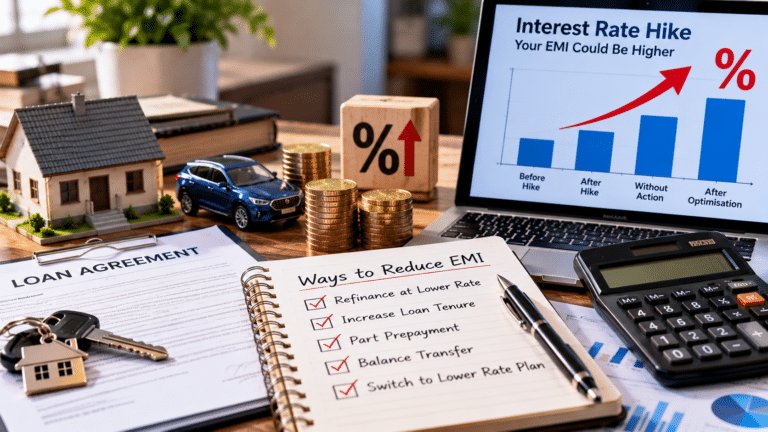
If affordable, raising the EMI is usually cheaper. On a ₹50 lakh loan, the higher EMI costs about ₹1.88 lakh over 20 years, while a 12-month extension costs about ₹4.96 lakh.
Is cheap money over in India?
The rate-cutting phase is over for now, but at 5.50% the repo rate is still a full point below the 6.50% of early 2025, so loans remain cheaper than before the 2025 cuts.
The Short Version
The RBI raised the repo rate to 5.50% on 7 October 2026 as inflation climbed to 5.54%, led by food. It says cuts are off the table and the next move is a hike or a pause. SBI has passed on the increase. A ₹50 lakh home loan costs about ₹781 more a month, but rates remain a point below early 2025. Check your loan’s benchmark, prefer a higher EMI to a longer tenure, and keep deposits short until rates settle.