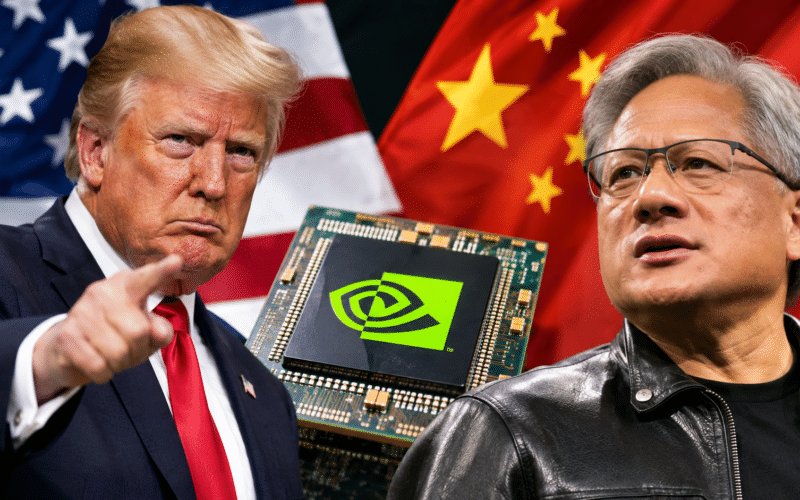
Technology · US-China · Export controls, November 2026
Why Did Trump Change His China Chip Policy for Nvidia? The Deal, the Critics and the Defence
The administration went from blocking Nvidia’s China chips in April 2025 to allowing more powerful H200 sales for a 25% cut of revenue. Critics call it corruption; the White House calls it strategy. Here is what the record shows, and how the Huang scandal has changed the picture.
A year ago, the most powerful AI chip Nvidia could legally sell in China was one Chinese buyers largely did not want. Then, in December 2025, President Trump announced on social media that Nvidia could sell its far more capable H200 to approved Chinese customers, with a quarter of the revenue going to the US government. To supporters, it was a pragmatic trade deal. To critics, including some Republicans, it looked like national security put up for sale.
The question has returned with force this month. Jensen Huang’s resignation and reinstatement as Nvidia’s CEO, amid reports involving a suspected Chinese intelligence asset, put the company’s China business under a microscope. Some commentators have gone as far as calling the policy a “scam”. That is an allegation, not an established fact, and this explainer treats it that way: it sets out what changed, the reasons given, the evidence critics cite, and the case made in its defence.
From Ban to Bargain: How the Policy Shifted
The starting point was restrictive. Nvidia’s annual report states that in April 2025 the US government required a licence for exports of its H20, the chip designed to comply with earlier rules. Nvidia took a $4.5 billion charge for excess inventory as a result. In August 2025 the government granted licences for some H20 shipments; Nvidia said it earned about $60 million under them.
- $4.5 bnNvidia charge after the April 2025 H20 licence requirement
- $10.5 bnLost H20 sales to China, as valued by Nvidia, per The Register
- 15%Revenue share floated for H20 sales in August 2025
- 6xH200’s power versus H20, per the Institute for Progress
- Up to 10xBlackwell’s speed-up on some workloads, per Nvidia research cited by Reuters
- $0H200 revenue Nvidia had booked by its FY2026 annual report
Then came the bigger step. On 8 December 2025, Trump posted that Nvidia could sell H200s to “approved customers” in China and that 25% of sales would be paid to the United States, Reuters and Al Jazeera reported. The Commerce Department later formalised a 25% tariff on the chips, TechCrunch reported. Blackwell and the upcoming Rubin chips remained off limits.
Figures from Nvidia’s FY2026 annual report and The Register; the $250 million row is our illustration of a 25% fee on $1 billion of sales. Bar length scaled to $10.5 billion.
The gap between what Nvidia says it lost and what it actually earned under the new licences is striking. It helps explain why the company lobbied so hard, and why critics question whether the deals delivered much benefit to anyone.
Why Trump Changed Course: The Reasons Reported
The administration has not published a single formal rationale, but reporting points to several overlapping motives.
Huawei and the fear of losing the market
Bloomberg reported that the H200 reprieve was spurred by Huawei’s progress in AI chips. Reuters reported that officials saw the H200 as a compromise between sending Blackwell to China and sending nothing, which they believed would help Huawei sell more of its own chips. Nvidia’s filings make the same argument: being shut out of China helps rivals build larger developer and customer ecosystems.
Revenue and the trade talks
The Atlantic Council said the administration’s calculus came down mainly to economics and a belief that spreading US technology strengthens national power, with the 25% cut offering a benefit to taxpayers. Trump said he had informed Chinese President Xi Jinping of the decision and that Xi “responded positively”. A White House spokesman defended a related revenue-sharing arrangement as a way to raise revenue while safeguarding national security.
Lobbying by Nvidia’s chief executive
Tilly Zhang of Gavekal Dragonomics told Al Jazeera the decision reflected market realities as well as intense lobbying by Huang. Reuters reported that Trump said he had met Huang and discussed export controls the week before the announcement. Lobbying is legal, but critics argue it gave one company outsized influence over a national security decision.
What people get wrong: a licence to sell is not a sale. Nvidia’s annual report said it had generated no revenue under the H200 programme by the end of its fiscal year, and analysts told CNBC that Beijing did not approve large-scale imports. Approvals in Washington did not automatically mean chips reached China.
The Critics’ Case, Including the ‘Corruption’ Charge
Opposition has come from both parties. Representative Gregory Meeks, the top Democrat on the House Foreign Affairs Committee, said in December 2025 that the decision “reeks of corruption” and that national security was “for sale”. Senator Elizabeth Warren accused the administration of “selling out US security”, and several Democratic senators called it a “colossal economic and national security failure”.
Republican China hawks objected too. Representative John Moolenaar, who chairs the House China select committee, questioned whether a revenue-sharing arrangement was legal or constitutional and warned against incentivising the government to license technology sales to China. Brad Carson, a former Under Secretary of the Army, said the move “puts our competitive edge up for sale, all for a 25% cut”.
Allegation versus finding: “scam” and “corruption” are political charges. No court, inspector general or congressional investigation has concluded that the policy was corrupt or that anyone profited improperly. The White House and Nvidia say the sales were lawful and subject to strict conditions.
What the House Records Revealed
On 19 November 2026, the House Foreign Affairs Committee, chaired by Republican Brian Mast, released licensing records. Reuters and Al Jazeera reported that Commerce approved 879,000 Nvidia H200 and AMD MI325X chips for Chinese companies from December 2025 to May 2026, through 21 licences. Companies had sought permission for more than 3.4 million.
Figures from House Foreign Affairs Committee records as reported by Reuters, Al Jazeera and Attack of the Fanboy. Bar length scaled to 3.4 million requested chips.
By our calculation, Commerce approved about 26% of the chips requested, and the four named firms, Tencent, Alibaba, Baidu and BYD, all on the Pentagon’s list of alleged Chinese military companies, accounted for 272,000, or about 31% of approvals. Attack of the Fanboy reported that Nvidia had applied to sell 40,000 H200s to a company with reported ties to the woman at the centre of the Huang scandal; that application’s outcome was not detailed.
Nvidia told CNBC that the approvals were “subject to strict conditions and limited volumes”, that limited shipments were “legal and authorized”, and that “despite receiving some licenses, we have since stopped shipping H200s to China”. It was not clear how many approved chips were actually delivered.
The Defenders’ Case
The policy has serious supporters. The Information Technology and Innovation Foundation argued that cutting US chipmakers out of China only accelerates China’s own chip progress, and called allowing H200 sales “the right move”, though it criticised the revenue cut. Some China hawks, including James Mulvenon, whose 2020 report helped drive sanctions on Chinese chipmaker SMIC, saw the impact as more limited than critics claimed, Reuters reported.
| Question | Case for the policy | Case against the policy | What the evidence shows so far |
|---|---|---|---|
| Does it help China’s AI? | H200 is a generation behind; Blackwell stays banned | Even H200 is about 6x the H20 and useful for training | Beijing limited imports; actual deliveries unclear |
| Does it help Huawei? | Selling US chips denies Huawei market share | Huawei will grow anyway; US gives up leverage | Bloomberg says Huawei’s gains spurred the decision |
| Is the 25% cut lawful? | Formalised as a tariff by Commerce | Moolenaar questions legality and precedent | No court ruling reported |
| Was it corrupt? | White House says it raises revenue and protects security | Meeks says it “reeks of corruption” | No official finding of wrongdoing |
| Who were the buyers? | Approvals were vetted by Commerce | Several are on a Pentagon military-linked list | 879,000 approved; 272,000 to four listed firms |
The final column is our summary of what has been publicly reported, not a verdict.
Worked example: what the 25% cut means in dollars. If Nvidia sold $1 billion of H200 chips to approved Chinese buyers, the US government would collect $250 million under the 25% arrangement, compared with $150 million under the 15% rate floated in August 2025. Nvidia’s filings warn it may not be able to pass the cost on to customers. These figures are our illustration; neither Nvidia nor the government has disclosed how much has actually been collected.
After the Huang Scandal: Tighter Rules, Same H200 Line
The scandal shifted the politics. On 16 November 2026, the Commerce Department’s Bureau of Industry and Security issued an interim final rule, written at the direction of the Treasury and the National Security Council, to stop Chinese companies accessing advanced chips remotely through overseas data centres. It also requires licences for advanced chips going to Indonesia, Malaysia, Singapore, Thailand and Brazil, which it describes as posing a higher-than-normal risk of diversion.
Day counts are our calculations from dates reported by Al Jazeera, Nvidia’s filings and law-firm summaries by Greenberg Traurig, Pillsbury and HLC. Bar length scaled to 60 days.
The rule requires a licence for any data centre, anywhere, that gives Chinese-headquartered companies access to more than 12 million TPP of advanced AI compute, a measure of total processing performance, according to Lets Data Science.
The rule took effect on 19 November 2026, with comments due by 18 January 2027. It also formally rescinded the Biden-era AI Diffusion Rule. Axios reported a public dispute between Treasury Secretary Scott Bessent and Commerce Secretary Howard Lutnick over export controls; Trump said he had no plans to replace Lutnick.
Yet the core H200 policy did not change. Bessent told CNBC on 20 November that “the H200s are the threshold level of chips that could be sold to the Chinese” and that he would not anticipate any change. Trump, who also discussed Huang with Xi, publicly supported Huang’s return as CEO on 23 November.
Timeline: Two Years of Reversals
- Licence required for H20 exports; Nvidia takes a $4.5 billion charge.
- H20 licences granted; 15% revenue share floated.
- Trump allows H200 sales to approved Chinese buyers for 25%.
- Commerce approves 879,000 Nvidia and AMD chips.
- Nvidia receives a licence for small amounts of H200s.
- Huang scandal; he resigns as Nvidia CEO.
- Remote-access rule and five-country licence requirement issued.
- House committee releases licence records; Nvidia says H200 shipments stopped.
- Bessent says H200 policy unchanged.
- Huang reinstated as Nvidia CEO.
What to Watch Next
- Whether Congress moves to legislate limits on chip export licences or revenue-sharing deals.
- Any findings from Nvidia’s independent investigation and the House inquiries.
- Whether Nvidia resumes H200 shipments, and whether Beijing allows imports.
- Comments and possible revisions to the remote-access rule before 18 January 2027.
- Disclosure of how much revenue the US has collected under the 25% arrangement.
What We Know, and What Is Still Unclear
What We Know
- Trump allowed H200 sales to approved Chinese buyers in December 2025 for a 25% fee.
- Commerce approved 879,000 chips from December 2025 to May 2026.
- A new rule on 16 November 2026 tightened remote access and five-country exports.
- Nvidia says it has stopped shipping H200s to China.
What Is Still Unclear
- How many approved chips were actually delivered.
- How much revenue the US government has collected.
- Whether any investigation will substantiate corruption claims.
- Whether the H200 policy will survive congressional pressure.
Frequently Asked Questions
Why did Trump allow Nvidia to sell H200 chips to China?
Reported reasons include preventing Huawei from dominating China’s market, earning a 25% cut for the US government, trade talks with Beijing and lobbying by Nvidia. Blackwell and Rubin chips remain banned.
Is Trump’s Nvidia chip deal a scam?
Critics such as Representative Gregory Meeks have called it corrupt, but that is a political allegation. No court or official investigation has found wrongdoing, and the administration says the policy protects national security.
How many Nvidia chips were approved for China?
House records show Commerce approved 879,000 Nvidia and AMD chips for Chinese companies from December 2025 to May 2026, against requests for 3.4 million.
Is Nvidia still selling H200 chips to China?
Nvidia said in November 2026 that it had stopped shipping H200s to China despite holding some licences.
What is the 25% fee on Nvidia chips?
It is a charge the US collects on approved H200 sales to China, formalised by the Commerce Department as a tariff. It replaced the 15% share floated for H20 sales in August 2025.
Did the Jensen Huang scandal change China chip policy?
It led to a new 16 November rule restricting remote access and adding licence requirements for five countries, but Treasury Secretary Bessent said the H200 policy is unchanged.
Which Chinese companies were approved for Nvidia chips?
Approvals included 150,000 chips for Tencent, 75,000 for Alibaba, 43,000 for Baidu and 4,000 for BYD, all on a Pentagon list of alleged military-linked firms.
Can Nvidia sell Blackwell chips to China?
No. Blackwell and the upcoming Rubin chips remain off limits for China under current US policy.
The Short Version
Trump changed China chip policy from blocking Nvidia’s H20 to allowing the more powerful H200 for a 25% cut, keeping Blackwell banned. Reported reasons include countering Huawei, revenue, trade talks and Nvidia’s lobbying. Critics from both parties call it a security risk, and some call it corrupt, though no official finding supports that. Records show 879,000 chips approved. After the Huang scandal, rules on remote access tightened, but the H200 line stands, and Nvidia says shipments have stopped.