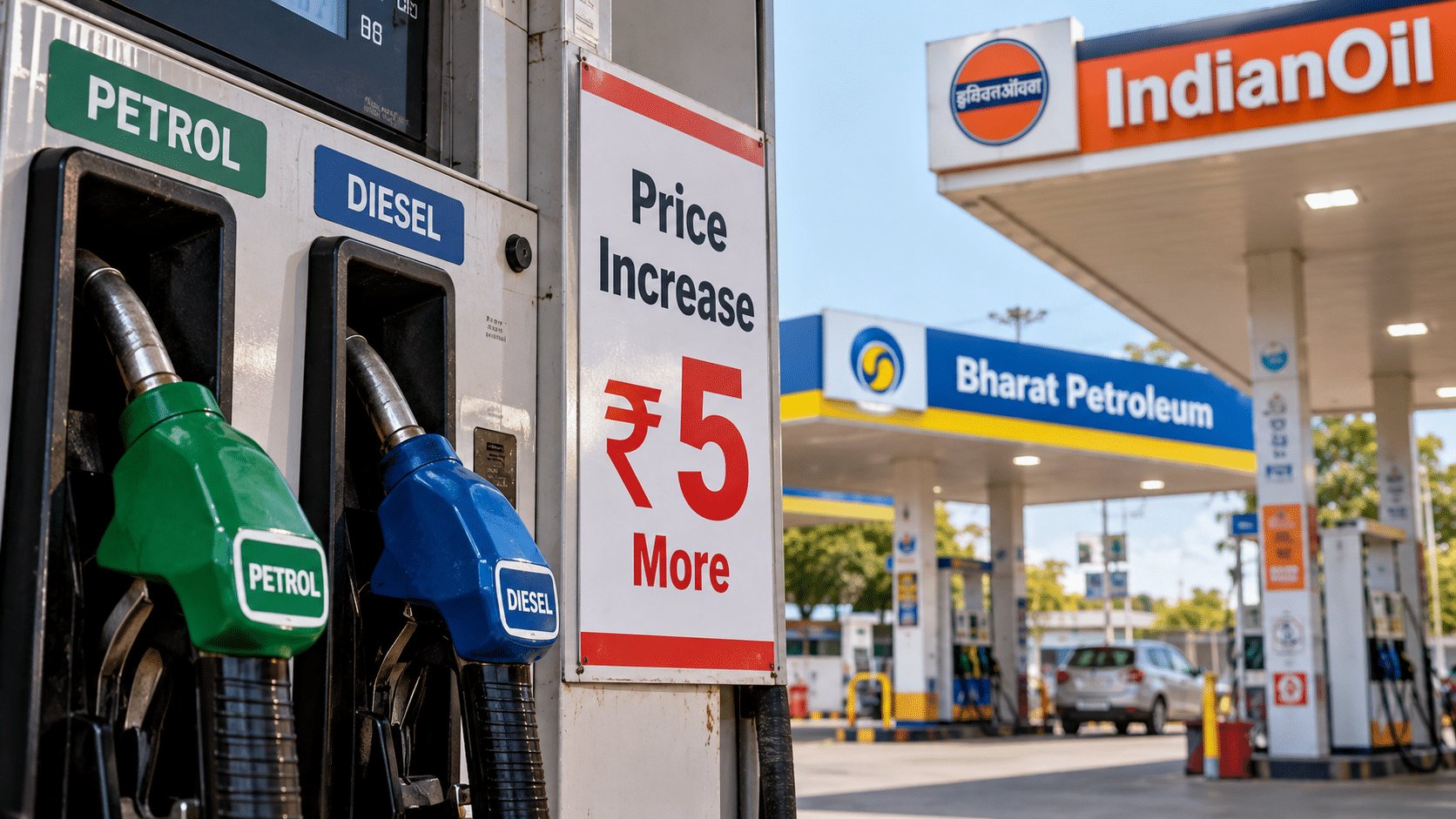
Petrol and Diesel Price Hike and the Windfall Tax: Why Private Pumps Now Charge ₹5 More — and Whether State-Run Pumps Follow
Petrol and Diesel Price Hike and the Windfall Tax: Why Private Pumps Now Charge ₹5 More — and Whether State-Run Pumps Follow
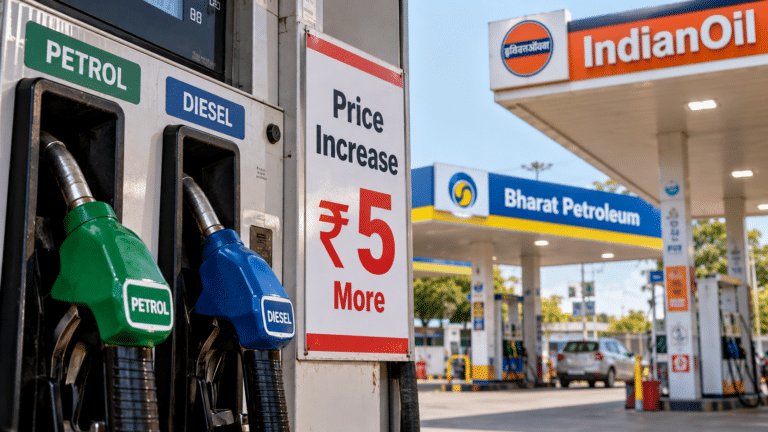
Nayara and Jio-bp raised petrol by ₹5 and diesel by ₹3 a litre this month. IOC, BPCL and HPCL pumps have held prices since May, while losing money on every litre. On 16 October, the Centre also revised its windfall export duties.
Fill up at a Nayara or Jio-bp pump this month and you will pay more than you did in September: ₹5 a litre more for petrol and ₹3 more for diesel. Drive a kilometre further to an Indian Oil, Bharat Petroleum or Hindustan Petroleum outlet, and the price has not moved since May. In Delhi, that is still ₹102.12 for petrol and ₹95.20 for diesel.
Two pump prices for the same fuel on the same street is unusual, and it tells you a lot about the strain in India’s fuel market. Crude oil is above $100 a barrel, state-run companies are losing money on every litre, and the Finance Ministry keeps adjusting a “windfall” duty on fuel exports. Here is what has actually changed, what it costs you, and the signals to watch for a wider hike.
Quick Summary
There has been no fresh petrol or diesel price hike at state-run pumps in October; the increases are at private retailers. Nayara raised petrol by ₹5 and diesel by ₹3 a litre on 3 October, and Jio-bp did the same on 11 October. PSU prices have been unchanged since a series of May hikes added about ₹7.4 a litre. The windfall tax is a separate export duty: on 16 October, the Centre raised it on petrol exports to ₹2.5 a litre and cut it on diesel exports to ₹8.5. It does not apply to the price you pay at the pump.
What We Know
- Nayara Energy raised petrol by ₹5 and diesel by ₹3 a litre across 7,108 outlets from 3 October.
- Jio-bp made the same increase across 2,304 outlets from 11 October.
- State-run pump prices were unchanged on 15 October, with Delhi petrol at ₹102.12 and diesel at ₹95.20.
- From 16 October, the export duty on petrol rose from ₹0.5 to ₹2.5 a litre and on diesel fell from ₹16 to ₹8.5.
- Brent crude traded around $104 a barrel in mid-October.
What Is Still Unclear
- Whether IOC, BPCL and HPCL will raise prices, and when.
- Whether the government will cut excise duty to cushion a PSU hike.
- Whether a windfall levy also applies to domestic crude production in this cycle; recent notices cover product exports.
- How long state companies can absorb losses estimated at ₹530 crore a day.
Two Prices on the Same Road
Private retailers sell a small share of India’s fuel, but their pricing is a useful early signal. Nayara, which is part-owned by Russia’s Rosneft, and Jio-bp, the Reliance and BP joint venture, buy crude and sell fuel on commercial terms. When international prices rise and stay high, they pass the cost on. Nayara said its 3 October increase reflected higher crude and product prices squeezing retail margins; it was its second revision this year, after a rise in March and a cut in July.
State-run companies have held back. The government has also asked private retailers not to restrict sales at their outlets, Sarkaritel reported, a sign that officials are watching for the queues and dry pumps that appeared during earlier periods of price gaps.
| City | Petrol, PSU | Diesel, PSU | Private hike | Change at PSU in October |
|---|---|---|---|---|
| Delhi | ₹102.12 | ₹95.20 | +₹5 / +₹3 | None |
| Mumbai | ₹111.21 | ₹97.83 | +₹5 / +₹3 | None |
| Kolkata | ₹113.51 | ₹99.82 | +₹5 / +₹3 | None |
| Chennai | ₹107.76 | ₹99.55 | +₹5 / +₹3 | None |
| Bengaluru | ₹111.68 | ₹99.56 | +₹5 / +₹3 | None |
| Hyderabad | ₹116.15 | ₹104.23 | +₹5 / +₹3 | None |
Private-pump prices vary by state because of local taxes. Goodreturns reported Jio-bp’s new prices at ₹109.80 for petrol and ₹97.75 for diesel in Haryana, and ₹108.54 and ₹99.19 in Punjab.
The May Hikes Most Drivers Have Already Absorbed
State-run prices have not been frozen all year. In May, oil companies raised prices four times in ten days, the first increases in nearly four years, Univest reported. Delhi petrol went from about ₹94.74 to ₹102.12, and diesel rose by about ₹7.53 to ₹95.20. Prices have been unchanged since 25 May.
The trigger was the war involving Iran, which began on 28 February and disrupted tanker traffic through the Strait of Hormuz. India’s crude import basket rose from $69 a barrel in February to an average of $113 to $114 in later months, and Brent peaked at $126 in late April, according to Univest. Brent has since eased to around $104, but that is still far above the level at which today’s pump prices make sense for the oil companies.
How your pump price is built
A litre of petrol at a state-run pump has four layers. The first is the base price, which reflects the international cost of crude and refining, freight and the oil company’s margin. On top sits central excise duty, a fixed amount per litre set by the Centre. Then comes the dealer’s commission. Finally, each state adds VAT, mostly charged as a percentage. Because VAT is a percentage of everything below it, any increase in the base price is magnified at the pump, which is why Hyderabad and Kolkata pay ₹11 to ₹14 a litre more than Delhi for the same fuel.
The rupee is the other quiet factor. Crude is bought in dollars, so a weaker rupee raises the base price even if oil is flat. Univest put the rupee at ₹96.26 per dollar in May; it has since firmed slightly, to about ₹95 in mid-October, which offers a little relief but nowhere near enough to close the gap.
What the Windfall Tax Is, and What It Is Not
“Windfall tax” sounds like a tax on drivers. It is not. In India, it refers to special duties the government imposes when global prices create unusually large profits for producers and refiners. India first introduced it in July 2022, removed it in December 2024, and reintroduced levies in 2026 after the Iran conflict drove crude prices up.
The current version works mainly as an export duty. When diesel, petrol or jet fuel fetch very high prices abroad, refiners have an incentive to export rather than sell at home. A per-litre export duty reduces that incentive and captures part of the gain for the exchequer. The Finance Ministry reviews the rates every fortnight to track international prices.
Why petrol went up and diesel came down
The direction of each change reflects export margins. Higher duty on petrol suggests international petrol margins widened, making exports more lucrative; the cut for diesel suggests diesel margins narrowed. The rates have moved repeatedly this year. ClearTax recorded a 1 July revision in which petrol rose from ₹1.5 to ₹4, diesel fell from ₹14 to ₹8.5 and jet fuel from ₹12.5 to ₹7.5 a litre. Telangana Today reported an August round in which diesel’s total duty rose to ₹25.5 and jet fuel’s to ₹22.
| Revision | Petrol export | Diesel export | Jet fuel export | Direction |
|---|---|---|---|---|
| 1 July 2026 | ₹1.5 to ₹4 | ₹14 to ₹8.5 | ₹12.5 to ₹7.5 | Mixed |
| August 2026 | ₹2.5 to ₹3.5 | ₹15.5 to ₹25.5 | ₹14.5 to ₹22 | Up |
| September 2026 | Cut to ₹0.5 | Reduced | Reduced | Down |
| 16 October 2026 | ₹0.5 to ₹2.5 | ₹16 to ₹8.5 | Not reported | Mixed |
Source figures for each round come from different reports and do not always reconcile, so treat the table as a guide to direction rather than an exact series. What matters for drivers is the principle: these duties are levied on exports and do not appear on your pump bill.
The Losses Behind the Frozen Prices
Why are state-run pumps still at May prices when crude is above $100? Because the government and the oil companies have chosen, for now, to absorb the gap. Business Today, citing ICRA, reported that marketing margins in September were negative: about minus ₹8 a litre on petrol and minus ₹9 on diesel, with combined losses of roughly ₹530 crore a day.
Those losses cannot run indefinitely. If crude stays near current levels, the realistic options are a price increase at state-run pumps, a cut in central excise duty to absorb part of the gap, compensation to the oil companies from the budget, or a mix. Each choice shifts the cost: to drivers, to the exchequer, or to the companies’ shareholders, including the government itself.
What It Costs You Today
For most drivers, the relevant number is still the May increase. Someone using 40 litres of petrol a month in Delhi is paying about ₹295 more a month than before 15 May. If you buy from a private pump, add another ₹200 a month at the new ₹5 premium. A diesel user taking 60 litres a month pays about ₹452 more since May, and about ₹180 more on top at a private pump.
Where the knock-on effects show up
Diesel matters more to the wider economy than petrol, because it moves trucks, buses and farm equipment. Any future diesel increase at state-run pumps would feed into transport costs and food prices. That is one reason the Reserve Bank of India cited fuel costs when it raised the repo rate to 5.50% on 7 October. Business Today quoted analysts warning that high Brent prices complicate India’s inflation outlook.
CNG users have not been spared either. Delhi’s CNG price rose by ₹1 to ₹81.09 a kilogram on 23 May, Univest reported, in the same week as the petrol and diesel increases. For commercial fleets and auto-rickshaws that run on gas, that was a smaller rise than petrol and diesel saw in the same week.
The Fuel Timeline of 2026
- 28 FebruaryUS-Iran conflict begins; Hormuz shipping disrupted
- MarchWindfall-style export duties reintroduced; Nayara raises prices
- Late AprilBrent peaks at $126 a barrel
- 15 to 25 MayFour PSU hikes; Delhi petrol to ₹102.12, diesel to ₹95.20
- 1 JulyExport duty revision: petrol ₹4, diesel ₹8.5, jet fuel ₹7.5
- SeptemberPSU margins at minus ₹8 to ₹9 a litre, ICRA
- 3 OctoberNayara: petrol +₹5, diesel +₹3
- 11 OctoberJio-bp: petrol +₹5, diesel +₹3
- 16 OctoberPetrol export duty ₹2.5; diesel ₹8.5
How to Spend Less on Fuel Right Now
You cannot change crude prices, but you can control where and how you buy.
- Compare the board price at PSU and private pumps, up to ₹5 a litre apart
- Keep tyres at the recommended pressure printed on the door frame
- Check fuel-card and credit-card cashback and surcharge waivers
- Track state VAT; neighbouring states can differ by ₹5 or more
- Plan longer trips around PSU outlets on highways
- Combine short trips; cold starts burn more fuel
- For fleets, review diesel surcharges in contracts now
- Watch the next fortnightly duty review, in early November
Frequently Asked Questions
Has the petrol price increased in October 2026?
Only at private pumps. Nayara raised petrol by ₹5 a litre on 3 October and Jio-bp on 11 October. State-run IOC, BPCL and HPCL pumps have not changed prices since 25 May.
What is today’s petrol price in Delhi?
At state-run pumps, petrol costs ₹102.12 a litre and diesel ₹95.20 in Delhi, unchanged since 25 May 2026. Private pumps charge more after their October increases.
What is the windfall tax on petrol and diesel?
It is a special duty on exports of petrol, diesel and jet fuel, revised every fortnight. From 16 October 2026, it is ₹2.5 a litre on petrol exports and ₹8.5 on diesel exports. It does not apply to fuel sold at Indian pumps.
Does the windfall tax increase petrol prices for consumers?
Not directly. It is levied on exports, not on domestic retail sales. Pump prices depend on crude costs, central excise duty, state VAT and dealer commission.
Why are private petrol pumps more expensive than IOC or HPCL?
Private retailers price on commercial terms and have passed on higher crude costs. State-run companies have held prices and are absorbing losses, estimated at about ₹8 to ₹9 a litre in September.
Will petrol and diesel prices go up at PSU pumps?
No increase has been announced. With crude near $104 and estimated losses of about ₹530 crore a day, pressure is building; a hike, an excise duty cut or government compensation are all possible.
When were petrol and diesel prices last increased at PSU pumps?
The last increase was on 25 May 2026, the fourth in ten days. Delhi petrol rose from about ₹94.74 to ₹102.12 over that period, and diesel by about ₹7.53 to ₹95.20.
Why is diesel export duty higher than petrol?
The duty tracks export margins. Diesel has fetched higher prices abroad this year, so the government taxes diesel exports more to keep supply at home. After 16 October, diesel’s export duty is ₹8.5 a litre and petrol’s ₹2.5.
The Short Version
October’s fuel price hikes are at private pumps: Nayara and Jio-bp raised petrol by ₹5 and diesel by ₹3 a litre. State-run pumps have held Delhi petrol at ₹102.12 and diesel at ₹95.20 since May, while losing an estimated ₹8 to ₹9 a litre. The windfall tax is a separate, fortnightly export duty; from 16 October it is ₹2.5 a litre on petrol exports and ₹8.5 on diesel, and it does not hit the pump price. With Brent near $104, the question is not whether the pressure is real but who absorbs it: drivers, the exchequer or the oil companies.