India, US and UAE Trilateral Talks in Mumbai: What the Oil Security Meeting Means With Hormuz Shut and Brent Above $110
India, US and UAE Trilateral Talks in Mumbai: What the Oil Security Meeting Means With Hormuz Shut and Brent Above $110
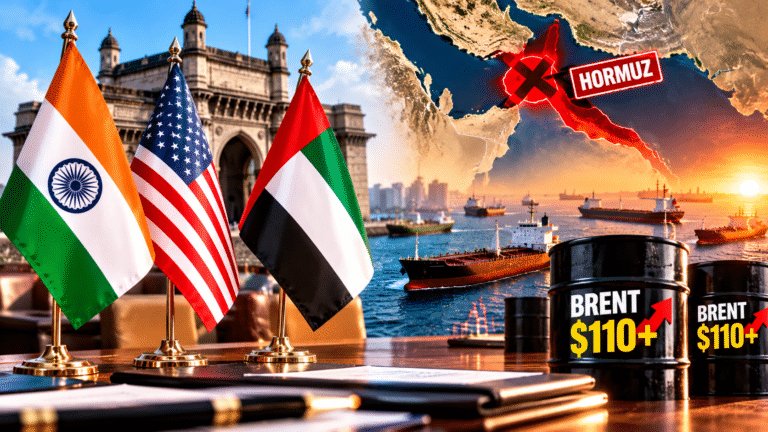
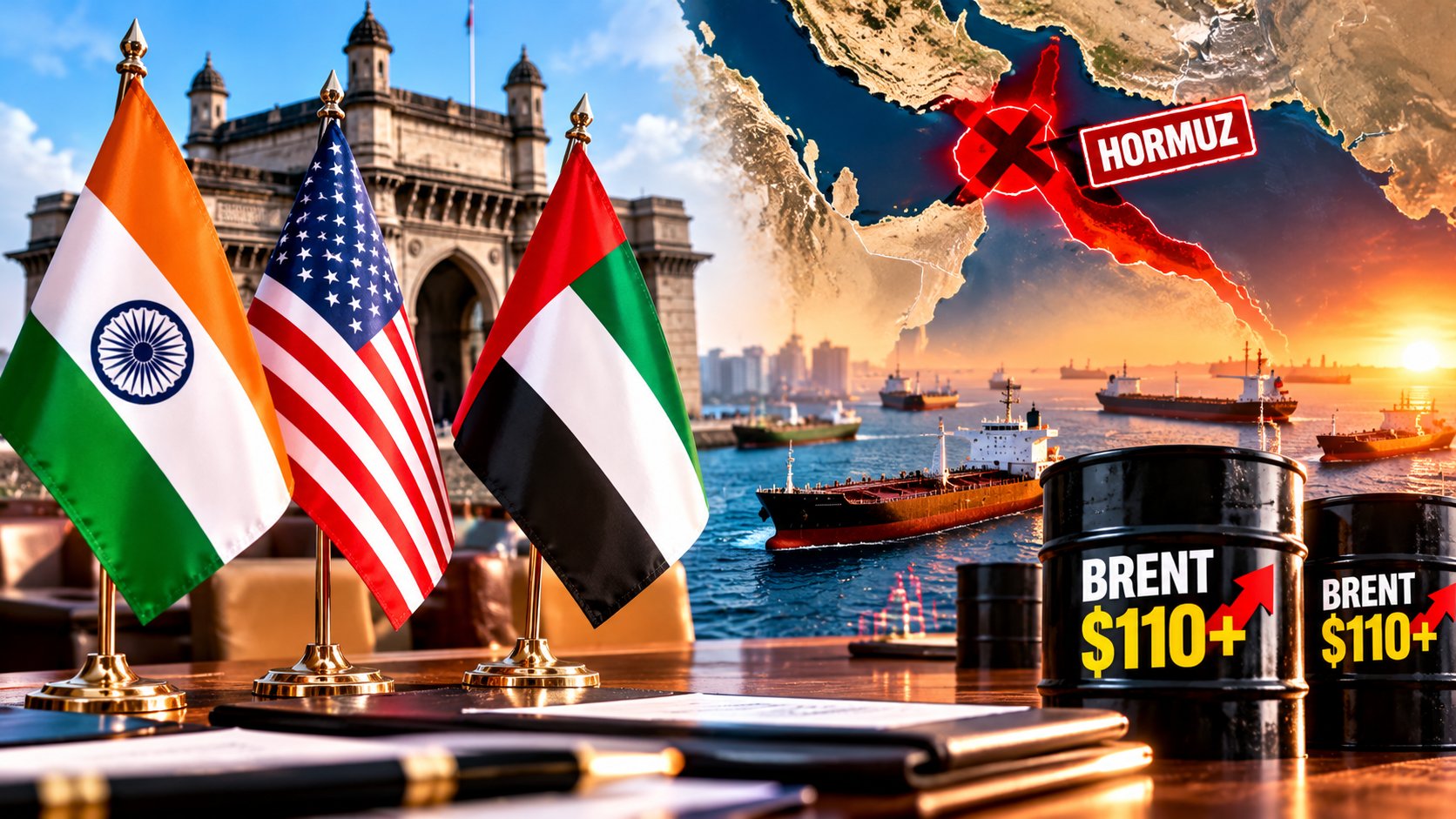
The foreign ministers of India, the United States and the UAE met in Mumbai on 20 October 2026 to discuss regional energy security, connectivity and the West Asia crisis. No oil supply agreement or joint statement was announced.
Every tanker that carries Gulf crude to Jamnagar, Mumbai or Paradip normally sails through a strip of water barely 40 kilometres wide at its narrowest point. For weeks now, Iran has kept the Strait of Hormuz shut. On Tuesday, the three countries with perhaps the biggest stake in what happens next, the largest oil importer in the room, the world’s most powerful navy and a Gulf producer that can partly sail around the blockade, sat down together in Mumbai.
The headlines called them talks for oil. That is close, but not quite right. No barrel was bought, no supply pact signed and no joint statement released. What happened was a ministerial-level conversation about keeping energy moving through a crisis. Understanding why these three countries, and why now, tells you more about India’s fuel bill over the next few months than any single announcement could.
Quick Summary
The Mumbai meeting was about energy security, not an oil purchase deal. Jaishankar, Rubio and Sheikh Abdullah bin Zayed discussed regional energy security, connectivity and the West Asia crisis on 20 October 2026, with Iran’s closure of the Strait of Hormuz the backdrop. Jaishankar called it “a useful exchange of perspectives.” The stakes for India are large: the Indian crude basket averaged $116.09 a barrel in September, up from $69.61 a year earlier, and the crude import bill jumped 47% to $15.4 billion that month.
What We Know
- The three foreign ministers met in Mumbai on Tuesday, 20 October 2026.
- Rubio said they met “to discuss regional energy security and advance our shared economic priorities.”
- Jaishankar described “a useful exchange of perspectives on energy, connectivity and contemporary developments.”
- The ministers reviewed the economic fallout of disrupted shipping through Hormuz, and Houthi attacks on Saudi energy infrastructure.
- Rubio’s India itinerary also included Jamnagar, home to one of the world’s largest refining complexes.
What Is Still Unclear
- Whether any supply guarantees, storage arrangements or shipping escorts were discussed in detail.
- Whether the three countries plan to meet again in this format, or set up a working group.
- How much more US crude or LNG India may commit to buying, which reports say Washington wants.
- When the Strait of Hormuz will reopen; Iran says it stays shut until its conditions are met.
Three Ministers, Three Very Different Bets on One Strait
The meeting makes sense only when you see what each country brought to the table. They are not natural allies on every question. India buys heavily from Russia, which Washington has been pressing it to reduce. The UAE sits inside the Gulf, within range of the conflict. The United States is a party to the confrontation with Iran. What unites them is a shared interest in oil and goods continuing to move.
India: the buyer with the most to lose
India imports the large majority of the crude it refines. Petroleum Planning and Analysis Cell data reported by Business Standard show 21.7 million tonnes of crude imports in September 2026, and crude was about 20% of the country’s entire merchandise import bill. Every dollar on the price of a barrel lands on the trade deficit, the rupee and eventually inflation.
The UAE: the producer with a side door
The UAE is not just a seller. It owns a pipeline from its Habshan fields to the port of Fujairah, on the Gulf of Oman, which lets it ship some crude without passing through Hormuz. Its national oil company has also stored crude in India’s strategic reserve at Mangaluru in the past. For India, Abu Dhabi is one of the few Gulf partners that can offer supply that partly bypasses the chokepoint.
The United States: the security actor and a seller
Washington is the dominant naval power in the region and is directly involved in the standoff with Tehran. It is also an oil and gas exporter that wants India to buy more. Press Trust of India’s coverage carried a related headline about Rubio seeking greater Indian purchases of US energy and arms, and US crude made up only about 141,000 barrels a day of India’s September imports by Kpler’s count.
Where India’s Barrels Came From as the Crisis Deepened
India’s supplier mix shifted sharply through the summer. When Gulf flows were disrupted, Russian crude filled the gap. As tankers found other routes, ship-to-ship transfers and logistical workarounds, Gulf supply crept back. ThePrint, citing Kpler ship-tracking data on 29 September, reported Gulf imports broadly returning to pre-conflict levels.
Russia remained the single largest supplier, but its volumes have been falling: about 2.66 million barrels a day in July, 2.02 million in August and 1.74 million in September, according to the same Kpler data. A Reuters report cited by the Free Press Journal put September Middle East imports at about 2.8 million barrels a day, or 54% of the total, and noted the discount on Russian crude had narrowed to $1 to $2 a barrel from more than $10.
That shrinking discount matters for the talks. When Russian oil was much cheaper, India had a strong commercial reason to keep buying it regardless of diplomatic pressure. With the gap narrowed to a dollar or two, Gulf and even US barrels become easier to justify, which gives Washington and Abu Dhabi more room to make their case.
Why the figures do not always match
Ship-tracking firms count cargoes differently, and monthly snapshots move as late cargoes are logged. Kpler via ThePrint shows Iraq at about 575,000 barrels a day in September, while the Reuters figure reported by the Free Press Journal put Iraq near 830,000. Treat any single supplier number as a range, not a precise total.
The Detours Around Hormuz, and Why They Are Under Fire
Hormuz normally carries roughly one fifth of the world’s petroleum. When it closes, the Gulf has only a handful of exits that avoid it. Two pipelines matter most, and one of them is now being attacked.
| Route | Operator | Exit point | Approx. capacity | Current risk |
|---|---|---|---|---|
| Strait of Hormuz | Shipping lane | Arabian Sea | About 20% of global petroleum | Closed by Iran |
| East-West pipeline | Saudi Aramco | Yanbu, Red Sea | About 5 to 7 mb/d | Targeted by Houthi attacks |
| Habshan-Fujairah pipeline | ADNOC, UAE | Fujairah, Gulf of Oman | About 1.5 mb/d | Outside Hormuz, within regional range |
| Bab-el-Mandeb | Shipping lane | Red Sea to Gulf of Aden | Carries Yanbu exports south | Houthi threat to navigation |
| Ship-to-ship transfers | Traders | Varies | Not published | Higher cost and insurance |
Pipeline capacities are approximate published nameplate figures and actual flows can differ. The Saudi East-West line, which carries crude to the Red Sea port of Yanbu, has become far more important during the blockade, which is exactly why Iran-backed Houthis have attacked it. India has publicly expressed concern about attacks on Saudi civilian infrastructure and warned they threaten freedom of navigation through Bab-el-Mandeb, the strait that links the Red Sea with the Gulf of Aden and the Arabian Sea.
That leaves the UAE’s Fujairah route as one of the few relatively open doors. It cannot replace Hormuz, but for India, on the other side of the Arabian Sea, it is short, familiar and already used. That alone explains why the UAE was the third chair at the table rather than Saudi Arabia or Iraq.
What a $110 Barrel Does to India’s Import Bill
The economic case for the talks is written in India’s trade data. Business Standard, using PPAC figures released on 21 October, reported that the crude import bill rose 47% year on year to $15.4 billion in September, while import volume rose only 7%. Almost all of the increase was price.
The September 2025 crude bill of about $10.5 billion is our back-calculation from the 47% rise. Over the first half of 2026-27, April to September, the crude import bill reached $90.6 billion, up 46.4%, and the net oil and gas bill $81.1 billion, up 35%. Oil prices kept climbing after the Mumbai meeting: Brent futures traded at about $111.64 a barrel on 22 October as renewed Houthi attacks on Saudi Arabia hit sentiment, while US crude was near $99.39.
Worked example: what each $10 costs India
At about 5.3 million barrels a day, India buys roughly 161 million barrels a month. A $10 rise in the price of each barrel adds about $1.6 billion a month to the import bill, or close to $19 billion a year if it lasts. That is why even a modest easing of supply risk, if talks like these help produce one, is worth billions to India. These are our indicative calculations using September volumes, not official estimates.
| Brent change | Extra cost a month | Extra cost a year | Likely pressure point |
|---|---|---|---|
| +$5 a barrel | About $0.8 bn | About $9.7 bn | Trade deficit |
| +$10 a barrel | About $1.6 bn | About $19.3 bn | Rupee and deficit |
| +$20 a barrel | About $3.2 bn | About $38.7 bn | Fuel prices and inflation |
| +$30 a barrel | About $4.8 bn | About $58.0 bn | Subsidies and fiscal math |
| -$10 a barrel | About $1.6 bn saved | About $19.3 bn saved | Relief on all fronts |
Table assumes constant imports of 5.3 million barrels a day and a 30.4-day month; it is our illustration only. Actual bills also depend on the rupee, freight and insurance, which have all risen during the crisis.
Nine Dates That Led to the Mumbai Table
The meeting was the product of several pressures building at once: a closed strait, attacks on alternative routes, a sanctions deadline on Russian oil and US domestic politics.
One more date hangs over everything: 3 November 2026, when the United States holds midterm elections. According to Outlook’s report, Trump said the US would not attack Iran before then. Iran’s foreign minister has said indirect talks continue through Pakistan and Qatar, while Trump said on 21 October that the US was not negotiating. Those conflicting signals are exactly the kind of uncertainty that pushes importers like India to seek reassurance from producers and security partners.
Four Things the “Talks for Oil” Headline Gets Wrong
Fact box: this is not the first India-US-UAE grouping
India, the United States and the UAE already sit together with Israel in the I2U2 group, launched at leaders’ level in July 2022 with a focus on food security, clean energy and infrastructure. India and the UAE also signed a Comprehensive Economic Partnership Agreement in February 2022. The Mumbai meeting is a three-way foreign ministers’ format focused on the immediate crisis, rather than a replacement for those arrangements.
India’s Balancing Act Between Washington, Abu Dhabi and Moscow
For New Delhi, the hardest part of this meeting is not the Gulf. It is the triangle with Russia. Rubio’s visit came days after a reported 18 October deadline under US legislation penalising countries that buy Russian energy, and India has been among the largest buyers of Russian crude since 2022. Any visible shift toward US or UAE barrels will be read in Washington as progress and in Moscow as a signal.
India’s stated approach has long been to buy wherever it gets the best deal for its consumers, and the numbers give it some cover. With Russia’s discount narrowed to a dollar or two, market logic and diplomatic preference point in the same direction for now. That convergence may be temporary. If the Strait reopens and Gulf prices ease, or if Russian discounts widen again, the commercial pull could change quickly.
The UAE offers India something neither of the others can: a Gulf supplier with a route around the chokepoint, deep commercial ties and no direct part in the conflict. That makes Abu Dhabi a natural bridge in a three-way format. It can talk supply with India and security with Washington in the same room, which is a large part of why it was invited, and why the format may be used again if the crisis drags on.
Signals Worth Watching in the Next Six Weeks
Because nothing concrete was announced, the real test of the Mumbai meeting lies in what follows. These are the measurable signs that the conversation is turning into supply or security arrangements.
For ordinary readers, the most direct effect remains the price of petrol, diesel and cooking gas. Those are set by oil marketing companies and government tax decisions, not by diplomacy, but they ultimately follow crude. If talks like this help keep Gulf crude flowing to India through Fujairah, Yanbu and eventually a reopened Hormuz, the pressure on those prices eases. If the alternative routes keep coming under attack, the pressure grows regardless of what was said in Mumbai.
Frequently Asked Questions
Why did India, the US and the UAE hold trilateral talks in Mumbai?
To discuss regional energy security, connectivity and the West Asia crisis, including Iran’s closure of the Strait of Hormuz and Houthi attacks on Saudi energy infrastructure. Rubio said the aim was to discuss energy security and shared economic priorities.
Did India sign an oil deal with the US or UAE?
No. Reports from PTI and others say no agreement, commitment or joint statement was announced. Jaishankar described the meeting as a useful exchange of perspectives.
Who attended the India-US-UAE meeting?
External Affairs Minister S. Jaishankar, US Secretary of State Marco Rubio and UAE Foreign Minister Sheikh Abdullah bin Zayed Al Nahyan, on 20 October 2026 in Mumbai.
Why is the Strait of Hormuz important for India?
It normally carries about one fifth of global petroleum, including most crude from Iraq, Saudi Arabia, Kuwait and much of the UAE’s exports. Middle East suppliers provided about 54% of India’s crude imports in September 2026, according to a Reuters report.
Can the UAE supply oil to India without using Hormuz?
Partly. The UAE’s pipeline from Habshan to Fujairah on the Gulf of Oman can carry around 1.5 million barrels a day, bypassing the strait. That cannot replace Hormuz, but it is one of the few open Gulf exits.
Which country is India’s biggest crude supplier now?
Russia, at about 35% of crude imports in September 2026 by PPAC and Kpler data, though its volumes fell from about 2.66 million barrels a day in July to about 1.74 million in September.
Will petrol and diesel prices in India go up?
Retail prices are set by oil marketing companies and government taxes, so they do not move automatically. But the Indian crude basket averaged $116.09 a barrel in September, against $69.61 a year earlier, which puts sustained pressure on fuel prices and the import bill.
Is the India-US-UAE grouping the same as I2U2?
No. I2U2 also includes Israel and was launched in 2022 around food security, clean energy and infrastructure. The Mumbai meeting was a separate three-way foreign ministers’ discussion focused on the current energy crisis.
The Short Version
India, the US and the UAE met in Mumbai on 20 October 2026 to talk about keeping energy flowing while Iran keeps the Strait of Hormuz shut and Houthis attack Saudi pipelines. It was a strategic conversation, not an oil purchase: no deal or joint statement emerged. The stakes for India are measured in billions: its crude bill rose 47% to $15.4 billion in September as the basket hit $116.09 a barrel. The UAE matters because its Fujairah pipeline partly bypasses Hormuz; the US matters as the region’s main security power and a seller wanting more Indian purchases. Watch import volumes and Brent for signs of real change.