EPFO Portal Goes Dark for 5 Days — What Happens to Your PF Claim, Passbook & ECR Filing Before July 1?
If you tried logging into the EPFO member portal, checked your e-Passbook on the UMANG app, or attempted to file your ECR between June 26 and June 30, 2026, you were met with a blank screen and a frustrating message: services unavailable. You are not alone. Over 70 million active EPF subscribers and lakhs of employers across India hit the same digital wall — and for once, it was not a glitch. It was planned. The Employees’ Provident Fund Organisation officially took its entire digital infrastructure offline for five full days to carry out a critical system migration — one of the most ambitious technology overhauls EPFO has undertaken in recent years. The stakes are high, the timing is sensitive (right at the financial month-end), and millions of workers and HR professionals are left wondering: what actually happens to their PF claims, passbooks, and compliance filings? This article breaks it all down with verified facts, practical guidance, and everything you need to know before services resume on July 1, 2026.
Why Did EPFO Shut Down for 5 Days?
The EPFO officially announced that its Member Portal, Employer Portal, and UMANG App services would remain completely unavailable from June 26, 2026 at 12:00 AM to June 30, 2026 at 11:59 PM, with services expected to resume from July 1, 2026 at 12:00 AM. The reason cited is a scheduled system migration — not a routine maintenance window, but a full-scale backend infrastructure upgrade aimed at delivering faster, more reliable, and more secure services to all stakeholders. This is not unprecedented. EPFO’s digital infrastructure has long been criticized for sluggish performance, frequent timeouts, and server errors that make even a simple balance check feel like a chore. The migration is EPFO’s answer to that systemic criticism — a complete overhaul that requires taking the entire system offline rather than performing patchwork fixes on a live platform. Think of it like renovating the foundation of a building: you cannot do it while people are walking through the lobby. The decision to schedule it over a five-day window spanning a month-end was likely deliberate, as June 26 to 30 falls on days that precede the July 1 compliance cycle, giving employers some buffer — though far too little notice for many.
What Services Are Completely Off?
During the migration window, the following services are entirely suspended across all EPFO digital platforms — the member portal at epfindia.gov.in, the employer portal, and the UMANG mobile application:
- Submission of new EPF claims (withdrawal, advance, full settlement)
- Processing of existing EPF claims already submitted before June 26
- Access to and download of e-Passbook statements
- Electronic Challan-cum-Return (ECR) filing by employers
- UAN linking and activation for newly joined employees
- All claim-related services including pension claims, transfer requests, and scheme certificates
- EPFO grievance registration through the online portal
- Jeevan Pramaan certificate applications via UMANG
Every single digital touchpoint that an employee or employer would use to interact with EPFO is offline. The depth of this shutdown is what makes it extraordinary. It is not just one module or one feature; it is the entire ecosystem, simultaneously, for five straight days.
What Happens to Your PF Claim Submitted Before June 26?
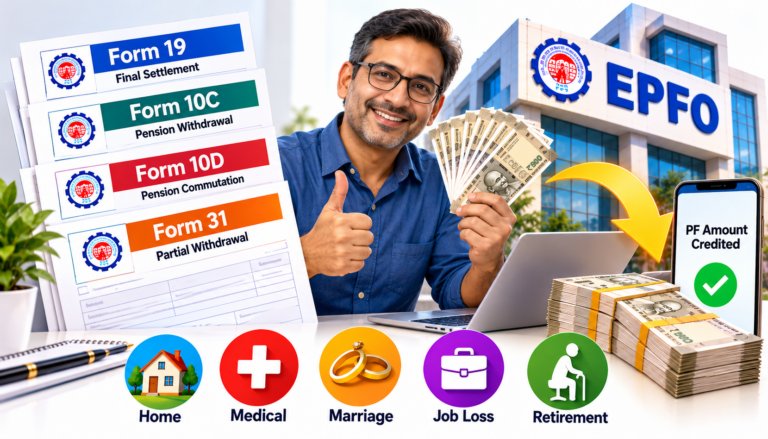
This is the question that is causing the most anxiety among members, and the answer requires precision. If you submitted a PF withdrawal, advance claim, transfer request, or pension claim before June 26, 2026 — your claim has not been cancelled, rejected, or lost. EPFO has officially clarified that claims submitted before the migration window will not be voided. However, processing is halted for the duration of the downtime. Your claim will be picked up and processed once the upgraded system comes back online on July 1. What this means practically is that if you were expecting your PF withdrawal to hit your bank account between June 26 and June 30, you will need to wait. The processing clock essentially paused the moment the system went dark. Settlement timelines that EPFO typically maintains — three to twenty days depending on the claim type — will be pushed forward by five days at minimum. If your claim was in the final stages of processing on June 25 and would have been credited the next day, it is now in a queue that resumes on July 1. There is no cause for panic, but there is a legitimate reason for patience. You cannot track your claim status during the downtime either, since the claims tracking module is part of the same suspended ecosystem.
What About Claims You Wanted to Submit During This Period?
If you had a financial emergency — a medical situation, a housing need, a child’s education fee — and planned to submit an EPF advance or withdrawal claim between June 26 and June 30, you are out of options through the official digital portal. EPFO has advised subscribers who are planning PF withdrawals, pension claims, or transfer requests to wait until services are fully restored. There is no offline backdoor, no emergency processing window, and no way to manually fast-track a claim during a system migration. This is where EPFO’s digital-only claim submission model creates a real vulnerability. Unlike many government services that maintain physical fallback mechanisms, EPFO’s claims ecosystem has been largely centralized online, meaning a full portal shutdown translates directly to zero claim access for members. If your situation is time-critical and absolutely cannot wait, the only recourse is to call the EPFO call centre at 14470 and explain the emergency. While call centre agents cannot submit or process claims on your behalf, they may be able to advise on escalation paths or physical visit options at your nearest EPFO regional office — though even those options are likely limited during a migration window.
ECR Filing: The Employer’s Deadline Crisis
For employers, the most urgent concern is the Electronic Challan-cum-Return, commonly known as ECR. ECR is the monthly compliance filing through which employers declare their employee PF contributions and remit them to EPFO. It has a strict monthly deadline, and failure to file on time invites penal interest and damages under the EPF and MP Act, 1952. The June ECR filing window typically runs through the end of June, which directly overlaps with the five-day shutdown. EPFO explicitly advised employers to complete their ECR filings before the migration begins — in other words, before June 26, 2026. Employers who heeded this advisory and filed early are safe. But those who missed the window — either due to late awareness, payroll processing delays, or administrative oversight — are now locked out of the ECR filing system with no alternative. There is currently no official statement from EPFO confirming a deadline extension for ECR filing, nor has there been a grace period announced as of the date of this article. This creates a genuine compliance risk for employers who rely on the standard end-of-month deadline. HR professionals and payroll teams in companies that have not filed ECR before June 26 should be proactively reaching out to EPFO’s regional offices and keeping documentation of the shutdown as evidence should a penalty dispute arise. The system migration is an official act of the organization — it is not the employer’s fault that the portal was unavailable — and this context will matter if a compliance challenge is raised.
Your e-Passbook Is Frozen — Here’s How to Check Your Balance Anyway
One of the more routine concerns for members is simply this: I cannot see my PF balance. The e-Passbook service — accessible via passbook.epfindia.gov.in and the UMANG app — is fully suspended during the downtime. You cannot download a passbook PDF, check your contribution history, or verify your employer’s deposits for the current cycle. However, EPFO has provided two alternative channels that remain functional even during portal downtime and do not require internet access:
- Missed Call Service: Give a missed call from your registered mobile number to 011-22901406. You will receive an SMS with your PF balance details. Ensure your UAN is seeded with your Aadhaar, PAN, and bank account for this to work.
- SMS Service: Send a message to 7738299899 in the format: EPFOHO UAN ENG (replace ENG with the first three letters of your preferred language, e.g., HIN for Hindi, MAR for Marathi). This will return your most recent contribution details and balance.
These services operate through EPFO’s backend data infrastructure independently of the web portal, and they have not been suspended during the migration. They will not give you a full statement or a downloadable passbook, but they will confirm your balance and your last credited contribution — which is sufficient for most informational needs during the downtime.
UAN Linking for New Employees: A Hidden Disruption
One of the less-discussed impacts of this shutdown is on newly joined employees. When a fresh employee joins a company, their employer is required to link their UAN (Universal Account Number) to their current establishment on the EPFO employer portal. This process activates their PF account, enables the employer to start making contributions, and ensures the employee’s KYC details are registered. During the June 26 to June 30 shutdown, UAN linking for newly joined employees is entirely unavailable. For companies with onboarding cycles at month-end — which is extremely common, as many organizations align joinings with the last week of the month — this creates a compliance gap. The new employee cannot have their PF contributions counted for June if the UAN linking cannot be completed before the ECR filing. HR teams need to note that this delay is officially attributable to the system migration and should be documented accordingly.
Will Your Data Be Safe During the Migration?
This is a valid concern and deserves a direct answer. EPFO is not deleting, archiving, or wiping any member data during the migration. The system migration is a technology infrastructure overhaul — it involves moving data to a new, more robust backend platform, upgrading software layers, and improving the security architecture. All your contribution history, passbook records, claim history, KYC data, UAN details, and employer records are being preserved and migrated to the upgraded system. No member data is at risk of loss during this process. This is a standard enterprise-grade migration where data integrity is the primary technical priority. The reason the portal goes completely dark — rather than staying partially live — is precisely to prevent any data write conflicts or corruption that could occur if users were interacting with the system while the backend was being restructured.
What Changes After July 1?
When the portal comes back online on July 1, 2026, it is not the same system you left. EPFO has committed that the upgraded platform will deliver faster load times, improved security protocols, and a more reliable service experience. Based on EPFO’s stated goals and the scale of this migration, members can expect a more stable login experience, faster claim processing timelines, improved passbook loading speeds, and potentially a more responsive UMANG app integration. Past EPFO migrations have historically led to temporary glitches in the immediate post-launch days — it would be wise to wait 24 to 48 hours after July 1 before attempting high-priority transactions, as the system stabilizes under real-world traffic after going live. If you are submitting a PF claim, filing ECR, or activating a UAN on July 1 itself, be prepared for possible slowness as millions of backlogged users rush back to the platform simultaneously.
A Practical Action Plan: What You Should Do Right Now
Whether you are an employee or an employer, here is exactly what you need to do during and after this shutdown window:
- If you have a pending claim submitted before June 26: Do not re-submit. Wait for processing to resume on July 1. Re-submitting could create duplicate claim entries that cause delays.
- If you need to check your balance urgently: Use the missed call service (011-22901406) or the SMS service (7738299899) from your registered mobile number.
- If you are an employer with unfiled ECR: Document the portal downtime officially, reach out to EPFO’s regional office via phone, and be prepared to file immediately when services resume on July 1.
- If you have a newly joined employee: Hold the UAN linking and onboarding documentation ready. Complete it as the first action when the portal goes live.
- If you need support during the blackout: Call the EPFO helpline at 14470 — this is the official channel operational during the migration.
- If you planned a claim in June but haven’t submitted yet: Wait for July 1 and submit on the upgraded portal. Do not attempt to reach a physical EPFO office expecting emergency processing, as field offices are also operating under the migration constraint.
The Bigger Picture: Why This Migration Matters
EPFO manages retirement savings for over 70 million members and handles crores of rupees in daily transactions. For years, its technology stack has lagged well behind the scale it is expected to serve — a reality repeatedly flagged by members, HR professionals, and even government auditors. The five-day blackout, while genuinely disruptive, is the price of a necessary leap forward. A system that crashes under normal load, times out on routine passbook requests, and fails during claim submissions is far more damaging in the long run than a planned five-day shutdown that results in a stable, faster platform. EPFO’s move to absorb the short-term disruption in exchange for long-term infrastructure health is the right call — provided the upgraded system delivers on its promises after July 1. The burden of poor timing falls hardest on workers who needed their claims processed this week and employers navigating a month-end compliance cycle. Their frustration is legitimate and entirely understandable. But the structural argument for this upgrade is sound, and if EPFO executes it well, July 1 should mark the beginning of a significantly better digital experience for India’s salaried workforce.