HDFC Bank's Flexi Green EV Loan Splits the Battery From the Car — When Do Two Repayment Schedules Actually Cost You Less?
HDFC Bank’s Flexi Green EV Loan Splits the Battery From the Car — When Do Two Repayment Schedules Actually Cost You Less?
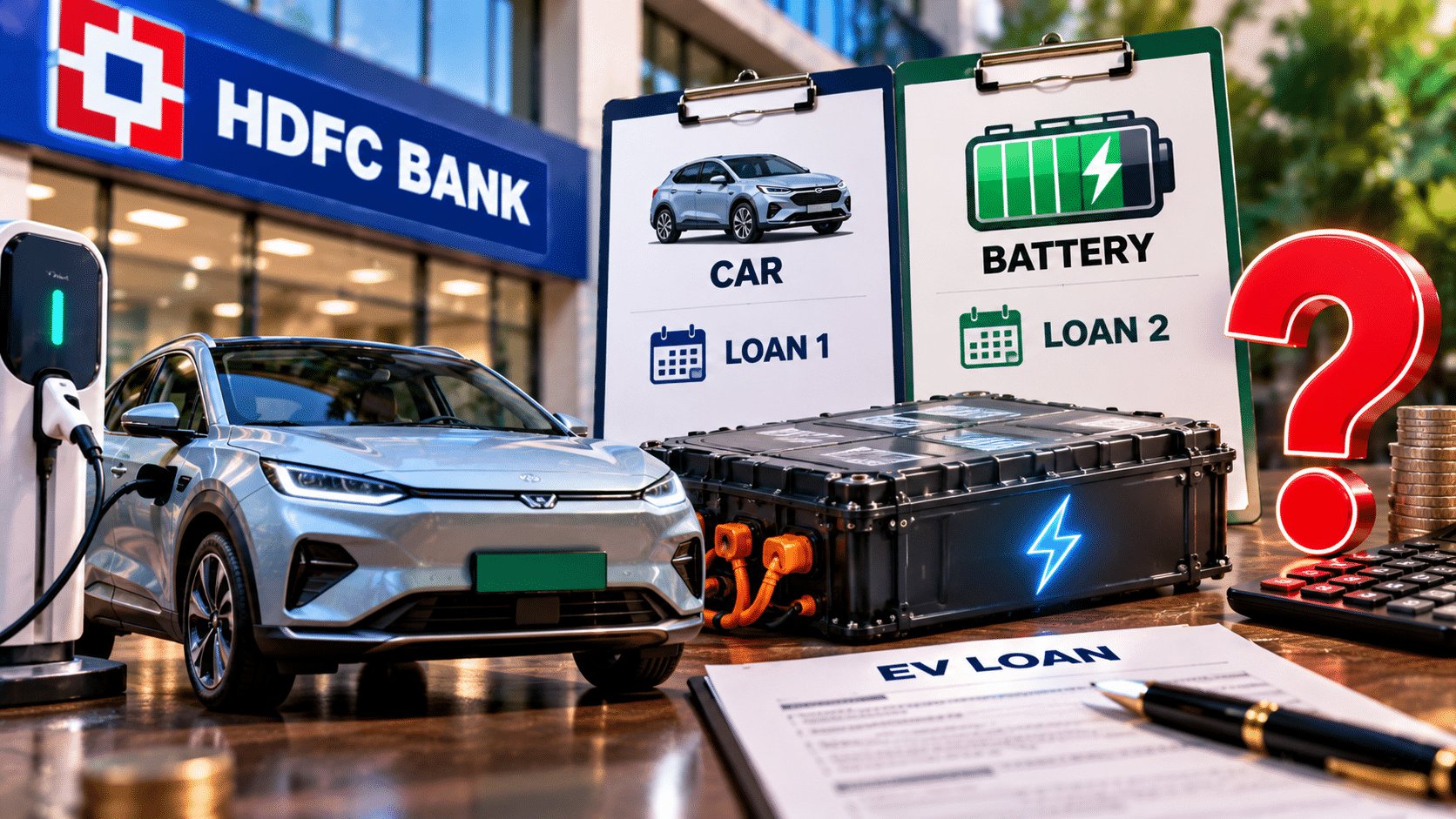
HDFC Bank has launched an electric car loan that lets buyers finance the vehicle body and the battery separately, with a longer repayment period for the battery. It lowers the monthly EMI, but a longer battery tenure usually means more total interest.
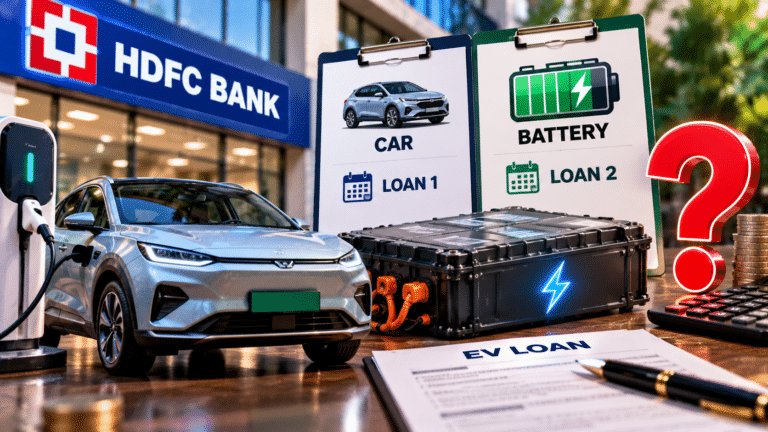
Illustration of the structure. HDFC Bank has not published the exact tenure split.
You have picked an electric car, done the charging maths and liked the result. Then the loan quote arrives, and the EMI is noticeably higher than for a similar petrol car. The reason is mostly one component: the battery, which can make up 30% to 40% of an EV’s price, according to MeraEV’s 2026 battery guide.
HDFC Bank’s answer, announced on October 25, 2026, is to treat the battery and the rest of the car as two separately repayable parts. The battery can be repaid over a longer period, which shrinks the monthly payment. That sounds simple, but it changes how much you pay in total and how long you stay in debt. We worked through the numbers.
Why the Battery Is the Problem Being Solved
Electric cars cost more upfront than comparable petrol cars, and the battery is the biggest reason. MeraEV estimates that replacing a full battery pack through authorised service costs ₹8,000 to ₹15,000 per kWh. That puts a mid-size 40 to 45 kWh pack at roughly ₹4 lakh to ₹6.5 lakh, a large slice of the car’s price.
Batteries also last a long time. Mainstream EVs in India carry a battery warranty of eight years or about 1.6 lakh km, whichever comes first, and some models now offer lifetime warranties for the first owner. That is the logic behind a longer battery tenure: the asset being financed is expected to outlast a typical five-year car loan.
How the Split Works in Practice
A normal car loan has one amount, one rate, one tenure and one EMI. HDFC’s structure, as described in launch reports, divides the financed amount into two parts. The vehicle body is repaid over one period and the battery over a longer one. You pay both EMIs together until the body loan ends, and then only the battery EMI continues.
What people often get wrong is assuming a lower EMI means a cheaper loan. Stretching any part of a loan over more years reduces the monthly payment but increases total interest, because the balance stays outstanding longer. Free Press Journal made the same point in its launch report. The split is useful for cash flow, not for cutting the overall cost.
Our worked example
Since HDFC has not disclosed the product’s tenures or rate, we used assumptions. A buyer borrows ₹15 lakh for an electric car, of which ₹5 lakh is attributed to the battery. We used HDFC’s published EV car loan rate of 9.40% onwards, as listed by BankBazaar, and the 8-year maximum tenure BankBazaar lists for EV loans. All figures are on a reducing balance basis.
| Option | EMI, months 1 to 60 | EMI after month 60 | Total interest | Loan ends |
|---|---|---|---|---|
| Single loan, 5 years | ₹31,430 | ₹0 | ₹3,85,772 | Month 60 |
| Split: body 5 yrs, battery 7 yrs | ₹29,099 | ₹8,146 to month 84 | ₹4,41,480 | Month 84 |
| Split: body 5 yrs, battery 8 yrs | ₹28,382 | ₹7,429 to month 96 | ₹4,70,392 | Month 96 |
| Single loan, 7 years | ₹24,439 | ₹24,439 to month 84 | ₹5,52,895 | Month 84 |
| Single loan, 8 years | ₹22,288 | ₹22,288 to month 96 | ₹6,39,630 | Month 96 |
The pattern is clear. The split sits between a short single loan and a long single loan. Compared with a five-year loan, splitting with an eight-year battery tenure cuts the EMI by ₹3,048 a month but adds ₹84,620 of interest. Compared with simply stretching the whole loan to eight years, the split costs ₹1,69,238 less in interest, because only one-third of the loan runs long.
The Hidden Cost: How Long You Owe More Than the Car Is Worth
Interest is only one way to measure a car loan. The other is how long the loan balance stays above the car’s resale value. During that window, if you sell the car or it is written off, the sale price or insurance payout will not clear the loan, and you pay the difference yourself.
We ran our ₹15 lakh example against a car with an on-road price of ₹18 lakh, bought with ₹3 lakh down. We assumed the car loses 25% of its ex-showroom value in the first year and 15% a year after that. These are standard planning assumptions, not EV-specific data, and used EV values in India are still uncertain.
| Loan structure | Months underwater | Window | Worst shortfall |
|---|---|---|---|
| Single loan, 5 years | 11 months | Months 9 to 19 | About ₹48,000, month 12 |
| Split: body 5 yrs, battery 8 yrs | 23 months | Months 7 to 29 | About ₹86,000, month 12 |
| Single loan, 8 years | 63 months | Months 5 to 67 | About ₹2,01,000, month 28 |
The split sits in the middle again. It roughly doubles the window of negative equity compared with a five-year loan, but it is far less exposed than stretching the whole loan to eight years. The reason is that most of the debt, the body loan, still falls away on a five-year schedule. For a buyer who plans to keep the car for at least three years, the extra risk is limited. For someone who might sell within two years, it matters more.
A bigger down payment shrinks this window for every option. If you can pay more upfront, the case for a long battery tenure weakens, because the EMI saving is smaller and the interest cost of the longer tenure stays.
Does the Battery EMI Really Match a Petrol Bill?
HDFC Bank says the battery EMI can be kept close to the running cost of an ICE car. That claim depends heavily on how far you drive. We compared monthly costs for 1,250 km, or 15,000 km a year, using clearly stated assumptions.
At 1,250 km a month, the battery EMI in our example is close to what a petrol car would spend on fuel. Add the EV’s charging cost of about ₹1,429, and the electric car’s battery-plus-energy bill is roughly ₹8,858 against ₹7,917 for petrol fuel. Drive more, and the EV pulls ahead. Drive less, say 600 km a month, and the petrol bill halves while the battery EMI does not change.
Split Loan or Battery Subscription?
Several carmakers already offer battery-as-a-service, or BaaS, where you buy the car without the battery and pay a per-km fee for it. MG introduced this with the Windsor in September 2024. MeraEV reports the Punch EV’s BaaS price at ₹6.49 lakh without the battery, against ₹9.69 lakh with it, plus ₹2.6 per km.
HDFC says its loan fits emerging battery subscription models, but the two approaches differ. With a split loan, you own the battery and the payments end. With BaaS, you never own it, and the per-km fee continues for as long as you drive. BaaS shifts cost to people who drive more, while a split loan has a fixed EMI regardless of distance.
The Risks Nobody Puts in the Brochure
Car loans carry a risk that home loans do not: the car loses value faster than the loan is repaid. A longer battery tenure keeps part of the debt alive for longer, which matters if you want to sell, upgrade or if the car is written off in an accident.
- Debt outlives the body loan. In our 8-year example, you still owe battery EMIs for three years after the body loan closes.
- Selling becomes more complicated. If the battery loan is still open, the bank’s lien must be cleared before ownership can transfer. HDFC has not explained how the two parts are released.
- Resale values for EVs are still uncertain. The used EV market is young, so the car’s value in year six or seven is hard to predict.
- Insurance is not optional. Comprehensive cover, including protection for the battery, matters more when part of the loan runs for eight years.
Who the Split Loan Suits, and Who Should Skip It
Putting the numbers together gives a fairly clear picture of who benefits. The split loan is a cash-flow tool. It makes sense when the monthly payment is the main constraint and the buyer is confident about keeping the car for most of the loan period.
Likely to benefit
High-mileage drivers whose fuel savings offset the battery EMI, buyers who will keep the car for six years or more, and households whose income is expected to rise, who can prepay the battery portion later. For these buyers, the lower EMI in the early years is worth the extra interest.
Likely to be better off elsewhere
Low-mileage drivers, people who change cars every two or three years, and anyone who can afford the five-year EMI comfortably. They gain little from the lower payment and take on more interest and a longer period of negative equity. A standard loan, a larger down payment or, for low-mileage drivers, a battery-as-a-service car may suit them better.
Questions to Ask Before You Sign
Because HDFC has not published the product’s detailed terms, the burden falls on the borrower to ask. These questions will tell you whether the split helps you.
- Get the full repayment schedule for both parts, with total interest, in writing.
- Compare it with a standard single-tenure EV loan from HDFC and at least one other lender.
- Check the carmaker’s battery warranty, in years and kilometres, against the battery tenure.
- Calculate your own monthly running cost using your actual distance and electricity tariff.
- Plan to prepay the battery portion once the body loan ends, if the terms allow it without a penalty.
Frequently Asked Questions
What is HDFC Bank’s Flexi Green EV loan?
It is an electric car loan from HDFC Bank, announced on October 25, 2026, that lets borrowers finance the car body and the battery separately. Each part has its own repayment period, and the battery can be repaid over a longer tenure.
What is the interest rate on the HDFC electric car loan?
HDFC has not published a rate for the Flexi Green product. BankBazaar lists HDFC Bank’s EV car loan rate at 9.40% a year onwards as of October 5, 2026. Your actual rate depends on your profile and the car.
Does splitting the battery loan reduce the EMI?
Yes, a longer battery tenure reduces the monthly payment. In our illustration of a ₹15 lakh loan at 9.40%, an 8-year battery tenure lowers the EMI from ₹31,430 to ₹28,382 during the first five years.
Will I pay more interest with a split EV loan?
Usually, yes. Repaying the battery over a longer period means more interest overall. In our example, total interest rises from ₹3,85,772 on a 5-year single loan to ₹4,70,392 with an 8-year battery tenure.
What is the maximum tenure for an EV car loan?
BankBazaar lists EV car loan tenures of 1 to 8 years. HDFC has not stated the exact tenures available for the body and battery portions of the Flexi Green loan.
How much does an electric car battery cost in India?
MeraEV estimates authorised replacement at ₹8,000 to ₹15,000 per kWh, or about ₹4 lakh to ₹6.5 lakh for a 40 to 45 kWh pack. Batteries typically make up 30% to 40% of an EV’s cost.
Is a split EV loan better than battery-as-a-service?
It depends on how much you drive. A split loan has a fixed EMI and you own the battery when it ends. BaaS charges per km, for example ₹2.6 per km on the Punch EV, so it can suit low-mileage drivers but costs more for heavy users over time.
Can I claim tax benefits on an EV car loan?
Salaried individuals using the car personally cannot claim a deduction now. Section 80EEB covered only EV loans sanctioned between April 1, 2019 and March 31, 2023. Business users may be able to claim interest and depreciation.
The Short Version
HDFC Bank’s Flexi Green EV loan, announced on October 25, 2026, lets buyers repay an electric car’s battery over a longer period than the body. That lowers the EMI, but stretching the battery tenure usually adds interest. In our ₹15 lakh example at 9.40%, an 8-year battery tenure cuts the EMI by ₹3,048 a month and adds ₹84,620 of interest compared with a 5-year loan, while costing far less than stretching the whole loan. HDFC has not published the tenures, rates or fees, so get the full schedule in writing before deciding.