IDBI Bank Sold to Fairfax for ₹52,878 Crore: Why ₹81 a Share Is Below the Market Price — and What Changes for Customers
Banking · Disinvestment · India, October 2026
IDBI Bank Sold to Fairfax for ₹52,878 Crore: Why ₹81 a Share Is Below the Market Price — and What Changes for Customers
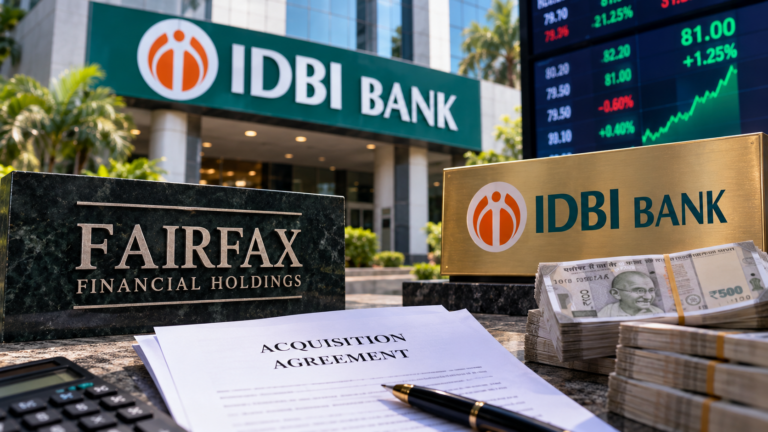
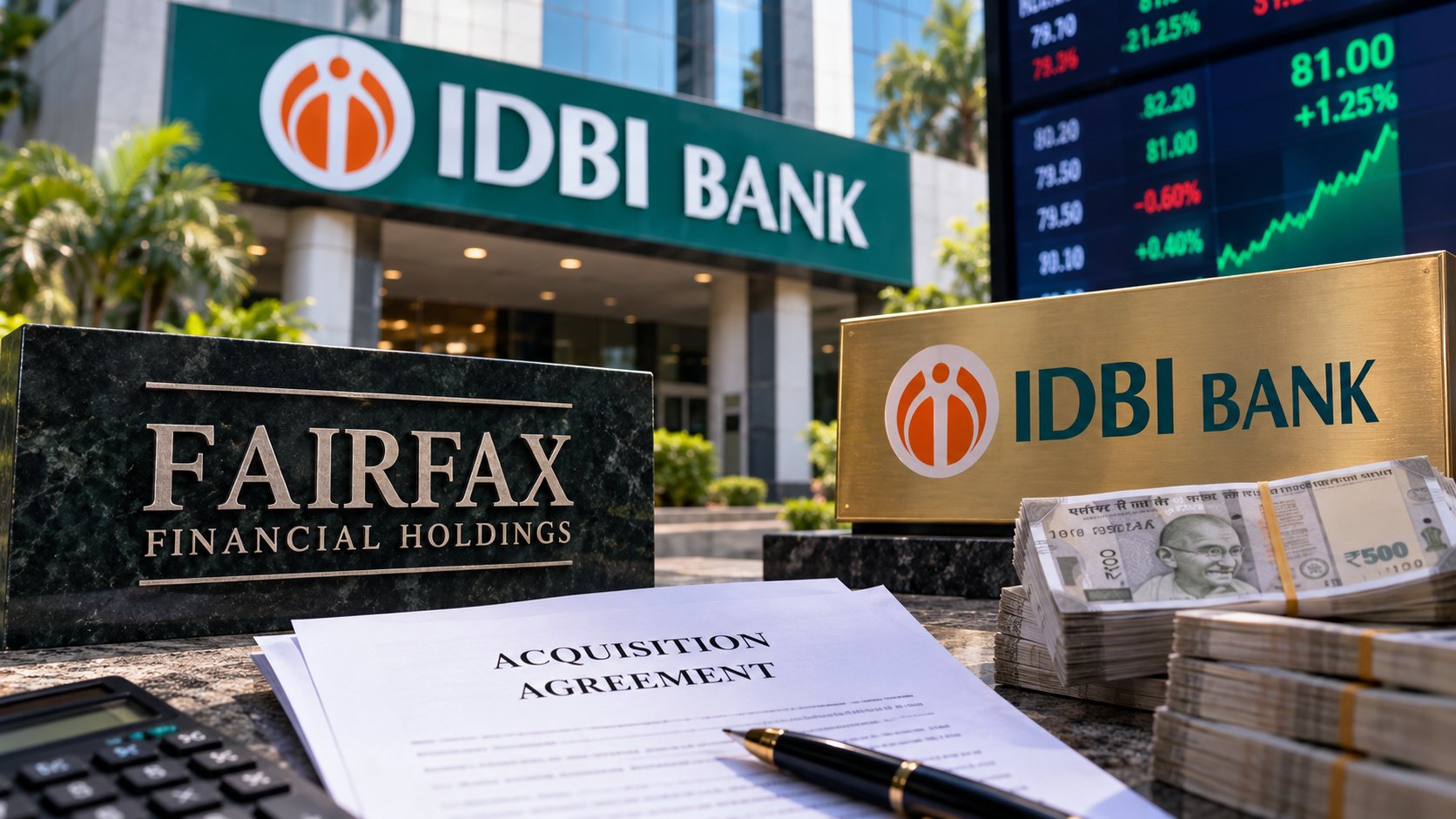
The Cabinet on 14 October 2026 approved the sale of 60.72% of IDBI Bank to Prem Watsa’s Fairfax Financial Holdings. It is India’s biggest strategic sale since Air India, but RBI’s final approval is still pending.
If you bank with IDBI, hold its shares, or simply followed one of India’s longest-running privatisation stories, Wednesday brought the answer. After four years of bidding, two rounds and one rejected set of offers, the Cabinet Committee on Economic Affairs cleared the sale of a controlling stake in IDBI Bank to a company owned by Fairfax Financial Holdings, the Canadian group led by Prem Watsa.
The headline number is ₹52,878.08 crore for 60.72% of the bank, or ₹81 a share. But that price raises an obvious question. On the day of the approval, IDBI’s shares traded near ₹93.62, well above what Fairfax is paying. And in 2025-26 the government had rejected offers that fell short of a ₹94.42 reserve price. This article explains how the deal came together, why the price is what it is, what still has to happen, and what changes, or does not, for the bank’s customers.
What We Know
- The CCEA approved Fairfax’s ₹52,878.08 crore bid for 60.72% of IDBI Bank on 14 October 2026.
- The government sells 30.48% and LIC 30.24%; afterwards they hold 15% and 19%.
- The winning bid of ₹81 a share exceeded the ₹75.99 average of two independent valuations.
- The DIPAM Secretary said Fairfax’s capital will be locked in for three years and the IDBI name will stay.
What Is Still Unclear
- When RBI will complete its fit-and-proper review and when the deal will close.
- The size, price and timing of Fairfax’s open offer to public shareholders.
- The identity of the second bidder in the final round.
- Fairfax’s plans for staff, branches and products, and how CSB Bank will be handled.
The Deal in Numbers
The sale combines two holdings. The government owned 45.48% of IDBI Bank and LIC 49.24%, together about 95% of the bank. Each is selling roughly half of its holding to Fairfax and keeping the rest, so that after the sale they own 34% between them as minority investors and Fairfax controls the bank.
Public shareholders hold about 5.28% in both cases.
Dividing the ₹52,878.08 crore by ₹81 gives about 652.8 crore shares sold, which implies roughly 1,075 crore shares in total. At ₹81, the whole bank is valued at about ₹87,085 crore. On a pro-rata basis, the government should receive about ₹26,544 crore and LIC about ₹26,335 crore. These splits are our calculation; the government has not published them separately.
The ₹81 Puzzle: Below the Market, Above the Benchmark
The price looks odd at first. IDBI shares rose about 13% to ₹93.62 on 14 October, according to Business Today, so Fairfax is paying roughly 13% less than the market price. And in 2025-26 the government rejected offers below a ₹94.42 reserve price. So why accept ₹81 now?
Why the market price is a poor guide
The answer lies in how few IDBI shares actually trade. The government and LIC together hold about 95% of the bank, so only around 5% is in public hands. Sunny Agarwal of SBICAPS Securities made this point to Business Standard in September, when the stock fell 10.6% in a day on reports of the ₹81 price. With such a thin float, small trades can move the price a long way, and the stock ranged from ₹61.01 to ₹118.38 during the valuation period. A buyer of 60% of the bank cannot be priced off that.
How the benchmark was set
Instead, the government used the average of two independent valuations: a market-multiple method comparing IDBI with listed public sector banks, and an asset valuation method using IDBI’s audited accounts to 31 March 2026. Their average was ₹75.99 a share, and Fairfax’s ₹81 is about 6.6% above it. The earlier ₹94.42 reserve applied to the 2025-26 round, which was abandoned; the fresh round in 2026-27 used the new benchmark. Fairfax is also paying about 15% more than the ₹70.38 closing price on 18 May 2026, the last trading day before best-offer bids were invited.
What Fairfax Is Buying
IDBI Bank is a very different institution from the one that was placed under RBI’s Prompt Corrective Action framework in May 2017 with heavy bad loans. Its results for April to June 2026 show a profitable, well-capitalised bank with very low net bad loans.
In that quarter IDBI earned a net profit of ₹2,115 crore, up 5% on a year earlier, on net interest income of ₹3,486 crore. Net advances grew 22% to ₹2,58,968 crore and deposits 10% to ₹3,25,757 crore. The capital adequacy ratio of 26.92% is far above regulatory minimums, which means the bank has room to grow its loan book quickly without immediately needing new capital. For a long-term investor like Fairfax, that combination of clean books and spare capital is the attraction.
Who is Prem Watsa, and what is Fairfax?
Fairfax Financial Holdings is a Toronto-based insurance and investment group founded and led by Prem Watsa, who was born in Hyderabad. Fairfax has invested in India for years, including a 40% stake in CSB Bank, according to Business Today. Because RBI rules do not allow one promoter to control two banks, Fairfax had committed to divest CSB Bank after acquiring IDBI. CSB’s shares rose about 5.7% on the approval news.
The CSB Bank question
How Fairfax handles CSB Bank is one of the most important open points. Business Today reported both that Fairfax had committed to divest its CSB stake and, in less clear wording, that it may be asked to merge CSB into IDBI within two years. Those are very different outcomes for CSB’s shareholders and customers. A sale would bring in a new owner for CSB; a merger would fold CSB’s branches, concentrated in Kerala, into IDBI. Until Fairfax or RBI sets out the route, CSB investors should treat both as possible.
Why the government sold now
The timing reflects both price and patience. The first round of financial bids in 2025-26 was rejected because offers fell short of the ₹94.42 reserve. Rather than abandon the sale, the government reopened it with fresh valuations based on March 2026 accounts. IDBI’s profits and capital had improved, but bank valuations across the market had also softened, which lowered the benchmark. Selling now locks in more than ₹52,000 crore for the government and LIC at a time when markets had just touched a 52-week low and foreign investors were net sellers.
Four Years From Invitation to Approval
- 5 May 2017RBI places IDBI Bank under Prompt Corrective Action because of high bad loans.
- January 2019After LIC takes control, IDBI is reclassified as a private sector bank.
- 10 March 2021RBI lifts PCA restrictions, subject to conditions and monitoring.
- 7 October 2022DIPAM invites expressions of interest for 60.72% of the bank.
- 2025-26Financial bids fall short of the ₹94.42 reserve price and are rejected.
- May 2026Fresh best-offer bids invited; the stock closes at ₹70.38 on 18 May.
- 8 September 2026Reports of an ₹81 Fairfax bid; IDBI shares fall 10.6% to ₹81.12.
- 14 October 2026CCEA approves Fairfax’s ₹52,878 crore bid; shares rise about 13%.
What still has to happen
The DIPAM Secretary also said Fairfax’s invested capital will be locked in for three years under the share purchase agreement. The government’s remaining 15% can later be sold in the open market through the Alternative Mechanism, the group of ministers that oversees disinvestment.
What Changes for Customers, Shareholders and Staff
For most people with an IDBI account, the honest answer is: nothing yet, and probably not much soon. Ownership is changing, not the legal entity. Accounts, fixed deposits, loans, cards and cheque books remain with IDBI Bank Limited.
| Who you are | Now, after approval | After completion | What to watch |
|---|---|---|---|
| Savings or current account holder | No change | Same bank, same account numbers | Any change in fees or rates, notified in advance |
| Fixed deposit holder | No change | Contracted rate and tenure continue | Deposit insurance cover of ₹5 lakh per depositor still applies |
| Home or personal loan borrower | No change | Loan terms continue as agreed | Benchmark-linked rates move with policy rates, not ownership |
| Public shareholder | Price volatile; float about 5% | Open offer to be made | Open offer price, which typically cannot be below the price paid to sellers |
| Employee | No announcement | Not yet disclosed | Fairfax’s plans for staff and branches |
| CSB Bank shareholder | Shares up about 5.7% | Fairfax committed to divest | Sale or other route, and its timing |
- Do not close accounts or break deposits because of the ownership change; penalties for early withdrawal would cost you, the sale would not.
- Watch for official notices from IDBI Bank itself about any change to terms, and ignore unsolicited calls or messages about “updating” accounts after the sale.
- Shareholders: wait for the open offer letter. Its price and acceptance window will be set out formally.
- Keep deposits within insured limits across banks if you want maximum protection, as you would with any bank.
Why This Deal Matters Beyond IDBI
The government describes the sale, once completed, as the largest foreign direct investment in India’s financial sector, and it is the biggest strategic disinvestment since Air India was sold to the Tata group. It also moves the government towards its asset-sale target for the year, which Outlook Business put at ₹80,000 crore.
- ₹52,878 crore deal, largest financial-sector FDI on completion
- ₹81 a share, 6.6% above the ₹75.99 benchmark
- 60.72% stake passes to a foreign-owned promoter
- 34% stays with government and LIC as minority holders
- 3-year lock-in on Fairfax’s invested capital
- LIC stake to fall to 15% within 2 years
The deal also sets a precedent. If RBI clears a foreign insurance and investment group to control a sizeable Indian bank, it widens the pool of potential buyers for future bank privatisations. The government has spoken for years about selling stakes in other public sector banks; how smoothly IDBI’s handover goes will shape how credible those plans look.
There are risks too. Integrating a new owner’s systems and culture into a bank with a long public sector history is rarely quick. Fairfax’s record in India is mostly as a long-term financial investor rather than a hands-on bank operator, and RBI will examine its plans closely. For minority shareholders, the key questions are whether Fairfax raises growth without diluting them, and how the government and LIC eventually sell their remaining 34%, which could weigh on the share price when it happens.
Frequently Asked Questions
Has IDBI Bank been sold to Fairfax?
The sale has been approved but not completed. The Cabinet Committee on Economic Affairs approved Fairfax’s ₹52,878 crore bid for 60.72% on 14 October 2026. RBI’s fit-and-proper approval and other steps are still needed before ownership transfers.
At what price is Fairfax buying IDBI Bank shares?
₹81 per share, about 6.6% above the ₹75.99 fair-value benchmark set by two independent valuations, and about 15% above the ₹70.38 close on 18 May 2026, before final bids were invited.
Why is the deal price lower than the IDBI share price?
Only about 5% of IDBI’s shares are held by the public, so the market price is volatile and can be pushed up by small trades. The government used independent valuations rather than the market price as its benchmark.
Is my money safe in IDBI Bank after the sale?
The sale does not change your deposits, loans or account numbers. IDBI remains an RBI-regulated bank, and DICGC deposit insurance covers up to ₹5 lakh per depositor per bank, as before.
Will IDBI Bank’s name change?
No change is planned. The DIPAM Secretary said the IDBI brand name will remain the same after the sale.
How much stake will the government and LIC keep in IDBI Bank?
After the sale the government will hold 15% and LIC 19%. LIC is expected to reduce its holding to 15% within two years, in line with RBI norms.
Will there be an open offer for IDBI Bank shares?
Yes. Fairfax must make an open offer to public shareholders under takeover rules. Its size, price and dates have not yet been announced.
Who owns Fairfax Financial Holdings?
Fairfax is a Toronto-based insurance and investment group founded and led by Prem Watsa. It already holds 40% of CSB Bank, which it has committed to divest because RBI rules bar one promoter from controlling two banks.
The Short Version
The government has approved the sale of 60.72% of IDBI Bank to Fairfax for ₹52,878 crore, or ₹81 a share. That is below the thinly traded market price but above independent valuations and the pre-bid share price. The government and LIC keep 34%, the brand stays, and Fairfax’s capital is locked in for three years. RBI’s approval and an open offer are still pending. For customers, nothing changes: accounts, deposits and loans continue as before.