Savings · FD and RD rates · India, November 2026
Best FD and RD Rates in November 2026: Which Banks Pay More After the Repo Hike, and Which Conditions Decide Your Real Return
Small finance banks advertise up to 8.60% for senior citizens, while HDFC Bank and ICICI Bank top out at 7.20% and PNB at 7.30% after November revisions. Tenure bands, tax slab and the ₹5 lakh insurance limit matter as much as the headline rate.
For most of 2025 and 2026, depositors watched FD rates drift lower. Then on 7 October 2026 the RBI raised the repo rate for the first time since February 2023, and banks started repricing. Within five weeks HDFC Bank, ICICI Bank, Punjab National Bank and Indian Overseas Bank had all revised their cards, and two small finance banks pushed senior citizen rates to 8.50% and above.
That is good news if you have money to park. But the “best rate” headline hides almost everything that decides what you actually take home: the exact tenure band, whether you are 60 or 80, which tax slab you sit in, and how much of your balance is covered by deposit insurance. This guide compares the November 2026 rates bank by bank, then works through those conditions in rupees.
Why Deposit Rates Turned Upward This Autumn
The trigger was monetary policy. On 7 October 2026 the RBI’s Monetary Policy Committee voted unanimously to raise the repo rate by 25 basis points to 5.50% and shifted its stance to calibrated tightening. That followed a 2025 cutting cycle of 125 basis points that had taken the repo rate down from 6.5%. The RBI also raised its inflation forecast for FY27 to 5.2%.
- 5.50%Repo rate after the 25 basis point hike on 7 October 2026
- 5.2%RBI’s CPI inflation projection for FY 2026-27
- 125 bpsTotal repo cuts during 2025, now partly reversed
- 6.7%Post Office 5-year RD rate, October to December 2026
- 10thConsecutive quarter with small savings rates unchanged
- 2 to 4 DecemberNext RBI MPC meeting, 2026
Banks tend to move deposit rates more slowly than loan rates, and they rarely move together. That is why November’s rate cards look uneven: some banks have revised, some have not, and the increases cluster in particular tenure bands rather than across the board. Government small savings rates did not move at all. The Finance Ministry kept them unchanged for October to December 2026, the tenth quarter in a row.
The Top of the Table: Who Pays the Most Right Now
Business Today and Upstox reports from early November put two small finance banks at the head of the senior citizen table. Suryoday Small Finance Bank offers 8.60% to senior citizens on a 5-year FD, with 8.25% for regular depositors. Utkarsh Small Finance Bank, which revised rates from 1 November, offers 8.50% to seniors and 8.10% to others on a 666-day deposit. Among private banks, Kotak Mahindra Bank offers up to 7.55% and Axis Bank up to 7.35% for seniors.
Peak advertised senior rate for deposits below ₹3 crore, from Business Today, Upstox and bank revisions dated 1 to 11 November 2026. Each peak applies to a specific tenure band only. Bar length scaled to 8.60%.
The large-bank revisions, date by date
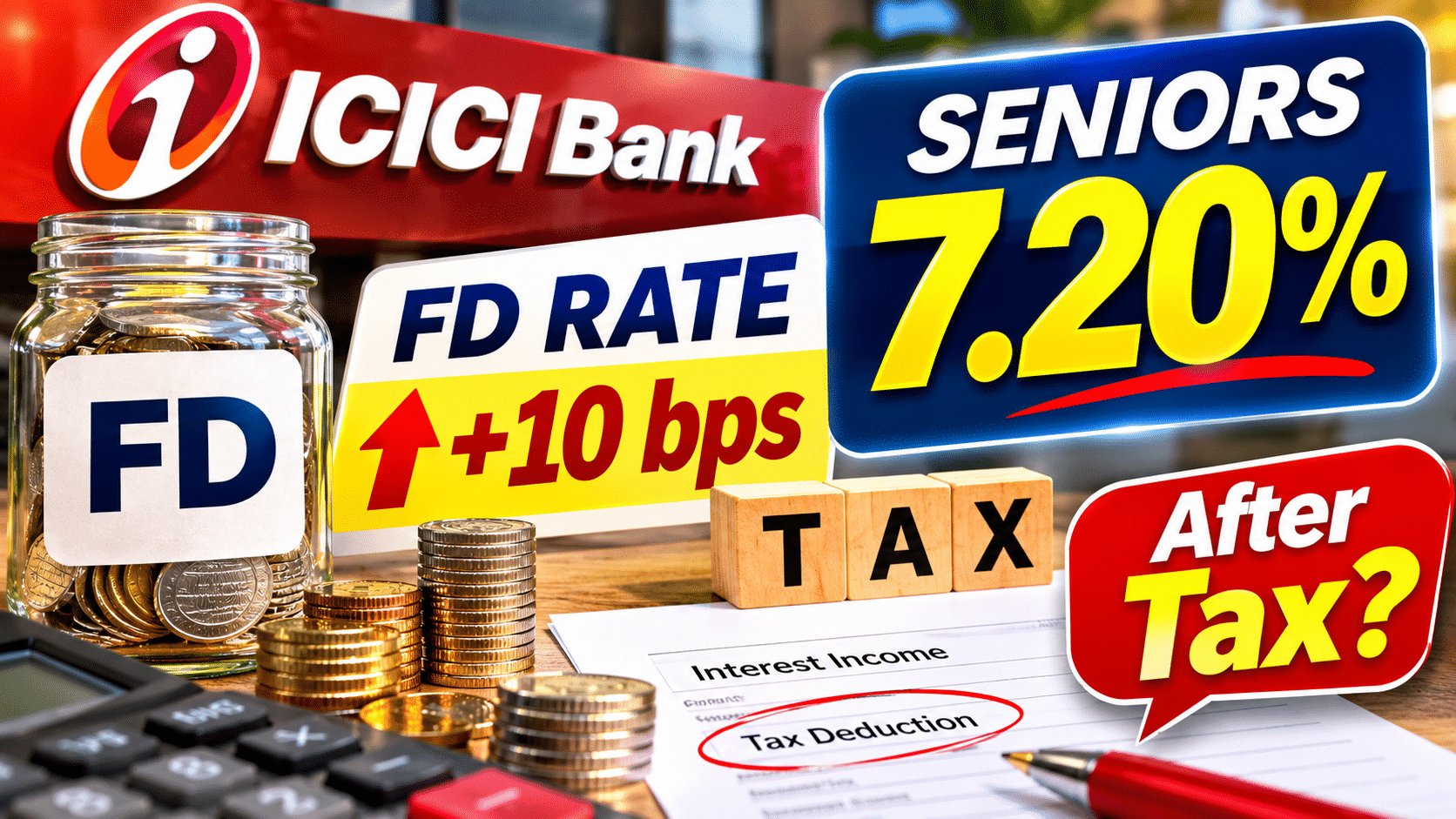
According to Upstox’s tracking of bank websites, HDFC Bank’s new card took effect on 4 November, PNB’s on 5 November, IOB’s on 10 November and ICICI Bank’s on 11 November. HDFC Bank and ICICI Bank both pay a peak of 6.60% to regular depositors for 3 years 1 day onwards, and 7.20% to seniors. PNB pays 6.80% on its 680-day deposit, rising to 7.30% for seniors and 7.55% for super seniors aged 80 and above. IOB’s peak is 6.75% on 444 days.
SBI’s retail card, as listed on rate aggregator pages in November, still shows 6.25% for 1 to 2 years, 6.40% for 2 to 3 years, 6.30% for 3 to 5 years and 6.45% on the 444-day Amrit Vrishti deposit, with seniors earning up to 7.05% on 5 to 10 years. We could not confirm an SBI revision after the October hike; check its website before booking.
The Tenure Trap: Why “Up To” Rarely Means Your Rate
Every peak in that chart applies to one tenure band. HDFC Bank’s 7.20% senior rate applies from 3 years 1 day to 5 years; at exactly 3 years, the senior rate is 7.05%. PNB’s 7.30% applies to 680 days, while its 3-year bucket pays 6.30% to regular depositors. Book a round tenure without checking and you can easily earn half a percentage point less than the headline.
General-public rates for the band covering 3 years, deposits below ₹3 crore, November 2026. Sources: Paisabazaar (Jana, Utkarsh), Ministry of Finance (Post Office), Upstox (HDFC, ICICI, PNB, IOB), aggregator listings (SBI). Bar length scaled to 8.00%.
Notice where the Post Office lands. Its 3-year Time Deposit at 7.1% beats every large bank’s 3-year rate for regular depositors, and its rate is set by the government each quarter. The 5-year Post Office Time Deposit pays 7.5%. Neither offers a senior citizen premium, so for seniors the large banks narrow the gap.
Senior and super senior premiums differ by bank. Most large banks add about 0.50 percentage points for depositors aged 60 and above. PNB adds more for those aged 80 and above, reaching 7.55% on 680 days. On the November figures, Suryoday’s senior premium on its 5-year deposit works out to 0.35 points, while Paisabazaar lists Jana’s at 0.50 points.
Recurring Deposits: Where Monthly Savers Get the Best Deal
RDs work differently from FDs. You commit a fixed sum each month, and each instalment earns interest only from the date it is paid. Rates usually track the FD card for the same tenure. HDFC Bank offers up to 6.60%, or 7.20% for seniors, on RDs of 39 to 60 months, and ICICI Bank matches those rates for 3 to 10 years. On 17 November, Suryoday Small Finance Bank launched a 5-year RD at 8.25% for regular customers and 8.50% for seniors.
The Post Office RD remains the simplest option. It pays 6.7% a year for five years, with a minimum monthly deposit of ₹100, and the rate is locked for the whole term once you open the account. There is no senior citizen premium.
Our calculation. 60 monthly deposits of ₹10,000 (₹6 lakh in total), interest compounded quarterly, before tax. Rates as published in November 2026. Bar length scaled to ₹7,48,495.
The spread between the Post Office and Suryoday on the same ₹6 lakh is about ₹29,900 over five years, by our calculation. That is meaningful, but it comes with a condition covered below: by the end of year five the Suryoday RD balance would be about ₹7.4 lakh, above the ₹5 lakh insurance limit.
Gross Rate Is Not What You Keep
FD and RD interest is taxed at your income tax slab rate, every year, even on cumulative deposits that pay nothing until maturity. TDS is deducted when interest exceeds ₹50,000 a year at one bank, or ₹1 lakh for senior citizens, but TDS is only an advance; the full tax is due at your slab. That makes the post-tax yield, not the quoted rate, the number to compare.
Our calculation using effective annual yield with quarterly compounding; tax at slab rate, cess and surcharge ignored. Real return assumes 5.2% inflation, the RBI’s FY27 projection. Bar length scaled to 7.40%.
Worked example: the same rupees, very different outcomes. ₹5 lakh in a 3-year FD at 6.60% matures at ₹6,08,497, an effective yield of 6.77% thanks to quarterly compounding. For a saver in the 30% slab, the post-tax yield drops to 4.74%, and with inflation at 5.2% the real return is minus 0.46% a year. Move the same money to an 8.00% small finance bank FD and the post-tax yield rises to about 5.77%, a real return of plus 0.57%.
A senior citizen in the 5% slab under the old regime, earning 7.20%, can claim the Section 80TTB deduction of up to ₹50,000 on deposit interest. Average interest of about ₹39,800 a year falls inside that limit, so no tax is due and the real return is about plus 2.20%. All figures are our calculations.
The ₹5 Lakh Line Every High-Rate Depositor Must Respect
Small finance banks are scheduled banks regulated by the RBI, and their deposits are insured by the DICGC like those of any other bank. But the cover has a ceiling: ₹5 lakh per depositor per bank, including interest, across all your accounts in the same capacity. Business Today’s November report on senior rates repeats this limit, and it matters more than any rate difference.
Put ₹8 lakh in one small finance bank at 8.60%, and ₹3 lakh of it, plus interest, is uninsured. The extra percentage point over a large bank is then partly a payment for taking credit risk on a smaller lender. Splitting across two banks, or using different holding patterns such as single and joint accounts, can bring more of the balance under cover.
A simple rule. Keep the principal at any one small finance bank low enough that principal plus expected interest stays below ₹5 lakh at maturity. For a 5-year deposit at 8.25%, that means a principal of about ₹3.3 lakh or less, by our calculation.
Premature withdrawal re-prices the whole deposit
If you break an FD early, banks typically pay the rate applicable to the period you actually held it, minus a penalty that is often 0.50 to 1 percentage point. That can erase most of the advantage of a high-rate long deposit. Check the bank’s premature withdrawal policy, and keep emergency money in a shorter deposit or a sweep account rather than locking it into a 5-year peak rate.
Rate Card by Bank Type: The Comparison That Matters
| Bank or scheme | Peak general rate (tenure) | Peak senior rate | 3-year general rate | Insurance and conditions |
|---|---|---|---|---|
| Suryoday SFB | 8.25% (5 years) | 8.60% | 7.25% | DICGC up to ₹5 lakh; small finance bank |
| Utkarsh SFB | 8.10% (666 days) | 8.50% | 7.50% | DICGC up to ₹5 lakh; revised 1 November |
| Jana SFB | 8.00% (3 years) | 8.30% | 8.00% | DICGC up to ₹5 lakh |
| PNB | 6.80% (680 days) | 7.30% (7.55% for 80+) | 6.30% | Public sector; revised 5 November |
| HDFC Bank | 6.60% (3 years 1 day to 10 years) | 7.20% | 6.55% to 6.60% | Private; revised 4 November |
| ICICI Bank | 6.60% (3 years 1 day to 10 years) | 7.20% | 6.55% | Private; revised 11 November |
| SBI | 6.45% (444 days, Amrit Vrishti) | 7.05% (5 to 10 years) | 6.30% | Public sector; revision after October not confirmed |
| Post Office Time Deposit | 7.5% (5 years) | No premium | 7.1% | Government scheme; rate set quarterly |
Small finance bank figures are from Paisabazaar and news reports in November 2026; large bank figures from Upstox’s tracking of bank websites; Post Office rates from the Finance Ministry’s October to December 2026 notification. Rates apply to deposits below ₹3 crore and change frequently.
A Six-Step Way to Pick Your Deposit
- Decide when you need the money, then search only the tenure bands that fit. Don’t stretch to 5 years for a peak rate if you need cash in 2.
- Compare the exact band rate, not the “up to” headline, on the bank’s own rate card.
- Work out your post-tax yield for your slab, and the real return after about 5% inflation.
- Keep principal plus interest at each bank under ₹5 lakh, especially at small finance banks.
- Check premature withdrawal penalties and choose cumulative or payout to match your income needs.
- Submit Form 15G or 15H, where eligible, to avoid unnecessary TDS, and claim 80TTB if you are a senior under the old regime.
- RBI cuts the repo rate by a total of 125 basis points, from 6.5% to 5.25%.
- Small savings rates held for October to December; Post Office RD stays at 6.7%.
- RBI raises the repo rate by 25 basis points to 5.50%.
- Utkarsh SFB revises rates; seniors get up to 8.50%.
- HDFC Bank, PNB, IOB and ICICI Bank revise FD cards.
- Suryoday SFB launches 5-year RD at 8.25%, or 8.50% for seniors.
- Next RBI policy meeting.
- Current small savings quarter ends; next rates due for January to March 2027.
What We Know, and What Is Still Unclear
What We Know
- The RBI raised the repo rate to 5.50% on 7 October 2026.
- HDFC Bank and ICICI Bank pay up to 7.20% for seniors; PNB pays 7.30%.
- Suryoday and Utkarsh SFBs offer seniors 8.60% and 8.50%.
- Post Office RD pays 6.7% until at least 31 December 2026.
- DICGC cover is ₹5 lakh per depositor per bank, including interest.
What Is Still Unclear
- Whether SBI and other large banks will revise their cards further.
- What the RBI will decide at its 2 to 4 December meeting.
- Whether small savings rates will change for January to March 2027.
- Exact tenure bands for some advertised peak rates, which reports do not always state.
Frequently Asked Questions
Which bank gives the highest FD rate in November 2026?
Among those compared, Suryoday Small Finance Bank offers the highest senior rate at 8.60% on a 5-year FD, and 8.25% for regular depositors. Among large banks, PNB offers 7.30% for seniors on 680 days.
What is the HDFC Bank FD rate for senior citizens now?
From 4 November 2026, HDFC Bank’s highest senior rate is 7.20% for 3 years 1 day to 5 years, on deposits below ₹3 crore. Regular depositors get up to 6.60%.
Which bank offers the best RD rate?
Suryoday SFB’s 5-year RD, launched on 17 November 2026, pays 8.25%, or 8.50% for seniors. HDFC Bank and ICICI Bank pay up to 6.60%, or 7.20% for seniors, and the Post Office RD pays 6.7%.
Are small finance bank FDs safe?
They are RBI-regulated and DICGC-insured up to ₹5 lakh per depositor per bank, including interest. Amounts above that limit carry the bank’s credit risk, so many savers split deposits across banks.
Will FD rates rise further after the repo rate hike?
Nobody can say for certain. Some banks have already revised rates after the October hike, and the next RBI meeting is on 2 to 4 December 2026. Locking in should depend on your own needs, not a forecast.
Is FD interest taxable?
Yes, at your slab rate, every year on accrual. TDS applies above ₹50,000 of interest a year per bank, or ₹1 lakh for seniors. Seniors under the old regime can deduct up to ₹50,000 under Section 80TTB.
Is the Post Office FD better than a bank FD?
For regular depositors, the Post Office 3-year Time Deposit at 7.1% and 5-year at 7.5% beat large-bank rates. Seniors may do better at banks that add a senior premium, while small finance banks pay more again.
What happens if I break an FD early?
Banks usually pay the rate for the period actually held, minus a penalty of often 0.50 to 1 percentage point. Check your bank’s terms before booking a long deposit.
The Short Version
The October repo hike has nudged FD and RD rates higher, but unevenly. Small finance banks lead at 8.25% to 8.60%, large banks top out at 7.20% to 7.55% for seniors, and the Post Office sits at 6.7% to 7.5% with no senior premium. Before chasing the top number, check the exact tenure band, run your post-tax return, keep each bank’s balance within the ₹5 lakh DICGC limit, and read the premature withdrawal rules. For a 30% taxpayer, even good deposits only just keep pace with inflation.