EPF Claim Forms and Their Uses in 2026: Which Form Actually Gets Your PF Money Out
Personal Finance · EPF · Updated 30 September 2026
EPF Claim Forms and Their Uses in 2026: Which Form Actually Gets Your PF Money Out
Form 19, Form 31, Form 10C, Form 13, Form 20 and the new Form 121 each do a different job, and the Employees’ Provident Fund Scheme, 2026 has changed the conditions behind several of them.
Most rejected provident fund claims do not fail because the member was ineligible. They fail because the wrong claim type was picked, a pension claim was filed too early, or a tax declaration was attached in a format that no longer exists. Each EPF form is a separate instruction to the Employees’ Provident Fund Organisation (EPFO), and choosing one tells the system which pot of money you are asking for: your provident fund, your pension, your insurance, or simply a move from one employer’s account to another.
That distinction matters more in 2026 than it did a year ago. The rules behind partial withdrawals, final settlement and pension withdrawal were rewritten, and the familiar tax form most members used to avoid TDS was retired on 1 April 2026.
The Quick Answer Before You Click Submit
Use Form 31 for a partial advance while you are still working, Form 19 to settle your full PF after leaving, Form 10C to withdraw pension money when your EPS service is under 10 years, Form 13 to transfer PF to a new employer, and Form 20 when a family member is claiming after a member’s death. To stop TDS on an eligible withdrawal from tax year 2026-27, the declaration is now Form 121, not Form 15G or 15H.
Eight Forms, Eight Different Jobs: The Map Most Members Never See
Think of your EPFO account as three linked buckets. The Employees’ Provident Fund holds your savings plus interest. The Employees’ Pension Scheme (EPS) holds the employer’s pension contribution. The Employees’ Deposit Linked Insurance (EDLI) scheme is a life cover that pays only on death. Every claim form targets one or more of these buckets.
Final settlement of the provident fund balance after leaving service.
For members out of covered employment, retiring, or meeting another full-withdrawal condition.
Partial withdrawal or advance for illness, education, marriage, housing and other listed needs.
For members still in service; account stays open.
Pension withdrawal benefit from EPS, or a scheme certificate to carry pension service forward.
Withdrawal benefit applies when EPS service is below 10 years.
Monthly pension claim for members, widows, children or nominees.
For those with 10 or more years of pensionable service.
Transfer of PF and pension service from an old employer’s account to a new one.
For job changers who want to keep service continuous.
Provident fund claim by a nominee or legal heir after the member’s death.
Usually filed alongside Form 10D and Form 5IF.
EDLI insurance benefit for the family of a member who died in service.
Cover is widely reported at up to ₹7 lakh.
Self-declaration to avoid TDS when your total tax liability for the year is nil.
Replaced Forms 15G and 15H from 1 April 2026.
Online, you rarely see three of these numbers at all. The Aadhaar-based composite claim form on the EPFO Unified Member Portal bundles Form 19, Form 10C and Form 31 into a single screen, where you simply choose “PF final settlement”, “pension withdrawal” or “PF advance”. Knowing which underlying form you are triggering is still what keeps the claim on track.
The Three Mix-Ups That Quietly Get Claims Returned
Form 10C is a pension form, not a PF advance
A surprising number of guides describe Form 10C as a partial withdrawal form. It is not. Form 10C deals only with the EPS pension bucket. If your pensionable service is under 10 years when you leave, it pays out the withdrawal benefit; if you want to preserve that service for a future job, it gets you a scheme certificate instead. Money for a wedding, a hospital bill or a home comes through Form 31.
Form 13 moves money; it does not pay it
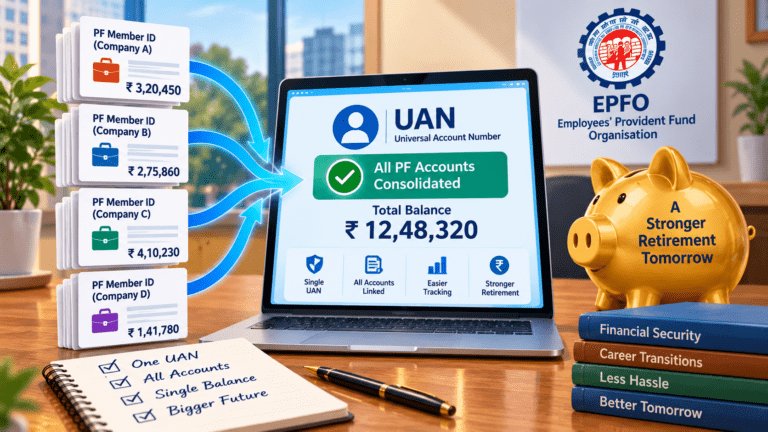
Form 13 is the transfer claim. It shifts both your PF balance and your pension service history from an old establishment to a new one under the same Universal Account Number (UAN). Nothing reaches your bank account. EPFO has also said auto-transfer has been live since 1 April 2024 for many cases, so check your passbook before filing one.
Form 15G was never a “withdrawal from abroad” form
Forms 15G and 15H were tax declarations, not claim forms, and members living outside India do not use them to withdraw. Both have now been replaced by Form 121 under the Income-tax Act, 2025, which EPFO confirmed publicly in July 2026. Members who have permanently migrated abroad follow a separate full-withdrawal condition inside the EPF rules.
What Changed in 2026, and Why the Old Numbers No Longer Work
The EPFO Central Board of Trustees approved a sweeping overhaul in October 2025, merging 13 separate partial-withdrawal provisions into three categories: Essential Needs (illness, education, marriage), Housing Needs, and Special Circumstances. The board approved new EPF, EPS and EDLI schemes aligned with the Code on Social Security, 2020 at its 239th meeting on 2 March 2026, and the Employees’ Provident Fund Scheme, 2026 was notified with effect from 29 June 2026.
The practical effect is a trade-off. Access during your working life became easier and more uniform, with a common 12-month service threshold and far more frequent withdrawals allowed for education and marriage. In exchange, members must keep 25% of the eligible balance untouched on partial withdrawals, and the waiting periods after leaving a job became much longer.
Old rule versus 2026 rule: waiting and service periods (months)
From Board Meeting to Your Claim Screen: The Reform Timeline
- 1 April 2024Auto-transfer of PF on job change goes live for eligible accounts, reducing the need for Form 13.
- 24 June 2025EPFO raises the auto-settlement limit for advance claims from ₹1 lakh to ₹5 lakh, with processing targeted within three days.
- October 2025Central Board of Trustees approves merging 13 withdrawal rules into 3 categories and a uniform 12-month service condition.
- 2 March 2026239th CBT meeting approves new EPF, EPS and EDLI schemes under the Code on Social Security, 2020.
- 1 April 2026Form 121 replaces Forms 15G and 15H for TDS non-deduction under the Income-tax Act, 2025.
- 29 June 2026Employees’ Provident Fund Scheme, 2026 takes effect with the revised partial-withdrawal norms.
Side by Side: Who Files What, and What They Walk Away With
| Form | Bucket | Main condition (2026) | Who files | Account after claim |
|---|---|---|---|---|
| Form 31 | EPF | 12 months of service; 25% balance retained | Working member | Stays open |
| Form 19 | EPF | Retirement at 55, or 12 months out of work, or other listed exits | Former employee | PF closed |
| Form 10C | EPS | Pension service under 10 years; 36-month wait for withdrawal | Former employee | Pension paid out or certified |
| Form 10D | EPS | 10+ years of service; pension age reached | Member or family | Monthly pension starts |
| Form 13 | EPF and EPS | New employer under same UAN | Job changer | Moved, not paid |
| Form 20 | EPF | Death of member | Nominee or legal heir | Balance paid to family |
| Form 5IF | EDLI | Death while in service | Nominee or legal heir | Insurance paid, up to ₹7 lakh |
The Fast Lane: How Some Claims Settle Without Anyone Touching the File
Auto-settlement is the least understood advantage in the whole system. According to the Ministry of Labour and Employment, EPFO processed a record 2.34 crore advance claims through auto-settlement in FY 2024-25, up from 89.52 lakh the year before, and 59% of all advance claims that year were settled with no human involvement. In the first two and a half months of FY 2025-26, the auto-mode share reached about 70%.
Share of advance claims settled automatically
The catch is that auto-settlement only works on clean data. A Form 31 claim for illness, education, marriage or housing up to ₹5 lakh, filed with Aadhaar-seeded UAN, verified bank account and matching KYC, can be credited in about three days. A name mismatch or an unlinked bank account pushes the same claim into manual review, where EPFO’s commonly cited service standard is 20 days.
The Tax Trap: Form 121 and the ₹50,000 Line
TDS on EPF withdrawals applies when your continuous service is under five years and the payout exceeds ₹50,000. With PAN on record, the deduction has been 10%. Service of five years or more, counting service carried over through transfers, generally means no TDS on the withdrawal.
If your total income for the year, including the PF payout, falls below the taxable limit, you can ask EPFO not to deduct TDS. That request is now made on Form 121, prescribed under Section 393(6) of the Income-tax Act, 2025. Unlike the old pair, it applies regardless of age. Reports from April 2026 stressed two practical points: submit Form 121 before the withdrawal claim rather than after it, and include the EPF amount in your estimated income.
Filing Online in Seven Steps Without Guesswork
- Log in to the EPFO Unified Member Portal with your UAN, password and captcha.
- Check that Aadhaar, PAN, bank account and mobile number are verified under the KYC section.
- Upload Form 121 first if you need to avoid TDS and qualify for it.
- Go to Online Services and choose the claim option covering Forms 31, 19 and 10C.
- Enter the last four digits of your bank account to verify it.
- Pick the claim type, reason and amount, and upload any document the screen asks for.
- Authenticate with the Aadhaar OTP and track the claim status from the same portal.
The documents that come up again and again are a cancelled cheque or bank passbook page, Aadhaar, PAN and your UAN. Death claims under Forms 20, 10D and 5IF additionally need the death certificate and proof of the claimant’s identity and relationship, and guardianship papers where a minor is involved.
A Before-You-Claim Checklist Worth Two Minutes
- Confirm which bucket you want: PF, pension, insurance, or a transfer.
- For a partial advance, check you have at least 12 months of service.
- Expect only the eligible 75% to be available on a partial withdrawal.
- After leaving a job, remember the 12-month wait for full PF and 36-month wait for final pension withdrawal.
- Match your bank account name exactly with your UAN record.
- Submit Form 121 before the claim, not after, if you qualify.
- Ask your HR or payroll team to fix exit dates if your date of leaving is missing.
What We Know
- The EPF Scheme, 2026 took effect on 29 June 2026.
- Partial withdrawals share a 12-month service threshold and a 25% minimum balance.
- Education withdrawals are reported at up to 10 times and marriage at up to 5 times.
- The auto-settlement limit for advances is ₹5 lakh.
- Form 121 replaced Forms 15G and 15H from 1 April 2026.
What Is Still Unclear
- Whether medical advances keep a lower service condition; published guides differ.
- When UPI and ATM-based PF withdrawals will reach all members.
- Whether final settlements will join the auto-settlement track, which EPFO has said it is working on.
- Whether form numbers will be renamed as the new scheme is fully rolled out.
Frequently Asked Questions About EPF Claim Forms
Which EPF form should I use to withdraw money while still employed?
Use Form 31, the partial withdrawal or advance form. Under the 2026 rules you need at least 12 months of service, and 25% of the eligible balance must remain in the account.
What is the difference between Form 19 and Form 10C?
Form 19 settles your provident fund balance. Form 10C covers only the pension (EPS) part, either paying the withdrawal benefit when service is under 10 years or issuing a scheme certificate. Most people leaving work file both.
How long after leaving a job can I withdraw my full PF?
Under the revised rules, full withdrawal on unemployment is available after 12 months without a job, up from 2 months earlier. Full withdrawal is also allowed on retirement at 55 and some other listed conditions.
Is Form 13 used for pension withdrawal?
No. Form 13 transfers your PF balance and pension service from a previous employer’s account to your current one. It does not pay any money into your bank account.
Can I still submit Form 15G to avoid TDS on my PF withdrawal?
No. From tax year 2026-27, Forms 15G and 15H have been replaced by Form 121 under the Income-tax Act, 2025. Submit Form 121 before filing the claim if your total tax liability for the year will be nil.
Which forms does a family need after an EPF member dies?
Typically Form 20 for the PF balance, Form 10D for family pension where eligible, and Form 5IF for the EDLI insurance benefit, reported at up to ₹7 lakh.
How fast is an EPF advance claim settled?
Eligible advance claims up to ₹5 lakh with verified KYC can be auto-settled in about three days. Claims that need manual review are commonly expected within 20 days.
How many times can I withdraw PF for education or marriage?
The revised framework is reported to allow up to 10 withdrawals for education and up to 5 for marriage during your service, subject to the 12-month service and 25% balance conditions.
The Short Version
Pick the form by bucket, not by habit. Form 31 is for advances while you work, Form 19 closes the PF account, Form 10C handles pension money under 10 years of service, Form 13 moves your account, and Forms 20, 10D and 5IF protect the family. The 2026 rules made advances simpler but introduced a 25% floor and longer waits after exit, and Form 121 now handles TDS. Clean KYC is still the single biggest factor in how fast any of it arrives.