New EPF Scheme 2026, EPS 2026 & EDLI 2026 Are Replacing 70-Year-Old Rules — Here Is Every Change That Affects Your Retirement Money
India’s retirement savings system just got its biggest overhaul in seven decades. If you are one of the more than 7 crore active EPF members in this country, the changes approved by EPFO’s Central Board of Trustees (CBT) in early 2026 will directly affect how much you save, how much pension you receive, how much insurance covers your family, and how fast you can access your own money. These are not minor tweaks. The Employees’ Provident Fund (EPF) Scheme, 2026, Employees’ Pension Scheme (EPS) 2026, and Employees’ Deposit Linked Insurance (EDLI) Scheme, 2026 collectively retire the frameworks that have governed India’s workforce social security since 1952 — replacing them with a legally modernised, digitally native structure built for the 21st century.
Why This Overhaul Happened Now
For decades, India’s retirement security rested on three pillars: the EPF Scheme of 1952, the EPS of 1995, and the EDLI Scheme of 1976. While these schemes served millions of workers faithfully, they were drafted in an era of paper registers, brick-and-mortar offices, and a workforce that largely worked in large scheduled-sector factories. The world of work has changed irreversibly — India now has gig workers, platform employees, remote professionals, NRIs managing accounts from abroad, and a workforce that changes jobs far more frequently than any earlier generation.
The legal trigger for this overhaul is the Code on Social Security, 2020 (CoSS), which subsumes the older EPF & MP Act, 1952 and 28 other labour statutes into a unified framework. The 239th meeting of EPFO’s Central Board of Trustees, held on March 2, 2026, formally approved all three new schemes. The definitions, provisions, and operational structures of EPF Scheme 2026, EPS 2026, and EDLI 2026 have been fully aligned with this Social Security Code, and all redundant or obsolete provisions from the older schemes have been deleted to ensure legal clarity. In plain language: the rulebook your employer and EPFO have been following since before India had a space programme is being retired.
The New EPF Scheme 2026 — What Changes for Your Provident Fund
The structure of contributions stays the same, but the universe of who contributes and how it is governed changes substantially. Employee and employer contributions remain at 12% each of the employee’s basic wages plus dearness allowance, and the mandatory contribution ceiling remains at ₹15,000 per month. However, the expanded definition of “wages” under the Code on Wages, 2019 — which is now fully operational alongside the Social Security Code — introduces a critical rule: allowances and non-basic pay components cannot exceed 50% of an employee’s total CTC. If they do, the excess is reclassified as “wages,” which directly raises the EPF contribution base for millions of workers in private-sector organisations with allowance-heavy salary structures.
The employer contribution rules have also been liberalised in a significant way under Budget 2026. Previously, an employer’s contribution to EPF above 12% of salary was automatically treated as a taxable perquisite in the hands of the employee. Under the new framework, that percentage-based restriction has been removed entirely. Now, employer contributions to EPF, NPS, and superannuation funds combined are governed solely by a ₹7.5 lakh annual monetary ceiling — contributions up to this cap remain tax-free, and any amount above it is taxed as a perquisite. This gives employers genuine flexibility to boost retirement savings for their employees without an immediate tax trigger.
The rule requiring parity between employer and employee contribution rates — which previously forced employers to match certain structural limits — has also been dropped. Additionally, the due date for employers to deposit employee contributions has been rationalised: employers can now claim a tax deduction on PF/ESI contributions deposited before the income tax return filing due date, even if they missed the labour law deposit deadline, providing much-needed compliance flexibility.
On the investment side, Budget 2026 removed the rigid statutory cap that previously limited PF trust investments in government securities to 50%. Going forward, investment norms for PF trusts will be governed entirely by the EPF framework and its subordinate regulations, bringing consistency between tax and labour laws. This could unlock better long-term returns for members of exempted trusts.
Coverage has been dramatically expanded. EPF now applies universally to all establishments with 20 or more employees regardless of industry — ending the old system where coverage was limited to scheduled sectors listed under the EPF Act, 1952. More significantly, mandatory EPF participation now extends to gig workers, app-based platform workers, part-time employees, and fixed-term contract staff. Aggregator platforms must contribute 1% to 2% of their annual turnover to a Central Social Security Fund, and workers must register on the centralised portal to access health, maternity, disability, and old-age benefits. For India’s estimated 10 million gig workers — projected to reach 23.5 million by 2030 — this is a historic shift.
The New EPS 2026 — Every Change to Your Pension
The Employees’ Pension Scheme 2026 is arguably the most discussed and controversial of the three new schemes. Here is a clear breakdown of what has actually changed:
The higher pension clause has been permanently removed. The old EPS-1995 contained Paragraph 11(4), which allowed employees and employers to jointly opt, within one year of joining, to contribute to the pension fund on salaries above the ₹15,000 monthly wage ceiling — enabling those workers to receive a higher pension after retirement. This clause has been deleted from EPS 2026 on the grounds that it is now “obsolete,” because the Supreme Court-mandated window for exercising this option has been conclusively closed. No new members will have any mechanism to opt for higher pension contributions going forward. Those who had already applied under the extended windows approved by the Supreme Court are protected for existing entitlements.english.
Pension calculation is now on a pro rata basis. Members retiring after April 1, 2026 will have their pension calculated pro rata, meaning each year of service is counted individually at the rate corresponding to the contribution made during that year, rather than through any blended or backdated higher-wage calculation.
The ₹15,000 wage ceiling and ₹1,000 minimum pension remain unchanged — a point that has drawn sharp criticism from workers’ welfare groups, a parliamentary committee, and labour economists. Both these figures have not been revised for over 11 years. Pensioners have demanded the minimum be raised to ₹7,500 per month, arguing that ₹1,000 does not cover basic survival expenses in any Indian city. The government has not included any such revision in EPS 2026, though a parliamentary panel has urged an immediate review.
What EPS 2026 does protect is that under the new scheme’s Paragraph 9(iv), an employee and employer can jointly submit a written request to contribute to the provident fund based on wages exceeding the wage ceiling — this flexibility remains for the EPF portion even though the EPS higher pension route is closed. Members can also make additional voluntary contributions, though employers have no obligation to match them.
Withdrawal rules have been eased in one important way: EPS 2026 now allows withdrawal benefits for even one month of contribution, reducing the prior threshold significantly. The withdrawal waiting period, however, now requires 36 months for certain EPS withdrawal claims to be processed.youtube+1
The Centralised Pension Payment System (CPPS) is now fully operational across all 122 EPFO regional offices. This means pensioners can receive their monthly pension in any bank account anywhere in India through a single national gateway managed by NPCI, credited on the 1st of every month. Previously, pensioners had to visit regional offices and update their Pension Payment Order (PPO) every time they changed their city or bank. That requirement is gone. Pensioners can also submit digital life certificates through facial authentication technology, eliminating mandatory annual visits to offices or banks.
EPS nomination has been made more flexible. Members can now assign multiple nominees for EPS pension benefits, allocating specific percentage shares digitally — rather than being restricted to a single nominee. This is stored securely in the EPFO system and integrated directly into pension disbursal calculations.
The New EDLI 2026 — Stronger Insurance for Your Family
The Employees’ Deposit Linked Insurance Scheme, 2026 replaces the 1976 scheme and brings several concrete improvements to the death benefit that every EPF member’s family is entitled to if the member dies while in service.
The insurance coverage range is now ₹2.5 lakh to ₹7 lakh. The maximum EDLI benefit was raised from ₹6 lakh to ₹7 lakh in 2021 and is now enshrined in the 2026 scheme. The minimum assured benefit of ₹2.5 lakh — restored in February 2020 — is also locked in. This means no matter how low the deceased employee’s salary or EPF balance was, the family receives at least ₹2.5 lakh as an assured floor amount.
The 12-month continuous service rule has been fundamentally reformed. Under the old EDLI rules, an employee often needed to be with the same employer for 12 unbroken months to qualify for the enhanced benefit. This penalised workers in sectors with high job mobility. Under the new rules, continuous EPF membership across multiple employers counts — provided there are no gaps exceeding 60 days between exit from one EPF-covered establishment and joining another. Weekends, public holidays, national holidays, gazetted holidays, and state holidays between two EPF-covered stints do not count as breaks in service.
Short-service coverage has been extended. EDLI benefits now apply even if death occurs within 6 months of the last PF contribution, provided the member remained on the employer’s rolls at the time of death. For workers who die early in a new job, this is a crucial protection that was absent before.
The minimum benefit for short-tenure members has been enhanced. Dependents or legal heirs of members who die in service with less than 12 months of continuous service and an average PF balance below ₹50,000 now receive a fixed ₹50,000 payout — an important floor for lower-income, short-tenure workers.
The employer contribution structure remains the same: 0.5% of monthly wages up to the ₹15,000 wage ceiling, meaning the maximum employer contribution is ₹75 per employee per month. The employee pays absolutely nothing for EDLI coverage — it is fully employer-funded.
The Digital Revolution Inside EPF 2026
Beyond the structural changes to contributions, pensions, and insurance, the EPF Scheme 2026 is built on a digital-first architecture that transforms how members interact with EPFO. These changes are not merely cosmetic — they eliminate years of procedural friction that caused real financial harm to real families.
ATM and UPI withdrawals for EPF funds were made operational starting April 2026, allowing members to access their PF balance directly through ATMs and the UPI ecosystem, making EPF as accessible as a savings account for emergency needs.
Auto-settlement has been elevated to ₹5 lakh, meaning claims below this threshold are processed automatically within 3 days without any human intervention — up from ₹1 lakh earlier. Over 71% of claims now fall within this limit.
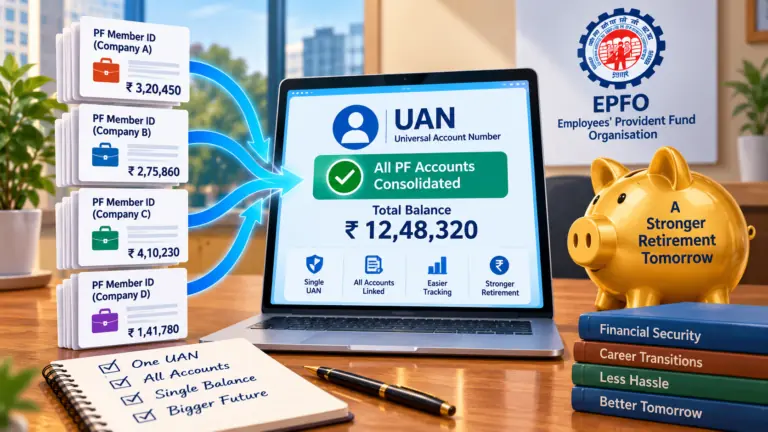
Job-change PF transfers are now automatic if your UAN is active and Aadhaar details match. No employer sign-off, no paperwork, no waiting weeks for an unresponsive ex-employer.
The 13 old withdrawal reasons have been consolidated into just three simple categories: Essential Needs (medical and education), Housing, and Special Circumstances. This simplification has reduced rejection rates significantly. For housing specifically, the eligibility period for withdrawing EPF has been reduced from 5 years to 3 years of EPF membership.
If you lose your job, you can immediately withdraw 75% of your EPF balance — with the remaining 25% accessible after two months if unemployment continues.
KYC and profile updates are now fully digital for Aadhaar-linked UANs. Name corrections, date of birth updates, and gender changes can all be made on the EPFO portal without physical documents or employer verification in most cases.
EPFO has also introduced a one-time Amnesty Scheme for income tax-recognised PF trusts that were not granted exemption under the old EPF Act but need to come into the compliance fold — giving a six-month window for retrospective regularisation and resolving over 100 active litigation cases.
The Employment Linked Incentive — A New Money-Back Benefit
One brand-new component introduced under the EPF 2026 framework is the Employment Linked Incentive (ELI) Scheme, effective August 1, 2026 under the Union Budget.
Under Part A of ELI, first-time EPFO-registered employees earning up to ₹1 lakh per month are eligible for a direct benefit transfer of one month’s EPF wage — up to ₹15,000 — disbursed in two instalments after 6 months and 12 months in their first formal job, conditional on completing a financial literacy course.
Under Part B of ELI, employers who hire additional staff receive up to ₹3,000 per employee per month for two years — extended to four years for manufacturing firms. The scheme requires UAN and Aadhaar linking for both employees and employers to participate.
What the 8.25% Interest Rate Means for You in 2026
The CBT, in the same March 2, 2026 meeting that approved the three new schemes, recommended maintaining the EPF interest rate at 8.25% per annum for FY 2025-26 — the third consecutive year at this level. With a corpus now exceeding ₹28 lakh crore, EPFO’s ability to sustain this rate while absorbing the costs of its expanding digital infrastructure and gig worker inclusion represents a significant management achievement. For members with, say, ₹10 lakh in their EPF accounts, this translates to ₹82,500 in guaranteed, tax-free interest annually — still beating most fixed deposits from public sector banks.
What You Must Do Right Now
If you are a current EPF member, the 2026 reforms create a clear action checklist. Link your UAN to Aadhaar immediately if you have not done so — virtually every digital benefit introduced in 2026 depends on this linkage. Review and update your nominees for both EPF and EPS through the EPFO Unified Member Portal, since the new multi-nominee facility for EPS is only available for those with updated nominations. Check whether your salary structure complies with the 50% wage rule under the Code on Wages — if your employer has an allowance-heavy structure, your EPF base may be recalculated upward, affecting both your take-home pay and long-term retirement corpus.
If you are in the private sector with a higher salary and had hoped to use EPS-1995’s Paragraph 11(4) for a higher pension, that option is definitively closed for new members under EPS 2026. Focus instead on maximising your Voluntary Provident Fund (VPF) contributions and exploring NPS as a supplementary pension vehicle. If your family has a pending EDLI claim, the 60-day gap tolerance and 6-month post-contribution coverage window in EDLI 2026 means that claims previously rejected for technical service-gap reasons should be resubmitted with updated documentation.english.
The replacement of 70-year-old rules with EPF Scheme 2026, EPS 2026, and EDLI 2026 is the most consequential reform of India’s workforce social security system in a generation. The digital simplifications are genuinely transformative — but the unchanged ₹15,000 wage ceiling and ₹1,000 minimum pension remain stubborn relics that dilute the reform’s impact for the most economically vulnerable workers. The full picture demands both acknowledgment of real progress and honest recognition of work that still needs to be done. Your retirement money is governed by these rules. Make it your business to understand every one of them
Related reading: why the EPF rate held at 8.25% for FY 2025-26, and where EPFO 3.0 currently stands on UPI and ATM withdrawals.