Good CIBIL Score vs Strong Credit Profile: What Actually Gets Your Loan Approved
Good CIBIL Score vs Strong Credit Profile: What Actually Gets Your Loan Approved
An 800 CIBIL score getting rejected while a 740 score gets approved isn’t a mistake. It’s how modern credit underwriting actually works, and understanding the difference can save your next loan application.
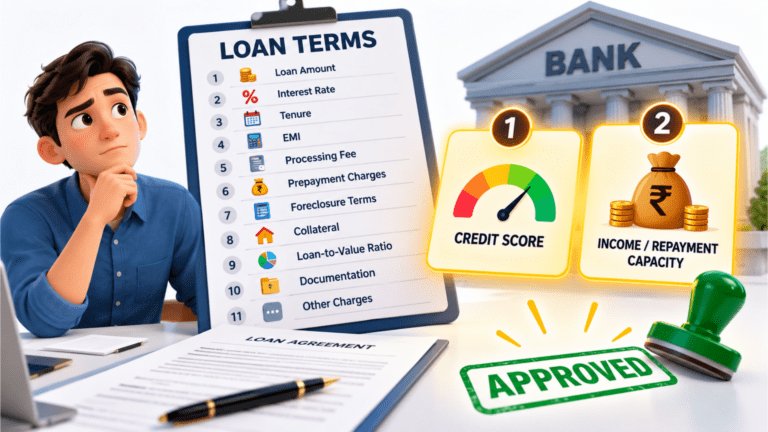
For years, borrowers have been taught to treat the CIBIL score as the final word on creditworthiness. Check your score, see a number above 750, and assume you are golden. That advice was never entirely wrong, but it was always incomplete. A CIBIL score is a snapshot. A credit profile is the full picture. And banks, especially in 2025 and 2026, lend against the full picture, not the snapshot.
This article breaks down the real difference between a good CIBIL score and a strong credit profile, explains why the two can point in opposite directions, and shows what actually drives approval decisions when a lender looks past the three-digit number on your credit report.
What Is a CIBIL Score, Really
A CIBIL score is a three-digit number, ranging from 300 to 900, generated by TransUnion CIBIL using the data in your credit report. It is calculated using a proprietary algorithm that weighs factors like repayment history, credit utilization, length of credit history, credit mix, and recent credit inquiries. The higher the number, the lower the statistical risk you represent, at least according to that formula.
The score is useful because it compresses a lot of financial behavior into a single, comparable figure. It lets a lender run a quick check before deciding whether to even look further. Most banks in India use 750 as an informal cutoff for prime rate approvals, and anything above 800 is generally considered excellent.
But a score is, by design, backward looking and narrow. It reflects what has already happened in your credit accounts. It does not know that you just took on a new personal loan two weeks ago that has not yet been reported. It does not know your current income, your job stability, your existing EMI obligations relative to your salary, or whether you have five live credit cards sitting at zero balance but with a combined limit of Rs. 40 lakh. The score is one input. It was never meant to be the entire decision.
What Is a Credit Profile
A credit profile is the complete financial identity a lender builds around you before approving credit. It includes your CIBIL score, yes, but also dozens of other data points: your debt-to-income ratio, the number and age of your active loans, your employment type and stability, banking transaction patterns, existing credit card limits and utilization trends, recent hard inquiries, any restructured or settled accounts in your history, and increasingly, alternative data like GST filings for self-employed applicants or even utility bill payment consistency.
Think of the CIBIL score as your exam grade and the credit profile as your entire academic transcript plus your teacher’s notes on classroom behavior. A single grade tells you something. The transcript tells you whether that grade is representative of a consistent pattern or an outlier.
Lenders build this profile using a combination of the credit bureau report, internal banking relationship data if you already hold an account with them, income documents, and increasingly, automated underwriting models that pull from multiple data sources simultaneously. This is why two people with an identical CIBIL score can receive completely different loan offers from the same bank.
The 800 Score Rejection, Explained
Here is a realistic scenario that plays out constantly at lending desks.
Clean card history, but four loan applications in two months, a debt-to-income ratio pushing past 55 percent, and an unexplained cash withdrawal pattern. The score says excellent. The profile says risky.
Shorter history with one old late payment, but a debt-to-income ratio of 25 percent, steady salary growth, no pending applications, and predictable cash flow. The profile says low risk.
This is not an anomaly. It is how modern, data-driven underwriting is designed to work. Lenders today are not just asking whether a person has historically repaid debts. They are asking what that person’s financial life looks like right now, and how likely they are to comfortably repay this specific new obligation without strain. The CIBIL score answers the first question reasonably well. It cannot answer the second one alone.
Key Differences Between a CIBIL Score and a Credit Profile
The distinction becomes clearer when you place the two side by side.
| Factor | CIBIL Score | Credit Profile |
|---|---|---|
| Scope of information | Numeric summary from the credit report | Income, obligations, banking behavior, employment, recent activity |
| Time horizon | Reflects historical repayment behavior | Captures current capacity and near-term risk |
| Update frequency | Updates with a reporting lag of weeks | Assessed close to real time in many cases |
| Role in decisions | Used as an initial filter to shortlist | Determines final approval, amount, and rate |
| Sensitivity to change | Can look excellent even as risk rises quickly | Catches recent liabilities the score has not yet reflected |
| Typical outcome | High score with a weak profile often means rejection | Moderate score with a strong profile often means approval |
Why a High Score Alone No Longer Guarantees Approval
Indian lending has changed considerably over the past several years. Rising instances of over-leveraged borrowers, several high-profile loan defaults among seemingly high-score customers, and tighter regulatory scrutiny from the Reserve Bank of India around unsecured lending have pushed banks and NBFCs to lean much more heavily on comprehensive underwriting models rather than score-based shortcuts.
Several forces are driving this shift. Multiple loan applications within a short window, even if none of them have been disbursed yet, show up as recent hard inquiries and signal potential credit hunger, regardless of what the existing score says. Debt-to-income ratio has become one of the single most decisive factors in approval decisions, because it directly measures whether a borrower can absorb a new EMI without financial stress. Income verification and employment stability now carry significant weight, particularly after the volatility many borrowers experienced during economic disruptions in recent years. Bureau data also has a reporting lag of typically thirty to forty five days, meaning a brand new loan or credit card might not appear on your report yet, but it absolutely appears in a bank’s internal cross-checks and in your bank statement analysis.
The Core Components of a Strong Credit Profile
Building a strong credit profile requires attention to several areas beyond simply paying bills on time.
- Debt-to-income ratioMost lenders prefer this ratio to stay below 40 percent, including the new loan being applied for. Keeping existing EMIs proportionate to income is one of the most powerful levers a borrower controls directly.
- Credit utilizationBeyond the score’s own calculation, lenders independently examine how much of your available credit limit you are using. Utilization consistently under 30 percent signals restraint and lowers perceived risk.
- Recent credit inquiriesA cluster of loan or credit card applications within a short period suggests urgency or financial stress, even if each individual application looks reasonable in isolation.
- Employment and income stabilityJob tenure, income growth trends, and the nature of employment, whether salaried, self-employed, or gig-based, all factor into how a lender assesses repayment capacity over the life of a loan.
- Banking behaviorConsistent salary credits, healthy average balances, and the absence of frequent bounced payments or overdrafts paint a picture of financial discipline that a bureau score cannot capture on its own.
- Existing loan structureThe mix of secured versus unsecured debt, and whether existing loans are nearing completion or freshly disbursed, both influence how much additional risk a new loan represents.
How Lenders Actually Evaluate Applications Today
Modern underwriting at most Indian banks and NBFCs now follows a layered process. The CIBIL score, along with scores from other bureaus like Experian, Equifax, or CRIF High Mark, is typically used first as a coarse filter, often through an automated system that either fast-tracks, flags for manual review, or declines an application outright based on a threshold.
Applications that clear this initial filter then move into a deeper underwriting stage, where the lender examines income documents, bank statements, existing obligations, and increasingly, alternative data sources. Many larger banks and fintech lenders now use their own proprietary risk models that combine bureau data with internal transaction history, especially for existing customers, to arrive at a more accurate risk assessment than the bureau score alone could provide.
This is also why pre-approved offers sometimes differ so dramatically from what a fresh applicant with a similar score receives. A bank that already holds your salary account has months or years of direct visibility into your cash flow, which often matters more to their internal model than the CIBIL score itself.
Common Mistakes Borrowers Make When They Focus Only on the Score
Many rejections trace back to a handful of avoidable habits. Applying for several loans or cards within a short window in an attempt to compare offers often backfires, since each application generates a hard inquiry that can make an applicant look credit hungry. Carrying high balances on credit cards, even when payments are made on time every month, keeps utilization high and can quietly work against approval odds. Overlooking the debt-to-income ratio while celebrating a high score is another frequent error, since a new EMI can push that ratio past a lender’s comfort threshold even when the score itself remains excellent. Finally, assuming that a score checked a month ago still reflects current reality ignores the reporting lag that can leave recent obligations invisible on paper but very visible in a bank statement.
How to Build Both a Good Score and a Strong Profile Together
The good news is that the habits which strengthen a CIBIL score and those which strengthen a broader credit profile overlap significantly, so borrowers rarely need to choose between the two.
- Pay on or before the due dateThis remains the single most influential habit for both the score and the profile, every single cycle.
- Keep utilization under 30 percentThis helps the score directly and signals restraint to any underwriter reviewing the fuller picture.
- Space out new credit applicationsIdeally by several months, to prevent a cluster of inquiries from suggesting financial stress.
- Maintain a healthy credit mixA mix of secured credit, such as a car or home loan, alongside a credit card tends to be viewed favorably by both bureau algorithms and manual underwriters.
- Monitor your debt-to-income ratioPay down existing balances where possible before applying for new credit, since this directly improves the metric that increasingly decides approval outcomes.
- Review your full credit report periodicallyNot just the headline score, to catch errors, outdated entries, or accounts that should have been closed but are still showing as active.
The Bottom Line
An 800 CIBIL score is not a guarantee, and a 740 score is not a weakness. Both numbers are simply summaries of past repayment behavior, filtered through a bureau algorithm that cannot see your current income, your existing obligations, or how many other loans you applied for last week.
Lenders today look far beyond that number, building a complete credit profile that weighs debt-to-income ratio, banking behavior, employment stability, and recent credit activity alongside the score itself. Borrowers who understand this shift stop chasing a single number and start managing the full financial picture that actually determines approval, loan amount, and interest rate. That shift in thinking is what separates a good CIBIL score from a strong credit profile, and increasingly, it is the profile that gets the loan approved.
Frequently Asked Questions
Yes. A high score reflects past repayment discipline but does not capture current obligations, recent loan applications, or your debt-to-income ratio. Lenders regularly reject high-score applicants when the broader profile signals risk.
Most lenders use the score as an initial filter and the full credit profile for the final decision. In practice, the profile carries more weight once an application moves past the first stage of review.
Credit bureaus typically update records every thirty to forty five days, so a new loan or credit card may not appear on your score for over a month, even though it already affects your real debt-to-income ratio.
Most banks and NBFCs prefer a total debt-to-income ratio below 40 percent, including the EMI for any new loan being applied for. Ratios above this threshold often lead to rejection or a reduced loan amount regardless of score.
No. Checking your own score is a soft inquiry and does not affect your CIBIL score. Only hard inquiries made by lenders when you apply for credit have any impact, and even that impact is typically small.
Yes. Reducing your debt-to-income ratio, spacing out credit applications, maintaining stable banking behavior, and lowering credit utilization all strengthen your credit profile even if your score moves only marginally in the short term.