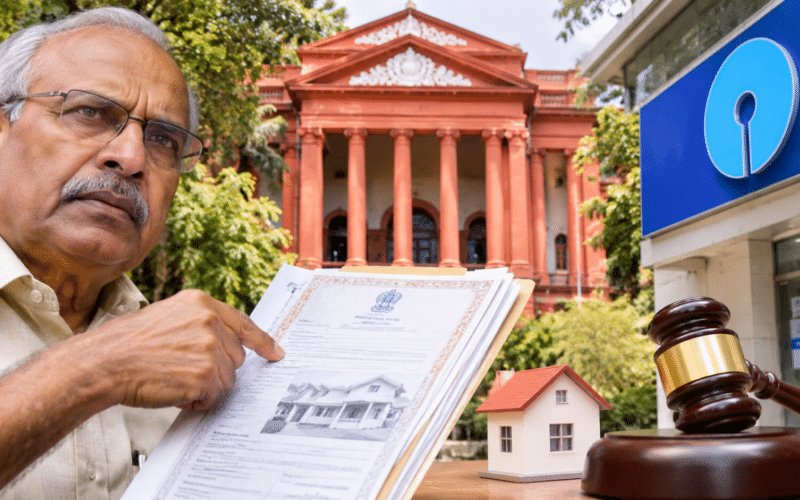
Banking · Borrower rights · Karnataka High Court, November 2026
Karnataka High Court Orders SBI to Pay Over ₹50 Lakh for Losing a Retired Manager’s Original Title Deeds — and Why Certified Copies Did Not End the Bank’s Liability
On 26 November 2026, Justice T.P. Vivekananda directed SBI to pay ₹5,000 a day from 1 December 2023 to a former chief manager whose property papers went missing after he repaid two housing loans. The ruling rests on an RBI rule that every borrower with a mortgage should know.
He had spent a career inside the bank. He had taken a staff housing loan to build his house, borrowed again to renovate it, and repaid both. What he expected next was routine: a call from the branch, a signature, and a packet of fifteen original documents handed back across the counter. That packet never came.
R. Murali Mohan, a former chief manager of the State Bank of India, spent the next few years asking for his title deeds through letters, representations and an RTI application. The bank could not find them. Instead it obtained certified copies, sent them to him, and argued that its obligation was over. The Karnataka High Court disagreed, and the price of that disagreement is now more than ₹50 lakh.
Fifteen Papers In, None Back Out
According to LiveLaw’s report of the judgment, the story begins on 7 January 2005, when the borrower executed a deed of equitable mortgage by depositing title deeds. Fifteen documents went into the bank’s custody. That year he took a staff housing loan of ₹7.50 lakh from the erstwhile State Bank of Mysore to build a house. In 2012 he took an additional ₹12.5 lakh to repair and renovate it, against the same security.
Both loans were repaid, in April 2021 and May 2022. Then the trouble started. The originals could not be traced, and on 20 October 2023 the bank asked him to collect certified copies of the sale deed and an encumbrance certificate. He objected that the copies had been obtained in his name without his knowledge. The bank forwarded them on 2 January 2024 anyway, and in February 2024 said it was still trying to trace the originals.
- 15Documents deposited on 7 January 2005
- ₹7.50 lakhStaff housing loan, 2005
- ₹12.5 lakhAdditional loan for renovation, 2012
- Apr 2021First loan repaid
- May 2022Second loan repaid
- 26 Nov 2026Date of the High Court’s decision
A Timeline That Stretches Across Two Decades
- Deed of equitable mortgage; 15 original documents deposited.
- ₹7.50 lakh staff housing loan from State Bank of Mysore.
- ₹12.5 lakh additional loan against the same property.
- The two loans are repaid in full.
- RBI issues directions on releasing property documents.
- Bank asks him to collect certified copies instead of originals.
- RBI directions take effect; the court’s compensation period begins.
- Bank forwards the certified copies.
- Bank says efforts to trace the originals are continuing.
- Police complaint lodged, as reported; judgment delivered on 26 November.
The ₹1.60 Lakh Offer That Became a ₹50 Lakh Order
SBI did not deny that the documents were missing. Its defence was about timing. The bank said it had lodged a police complaint and issued a public notice, and it offered ₹1.60 lakh as compensation for the period from 1 December 2023 to 2 January 2024. That is roughly 32 days at ₹5,000 a day. In the bank’s view, the meter stopped when it posted the certified copies.
The court found that the bank’s liability did not end on 2 January 2024. LiveLaw reports that the bank had kept assuring the borrower that tracing was underway, did not tell him about the loss for a long time, and lodged the police complaint only in November 2026. The public notice it published referred to a gift deed the borrower had never deposited. None of that, the court held, amounted to completing the formalities for declaring the documents lost.
Compensation at ₹5,000 a day, counted from 1 December 2023. Our calculation from the reported dates; the court’s exact total was not reported.
The gap in one line: the bank priced its delay at about one month. The court priced it at almost three years, because the delay was not over until the loss was formally documented.
What the RBI’s September 2023 Rule Actually Requires
The court’s order rests on the RBI’s directions of 13 September 2023 on responsible lending conduct. The Reserve Bank of India told regulated lenders to release all original movable and immovable property documents, and remove charges registered with any registry, within 30 days of full repayment or settlement of the loan. The rule covers banks, NBFCs including housing finance companies, cooperative banks and asset reconstruction companies.
If the delay is the lender’s fault, it must pay ₹5,000 for each day beyond the deadline. If documents are lost or damaged, the lender must help the borrower obtain duplicate or certified copies and bear the costs. In that case the lender gets an additional 30 days, and the daily penalty is counted after a total of 60 days. The directions apply to every case where release of documents fell due on or after 1 December 2023.
- Day 0Loan fully repaid or settled.
- Day 30Originals due back; charge removed from the registry.
- Day 60Outer limit if documents are lost or damaged.
- ₹5,000/dayCompensation for every day of delay after that.
| Provision | What the lender must do | Time limit | Money involved |
|---|---|---|---|
| Release of documents | Return all originals and remove registered charges | 30 days after repayment | None if on time |
| Place of collection | Let the borrower collect from the branch where the loan was serviced or another office with the documents | Stated in sanction letters issued after the effective date | None |
| Delay by lender | Tell the borrower the reasons and compensate | From day 31 | ₹5,000 per day |
| Loss or damage | Help obtain duplicate or certified copies and bear the cost | 30 extra days, so 60 in total | ₹5,000 per day after day 60, plus copy costs |
| Other compensation | Paid without prejudice to any other remedy under law | Through other forums | Depends on the forum |
| Applicability | All cases where release fell due on or after this date | 1 December 2023 | Applies to banks, NBFCs, HFCs and others |
Why Certified Copies Did Not Stop the Meter
The heart of the judgment is a question of interpretation. SBI read the duty to help obtain certified copies as the end of the matter: once copies were delivered, there was nothing left to compensate. The court read the same clause as part of a wider obligation. Offering certified copies did not comply with the circular, it held, and liability continued until the bank completed the formalities for declaring the originals lost.
Copies Are Not the Same as a Clean Title Trail
The distinction matters in practice. A certified copy proves that a registered document exists. It does not explain where the original went, and it does not protect the owner if someone later surfaces with the original deed. That is why a formal declaration of loss, backed by a police complaint, an accurate public notice and a certificate from the bank, carries weight. Here the public notice named the wrong document, which the court treated as a failure in its own right.
RBI Directions Are Binding, Not Advisory
SBI’s position also implied that the circular was guidance to be applied with discretion. The court rejected that. Relying on the Supreme Court’s decision in Central Bank of India v. Ravindra, it held that RBI directions issued under statutory powers bind the banks they are addressed to. A borrower can therefore enforce them, and a court can order the compensation the directions specify.
What the court did not decide: it ordered compensation under the delay and loss clauses only. Any claim for further loss, hardship or mental agony must go to a consumer forum or a civil court.
The Arithmetic of ₹5,000 a Day
A flat daily rate is blunt by design. It does not depend on the size of the loan, the value of the property or the borrower’s losses. A ₹7.50 lakh loan and a ₹75 lakh loan attract the same ₹5,000. That is what makes the rule easy to enforce, and what makes delay expensive quickly. A lender that sits on a file for six months owes ₹9 lakh before any argument about damages begins.
₹5,000 multiplied by days of delay counted by the rule. Our calculation; actual awards depend on the facts and on when the meter starts.
Worked example (our calculation): counting both ends, 1 December 2023 to 26 November 2026 is 1,092 days. At ₹5,000 a day that is ₹54.60 lakh. If the period ran to 30 November 2026 it would be 1,096 days, or ₹54.80 lakh. Either way the total clears ₹50 lakh, which matches the reports. The court’s own figure was not published in the reports we checked, so treat these as estimates.
For comparison, the two loans together came to ₹20 lakh. The compensation is more than two and a half times what the borrower originally borrowed.
One detail deserves attention. The loans were repaid in 2021 and 2022, before the RBI directions took effect, yet the compensation runs from 1 December 2023. The reports do not explain exactly how the court treated a release that was already overdue on that date. The practical effect is clear: the meter began when the rule began, not when the loans closed.
How Other Forums Have Priced Lost Deeds
This is not the first time SBI has been told to pay for missing papers, and the awards vary widely because the legal bases differ. A writ court enforcing the RBI rule applies the fixed daily rate. Consumer commissions assess deficiency in service, and can order market value, damages for mental agony and payments to welfare funds.
Headline amounts as reported; bases differ, so the bars are not like-for-like. Karnataka figure is our estimate of the reported “over ₹50 lakh”.
| Forum | Borrower | What was ordered | Basis |
|---|---|---|---|
| Karnataka High Court | Former SBI chief manager | ₹5,000 a day from 1 Dec 2023; loss certificate in 6 weeks | RBI 2023 directions, enforced in a writ |
| NCDRC | Borrower named Goswami | ₹25 lakh, rising to ₹50 lakh if SBI did not certify the loss and publish a notification | Deficiency in service; conflicting statements by the bank |
| Kanchipuram district commission | Home loan borrowers | Return documents or pay ₹46.35 lakh market value with 18% interest from 16 Apr 2024; ₹25,000 costs; ₹50 lakh to a welfare fund | Deficiency in service after full repayment |
| Chennai consumer commission | VR Nagarajan, retired SBI manager | ₹10 lakh plus ₹10,000 costs; certified copies at the bank’s cost; indemnity bond | Deficiency in service and mental agony |
| Bank’s own offer, Chennai case | Same borrower | ₹50,000 proposed by the bank | Rejected route; the commission awarded more |
Writ Court or Consumer Forum: Picking the Right Door
The Karnataka judgment draws a clear line about remedies. A High Court, exercising its writ jurisdiction under Article 226, can enforce the delay and loss clauses of the RBI directions and order the fixed compensation. Any further compensation for loss, hardship or mental agony has to be sought before a consumer forum or a civil court. A borrower who wants both may need two proceedings.
Why the Public Sector Status Matters
Writ petitions are generally available against the State and its instrumentalities, which is why a petition against SBI, a public sector bank, was maintainable. Borrowers of private banks and NBFCs usually start with the lender’s grievance process, then the RBI Ombudsman, then a consumer commission. The ₹5,000 daily rate applies to all regulated lenders; only the route to enforce it differs.
- Write to the branch within the first week after repayment, asking for the originals and the date and place of return.
- If 30 days pass, send a written complaint citing the RBI’s 13 September 2023 directions and asking for reasons for the delay.
- If the bank says documents are lost, ask in writing for a police complaint, a correctly worded public notice, a loss certificate and certified copies at its cost.
- Keep a dated record of every reply. The ₹5,000 meter depends on dates you can prove.
- If there is no resolution within 30 days of your complaint, escalate to the RBI Ombudsman through the RBI’s complaint portal.
- For damages beyond the daily rate, take advice on a consumer commission complaint; for a public sector bank, a writ may also be possible.
What This Means If You Are Repaying a Home Loan
For most borrowers the lesson is preventive. Before you close a loan, ask for a list of the documents the lender holds, and compare it with the list of documents deposited when the loan was sanctioned. Many lenders give a list of documents at disbursal; if you never received one, request it now. A missing item is far easier to chase while the file is active than after the account is closed.
The common mistake: accepting certified copies as a settlement without a written loss certificate. Copies help, but the Karnataka ruling shows the bank’s duty runs further, and the record of that duty protects you if the title is ever questioned.
What We Know
- On 26 November 2026, Justice T.P. Vivekananda of the Karnataka High Court ruled in R. Murali Mohan v. Chief Manager and Ors.
- SBI must pay ₹5,000 a day from 1 December 2023 until November 2026, taking compensation past ₹50 lakh.
- The bank must issue documents certifying the loss within six weeks.
- The court held that forwarding certified copies did not end SBI’s liability.
- SBI had offered ₹1.60 lakh for 1 December 2023 to 2 January 2024.
- Claims for further loss or mental agony must go to a consumer forum or civil court.
What Is Still Unclear
- The exact rupee total and end date the court used were not given in the reports we checked.
- Whether SBI will appeal to a division bench or the Supreme Court.
- How the court applied a rule effective from December 2023 to loans repaid in 2021 and 2022.
- Whether the extra 30 days allowed for lost documents was factored in.
- The deadline for paying the compensation itself.
- Some reported dates for the bank’s later steps should be checked against the full order.
Frequently Asked Questions
How long does a bank have to return property documents after a loan is repaid?
Under the RBI’s 13 September 2023 directions, lenders must release all original property documents and remove registered charges within 30 days of full repayment or settlement.
What compensation do I get if the bank delays returning my documents?
If the delay is the lender’s fault, it must pay ₹5,000 for each day of delay beyond the deadline, and tell you the reasons for the delay.
What happens if the bank loses my original property papers?
It must help you obtain duplicate or certified copies and bear the cost. It gets 30 extra days, so the ₹5,000 daily penalty is counted after 60 days in total.
Do certified copies end the bank’s liability?
Not according to the Karnataka High Court. It held that liability continues until the bank completes the formalities for declaring the originals lost.
How much did the Karnataka High Court order SBI to pay?
₹5,000 a day from 1 December 2023 until November 2026, which takes the total past ₹50 lakh. By our calculation, 1,092 days to 26 November comes to about ₹54.6 lakh.
Does the RBI rule apply to NBFCs and housing finance companies?
Yes. It applies to commercial banks, NBFCs including housing finance companies, cooperative banks, asset reconstruction companies and other regulated lenders.
Can I claim compensation for mental agony too?
Yes, but not through the same writ. The Karnataka court said such claims must be filed before a consumer forum or a civil court.
Where should I complain if my lender will not return my documents?
Start with a written complaint to the lender. If it is not resolved within 30 days, approach the RBI Ombudsman. Consumer commissions and, for public sector banks, High Courts are further options.
The Short Version
A retired SBI chief manager repaid two housing loans, and the bank could not find his fifteen original title deeds. SBI sent certified copies and offered ₹1.60 lakh. The Karnataka High Court held that copies do not end a bank’s duty under the RBI’s 2023 rule. The ₹5,000 daily compensation runs until the loss is formally declared, which here meant from 1 December 2023 to November 2026, more than ₹50 lakh. If you are closing a loan, list your documents now, and if they go missing, insist on a written loss certificate, not just copies.