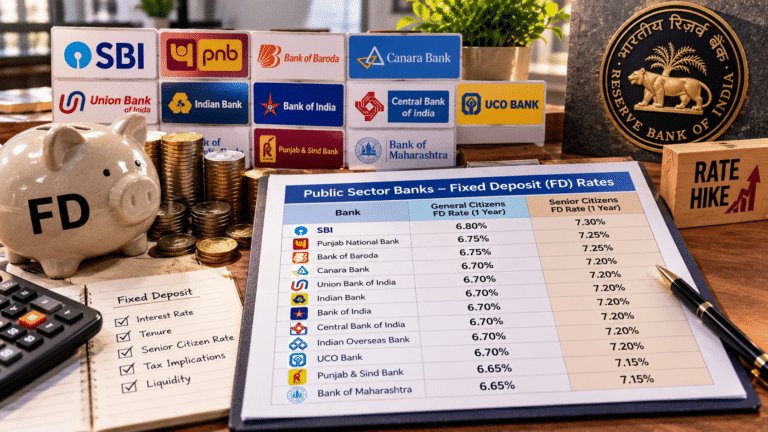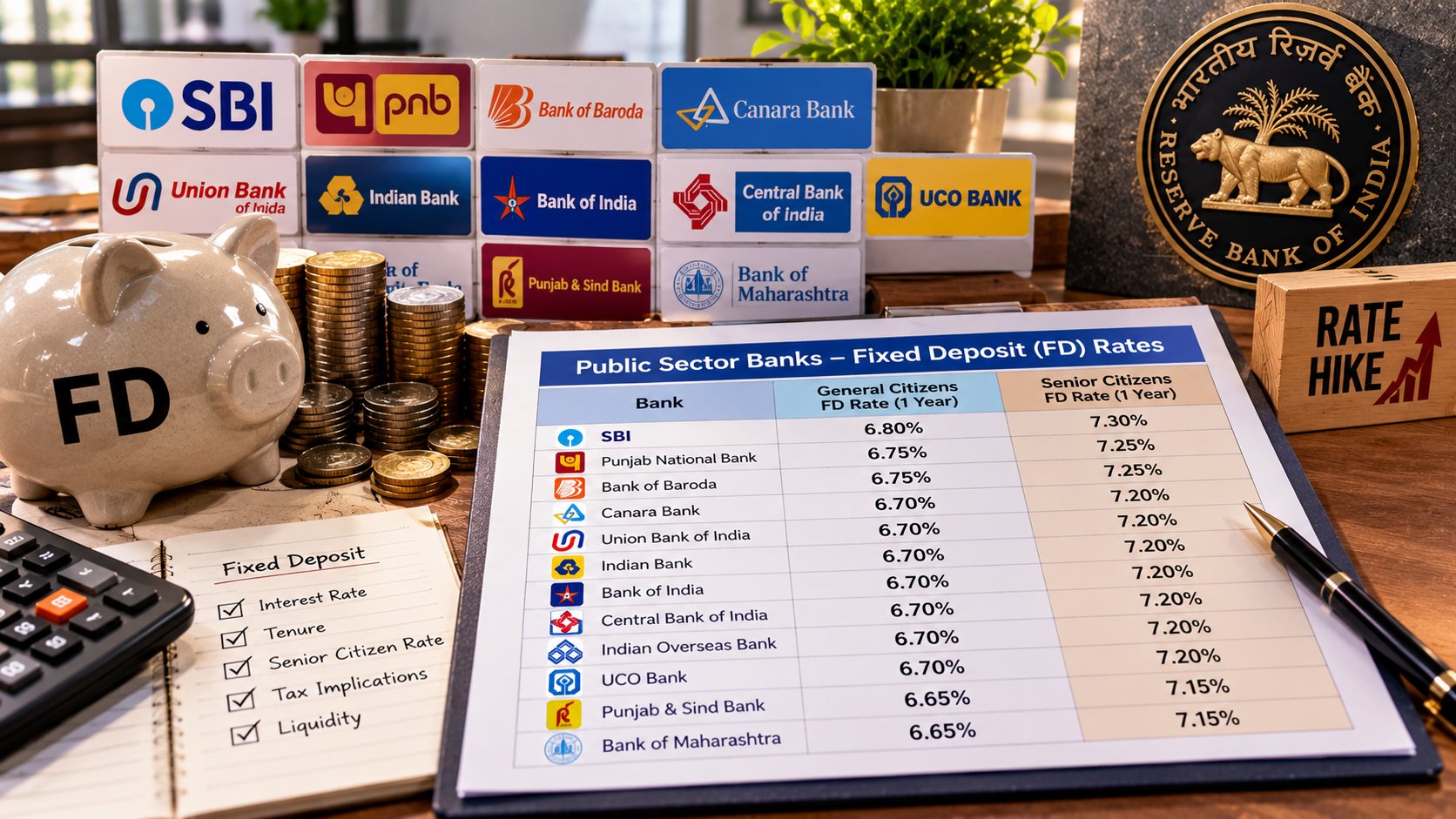
FD Rates at All 12 Public Sector Banks After the RBI Hike — Who Pays Most, and Why Most Have Not Moved Yet
FD Rates at All 12 Public Sector Banks After the RBI Hike — Who Pays Most, and Why Most Have Not Moved Yet
A week after the RBI raised the repo rate to 5.50% on 7 October 2026, the best regular FD rates at India’s 12 public sector banks range from 6.45% to 6.85%. Here is the bank-by-bank picture, what your money actually earns after tax, and whether to lock in now or wait.
If you have an FD maturing this month, the timing feels awkward. The Reserve Bank of India has just raised interest rates for the first time in more than three years, which should mean better deposit rates. Yet when you open your bank’s website, the rate card looks almost the same as it did in September. Do you renew now, or park the money for a few weeks and hope for a higher rate?
The answer depends on numbers most headlines skip: how far apart the 12 public sector banks actually are, what each tenure pays, what is left after tax, and how big a rate rise you would need to make waiting worthwhile. We pulled together the latest available rates for all 12 government-owned banks, ran the arithmetic, and set out what we know and what is still uncertain.
Quick Summary
Public sector bank FD rates have barely moved since the 7 October repo hike. As of 14 October 2026, the best regular rate at each of the 12 PSU banks sits between 6.45% and 6.85%, with Bank of India and Punjab & Sind Bank on top. SBI’s chairman said deposit rates may not change for two to three months. Small finance banks moved first, with rates up to 8.25%. For most savers, the gap between PSU banks matters less than choosing the right tenure.
What We Know
- The RBI raised the repo rate by 25 basis points to 5.50% on 7 October 2026 and shifted its stance to calibrated tightening.
- As of 14 October, top regular FD rates at the 12 PSU banks range from 6.45% to 6.85%.
- SBI pays 6.25% for 1 to 2 years, 6.45% for 2 to 3 years and 6.05% for 5 to 10 years.
- SBI chairman C S Setty said there may not be deposit rate action for the next two to three months, citing sufficient liquidity.
- Several small finance banks have lifted rates to 8.00% to 8.25%.
What Is Still Unclear
- Whether any PSU bank has formally revised its card since 7 October, as no bank has announced a change.
- Whether Bank of India’s top rate rose from 6.70% in September to 6.85%, or the two sources measure different slabs.
- Exact senior citizen rates for every bank and tenure, which most listings do not give.
- How large any eventual PSU deposit rate rise will be, and when.
- What the RBI will do at its next meeting, due on 2 to 4 December 2026.
The Hike That Hasn’t Reached Your Passbook
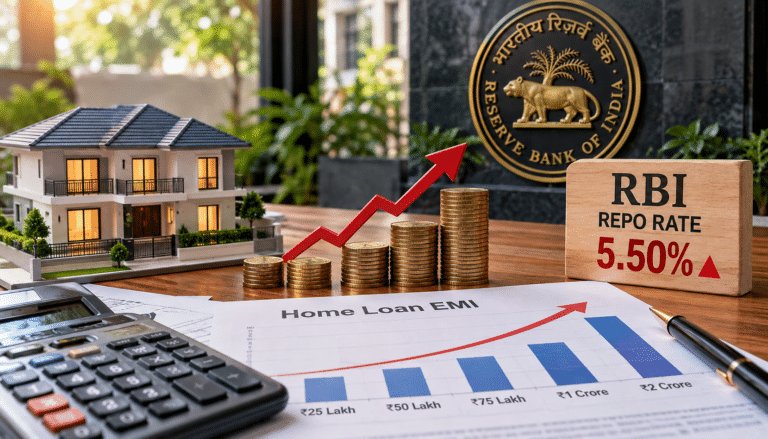
On 7 October 2026, the RBI’s Monetary Policy Committee voted unanimously to raise the repo rate from 5.25% to 5.50%. It was the first increase since February 2023 and a sharp turn after the cutting cycle of 2025. Retail inflation had climbed to 5.54% in September, and the RBI changed its stance to calibrated tightening, signalling that rate cuts are off the table for now.
For borrowers, the effect is quick. More than half of bank loans are now linked to external benchmarks such as the repo rate, so many floating-rate EMIs reset within weeks. Punjab National Bank and Bank of Baroda raised lending rates soon after the decision. Deposits are different. Banks set FD rates themselves, and they raise them when they need money, not automatically when the RBI moves.
- 5.25% to 5.50%Repo rate change on 7 October 2026
- Feb 2023Last time the RBI raised rates before this
- 5.54%CPI inflation, September 2026
- Over 50%Share of bank loans linked to external benchmarks
That is why SBI’s chairman, C S Setty, was blunt the day after the decision. “I believe that next two-three months, there may not be any rate action on the deposits,” he said, adding that there is sufficient liquidity in the system. He also said savers should earn some positive real interest rate as inflation rises, and that some lenders may need to raise deposit rates if loan demand stays strong. In other words: not yet, but not never.
How a policy decision travels to an FD rate
- Day 0RBI sets repo7 October 2026: repo raised to 5.50%
- Days 1 to 30Loan rates resetRepo-linked loans move first; PNB and BoB raised lending rates
- Weeks to monthsBank reviews depositsEach bank’s committee decides when it needs more deposits
- From the new card dateNew FDs onlyExisting FDs keep their booked rate to maturity
All 12 Public Sector Banks, Side by Side
India has 12 public sector banks after the mergers of 2019 and 2020. The table below shows their rates for the most commonly chosen tenures, as compiled by Paisabazaar as of 14 October 2026. “Highest slab” is the best regular rate the bank offers on any tenure, which is often a special window rather than a round number of years.
| Bank | Highest slab | 1 year | 3 years | 5 years |
|---|---|---|---|---|
| Bank of India | 6.85% | 6.50% | 6.70% | 6.00% |
| Punjab & Sind Bank | 6.85% | 5.85% | 5.85% | 5.95% |
| Bank of Baroda | 6.75% | 6.25% | 6.25% | 6.30% |
| Central Bank of India | 6.75% | 6.10% | 6.00% | 6.00% |
| Indian Bank | 6.65% | 6.10% | 6.05% | 6.00% |
| Bank of Maharashtra | 6.65% | 6.20% | 5.25% | 5.00% |
| Punjab National Bank | 6.60% | 6.25% | 6.35% | 6.10% |
| Canara Bank | 6.60% | 6.25% | 6.25% | 6.25% |
| Indian Overseas Bank | 6.60% | 6.50% | 6.10% | 6.10% |
| Union Bank of India | 6.55% | 6.20% | 6.10% | 6.00% |
| State Bank of India | 6.45% | 6.25% | 6.30% | 6.05% |
| UCO Bank | 6.45% | 6.10% | 6.00% | 6.00% |
Two things stand out. First, the spread at the top is narrow: just 0.40 percentage points separates the most and least generous banks. Second, the spread at specific tenures is much wider. Punjab & Sind Bank ties for the best headline rate, yet pays only 5.85% for a 1-year deposit. Bank of Maharashtra offers 6.65% somewhere on its card, but just 5.00% for five years.
The special-window trap
Several PSU banks reserve their best rate for odd tenures. Business Today’s comparison as of 9 September 2026 showed Bank of Baroda’s 6.75% on a 555-day deposit, and Punjab National Bank’s and Indian Overseas Bank’s 6.60% on 444 days. SBI’s 6.45% applies to 2 years to less than 3 years. A saver who books a round 3 or 5 years expecting the headline rate will get something lower, sometimes much lower. Always read the tenure next to the rate.
Did Bank of India quietly move?
Business Today listed Bank of India’s best rate at 6.70% for 3 years on 9 September. Paisabazaar’s 14 October listing shows a 6.70% 3-year rate and a 6.85% highest slab. That could mean a new special tenure or a revision, or simply that the two compilations measured different slabs. We could not confirm a formal announcement, so treat the 6.85% as a figure to verify with the bank before booking.
Where the Real Gaps Hide: Five-Year Deposits
If you are saving for a goal five years away, or you want the tax-saver FD, the bank you choose matters far more than the headline rankings suggest. At five years, the 12 banks range from 5.00% to 6.30%, a gap of 1.30 points.
Seniors: the extra half-point, and a little more at SBI
Most PSU banks add 0.50 percentage points for depositors aged 60 and above. SBI goes further on long deposits: its WeCare scheme pays seniors 7.05% for 5 to 10 years, a full point above the regular 6.05%. Bank of Baroda’s tax-saver FD pays seniors 6.90% to 7.00%, according to Paisabazaar. Upstox’s 7 October comparison listed Bank of India at 7.45% for seniors on 3 years. Senior rates are rarely published together in one place, so check each bank’s own card for your exact tenure.
After Tax and Inflation, What Does 6.85% Really Pay?
FD interest is fully taxable at your slab rate, and on a cumulative deposit you owe tax each year as interest accrues. Against September’s inflation of 5.54%, that makes the difference between a deposit that grows your money and one that quietly loses ground. We ran ₹5 lakh for two years through the main slabs.
- 5% slabSmall earners and many retirees+1.14% real6.68% after tax at 6.85%. A senior at 7.35% gets about +1.64% real. The FD grows purchasing power.
- 20% slabMiddle-income savers+0.08% real5.62% after tax. The deposit roughly holds its value, no more.
- 30% slabHigher-income savers−0.62% real4.92% after tax, below inflation. At SBI’s 6.45% the real return is about −0.91%.
The lesson is not that FDs are bad. It is that for higher-income savers, the choice between Bank of India and SBI changes the post-tax yield by less than 0.3 points, while the tax slab changes it by nearly 1.8 points. If you are in the 30% slab, the bigger question is whether an FD is the right tool for this money at all, not which PSU bank to use.
Lock In Now or Wait for a Hike?
This is the question most savers with a maturing deposit are asking. The tempting answer is to wait, since rates are heading up. But waiting has a cost: money sitting in a savings account at about 2.5% earns far less than an FD in the meantime. The real question is how big a rise you need to make the wait worthwhile.
We modelled ₹5 lakh over a three-year horizon. Option one: book a 3-year FD today at SBI’s 6.30%. Option two: leave the money in savings at 2.5% for three months, then book an FD for the remaining 2 years and 9 months at a higher rate.
If PSU banks lift FD rates by the same 0.25 points as the repo, waiting three months leaves you about ₹1,584 worse off. You break even somewhere around a 0.35 to 0.40 point rise, and you only come out clearly ahead if banks raise rates by half a point or more within three months. Given that SBI’s chairman expects no deposit rate action for two to three months, waiting is a bet on a bigger and faster move than the largest PSU lender is signalling.
The Banks That Did Move: Small Finance Banks at 8%
While PSU banks waited, small finance banks acted. By 16 October 2026, Suryoday Small Finance Bank was offering up to 8.25%, Utkarsh up to 8.10%, and Equitas, ESAF, Jana and Shivalik around 8.00%, according to reports. Large private banks such as HDFC Bank, ICICI Bank and Axis Bank were around 6.50%. Small finance banks rely more on deposits for funding, so they compete harder for them.
An extra 1.40 points is meaningful. On ₹5 lakh for one year, 8.25% gives about ₹5,42,544, against about ₹5,35,140 at 6.85%. But the comparison needs one important qualification. DICGC insurance covers deposits up to ₹5 lakh per depositor per bank, including interest. Keep each small finance bank deposit, plus its interest, within that limit, and the insurance protection is the same as at a PSU bank.
How We Got Here: The Rate Cycle in Dates
Deposit rates fell steadily through 2025 as the RBI cut, and have only just started to bottom out. These dates explain why today’s cards look the way they do.
- February 2023Last RBI hike before this cycle; repo reaches 6.50%
- 2025RBI cuts repo in stages through the year as inflation eases
- Late 2025Repo stands at 5.25%; banks trim FD rates across tenures
- 9 Sep 2026PSU top rates: BoB 6.75%, BoI 6.70%, PNB and IOB 6.60%, SBI 6.45%
- Sep 2026CPI inflation rises to 5.54%
- 7 Oct 2026RBI raises repo 25 basis points to 5.50%
- 8 Oct 2026SBI chairman: no deposit rate action likely for 2 to 3 months
- 14 Oct 2026PSU top rates range from 6.45% to 6.85%
- 16 Oct 2026Small finance banks offer 8.00% to 8.25%
- 2 to 4 Dec 2026Next RBI policy meeting
A Five-Minute Plan for Your Next FD
Most of the value comes from a few deliberate choices rather than chasing the top of a league table. Use this as a checklist before your next booking or renewal.
- Fix the tenure from your goal date first, then compare rates
- Check the exact tenure for any headline rate, such as 444 or 555 days
- For 5 years, compare carefully: rates range from 5.00% to 6.30%
- Seniors: ask about extra schemes such as SBI’s 7.05% WeCare
- Keep each bank’s total within ₹5 lakh for full DICGC cover
- Compare post-tax yield at your slab, not the gross rate
- Do not leave money in savings for months waiting for a hike
- Consider a 1, 2 and 3 year ladder if unsure about timing
If your FD is maturing this month
Check whether your bank auto-renews at the prevailing rate for the same tenure, which may not be its best slab. If the money is needed within a year, a 1-year deposit at Bank of India or Indian Overseas Bank at 6.50% beats most of the field. If it is long-term money, consider splitting it so part is locked at today’s rates and part stays flexible for a possible rise after the December policy meeting.
If you already hold a long FD
Your rate is fixed until maturity, and breaking it to rebook at a slightly higher rate rarely pays. Banks typically re-price a broken deposit at the rate for the period actually held and subtract a penalty, often 0.50 to 1 point. A rise of 0.25 points would not cover that cost.
Frequently Asked Questions
Which public sector bank gives the highest FD rate in October 2026?
As of 14 October 2026, Bank of India and Punjab & Sind Bank show the highest regular rate among PSU banks at 6.85% on their best slab. For a 1-year deposit, Bank of India and Indian Overseas Bank lead at 6.50%; for 5 years, Bank of Baroda leads at 6.30%.
Have banks increased FD rates after the RBI repo rate hike?
Several small finance banks have, with rates up to 8.25%. Public sector banks had not announced FD rate increases as of mid-October, and SBI’s chairman said deposit rate action may not come for two to three months.
What is the current SBI FD interest rate?
SBI pays 6.25% for 1 to 2 years, 6.45% for 2 to 3 years, 6.30% for 3 to 5 years and 6.05% for 5 to 10 years for regular depositors. Seniors get 0.50 points more, and 7.05% for 5 to 10 years under WeCare.
Should I wait for FD rates to rise before investing?
Only if you expect a large and quick rise. Our calculation shows that waiting three months in a savings account loses money if rates rise by 0.25 points, and breaks even around 0.35 to 0.40 points.
Do senior citizens get higher FD rates at PSU banks?
Yes. Most PSU banks pay seniors 0.50 points more than regular depositors. SBI’s WeCare scheme pays 7.05% for 5 to 10 years, and some banks offer up to about 7.45% on specific tenures.
Are FDs in public sector banks fully guaranteed?
Deposit insurance from DICGC covers up to ₹5 lakh per depositor per bank, the same at public and private banks. Government ownership adds confidence but is not a legal guarantee above that limit.
Will my existing FD rate go up after the RBI hike?
No. An existing FD earns the rate fixed when it was booked until maturity. Any new rate applies only to fresh deposits and renewals.
How is FD interest taxed in India?
FD interest is taxed at your income tax slab each year as it accrues. Banks deduct TDS above a threshold, but that is an advance payment, not the final tax. Savers with income below the taxable limit can submit a declaration to avoid TDS.
The Short Version
The RBI raised the repo rate to 5.50% on 7 October 2026, but public sector bank FD rates have not yet followed. As of 14 October, the best rates at the 12 PSU banks range from 6.45% to 6.85%, with Bank of India and Punjab & Sind Bank on top. The bigger differences sit in specific tenures: five-year rates range from 5.00% to 6.30%. After tax, savers in the 30% slab earn less than inflation. SBI’s chairman expects no deposit rate move for two to three months, so waiting in savings only pays if rates rise by more than about 0.4 points. Choose tenure first, compare post-tax, and stay within ₹5 lakh per bank.