Why Sensex Jumped 333 Points After a 13-Week Low — and What the Nifty's 23,000 Line Now Decides
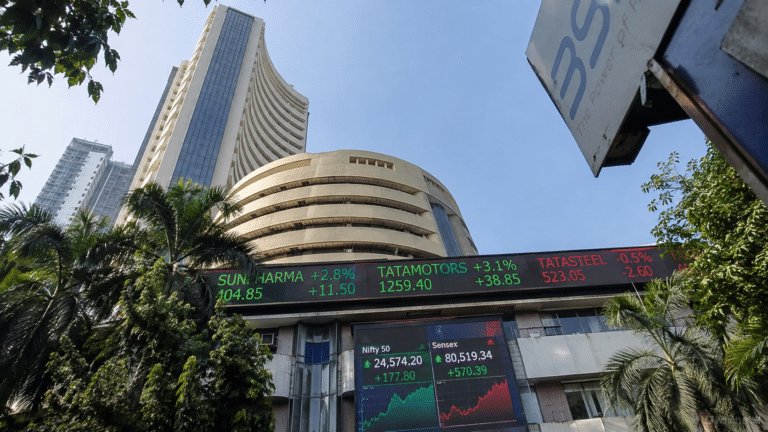
Indian stock market trends in July 2026 point to a market caught between resilient domestic fundamentals and a more difficult global backdrop. The BSE Sensex closed near 77,709 on 20 July, down 0.57% for the session, while the recent trading narrative has featured pressure on banking shares, selective strength in defensives, and heightened sensitivity to global energy, geopolitical, and currency developments.
For investors, this is not a simple “bull market versus bear market” moment. It is a stock-picker’s market: quality earnings, valuation discipline, balance-sheet strength, and sector selection matter more than chasing every index move.
Important note: This article is for education and research, not personalised investment advice. “Buy” candidates are watch-list ideas, not guarantees. Verify live prices, valuations, corporate announcements, and suitability with a SEBI-registered adviser before acting.
Indian Market Overview
BSE Sensex, NSE Nifty 50 and Bank Nifty
The BSE Sensex ended 20 July 2026 at approximately 77,709, declining 0.57% in the session. Despite a modest 0.80% rise over the preceding month, the benchmark remained about 5.46% below its level a year earlier, illustrating how volatile and uneven the 2026 recovery has been.
The NSE Nifty 50 was reported near 24,250 after the 20 July session, with banks acting as a meaningful drag while pharma and energy pockets offered relative support. The Nifty Bank trend is especially important because financials carry substantial weight in the broader indices and often determine whether rallies can sustain.
Nifty Bank was quoted at 57,484.60 on 16 July, down 273.25 points or 0.47% at the reported time. That does not automatically signal a structural banking crisis; rather, it signals that bank investors are reassessing credit growth, margins, deposit competition, bond yields, asset quality and the path of RBI repo rates.
What investor sentiment is saying
Investor sentiment in July 2026 appears cautious rather than capitulatory. Domestic investors continue to see long-term opportunity in India’s consumption, infrastructure, manufacturing, formalisation and digitalisation themes, but near-term risk appetite is constrained by:
- Higher energy and input-cost uncertainty linked to West Asia tensions and trade-route disruption.
- A neutral RBI policy stance instead of an immediate fresh rate-cut cycle.
- Valuation sensitivity in expensive growth franchises.
- Foreign institutional investor behaviour, which can react sharply to US yields, dollar strength, crude oil and global risk sentiment.
- Q1 FY27 earnings, management commentary and guidance revisions.
The key question is not whether the market can bounce on a particular day. It is whether earnings estimates can hold up while inflation trends India faces renewed commodity and supply-side risk.
NIFTY Today: Point-Wise View
Market map for Tuesday
- Trend context: Nifty 50 enters the 21 July session after a weak previous close near 24,250, with banking stocks reportedly weighing on the index.
- Immediate support zone: Traders should watch whether the market can defend the 24,000 to 24,200 region. A sustained failure below that area would indicate that sellers remain in control; a recovery above recent intraday highs would improve short-term sentiment.
- Immediate resistance zone: The 24,500 area is a practical sentiment marker. A decisive move above it, supported by broad participation rather than only a few heavyweight stocks, would be more constructive.
- Bank Nifty confirmation: A rebound in Nifty Bank is important for any durable Nifty rally. The recent level around 57,484.60 provides a reference point, but live NSE data should be used before any trade.
- Breadth matters: If the Nifty rises but mid-cap, small-cap and sectoral participation remains weak, the move may be defensive rather than broadly bullish.
- Watch crude and the rupee: Higher crude prices can hurt India’s import bill, inflation outlook and corporate margins. A sharp rupee decline can increase pressure on import-dependent businesses while benefiting select exporters.
- Earnings are the catalyst: July is a results-heavy period. Companies that beat expectations and retain guidance can outperform even if the index remains range-bound.
- Avoid opening-hour impulsiveness: The first 15 to 30 minutes can reflect overnight global cues rather than considered domestic pricing. Investors should distinguish between a market gap and a confirmed trend.
- Prefer staggered deployment: Rather than committing a full allocation on one day, use tranches in high-quality businesses, particularly after sharp volatility.
- Keep position size proportional to risk: A strong company can still be a poor purchase at an excessive valuation or an oversized portfolio weight.
Sensex versus Nifty 50 in July 2026
| Measure | BSE Sensex | NSE Nifty 50 | Why it matters |
|---|---|---|---|
| Index composition | 30 large, liquid BSE-listed companies | 50 large, liquid NSE-listed companies | Nifty offers broader representation, while Sensex is a more concentrated blue-chip barometer |
| Latest available reference | About 77,709 on 20 July, down 0.57% for the session | Near 24,250 after 20 July trading | Both indicate a cautious near-term market tone |
| One-month direction | About 0.80% higher over the prior month | Short-term action influenced by banking weakness | Recovery has been uneven rather than a straight-line rally |
| One-year context | About 5.46% lower year-on-year at the cited point | Exact comparable figure should be checked live on NSE | Highlights the importance of valuation and earnings recovery |
| Key swing factor | Heavyweight financials, IT, energy and consumer stocks | Financials, Reliance, IT leaders and broad large-cap participation | A few mega-caps can materially influence daily index direction |
| Investor use | Quick blue-chip sentiment gauge | Benchmark for index funds, ETFs and diversified large-cap exposure | Long-term investors should focus on allocation rather than daily points |
Key Economic Drivers
India GDP growth: resilient, but recalibrated
India GDP growth remains one of the most supportive structural arguments for Indian equities, but growth forecasts have become more measured. In the June 2026 policy review, the RBI reportedly cut its FY27 real GDP growth forecast to 6.6% from 6.9%, citing geopolitical tensions, higher commodity prices and supply-side uncertainty.
A 6.6% growth expectation is still strong relative to many major economies. However, markets price changes in expectations, not only headline levels. A downgrade can affect cyclical sectors such as banks, autos, capital goods, real estate, industrials and discretionary consumption if investors conclude that demand, lending or profit growth may soften.
At the same time, the RBI described domestic activity as broadly resilient, supported by services momentum, GST rationalisation effects and generally stable employment conditions. That creates a balanced outlook: domestic demand is a cushion, while external shocks remain the risk.
CPI inflation: the market’s most important macro variable
The Consumer Price Index measures retail inflation, which affects household purchasing power, interest-rate policy, input costs and equity valuations. RBI commentary indicated that CPI inflation had remained below target after the global shock’s initial impact, but the central bank expected price pressures to rise later in FY27.
The RBI’s FY27 CPI inflation projection was raised to 5.1%, with the quarterly path indicated at 4.2% in Q1, 5.1% in Q2, 5.9% in Q3 and 5.4% in Q4. This path is crucial for market prediction India because it suggests that inflation may become more uncomfortable later in the fiscal year even if current readings appear manageable.
For equities, inflation is not uniformly negative:
- Banks: May benefit from lending growth and pricing power, but can face pressure if rates rise, funding costs increase or borrowers become stressed.
- FMCG and consumer companies: Can suffer if commodity inflation cannot be passed through to consumers.
- IT exporters: May benefit from currency movement but face global demand uncertainty.
- Energy and logistics businesses: Often feel crude-oil and fuel-cost effects quickly.
- Pharma: Can be relatively defensive, though APIs, currency and regulatory developments matter.
RBI repo rates and monetary policy
The RBI maintained the policy repo rate at 5.25% in June 2026 and retained a neutral stance. The neutral stance is important: it means the central bank is preserving flexibility rather than committing to an easing or tightening path.
The RBI had already reduced rates by a cumulative 100 basis points since February 2025, according to contemporaneous coverage. Lower rates generally support credit demand, rate-sensitive sectors and equity valuations, but the impact takes time and can be offset by inflation, risk premiums or global stress.
For the Nifty Bank trend, the practical implication is mixed:
- Stable repo rates can support loan affordability and visibility.
- Banks may face continued pressure to transmit past reductions through lending rates.
- Deposit competition can constrain net interest margins.
- A later rise in inflation could reduce the scope for additional easing.
Employment and consumption
The official PLFS monthly bulletin is the appropriate source for monitoring labour-market data, though investors should note that the latest accessible search result did not provide a verified headline unemployment percentage for the relevant July 2026 market date. It would be inaccurate to invent a precise rate without the official release.
Instead, investors should track labour-force participation, worker-population ratio, urban employment, rural demand indicators, real wage trends, GST collections, passenger vehicle sales, two-wheeler sales and credit-card spending. These data points collectively shape the outlook for consumer goods, autos, retail lenders, housing finance and discretionary spending.
Latest Market News Highlights
1. RBI holds at 5.25%
The RBI’s June decision to retain the repo rate at 5.25% was unanimous, and the MPC retained a neutral stance amid heightened global uncertainty.
Immediate market impact:
- Supportive for rate-sensitive sectors compared with a surprise hike.
- Not a fresh catalyst for banks because there was no new cut.
- Encourages focus on bank-specific deposit costs, loan growth and asset quality.
- Makes inflation data and crude oil more influential for the next policy path.
2. GDP forecast lowered to 6.6%
The RBI reduced its FY27 growth forecast to 6.6%, citing geopolitical shocks, elevated commodity costs and supply disruptions.
Immediate market impact:
- Can limit valuation expansion in cyclicals.
- Raises the bar for capital-goods, real-estate and industrial companies to deliver strong order books and execution.
- Favors businesses with recurring revenue, strong balance sheets and pricing power.
3. Inflation forecast lifted to 5.1%
The RBI raised its FY27 CPI inflation forecast to 5.1%, with a projected Q3 reading of 5.9%.
Immediate market impact:
- Increases sensitivity to food prices, crude oil and imported inflation.
- Can favour selective energy and commodity-linked names.
- May weigh on highly valued consumer companies if gross-margin concerns intensify.
- Reduces confidence that interest rates will fall meaningfully in the near term.
4. Banking shares under pressure
The 20 July session reportedly saw banking stocks drag the Nifty, while pharma and energy names offered relative strength.
Immediate market impact:
- Nifty’s recovery remains less convincing unless financials stabilise.
- Investors should avoid treating all bank stocks alike: deposit franchise, CASA ratio, credit-cost discipline and valuation are differentiators.
- Defensive leadership in pharma can indicate investors are seeking earnings visibility.
5. West Asia and supply-chain risk
The RBI explicitly pointed to the geopolitical impasse in West Asia, energy-price escalation and supply-chain disruption as major uncertainties.
Immediate market impact:
- Crude-sensitive sectors can see sharp moves.
- Shipping, aviation, chemicals, paints, tyres and logistics may experience margin uncertainty.
- Exporters may face differing effects depending on currency movement and end-market demand.
Foreign Indices That Influence India
Foreign markets do not dictate Indian prices every day, but they influence risk appetite, FII flows, commodity prices, currencies and overnight opening gaps.
| Foreign index or market | Why Indian investors watch it | Typical impact on India |
|---|---|---|
| S&P 500 | Global equity-risk benchmark and indicator of US corporate earnings confidence | Strong US risk appetite can support global flows; a sell-off can pressure FIIs |
| Nasdaq Composite | Technology, AI and growth-stock barometer | Important for Indian IT sentiment and valuation appetite |
| Dow Jones Industrial Average | Broad US industrial and cyclical sentiment gauge | Influences global cyclicals, metals and risk-on mood |
| FTSE 100 | UK large-cap index with energy, banking and global commodity exposure | Offers clues on global commodities and financial-sector appetite |
| DAX | European growth, industrial and manufacturing indicator | Relevant to export demand and global industrial sentiment |
| CAC 40 | European luxury, industrial and financial-market signal | Helps assess European risk appetite |
| Nikkei 225 | Key Asian developed-market benchmark | Overnight Asian direction can influence India’s opening tone |
| Hang Seng | China and Hong Kong risk sentiment barometer | Impacts commodity, China-demand and broader Asian emerging-market mood |
| Shanghai Composite | Mainland Chinese economy and policy expectations | Influences metals, chemicals and Asian trade sentiment |
| Taiwan Weighted | Global semiconductor-cycle indicator | Relevant to Indian electronics, technology and supply-chain themes |
| KOSPI | South Korean export and semiconductor benchmark | Offers a read-through on global technology and industrial cycles |
The most useful approach is not to react mechanically to every foreign close. Instead, monitor the combination of US yields, dollar index, Brent crude, Asian market direction, global volatility and FII activity.
Sector Performance India 2026
The leadership map is changing
Sector performance India 2026 is likely to remain highly rotational. In the latest cited market commentary, pharma and energy showed relative strength while banking stocks weighed on the market. This does not mean the same sectors will lead every week; earnings, inflation, global demand and policy transmission can quickly change leadership.
| Sector | July 2026 market setup | Earnings drivers | Key risk | Investor lens |
|---|---|---|---|---|
| Banking and financials | Under recent pressure, with Bank Nifty soft in the cited session | Credit growth, fee income, treasury performance, credit costs | Deposit competition, NIM compression, unsecured-loan stress | Prefer strong liability franchises and disciplined underwriting |
| IT services | Sensitive to US growth, technology spending and currency | Deal wins, margin management, AI-led productivity, client budgets | Delayed discretionary spending and pricing pressure | Focus on diversified clients and credible growth commentary |
| Pharma | Relative support in the cited 20 July market commentary | US launches, domestic chronic therapies, API normalisation | USFDA issues, price erosion, currency and compliance | Useful as a selective defensive allocation |
| Energy | Relative strength was noted in the same session | Refining spreads, marketing margins, gas demand, crude movement | Oil-price volatility and policy intervention | Differentiate upstream, downstream and renewable exposure |
| FMCG | Consumption compounder, but inflation-sensitive | Volume growth, rural recovery, premiumisation | Input-cost inflation and weak rural purchasing power | Prefer brands with distribution strength and pricing power |
| Autos | Linked to consumption and financing conditions | Rural demand, replacements, premiumisation, EV adoption | Commodity prices, financing demand and competition | Select companies with product-cycle momentum |
| Industrials and capital goods | Supported by infrastructure and manufacturing investment | Order inflows, execution, government capex, private capex | Project delays, valuation excess and commodity costs | Prioritise order-book quality and cash conversion |
| Metals | Highly cyclical and globally driven | China demand, global manufacturing, prices | Trade barriers, price volatility and global slowdown | Tactical exposure rather than indiscriminate long-term buying |
| Consumer durables | Sensitive to urban demand and interest rates | Housing, premiumisation, channel expansion | Inflation and weaker discretionary consumption | Better for patient investors at reasonable valuations |
| Healthcare and hospitals | Defensive growth with domestic demand support | Occupancy, ARPOB, diagnostics volumes | Regulatory scrutiny and valuation | Consider as a balance against cyclical risk |
Top NSE/BSE Stocks to Watch for 2026
A “top 10 stocks to buy” list should not be treated as a blind purchase list, especially during volatile Indian stock market trends. Exact P/E, PEG and dividend yields move daily and must be checked from live NSE/BSE filings, company results and a trusted market-data terminal before purchase. The table therefore focuses on quality filters, catalysts and the valuation discipline required.
| Stock | Sector | 2026 thesis | Valuation lens | Dividend lens | Main trigger |
|---|---|---|---|---|---|
| HDFC Bank | Private banking | Scale, deposit franchise, long-term credit penetration | Compare P/E with its own cycle and ROA/ROE trend | Usually modest | Loan growth, deposit mobilisation, margin stability |
| ICICI Bank | Private banking | Strong execution track record and retail-corporate mix | Evaluate P/E against earnings growth and credit cost | Usually modest | Asset-quality consistency, fee income, loan growth |
| State Bank of India | PSU banking | Large franchise and potential valuation support | Track P/B versus ROE, NPA trajectory and treasury impact | Often meaningful relative to private peers | Credit growth, recoveries, capital efficiency |
| Reliance Industries | Energy, retail, telecom | Multiple earnings engines and optionality | Use sum-of-the-parts, not only headline P/E | Typically lower yield | Jio monetisation, retail growth, energy margins |
| TCS | IT services | Large-client resilience, cash generation and governance | Compare P/E with revenue growth and margin outlook | Regular dividend payer | Deal wins, demand recovery, AI productivity |
| Infosys | IT services | Digital capabilities and potential recovery in discretionary demand | Consider P/E relative to guidance credibility | Regular dividend payer | Large deals, margin outlook, US demand |
| Larsen & Toubro | Capital goods | Infrastructure and manufacturing capex beneficiary | Examine order-book quality, execution and cash flow | Moderate | Order inflows, project execution, margin mix |
| Sun Pharma | Pharmaceuticals | Domestic scale and specialty-business potential | Assess P/E against specialty growth and compliance record | Moderate | US specialty sales, India formulations, approvals |
| Bharti Airtel | Telecom | Data demand, premiumisation and ARPU potential | Use EV/EBITDA and free-cash-flow trajectory | Lower yield | Tariff actions, subscriber mix, 5G monetisation |
| Hindustan Unilever | FMCG | Brand strength and distribution resilience | Avoid overpaying; compare P/E to volume growth and margins | Typically steady | Rural recovery, volume revival, commodity easing |
How to use the list
- Do not purchase all 10 names at once.
- Start with business quality, then check valuation.
- Compare latest quarterly earnings against management guidance.
- Prefer staggered purchases over lump-sum buying after a sharp rally.
- Keep any single-stock allocation modest enough that a negative surprise does not damage the entire portfolio.
- Check the current P/E or PEG at the time of execution; a strong company can still be overvalued.
Nifty 50: Top 10 Gainers — 20 July 2026
| Rank | Stock | Close | Change |
|---|---|---|---|
| 1 | Trent | ₹2,915.10 | +2.56% |
| 2 | Cipla | ₹1,448.00 | +2.07% |
| 3 | JSW Steel | ₹1,260.20 | +1.85% |
| 4 | Bharti Airtel | ₹1,936.10 | +1.43% |
| 5 | NTPC | ₹346.10 | +1.24% |
| 6 | ONGC | ₹249.99 | +1.09% |
| 7 | Power Grid | ₹286.60 | +1.08% |
| 8 | Nestlé India | ₹1,442.20 | +1.05% |
| 9 | Hindalco | ₹953.00 | +0.94% |
| 10 | Apollo Hospitals | ₹8,890.00 | +0.73% |
Trent led the Nifty 50 gainers, while pharma, metals, telecom, power and healthcare names also advanced.
Nifty 50: Top 10 Losers — 20 July 2026
| Rank | Stock | Close | Change |
|---|---|---|---|
| 1 | Axis Bank | ₹1,258.30 | -5.28% |
| 2 | HDFC Bank | ₹779.75 | -4.86% |
| 3 | Kotak Mahindra Bank | ₹380.70 | -2.37% |
| 4 | Maruti Suzuki | ₹13,549.00 | -1.84% |
| 5 | Jio Financial Services | ₹238.65 | -1.78% |
| 6 | Bajaj Finance | ₹1,040.30 | -1.51% |
| 7 | Shriram Finance | ₹1,022.70 | -1.18% |
| 8 | SBI Life Insurance | ₹1,808.50 | -1.14% |
| 9 | IndiGo | ₹5,199.00 | -0.94% |
| 10 | TCS | ₹2,248.50 | -0.90% |
Financial stocks dominated the losing side, led by Axis Bank and HDFC Bank; Axis Bank’s fall followed its quarterly earnings update.
Stock Recommendations for Today
Conservative investor
- Build a core with Nifty 50 or Sensex index funds: This reduces single-stock risk and offers broad exposure to leading Indian companies.
- Add high-quality private banks gradually: HDFC Bank and ICICI Bank are examples of franchises to evaluate for long-term compounding, subject to current valuations and quarterly trends.
- Use FMCG and pharma for stability: Consumer staples and select pharma can balance a portfolio when inflation trends India and global risk elevate uncertainty.
- Keep cash or short-duration debt allocation: Liquidity is valuable in a volatile market because it allows investors to buy quality assets during sharper declines.
Pros: Lower concentration risk, easier execution, potentially smoother drawdowns.
Cons: May lag during speculative small-cap rallies and offers less chance of outsized single-stock returns.
Moderate-risk investor
- Core index allocation: Use Nifty 50 or a large-cap fund as the base.
- Financials: Blend a private bank with a selectively valued PSU bank instead of relying on one lender.
- Industrials and capital goods: Consider L&T-type infrastructure exposure after evaluating order-book quality and valuation.
- IT and telecom: Use TCS, Infosys or Bharti Airtel-type exposure for earnings diversification.
- Healthcare: Add pharma or hospital exposure as a defensive growth bucket.
Pros: Balances growth engines with defensive earnings streams.
Cons: Still vulnerable to a broad risk-off event, rate shocks and earnings disappointments.
Aggressive investor
- Keep at least half the equity allocation in proven large-cap quality.
- Use a controlled satellite allocation for mid-cap themes: Manufacturing, defence, railways, renewables, electronics, industrial automation and domestic consumption can create opportunity, but valuations need careful scrutiny.
- Prefer companies with visible earnings rather than story-only momentum.
- Use strict position sizing: High-beta stocks should be small positions, not portfolio anchors.
- Never average down without rechecking the investment thesis: A falling share price is not evidence of value unless earnings, balance sheet and competitive position remain intact.
Pros: Higher long-term upside if themes execute and earnings compound.
Cons: Larger drawdowns, liquidity risk, governance risk and valuation compression.
What Could Change the Market View?
Three developments could reshape Indian stock market trends quickly.
A positive upside surprise
A sustained easing in crude prices, better-than-feared inflation prints, strong monsoon-linked rural demand, favourable Q1 FY27 earnings and renewed FII inflows could improve the outlook. If that occurs alongside stable bond yields and a resilient rupee, banks, autos, consumer discretionary and industrials could lead a broader rally.
A downside surprise
Persistent crude inflation, supply disruptions, a weaker rupee, disappointing earnings guidance, softer global demand or an escalation in geopolitical tension could push investors toward defensives. Under that scenario, high-P/E cyclicals and leveraged businesses would face the most valuation risk.
The most likely base case
The base case is continued choppiness with sector rotation. The RBI’s neutral stance, a 5.25% repo rate, a 6.6% FY27 GDP growth forecast and a higher 5.1% CPI inflation outlook create a market environment in which stock selection should dominate index-level predictions.
Final Thought
The most important insight from this July 2026 Indian market briefing is that India’s growth story remains intact, but it is no longer enough to buy simply because the long-term narrative is attractive. The Sensex near 77,709 and Nifty near 24,250 reflect a market testing earnings confidence, banking-sector resilience and the inflation outlook.
India GDP growth is still projected at a relatively robust 6.6% for FY27, yet the RBI’s 5.1% inflation projection and unchanged 5.25% repo rate show why investors should be selective rather than euphoric. Focus on profitable bluechip stock picks, sustainable cash flows, reasonable valuation, diversification and staggered investing. In 2026, patience may be the most underrated market edge.