IMF Cuts India's 2026 Growth Forecast to 6.4% — But the 2027 Number Reveals a Much Brighter Story
The International Monetary Fund has trimmed India’s growth projection for fiscal year 2026-27 to 6.4 percent, down from the 6.5 percent estimate it made in April 2026, pointing to elevated global energy prices as the primary drag. Yet buried inside the same July 2026 World Economic Outlook Update is a far more encouraging signal: the IMF has actually raised its forecast for the following year to 6.7 percent, up from an earlier 6.5 percent estimate, suggesting the current slowdown is temporary rather than structural.
This dual narrative — a near-term downgrade paired with a medium-term upgrade — is exactly the kind of nuance that headlines often miss. For anyone tracking India’s economic trajectory, understanding why the IMF sees a dip this year and a rebound next year matters far more than fixating on a single decimal point.
What The IMF Actually Announced
In its World Economic Outlook July 2026 Update, the IMF revised India’s FY27 growth forecast downward by 10 basis points, from 6.5 percent to 6.4 percent. The reduction was described by the Fund as marginal, and India retained its position as the world’s fastest-growing major economy despite the trim.
Deniz Igan, Division Chief for World Economic Studies at the IMF, explained the revision in blunt terms. She noted that stronger-than-expected economic data and resilient high-frequency indicators through April had initially supported a more optimistic outlook for India, but these positive effects were ultimately outweighed by rising energy costs and their greater pass-through to fuel prices at the pump. In other words, India’s underlying economic engine is running well; it is the external energy shock, not domestic weakness, that is doing the damage.
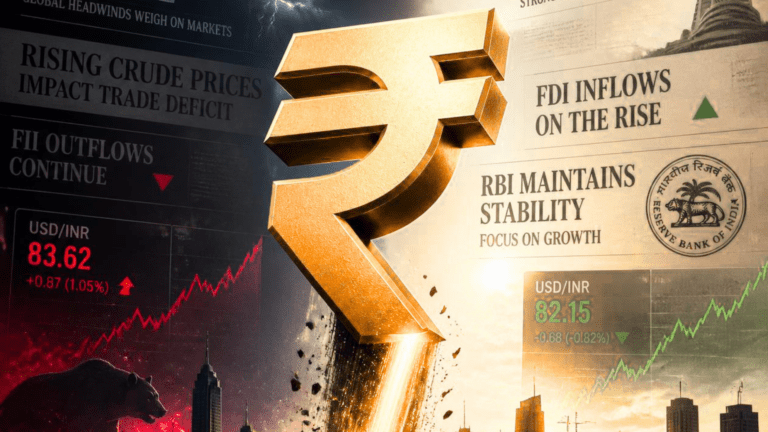
The timing lines up with the broader geopolitical backdrop. Reports covering the same IMF update explicitly linked the downgrade to the ongoing conflict in West Asia and its ripple effects on global oil markets, which pushed energy import costs higher for a country like India that remains heavily dependent on crude imports.
The 2027 Number That Changes The Picture
Here is where the story gets interesting. While the FY27 forecast slipped, the IMF simultaneously lifted its outlook for FY28 to 6.7 percent, an increase from the earlier projection of 6.5 percent. That is not a footnote — it is a meaningful upward revision that signals the Fund’s confidence in India’s ability to shake off the current energy-driven soft patch.
Igan was explicit about the reasoning behind this optimism. Looking ahead to 2027, she said the IMF expects a strengthening of the Indian economy as the energy shock dissipates, with medium-term growth settling around 6.5 percent. This framing matters because it reclassifies the current slowdown as cyclical rather than structural. Cyclical slowdowns tend to reverse once the triggering shock — in this case, elevated oil prices — fades from the base effect.
This pattern is consistent with what the IMF signaled earlier in the year as well. Back in January 2026, the Fund had actually raised India’s FY26 growth forecast to 7.3 percent on the back of strong momentum, while simultaneously flagging that growth was likely to moderate to around 6.4 percent in the following two fiscal years as cyclical tailwinds fade. The July update essentially confirms that earlier caution, while adding the energy-price twist as the specific mechanism behind the moderation.
Why Energy Prices Are The Real Story
India imports a substantial share of its crude oil requirements, which makes the country’s growth and inflation trajectory unusually sensitive to global energy markets. When oil prices spike, the effects cascade through the economy in multiple ways: higher import bills widen the current account deficit, costlier fuel raises transportation and input costs across sectors, and pass-through to retail pump prices squeezes household discretionary spending.
The IMF’s own explanation makes this mechanism explicit. Igan noted that the upside from strong domestic data was more than offset for 2026 by higher energy prices built into the baseline forecast, compounded by a greater pass-through of those oil costs to consumers at the pump in India. This is a textbook example of an external supply-side shock temporarily overpowering otherwise healthy domestic fundamentals.
Global context reinforces this reading. The IMF retained its overall global growth forecasts of 3 percent for 2026 and 3.4 percent for 2027, broadly unchanged from April on a cumulative basis, while explicitly citing the conflict in West Asia as a weight on activity, partially offset by the tailwind of rapid artificial intelligence adoption and the broader global technology cycle. India’s downgrade, in this sense, is not an India-specific failure but a localized manifestation of a global energy dynamic.
How India Stacks Up Against Other Major Economies
Despite the downward revision, India’s 6.4 percent growth rate remains dramatically ahead of nearly every other large economy tracked by the IMF. The table below places India’s trajectory in context.
| Economy | IMF 2026 Growth Forecast |
|---|---|
| India | 6.4% |
| Vietnam | 7.5% |
| Malaysia | 4.7% |
| China | 4.6% |
| South Korea | 2.6% |
| United States | 2.3% |
| Thailand | 1.9% |
| Canada | 1.1% |
| United Kingdom | 1.0% |
| Euro Area | 0.9% |
| Japan | 0.6% |
Only Vietnam, buoyed by technology exports and robust domestic demand, edges ahead of India in this comparison. China, often positioned as India’s chief rival for global economic influence, trails by nearly two full percentage points at 4.6 percent. The developed economies of the United States, the Eurozone, the United Kingdom, and Japan are not even in the same growth bracket, with most struggling to clear 2 percent.
This context is crucial for interpreting the headline number correctly. A 10-basis-point downgrade sounds alarming in isolation, but when the comparison set includes economies growing at a third or a quarter of India’s pace, the revision looks far less consequential.
Domestic Drivers Still Doing The Heavy Lifting
The IMF was careful to note what is still working in India’s favor even as it trimmed the forecast. The Fund’s statement specifically credited strong momentum in private consumption and resilient services sector activity as the pillars supporting the 6.4 percent projection. This is consistent with India’s long-standing growth pattern, where domestic demand and services exports — spanning IT, business process outsourcing, and financial services — have historically provided more stability than manufacturing or export-driven segments that are more exposed to global trade cycles.
Other domestic indicators referenced in coverage of the IMF update reinforce this picture. India’s own National Statistics Office had earlier lifted its growth estimate for the year ending March 31, 2026 to 7.4 percent, surpassing the government’s initial forecast and setting a strong base heading into the current fiscal year. That kind of statistical momentum from local data agencies typically gives international forecasters more confidence in near-term resilience, even when they are simultaneously trimming numbers for external reasons like energy costs.
Fitch Ratings, in a separate assessment around the same period, also cut its FY27 growth projection to 6.4 percent, explicitly citing the US-Iran conflict as a factor likely to slow the economy. The alignment between IMF and Fitch numbers, both converging near 6.4 percent for similar reasons, adds a layer of cross-agency validation to the IMF’s assessment rather than it being an outlier call.
What This Means For Policy And Markets
For policymakers in New Delhi, the IMF’s framing offers a useful validation point. The message is not that India’s growth engine is faltering, but that an external energy shock is temporarily capping what would otherwise be a stronger number. This distinction matters for how the Reserve Bank of India and the finance ministry calibrate their responses. A structural slowdown would call for demand-side stimulus or interest rate cuts, while a cyclical, energy-driven dip is better addressed through targeted measures like fuel subsidy management, strategic reserve releases, or diversification of crude import sources.
Investors parsing this data point should also resist the temptation to overreact to the 10-basis-point cut. Markets that focus purely on the FY27 number while ignoring the FY28 upgrade to 6.7 percent risk missing the more important signal, which is that the IMF views India’s medium-term trajectory as intact and even improving once the energy headwind passes. Medium-term growth settling around 6.5 percent, as Igan indicated, represents a level that few other economies globally can even approach in the current environment.
The Bigger Global Backdrop
It is worth situating India’s revision within the IMF’s broader worldview for 2026 and 2027. The Fund described the global economy as being pulled in two directions simultaneously: geopolitical conflict, particularly the war in West Asia, weighing on activity, while rapid advances in artificial intelligence and the technology cycle provide a counterbalancing lift. The IMF explicitly framed the modest global slowdown as the effect of the war being partly offset by stronger technology-led demand.
Risks that the IMF flagged as tilted to the downside include the possibility of renewed geopolitical tensions, volatile commodity prices, ongoing supply chain disruptions, trade fragmentation, and financial market uncertainty. On the upside, the Fund pointed to faster normalization in energy markets, stronger AI-related investment, and structural reforms as factors that could support global growth beyond current projections.
India sits at an interesting intersection of these forces. It is exposed to the downside energy risk given its import dependence, but it is also positioned to benefit from the AI and technology-led upside given its large services and IT export base. The IMF’s own commentary about resilient services activity supporting the current forecast reflects this dual exposure.
Reading The Forecast Correctly
The headline that India’s growth forecast was cut is technically accurate but incomplete without the context that the cut is small, driven by an external and largely temporary energy shock, and accompanied by an upward revision for the following year. India remains comfortably the fastest-growing major economy in the IMF’s dataset, ahead of China, the United States, and every developed economy tracked in the July update. The 6.7 percent projection for FY28 suggests that once energy markets normalize, the underlying strength in Indian consumption and services activity that the IMF itself highlighted is expected to reassert itself fully.
For anyone trying to make sense of India’s economic direction heading into the back half of 2026, the real takeaway is not the 10-basis-point trim itself, but the fact that the world’s premier economic forecasting body still sees India accelerating, not decelerating, over the medium term.