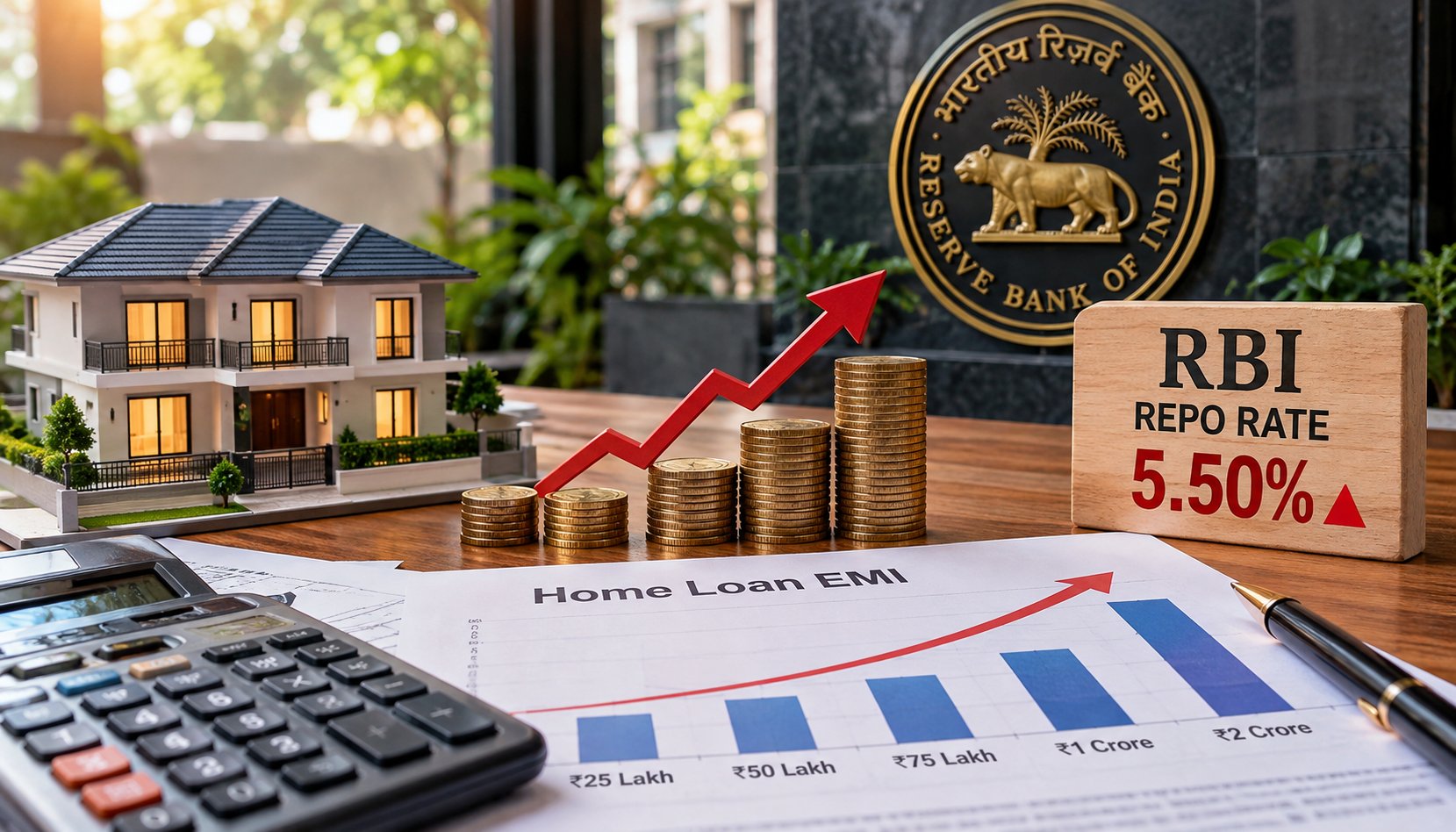
Home Loan EMI Set to Rise as RBI Lifts Repo Rate to 5.50%: What a 0.25 Point Hike Adds to ₹25 Lakh to ₹2 Crore Loans
Home Loans | RBI Policy
Home Loan EMI Set to Rise as RBI Lifts Repo Rate to 5.50%: What a 0.25 Point Hike Adds to ₹25 Lakh to ₹2 Crore Loans
The first repo rate increase since February 2023 will lift floating-rate home loan EMIs by about ₹380 to ₹3,100 a month on 20-year loans, depending on the amount outstanding.
By D. Kush, Dailyfinancial | Published 7 October 2026 | EMI figures are illustrative calculations for a 20-year outstanding tenure
The short answer: a 25 basis point rise adds roughly ₹15 to ₹16 a month for every ₹1 lakh you still owe on a 20-year home loan. On ₹50 lakh at 7.75% per annum moving to 8%, the EMI climbs from ₹41,047 to ₹41,822, which is ₹775 more every month.
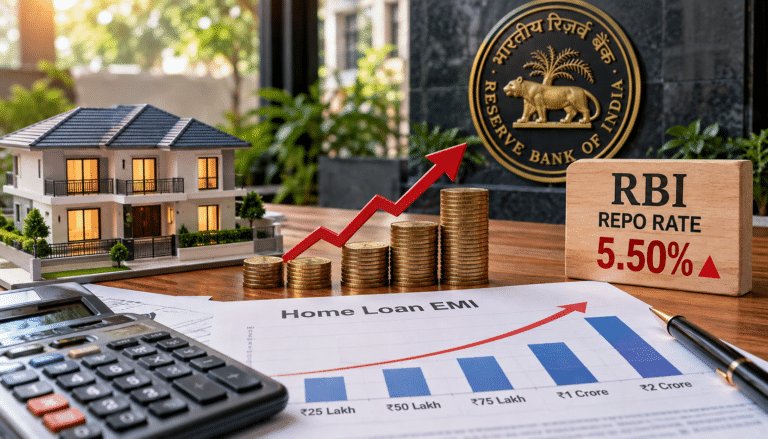
For nearly four years, home loan borrowers in India only saw rates fall or stand still. That changed on Wednesday, 7 October 2026, when the Reserve Bank of India raised the repo rate by 25 basis points to 5.50%. Because most bank home loans are tied directly to that rate, the increase will travel to household budgets within weeks, not years.
The rise per month looks small. The more useful question is what it adds up to over two decades, and whether you should absorb it through a higher EMI or a longer loan. The numbers below answer both.
Why a Decision Taken in Mumbai Reaches Your EMI So Quickly
The repo rate is the rate at which the RBI lends to banks. Since October 2019, banks have had to price new floating-rate retail loans off an external benchmark, and most chose the repo rate. A floating home loan rate is therefore the benchmark plus a spread fixed when the loan was sanctioned.
When the benchmark moves up by 0.25 percentage points, the loan rate moves by the same amount at the next reset. Banks must reset these loans at least once every three months, so the full effect arrives by early January 2027 at the latest for repo-linked borrowers.
Good to know: the spread over the repo rate generally stays the same for the life of the loan. The hike changes the benchmark, not your spread, so a borrower paying repo plus 2.25 points moves from 7.50% to 7.75%.
Three Kinds of Borrowers, Three Different Speeds
- Repo-linked bank loans: the increase passes through in full on the next reset date mentioned in your sanction letter.
- Older MCLR-linked bank loans: these change only when the bank revises its MCLR and your own reset date comes up, often once a year.
- Housing finance company loans: these follow the lender’s own reference rate, so timing and size of the change are the company’s decision.
The Monthly Bill: EMI Before and After a 0.25 Point Rise
The table shows two common situations: a borrower currently at 7.25% moving to 7.50%, and one at 7.75% moving to 8%. Every figure assumes 20 years of tenure remaining and an EMI that is raised to keep the loan on schedule. Amounts are rounded to the nearest rupee.
| 20-year tenure | Rate rises from 7.25% to 7.50% | Rate rises from 7.75% to 8.00% | ||||
|---|---|---|---|---|---|---|
| Loan outstanding | EMI before | EMI after | Increase | EMI before | EMI after | Increase |
| ₹25 lakh | ₹19,759 | ₹20,140 | +₹381 | ₹20,524 | ₹20,911 | +₹387 |
| ₹50 lakh | ₹39,519 | ₹40,280 | +₹761 | ₹41,047 | ₹41,822 | +₹775 |
| ₹75 lakh | ₹59,278 | ₹60,419 | +₹1,141 | ₹61,571 | ₹62,733 | +₹1,162 |
| ₹1 crore | ₹79,038 | ₹80,559 | +₹1,521 | ₹82,095 | ₹83,644 | +₹1,549 |
| ₹1.25 crore | ₹98,797 | ₹1,00,699 | +₹1,902 | ₹1,02,619 | ₹1,04,555 | +₹1,936 |
| ₹1.5 crore | ₹1,18,556 | ₹1,20,839 | +₹2,283 | ₹1,23,142 | ₹1,25,466 | +₹2,324 |
| ₹1.75 crore | ₹1,38,316 | ₹1,40,979 | +₹2,663 | ₹1,43,666 | ₹1,46,377 | +₹2,711 |
| ₹2 crore | ₹1,58,075 | ₹1,61,119 | +₹3,044 | ₹1,64,190 | ₹1,67,288 | +₹3,098 |
The increase scales in a straight line with the loan amount
7.25% to 7.50% 7.75% to 8.00% (extra EMI per month, in rupees)
A Detail Most Borrowers Miss in These Numbers
The same 0.25 point rise costs slightly more when your starting rate is higher. On ₹50 lakh, the jump is ₹761 a month from 7.25% but ₹775 from 7.75%. The gap is small, yet it shows why borrowers with weaker credit profiles and wider spreads feel each hike a little more.
From Pocket Change to Lakhs: The 20-Year View
Take the ₹50 lakh loan at 7.75%. The extra ₹775 a month is ₹9,300 a year. If the rate stayed at 8% for the full 20 years, total interest would be about ₹1.86 lakh higher than at 7.75%. On a ₹2 crore loan, the annual increase alone is ₹37,176.
Reality check: floating rates rarely stay unchanged for 20 years. Treat the lifetime figure as a measure of sensitivity, not a forecast of what you will pay.
Higher EMI or Longer Tenure: The Choice Is Yours to Make
Under the RBI’s floating-rate reset framework, a lender must tell you what the reset does to your loan and offer options. You can raise the EMI, extend the tenure, combine the two, switch to a fixed rate where available, or prepay part of the loan. A lender should not stretch your tenure silently.
Option A: Pay ₹775 More Each Month
The ₹50 lakh loan still ends in 240 months. Total interest rises by about ₹1.86 lakh if 8% persists throughout.
Option B: Keep the EMI at ₹41,047
The loan runs for about 252 months instead of 240, roughly 12 extra instalments. Total interest rises by about ₹4.76 lakh.
Option B protects this month’s budget but costs more in the end. Borrowers who are within a few years of retirement may also find that lenders limit how far the tenure can be extended.
How the Rate Cycle Turned in Under Four Years
- February 2023
The RBI raises the repo rate to 6.50%, its last increase before a long pause.
- February to December 2025
A cutting cycle lowers the rate by a cumulative 125 basis points, from 6.50% to 5.25%.
- 2026, first four reviews
The rate is held at 5.25% while inflation edges above the 4% target from June.
- 7 October 2026
The Monetary Policy Committee votes unanimously for a 25 basis point hike to 5.50% and shifts its stance to calibrated tightening.
The RBI cited rising price pressures. Retail inflation was 4.82% in August 2026, and the central bank lifted its inflation forecast for 2026-27 to 5.2% from 5.0%, while raising its GDP growth projection to 7.1%. Brent crude trading near $100 a barrel added to the concern.
Five Practical Moves Before Your Next Reset Date
- Find your reset date. It is in the sanction letter or loan agreement. That is when the new rate applies to you.
- Tell the lender which option you want. If you say nothing, some lenders extend the tenure by default. Ask for the revised repayment schedule in writing.
- Consider a part-prepayment. Floating-rate home loans to individuals for non-business purposes carry no prepayment charges under RBI rules, and prepaying early in the loan has the largest effect.
- Check your spread against current offers. If new borrowers at your lender get a lower spread, ask about repricing or compare a balance transfer after counting fees.
- Stress-test your budget. Some economists expect further increases. Work out your EMI at a rate 0.50 points higher than today so a second move does not surprise you.
What We Know
- The RBI raised the repo rate by 25 basis points to 5.50% on 7 October 2026, with all six committee members voting in favour.
- The policy stance moved from neutral to calibrated tightening.
- It is the first repo rate increase since February 2023.
- Repo-linked bank loans must be reset at least once every three months.
- On a 20-year loan, a 0.25 point rise adds about ₹380 to ₹390 a month per ₹25 lakh outstanding.
What Is Still Unclear
- The exact dates on which individual banks and housing finance companies will revise their lending rates.
- Whether lenders will pass on the full 0.25 points on MCLR-linked and housing finance company loans.
- How many more increases will follow. Forecasts published around the policy range from a one-off move to two further hikes.
- How quickly deposit rates will rise in response.
Frequently Asked Questions on the Repo Rate Hike and Home Loan EMIs
How much will my home loan EMI increase after the RBI repo rate hike?
On a 20-year loan, a 0.25 percentage point rise adds roughly ₹15 to ₹16 a month for every ₹1 lakh outstanding. For a ₹50 lakh loan moving from 7.75% to 8%, the EMI goes from ₹41,047 to ₹41,822, an increase of ₹775 a month. Your own figure depends on outstanding balance, remaining tenure and rate.
What is the RBI repo rate now?
The repo rate is 5.50% with effect from 7 October 2026, after the Monetary Policy Committee raised it by 25 basis points from 5.25%. The policy stance was changed from neutral to calibrated tightening. It is the first increase since February 2023.
When will my bank raise my home loan interest rate?
Bank floating-rate home loans linked to an external benchmark such as the repo rate must be reset at least once every three months. The increase therefore reaches you on your next reset date, which is written in your sanction letter. Loans from housing finance companies follow the lender’s own reference rate and may move on a different schedule.
Will my EMI go up or will my loan tenure get longer?
Either can happen, and you have a say. Under the RBI’s floating-rate reset framework, lenders must tell you the impact and offer choices: a higher EMI, a longer tenure, a mix of both, a switch to a fixed rate, or part-prepayment. Check your loan statement after the reset to see which option was applied.
Does the repo rate hike affect fixed-rate home loans?
No. A loan on a genuinely fixed rate keeps its EMI for the fixed period. Many products sold as fixed are fixed only for the first few years and then convert to floating, so read the reset clause in your loan agreement before assuming you are insulated.
Is it better to increase the EMI or extend the tenure?
Raising the EMI costs more each month but less overall. On a ₹50 lakh, 20-year loan moving from 7.75% to 8%, paying ₹775 more a month keeps the loan on schedule. Holding the EMI steady instead stretches the loan by about 12 months and adds more interest in total. Choose based on your monthly budget.
Can I prepay my home loan without a penalty to offset the hike?
Floating-rate home loans taken by individuals for non-business purposes do not attract prepayment or foreclosure charges under RBI rules. A part-prepayment reduces the principal on which the higher rate applies. Fixed-rate loans may carry charges, so confirm the terms with your lender first.
Do new home loan borrowers also pay more after the hike?
New floating-rate loans are priced at the benchmark plus a spread, so a higher repo rate generally means a higher starting rate once lenders revise their rates. Each lender announces its own change and date. Compare the Key Facts Statement and the annual percentage rate across lenders before you sign.