Banking · Digital Payments · India 2026
Failed UPI or ATM Transaction? Your Bank May Owe You ₹100 for Every Day It Is Late
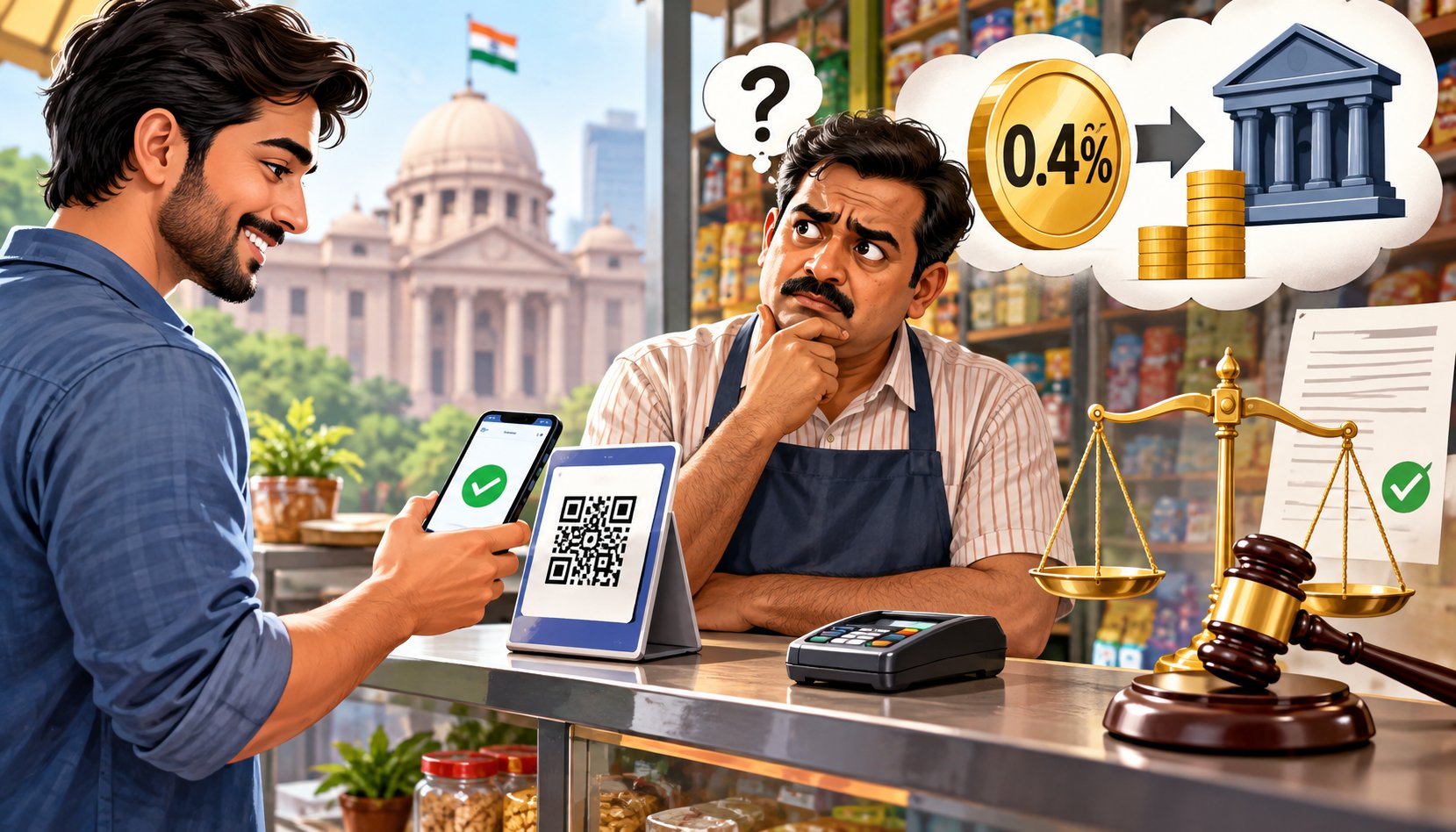
RBI’s turnaround-time rules give banks one day or five days to reverse money debited in a failed UPI, ATM, IMPS or card transaction. Miss the deadline, and the bank must credit ₹100 a day automatically, without you filing a claim.
The UPI app spun for a few seconds, then said the payment failed. Your bank sent an SMS saying the money was debited. The shopkeeper says nothing arrived. Or the ATM whirred, printed a slip and gave you no cash. Either way, your money is somewhere in between, and you are left wondering how long it will take to come back.
There is a firm answer, and it has been in force since October 15, 2019. RBI’s circular on harmonisation of turnaround time sets an outer deadline for every common failure. If the bank misses it, it owes you ₹100 for each day of delay, credited on its own initiative. Most people never check whether they received it.
Billions of Payments a Month Means Failures Are Inevitable
India’s digital payment rails carry enormous volumes. NPCI data reported by Outlook Money shows UPI processed 24.07 billion transactions worth ₹29.37 lakh crore in September 2026, an average of 802 million a day. At that scale, even a tiny failure rate touches millions of people.
The good news is that failures have fallen sharply. NPCI chief executive Dilip Asbe said in November 2024 that UPI’s technical decline rate had dropped to 0.7% to 0.8%, from as high as 8% to 10% in 2016. Most technical declines never debit your account at all. The ones that do, where money leaves your account but does not reach the other side, are exactly what the ₹100-a-day rule is for.
T, T+1 and T+5: Reading the Deadline Correctly
The whole rule rests on one letter. RBI defines T as the calendar date of the transaction. T+1 is the next calendar day, and T+5 is the fifth calendar day after it. Sundays and bank holidays are not excluded, which matters if your payment fails on a Friday evening before a long weekend.
The circular also defines R as the day the reversal is completed and the money reaches the issuing bank. The bank must post the reversal to your account the same day. Compensation runs for each day between the deadline and R. The deadline is an outer limit: RBI expects banks to fix failures sooner where they can.
Why Money Gets Stuck Between Two Banks
A UPI payment looks instant, but behind the screen at least three parties are involved: your bank, which debits the money; NPCI’s central switch, which routes the message; and the recipient’s bank, which credits it. A failure at any point after your bank has debited the account leaves money in limbo. The most common culprit is a timeout, where one bank does not receive a reply from another in time.
When that happens, the system often cannot tell immediately whether the credit went through. The transaction shows as pending, and the banks must reconcile their records before deciding to complete it or reverse it. That reconciliation is why a refund can take hours or a day even when nothing is really wrong. The TAT circular puts a ceiling on that waiting time.
Why ATM failures take longer
An ATM failure is physical as well as digital. The bank whose card you used has to confirm with the ATM’s owner, which may be another bank or a white-label operator, that cash really was not dispensed. That usually means checking the machine’s electronic journal and, in some cases, cash balances at the end of the day. Hence the longer T+5 window.
The same principle explains who pays. RBI’s circular says that where a transfer is debited but not credited, the recipient’s bank must either credit it or reverse it within the deadline. If the sending bank delays starting the process, the penalty falls on the sending bank. Either way, the compensation goes to the customer, not to the other bank.
What each app status usually means
- Success: money left your account and reached the recipient. The ₹100 rule does not apply.
- Failed, no debit: the payment did not go through and your balance is unchanged. Nothing to recover.
- Failed, but debited: this is the case the circular covers. The deadline clock is running from day T.
- Pending: banks are still reconciling. Wait for it to settle, but note the date, because the deadline still counts from T.
- Reversed or refunded: the money is back. Check the date to see if it came after the deadline.
Every Failure Type and Its Deadline in One Table
The circular covers eight payment systems and more than a dozen failure scenarios. This decoder lists the ones most people will meet, with the deadline and who is responsible for paying the ₹100.
| What went wrong | Reversal deadline | Compensation | Who acts |
|---|---|---|---|
| ATM debited, no cash dispensed | T+5 | ₹100/day beyond T+5 | Your bank, proactively |
| UPI transfer debited, beneficiary not credited | T+1 | ₹100/day beyond T+1 | Beneficiary bank reverses |
| UPI merchant payment debited, no confirmation | T+5 | ₹100/day beyond T+5 | Auto-reversal |
| IMPS debited, beneficiary not credited | T+1 | ₹100/day beyond T+1 | Beneficiary bank reverses |
| Card-to-card transfer not credited | T+1 | ₹100/day beyond T+1 | Card issuer |
| Card swiped at shop, no charge slip | T+5 | ₹100/day beyond T+5 | Auto-reversal |
| Aadhaar-enabled payment at merchant, no confirmation | T+5 | ₹100/day beyond T+5 | Acquirer starts credit adjustment |
| Government benefit via APBS not credited | T+1 | ₹100/day beyond T+1 | Beneficiary bank |
| NACH credit or reversal delayed | T+1 | ₹100/day beyond T+1 | Beneficiary bank |
| NACH debit after you revoked the mandate | T+1 | Not specified | Your bank |
| Wallet-to-wallet (same provider) not credited | T+1 | ₹100/day beyond T+1 | Wallet issuer |
| Wallet payment via UPI or card network | Same as that system | Same as that system | Per underlying rail |
The logic behind the split is simple. A person-to-person transfer only involves two banks talking to each other, so a day is enough. ATM and merchant failures involve a third party, such as the ATM operator or the merchant’s bank, and a physical check of cash or records, so RBI allows five days.
How Much You Could Be Owed: The Day-Count Maths
The compensation is flat. It does not depend on how much money was stuck. A ₹200 failed UPI payment and a ₹20,000 failed ATM withdrawal both earn ₹100 for each day beyond the deadline.
| Scenario | Transaction date (T) | Deadline | Money back on | Days late | Compensation |
|---|---|---|---|---|---|
| UPI transfer, ₹2,000 | Oct 5 | Oct 6 (T+1) | Oct 6 | 0 | ₹0 |
| UPI transfer, ₹2,000 | Oct 5 | Oct 6 (T+1) | Oct 10 | 4 | ₹400 |
| UPI merchant payment, ₹850 | Oct 3 | Oct 8 (T+5) | Oct 11 | 3 | ₹300 |
| ATM withdrawal, ₹10,000 | Oct 1 | Oct 6 (T+5) | Oct 12 | 6 | ₹600 |
| Card swipe at shop, ₹4,500 | Sep 28 | Oct 3 (T+5) | Oct 17 | 14 | ₹1,400 |
| IMPS transfer, ₹50,000 | Oct 2 | Oct 3 (T+1) | Oct 4 | 1 | ₹100 |
What people often get wrong is assuming the clock starts when they complain. It does not. It starts on the day of the failed transaction, and compensation is due whether or not you ever contacted the bank.
From a 2007 Payments Law to the ₹100 Rule
The ₹100-a-day rule did not appear overnight. It built on the payments law of 2007 and was later strengthened by a single ombudsman scheme that made complaints easier to file.
Spotting the Compensation on Your Statement
Because the ₹100 is meant to arrive automatically, many people never look for it. Banks label it differently, so it may appear as a separate credit described as compensation, a TAT penalty, or simply a credit with the original transaction reference. It may come on the same day as the reversal or a few days later.
Start with the reversal date. If the money came back within the deadline, there is nothing more to claim. If it came back late, count the calendar days beyond T+1 or T+5 and multiply by ₹100. Then check the statement for a matching credit. If it is missing, your complaint should be short and specific.
What to include in a complaint
- The transaction date, amount and reference number.
- The type of failure, such as ATM cash not dispensed or UPI transfer debited but not credited.
- The date the money was reversed, and the number of days beyond the deadline.
- A request for compensation under RBI circular RBI/2019-20/67 dated September 20, 2019.
A complaint written this way is easy for a bank to verify against its own records. It also becomes the first step in the paper trail the RBI Ombudsman will look for if you need to escalate.
When the ₹100 Does Not Arrive: An Escalation Ladder
The rule says compensation should arrive without asking. If it does not, the steps to recover it are clear. Keep the transaction reference number, often called the UTR or RRN, at every step.
What the ₹100 Rule Does Not Cover
The TAT circular is about technical failures, where money leaves your account because of a system or communication problem but the transaction does not complete. It is not a general refund guarantee. Knowing the boundaries saves you from chasing the wrong remedy.
- Fraud or unauthorised transactions. These fall under RBI’s separate limited-liability rules, where reporting quickly to your bank is critical.
- Disputes with a merchant. If the payment succeeded but goods were not delivered or were faulty, that is a consumer dispute, not a failed transaction.
- Payments sent to the wrong person. A successful UPI payment to an incorrect ID is not a failure under the circular; you must request a return through your bank.
- International transactions. The circular applies only to domestic payments.
Keep This Evidence Before You Close the App
Frequently Asked Questions
How long does a failed UPI transaction take to be refunded?
For a UPI transfer where your account is debited but the recipient is not credited, RBI’s rules require reversal by T+1, the next calendar day. For a failed UPI payment to a merchant, the deadline is T+5. If the bank misses the deadline, it must pay ₹100 for each day of delay.
What if an ATM debited my account but did not give cash?
Your bank must reverse the amount within T+5, five calendar days after the transaction. After that, it owes you ₹100 for every day of delay, credited automatically. Keep the ATM slip or the transaction details, and complain to your bank if the money and compensation do not arrive.
Do I need to file a complaint to get ₹100 per day compensation?
No. The RBI circular says compensation must be credited suo moto, without a complaint or claim. If you do not receive it, you can complain to your bank and then to the RBI Integrated Ombudsman after 30 days.
Do weekends and bank holidays count in the T+1 and T+5 deadlines?
Yes. RBI defines T as the calendar date of the transaction, so the count uses calendar days. A failure on a Saturday still has a deadline of Sunday for T+1 transfers.
Is the ₹100 per day compensation linked to the amount stuck?
No. It is a flat ₹100 for each day beyond the deadline, whatever the transaction amount. A ₹500 failed payment and a ₹50,000 failed transfer earn the same daily compensation.
Does the ₹100 rule apply to wallets like Paytm or PhonePe?
Yes, for authorised prepaid instruments. If a wallet-to-wallet transfer within the same provider fails, reversal is due by T+1 with ₹100 a day after that. If the wallet payment runs on UPI or a card network, that system’s deadlines apply.
How do I complain to RBI about a failed transaction?
First complain to your bank or payment provider. If it rejects your complaint, does not reply within 30 days, or you are unhappy with the reply, file a complaint on RBI’s portal at cms.rbi.org.in under the Integrated Ombudsman Scheme, 2021, generally within one year. Filing is free.
Does the rule cover a UPI payment sent to the wrong person?
No. The circular covers transactions that fail for technical reasons. A payment that succeeds but goes to the wrong recipient is not a failed transaction; ask your bank to request a return from the recipient’s bank.
The Short Version
RBI’s circular of September 20, 2019 gives banks a hard deadline to return money from failed digital and ATM transactions. UPI and IMPS transfers must be reversed by T+1, and ATM cash failures, card swipes and UPI merchant payments by T+5, counted in calendar days. If the bank is late, it owes you ₹100 a day, credited automatically and regardless of the amount. Check your statement for both the reversal and the compensation. If either is missing, complain to your bank, and after 30 days, to the RBI Ombudsman at cms.rbi.org.in.