Payments · AI agents · Launched 13 November 2026
ChatGPT Wallet Explained: How OpenAI’s AI Agents Pay Without Seeing Your Card — and What Could Still Go Wrong
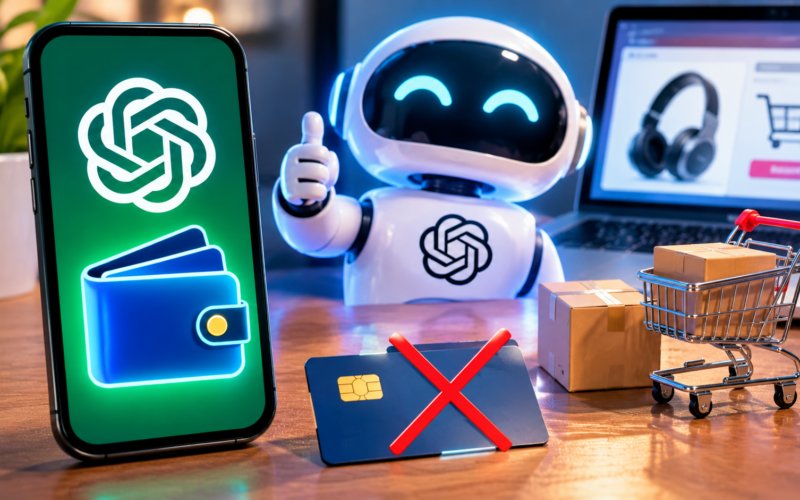
Built with American Express, Mastercard and Visa, the wallet swaps your card number for a network token and asks for a biometric check before every purchase. It starts with US Pro subscribers only.
You ask an AI agent to find a replacement phone charger, compare three options and order the best one. It does the research in seconds. Then it reaches the checkout page and stops, because somebody has to pay. Until now, that meant either typing your card number yourself or handing it to the agent, which most people, sensibly, would not do.
OpenAI’s answer, launched on Friday, 13 November 2026, is ChatGPT Wallet. The agent can complete the payment, but it never sees your card number. Neither does the shop. The idea sounds simple. The plumbing behind it, and the limits around it, are worth understanding before you let any agent near your money.
The Checkout Problem OpenAI Is Trying to Solve
ChatGPT is already where a lot of shopping starts. OpenAI says more than 1.2 billion people use it each week, and CNBC reported nearly 100 million paying users at the end of the third quarter. People ask it to research products and compare options. What it could not do well was finish the job.
- 1.2 billionWeekly ChatGPT users, as stated by OpenAI
- 100 millionPaying ChatGPT users at end of Q3 2026, per CNBC
- 693%Jump in AI-referred US retail traffic, Nov to Dec 2025, Adobe
- 65%Merchants considering a new payment partner for agentic commerce, S&P Global survey
- $62.9bnProjected global card-not-present fraud losses by 2027, Visa data
- 4%Fee OpenAI charged merchants under its earlier Instant Checkout
The gap between discovery and payment matters commercially. Adobe Analytics found that in March 2025, AI-referred shoppers converted 38% worse than other traffic. By March 2026 they converted 42% better. Shoppers arriving from AI tools now know what they want. The missing piece is a safe way for the agent itself to pay.
Adobe Analytics, US retail. Growth is year on year in AI-referred traffic; conversion compares AI-referred with other traffic. Bars scaled to the largest value.
How a Purchase Actually Flows
ChatGPT Wallet sits inside conversations with “dots”, OpenAI’s always-on personal agents. When a task you asked for reaches a merchant’s checkout, the wallet takes over the payment step.
- 1 timeAdd a cardLink an eligible credit card to the wallet once
- 3 detailsReviewCheck the items, the total and the card selected
- 1 checkApproveConfirm with Face ID, fingerprint or a similar security check
- 1 tokenPayThe network issues a token; the charge lands on your card
The key step is the last one. When you approve, the card network supplies a payment token with its own card number, security code and expiry date. The merchant charges that token. The network maps it back to your real card and the charge appears on your statement as usual. Reports describe the token as single-use for that purchase, so a copy of it is of little value to a thief.
Why the agent never needs the number
This is the clever part of the design. The agent’s job is to reach checkout and present the order. Paying is handled between the wallet, the card network and the merchant. The agent is a messenger that carries an approved token, not a holder of your credentials. OpenAI calls it the first wallet that lets agents pay without access to users’ actual card details and that requires a security check for every purchase.
Each approval creates a record of exactly what you authorised: the merchant, the items, the total and the card. That record matters if a purchase goes wrong and you need to dispute it.
Who Sees What in a ChatGPT Wallet Payment
The privacy claim is easiest to understand as a map of who holds which piece of information.
| Party | Sees your real card number? | Sees the order details? | Role |
|---|---|---|---|
| You | Yes | Yes | Add the card once, approve each purchase |
| Dots agent | No | Yes | Finds products, reaches checkout, proposes the purchase |
| Merchant | No, receives a token | Yes | Charges the token and ships the order |
| Card network | Yes | Payment data | Issues the token and maps it to your card |
| Card issuer | Yes | Payment data | Bills you, handles rewards and disputes |
| OpenAI’s wallet | Card stored on file | Yes | Holds the card link; storage details not fully published |
Why Tokens Make Fraud Harder
Tokenisation is not new. It is what already protects Apple Pay, Google Pay and card-on-file payments at big retailers. What is new is applying it to software agents that act for you. The track record helps explain why the card networks are comfortable doing so.
Percentages from Visa publications, 2025 to 2026. Different measures and periods; bars scaled to the largest value for display only.
The reason is simple. Card-not-present fraud, the kind that happens online, runs 7.5 to 8 times higher than in-person fraud on Visa’s data. Most of it depends on stolen card numbers. A token that only works for one merchant or one purchase is useless if it leaks.
Worked example, illustrative. Suppose an online store processes 100,000 orders a year and, using plain card numbers, sees 100 fraudulent orders. If tokenisation cuts e-commerce fraud rates by 35%, as Visa reports on average, the same store would expect about 65 fraudulent orders, or 35 fewer. At an average order of $80, that is $2,800 less fraud a year from that change alone. Now picture a database breach: with plain numbers, every stored card is exposed; with single-use tokens, the stolen data cannot be reused at other shops.
Real results vary by merchant, category and fraud tactics. The direction is what matters.
What the Token Does Not Protect You From
Here is the part most launch coverage skips. Tokenisation protects your card number. It does not protect you from an agent buying the wrong thing, or from a scam that tricks you into approving a purchase yourself. OpenAI itself warns that its agents can make mistakes and that users should review transaction details carefully before approving.
What people get wrong: “the agent can’t see my card” is not the same as “the agent can’t spend my money”. With the wallet, the agent can trigger a real charge the moment you approve. The biometric check is your last line of defence, so read the merchant, items and total every time instead of approving on reflex.
The fraud trend reinforces the point. Visa’s Spring 2026 Threats Report found scams, especially AI-enabled impersonation and social engineering, among the fastest-growing consumer risks, with nearly $1 billion in user-authorised fraud intercepted in the second half of 2025. Technical fraud is falling as tokens spread, while fraud that persuades a real person to say “yes” is rising. A wallet that asks you to approve every purchase is only as safe as your attention at that moment.
Mistakes, refunds and disputes
OpenAI says purchases keep existing card rewards and protections for eligible disputes. In practice, that means the usual credit card dispute process through your issuer still applies. What is less clear is how disputes will be handled when the agent misread your request rather than a merchant failing to deliver. The approval record helps, because it shows exactly what you authorised, but it also shows that you did authorise it.
OpenAI’s Second Attempt at Checkout
This is not OpenAI’s first try at selling inside ChatGPT. On 29 September 2025 it launched Instant Checkout, built on the Agentic Commerce Protocol it developed with Stripe. Merchants paid a fee on completed purchases, reported at 4%. It was expanded to all US users in February 2026 and wound down in March 2026, with OpenAI telling CNBC that the first version did not offer the flexibility it wanted.
- Instant Checkout launches in ChatGPT with Etsy sellers.
- NPCI, Razorpay and OpenAI start an agentic UPI payments pilot in India.
- “Buy it in ChatGPT” opens to all US users.
- Instant Checkout wound down; focus shifts to product discovery.
- Visa announces a partnership with OpenAI for agent payments.
- OpenAI announces advertising inside ChatGPT.
- ChatGPT Wallet launches with Amex, Mastercard and Visa.
The new approach is different in one crucial way. Instant Checkout tried to move the store into ChatGPT. The wallet lets the agent pay at the merchant’s own checkout, through payment systems shops already use. OpenAI says businesses need only make sure agents are not inadvertently blocked and that their risk systems recognise legitimate agent purchases. It also published a Commerce Partner Playbook for merchants.
| Feature | Instant Checkout (2025) | ChatGPT Wallet (2026) | India UPI pilot (2025) |
|---|---|---|---|
| Launched | 29 September 2025 | 13 November 2026 | 9 October 2025 |
| Where you pay | Inside ChatGPT | Merchant’s own checkout, via agent | Inside ChatGPT, via UPI |
| Payment method | Cards via Stripe and partners | Amex, Mastercard, Visa credit cards | UPI Reserve Pay and UPI Circle |
| Card or account details shared | Through payment token schemes | Network token only | UPI authentication via user’s app |
| Merchant fee to OpenAI | Reported 4% | None at launch | No revenue-share model announced |
| Who can use it | US users | US Pro subscribers, 18+ | Pilot users and merchants in India |
| Status | Wound down March 2026 | Rolling out | Pilot |
The Fine Print on Who Can Use It
The launch is deliberately narrow. OpenAI called agentic commerce “still in its early days” and said many websites and payment systems are still adapting to agents. Eligibility is limited to US ChatGPT Pro subscribers aged 18 and over, with eligible US-issued credit cards. Debit cards are not supported, and virtual cards are not available at launch. Chase cards must belong to the primary cardholder, who approves the link in the Chase app.
OpenAI also said it eventually expects users to delegate purchases to agents within set rules, such as spending limits, product categories or time periods, without approving each one. That is the bigger shift, and the riskier one. It has not given a date.
US$ billion. Projections from Juniper Research and Morgan Stanley with Bain, as reported; definitions differ widely. Bars scaled to the largest forecast.
Treat those numbers with caution. Forecasts vary enormously because firms define “agentic” differently. The useful signal is direction: card networks, payment processors and AI companies are all building for agents that pay, and they are racing to set the standards.
What It Means for Indian Users
ChatGPT Wallet is not available in India, and OpenAI has not said when it will reach users outside the US. But India has its own route to agent payments. On 9 October 2025, NPCI, Razorpay and OpenAI announced a pilot for agentic payments on ChatGPT using UPI, which processes over 20 billion transactions a month. It uses UPI Reserve Pay, which blocks a set amount for future debits to a chosen merchant, and UPI Circle, which delegates authentication within limits, with Axis Bank and Airtel Payments Bank providing the banking layer.
The design philosophies differ. The US wallet uses card-network tokens and a biometric check per purchase. India’s pilot uses pre-approved spending limits and delegated UPI authentication. India’s card rules already push in the same direction as the wallet: under RBI rules in force since October 2022, merchants cannot store full card numbers and must use tokens for saved cards.
What We Know
- ChatGPT Wallet launched on 13 November 2026 with American Express, Mastercard and Visa.
- Agents and merchants receive a network token, not the real card number.
- Every purchase needs a security check such as Face ID or a fingerprint.
- It is limited to US Pro subscribers aged 18+ with eligible US credit cards.
- OpenAI takes no share of transaction fees at launch.
What Is Still Unclear
- When the wallet will reach Plus, free or non-US users, including India.
- How disputes will work when an agent misreads a request.
- When spending-limit delegation without per-purchase approval will arrive.
- Whether OpenAI will charge fees later, and exactly how it stores linked cards.
Five Habits Before You Let an Agent Pay
Whether you use ChatGPT Wallet, India’s UPI pilot or another agent payment tool, the same habits apply.
- Read the merchant name, items and total on every approval screen before using Face ID or a fingerprint.
- Link a credit card rather than a debit card where you can, because disputes do not drain your bank balance while they are investigated.
- Turn on instant transaction alerts from your card issuer so unexpected charges show up within minutes.
- Be wary of any message urging you to approve a purchase quickly; urgency is the hallmark of social-engineering fraud.
- When spending limits arrive, start small, with tight caps and narrow categories, and widen them only after weeks of clean history.
India check: no official ChatGPT Wallet is available in India as of 15 November 2026. Treat any app, link or message offering “ChatGPT Wallet” activation in India as suspect.
Frequently Asked Questions
What is ChatGPT Wallet?
ChatGPT Wallet is a payment feature launched by OpenAI on 13 November 2026 that lets its “dots” AI agents pay merchants on a user’s behalf. It was built with American Express, Mastercard and Visa and uses network tokens so agents and merchants do not see the real card details.
Can the AI agent see my credit card number?
No. According to OpenAI, the card network provides a payment token instead of your actual card details, so neither the agent nor the business receives your real card number. The charge still goes to your selected card.
Who can use ChatGPT Wallet?
At launch, it is available to ChatGPT Pro subscribers in the US aged 18 and over, with eligible US-issued credit cards. Debit cards are not supported and virtual cards are not available at launch.
Is ChatGPT Wallet available in India?
No. OpenAI has not announced a date for users outside the US. Separately, NPCI, Razorpay and OpenAI have been piloting UPI-based agentic payments on ChatGPT in India since October 2025.
Do I need to approve every purchase?
Yes, for now. Each purchase requires a security check such as Face ID or a fingerprint after you review the items, total and card. OpenAI has said it plans to let users set spending limits and rules for future delegation.
Does OpenAI charge a fee for ChatGPT Wallet payments?
OpenAI will not take a share of transaction fees at launch, according to reports. It has not said whether that will change.
Do I keep my credit card rewards and protections?
Yes. OpenAI says existing card rewards and protections for eligible disputes are preserved, because the purchase is charged to your own card through the normal network.
What happens if the agent buys the wrong item?
OpenAI warns that agents can make mistakes and asks users to review each purchase before approving. If something goes wrong, you would use the merchant’s returns process or your card issuer’s dispute process, supported by the record of what you approved.
The Short Version
ChatGPT Wallet closes the gap between an AI agent finding something and paying for it, without handing the agent your card. Card networks issue a token, you approve with a biometric check, and the charge lands on your own card with its usual rewards and protections. It is US-only, Pro-only and credit-card-only for now, and OpenAI takes no fee at launch. The token protects your card number, not your judgement. The real test comes when agents get spending limits and stop asking first.