EPFO Auto-Settlement Limit Jumps From ₹1 Lakh to ₹5 Lakh — Here's Who Benefits and How to Check If Your Claim Qualifies
If you are one of the 7.5 crore active EPFO members in India, a policy change announced in June 2025 could fundamentally reshape how quickly you access your own provident fund money during a financial emergency. The Employees’ Provident Fund Organisation has raised its auto-settlement limit for advance claims from ₹1 lakh to ₹5 lakh, meaning that a significantly larger portion of withdrawal requests will now be processed automatically, without any human intervention, and with funds reaching your bank account within 72 hours. This is not a minor tweak — it is a five-fold jump that directly addresses one of the most frustrating pain points for salaried Indians: the agonising wait for PF money when you need it most.
What Is EPFO Auto-Settlement, and Why Does It Matter?
To understand the scale of this change, it helps to understand how EPFO’s claim system works at its core. When an EPFO member submits an advance withdrawal request, the claim can follow one of two routes — it either goes through an automated processing pipeline, or it gets routed to a field office for manual review by an EPFO official. The manual route involves document verification, officer scrutiny, and a queue that can stretch from days to weeks depending on workload and backlogs at regional offices. The automated route, known as Auto-Settlement of Advance Claims (ASAC), bypasses all of that entirely.
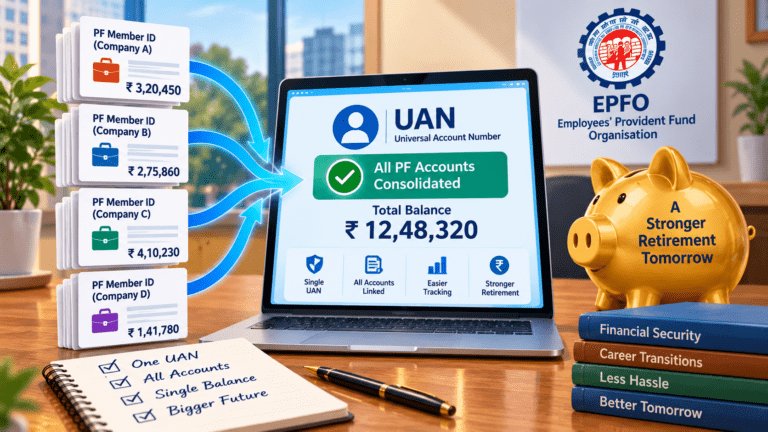
EPFO first introduced the auto-settlement mechanism during the COVID-19 pandemic to provide rapid financial relief to distressed workers. The system was designed to use seeded data — your Aadhaar, PAN, and bank account details already linked to your Universal Account Number (UAN) — to validate and disburse claims without requiring a human to review every file. The concept was revolutionary for a public institution of EPFO’s scale, and the results have been striking. In just the first 2.5 months of the financial year 2025-26, 76.52 lakh advance claims were settled through auto-processing, which represents approximately 70% of all advance claims filed during that period.
Yet, despite this high volume of auto-settled claims, the ₹1 lakh cap was a significant constraint. For members facing a major medical emergency, a child’s college admission fee, or a housing down payment, ₹1 lakh often fell well short of the actual need. Any amount beyond that threshold had to go the manual route, negating the very benefit the auto-settlement system was built to deliver. The new ₹5 lakh limit directly closes that gap.
The Official Announcement: What the Government Said
Labour and Employment Minister Mansukh Mandaviya announced the enhanced limit on June 24, 2025, confirming that claims up to ₹5 lakh would now qualify for automatic processing and be settled within three days of submission. The announcement was backed by a formal press release from the Press Information Bureau, making it an official government directive and not merely a proposal. The decision had a procedural runway before it reached this stage — the proposal was first approved by Sumita Dawra, Secretary of the Ministry of Labour and Employment, during the 113th meeting of the Executive Committee of the Central Board of Trustees, held in Srinagar on March 28, 2025. Following that approval, the Central Board of Trustees gave its final green light, and the enhanced limit came into force. The EPFO’s official press release confirmed that claims under the new ₹5 lakh ceiling “will be processed by the system without human intervention, promoting transparency and efficiency”.
This is significant because Ministerial and CBT-level backing means the change is not provisional — it is embedded in EPFO’s operational protocol and is now the baseline for all advance claim processing across the country.
Who Benefits From the New ₹5 Lakh Auto-Settlement Limit?
The beneficiary pool is enormous, but certain groups stand to gain the most immediately and tangibly from this policy change.
Salaried employees in medical emergencies are the single most affected group. EPFO allows advance withdrawals for treatment of serious illnesses — both for the member and for immediate family members. Previously, if a hospitalisation bill or surgery cost exceeded ₹1 lakh, the excess had to wait for manual approval. Under the new system, claims up to ₹5 lakh for medical treatment will be auto-settled, meaning a worker dealing with a cardiac procedure, cancer treatment, or accident-related hospitalisation can access funds within 72 hours of filing the claim online.timesofindia.
Parents funding higher education are another key group. Education costs in India — particularly for professional courses in engineering, medicine, and management — frequently cross ₹1 lakh. EPFO permits advance withdrawals for educational expenses, and with the revised ceiling, families can now access up to ₹5 lakh for this purpose without navigating manual bureaucracy.
Members approaching marriage expenses also benefit significantly. Wedding costs in India routinely run into several lakhs, and EPFO allows advance withdrawals for marriage-related expenses for self, children, or siblings. The revised limit makes this far more practical as a financial resource, especially for members who have accumulated sufficient balances but previously faced a bottleneck at the ₹1 lakh mark.
First-time homebuyers or those taking housing loans represent the fourth major beneficiary category. EPFO’s advance withdrawal provisions for housing — covering both construction and repayment of housing loans — now fall within the auto-settlement net up to ₹5 lakh, removing the need for physical office visits and paper-heavy verification processes.
Low-to-mid income workers across tier-2 and tier-3 cities, including those based in cities like Lucknow, Kanpur, Agra, and Varanasi, benefit disproportionately from the process simplification. For these workers, travelling to EPFO regional offices, taking days off work, and arranging documentation was a genuine hardship. The digitised, automated pipeline eliminates all of that friction.
The Evolution of the Auto-Settlement Limit: A Timeline
The journey of EPFO’s auto-settlement cap reflects the government’s incremental, data-driven approach to expanding digital public services. The system was introduced in 2020 during the pandemic with a modest cap. In May 2024, the limit was doubled from ₹50,000 to ₹1 lakh, which the government cited as delivering measurable “ease-of-living” improvements for subscribers. Now, in June 2025, the limit has been raised five-fold to ₹5 lakh, a jump that signals both confidence in the automated infrastructure and awareness that the earlier cap was leaving too many legitimate high-value claims in a manual queue. This progression — from ₹50,000 to ₹1 lakh to ₹5 lakh — reflects a system that is scaling its trust in automation as it accumulates proof of reliability.
How to Check If Your Claim Qualifies for Auto-Settlement
Not every EPFO member or every type of claim will automatically qualify for auto-settlement, even under the new ₹5 lakh regime. There are specific eligibility conditions that determine whether your claim enters the automated pipeline. Here is a clear, step-by-step breakdown of how to verify and proceed.
Step 1: Ensure Your KYC Is Fully Seeded and Verified. The auto-settlement system runs on data — it cannot process a claim if your UAN does not have a verified Aadhaar, active PAN, and an active, verified bank account linked to it. Log in to the EPFO Member Portal at unifiedportal-mem.epfindia.gov.in. Navigate to the “Manage” section and click on “KYC.” Check whether your Aadhaar, PAN, and bank details show as “Verified” (marked in green). If any of these are pending or rejected, auto-settlement will not be triggered regardless of the claim amount.
Step 2: Verify That Your Claim Type Falls Under an Eligible Category. The auto-settlement facility currently covers four specific purposes — illness or medical treatment, education, marriage, and housing. Claims for final settlement upon retirement or resignation, pension-related withdrawals, or transfer claims are not part of the ASAC system and follow their own processing rules. When filing your advance claim online, you will be asked to select a purpose. If your purpose falls within these four categories and your claim amount is ₹5 lakh or below, you are in the eligible zone.
Step 3: File Your Claim Online Through the Member Portal. Log in at the EPFO Member Portal using your UAN and password. Go to “Online Services” and select “Claim (Form-31, 19, 10C & 10D).” The portal will prompt you to enter the last four digits of your bank account to verify your details. Once verified, you will be guided to select your advance type and claim amount. Submit the form with the required supporting documents, which now no longer require a physical cheque leaf or bank passbook — a simple photograph of these documents is accepted.
Step 4: Track Your Claim Status. After submission, you can track your claim’s status in real time through the same Member Portal under “Online Services > Track Claim Status.” If your claim has entered the auto-settlement pipeline, you will see a status update reflecting automated processing. Under the new system, disbursement should reach your linked bank account within 72 hours of submission. You can also use the UMANG app, which provides a mobile-friendly interface for claim tracking.
Step 5: Contact EPFO Helpdesk If Your Claim Stalls. If your claim does not move within the expected 72-hour window, the EPFO national helpline is accessible at 1800-118-005 (toll-free). You can also raise a grievance through the EPFiGMS portal at epfigms.gov.in. In most cases, a stalled auto-settlement claim is traceable to an unverified KYC detail, a mismatch between Aadhaar-linked mobile number and OTP verification, or insufficient balance relative to the claim amount.
What This Means for EPFO’s Operational Efficiency
Beyond individual members, the ₹5 lakh limit has significant implications for EPFO as an institution. Every claim that auto-settles is a claim that does not burden a field office, does not require a file to be pulled, and does not occupy an officer’s desk time. With 76.52 lakh claims auto-settled in just the first 2.5 months of FY2025-26 alone, scaling the auto-settlement ceiling to ₹5 lakh means that the proportion of claims requiring manual review will shrink further. This creates a virtuous cycle — field offices can focus their human bandwidth on complex, high-value, or disputed claims, while routine withdrawals flow through the digital pipeline seamlessly.
The government has simultaneously been working on further simplification measures. The number of validation checkpoints for PF withdrawals has already been reduced from 27 to 18, with a plan to cut it further to just 6. EPFO is also preparing to integrate UPI and ATM-based withdrawal for PF funds, which, when combined with the higher auto-settlement limit, will make accessing provident fund money as frictionless as a standard bank transaction.
Important Caveats Every Member Should Know
While the expanded auto-settlement limit is unambiguously positive news, there are a few important points every member should be aware of before filing. First, the ₹5 lakh ceiling is the maximum for auto-settlement, not a guaranteed disbursal amount — you can only withdraw as much as your balance and the applicable EPFO advance withdrawal rules for your chosen purpose permit. Second, multiple advance claims within short intervals can flag your account for scrutiny, even within the automated system. Third, always ensure the bank account linked to your UAN is active and operational — a dormant account or a recently changed account that has not been re-verified with EPFO will cause the disbursement to fail even if the claim is auto-approved. Finally, tax implications apply on PF withdrawals made before completing five continuous years of service — if your account is less than five years old, the amount withdrawn may be added to your taxable income for that financial year. Understanding these nuances ensures you use the auto-settlement facility effectively rather than encountering avoidable complications.
A Genuine Step Forward for Financial Inclusion
India’s workforce is largely salaried, and for a vast majority of those workers, the EPF balance represents their most accessible and most substantial financial safety net outside of a fixed deposit or savings account. When that safety net comes with bureaucratic delays during an emergency, it defeats its fundamental purpose. The jump from ₹1 lakh to ₹5 lakh in the auto-settlement limit is more than an administrative upgrade — it is an acknowledgment that the needs of EPFO’s members have evolved, that emergencies do not wait for manual approval queues, and that public institutions must respond at digital speed. For anyone who has ever sat in an EPFO waiting room clutching a hospital bill or an admission letter, wondering when the money will arrive, this change represents a meaningful, practical improvement in the quality of the social security net that India’s formal workforce depends upon.timesofindia.
The information in this article is based on official EPFO press releases, Ministry of Labour and Employment announcements, and verified news sources. Always cross-check your specific claim eligibility on the official EPFO Member Portal at epfindia.gov.in before filing.