You Can Now Withdraw Up to 75% of Your EPF Balance via UPI — But There's a Catch That Most Subscribers Are Missing
The Employees’ Provident Fund Organisation (EPFO) has quietly rolled out one of its most significant digital upgrades in years — and if you’re one of the 70+ million active EPF subscribers in India, this directly affects how you access your hard-earned retirement savings. Starting 2025, EPFO introduced UPI-based withdrawals, allowing eligible members to claim up to 75% of their EPF balance without stepping into a regional office, without physical paperwork, and without the infamous waiting period that used to stretch weeks. It sounds like a game-changer, and in many ways, it is. But buried inside the fine print is a condition that most subscribers either overlook or misunderstand entirely — and ignoring it could mean your withdrawal request gets rejected, your account gets flagged, or worse, you trigger an unexpected tax liability.
Before we unpack the catch, let’s establish the full picture of what this update actually means, who qualifies, and how the process works in practice.
What the EPF–UPI Withdrawal Update Actually Means
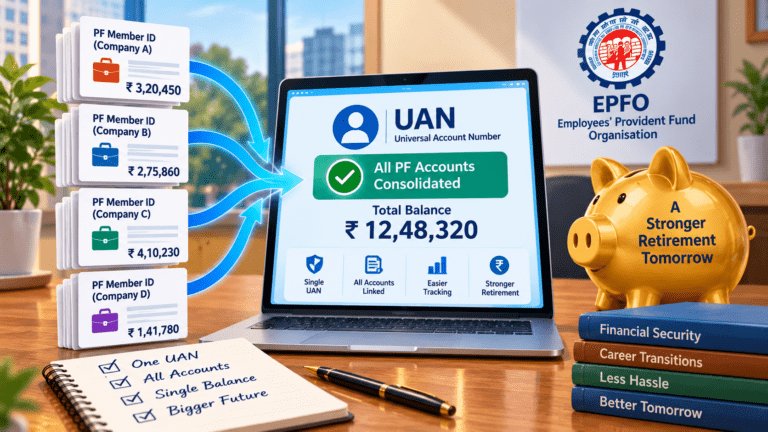
EPFO’s integration with the Unified Payments Interface (UPI) is part of its broader EPFO 3.0 vision, which aims to make the provident fund ecosystem as frictionless as a bank account. In theory, this means that just as you’d transfer money via PhonePe or Google Pay, you should eventually be able to access your EPF corpus with similar ease.
The UPI-linked withdrawal specifically targets non-refundable advance withdrawals — a category that already existed under EPF rules but required members to submit physical or portal-based claims that took anywhere from 3 to 20 working days to process. With UPI integration, EPFO aims to reduce this to near-real-time settlement, at least for the partial withdrawal use cases it has officially approved.
The 75% cap is not arbitrary. It mirrors the existing provision under Paragraph 68NN of the EPF Scheme, which allows members to withdraw up to 75% of their balance after one month of unemployment. This rule already existed — what’s new is the delivery mechanism. UPI essentially becomes the disbursement rail, not a new withdrawal entitlement.
Who Is Actually Eligible?
This is where many subscribers stumble. The UPI-based withdrawal is not available to every EPF member on demand. Eligibility is tied to a specific set of criteria, and all of them must be met simultaneously.
- Your UAN (Universal Account Number) must be active and KYC-verified, meaning your Aadhaar, PAN, and bank account must all be linked and verified on the EPFO member portal
- Your bank account must be registered with a UPI-enabled VPA (Virtual Payment Address), and the account number on EPFO records must match the account linked to that UPI ID
- Your Aadhaar must be seeded with your mobile number for OTP-based authentication during the withdrawal process
- The withdrawal reason must fall under one of EPFO’s approved advance categories — unemployment, medical emergency, housing, education, or marriage
- For the 75% unemployment-based withdrawal specifically, you must have been unemployed for at least one continuous month, and this status must reflect correctly in EPFO’s records
If even one of these conditions is partially unmet — a name mismatch between Aadhaar and EPFO records, a dormant UPI handle, an unverified PAN — the claim will either fail at the verification stage or get stuck in manual review, defeating the purpose of the fast-track UPI system entirely.
The Step-by-Step Withdrawal Process
For those who do meet eligibility, the process is relatively straightforward through the UMANG app or the EPFO member portal.
- Log in to the EPFO member portal (unifiedportal-mem.epfindia.gov.in) or the UMANG app using your UAN and password
- Navigate to “Online Services” and select “Claim (Form-31, 19, 10C & 10D)”
- Verify your bank account details — this step involves entering the last four digits of your bank account for confirmation
- Select the claim type: for the 75% advance, choose “PF Advance (Form 31)” and select the relevant purpose
- Enter the withdrawal amount (up to 75% of your current balance)
- Submit the claim and authenticate via Aadhaar OTP
- After submission, the disbursement is routed through UPI to your linked bank account
The actual UPI credit, in successful cases, is reported to happen within 72 hours for fully KYC-compliant accounts. In practice, EPFO has acknowledged that the first rollout phase is being tested in batches, so not every subscriber may see the UPI option available immediately on their portal dashboard.
The Catch Most Subscribers Are Missing
Here it is — the part that rarely makes it into the celebratory headlines.
The 75% UPI withdrawal is treated as a non-refundable advance, not a final settlement — and the tax treatment depends entirely on your years of continuous service at the time of withdrawal.
Most people assume that since it’s “their own money,” withdrawing from EPF is always tax-free. That assumption is dangerously incomplete. Under Indian income tax rules, EPF withdrawals are tax-free only if the member has completed five continuous years of service with the same employer (or across employers where the service has been transferred and merged without a break). If you withdraw before completing five years — even partially, even 75% — the entire withdrawn amount becomes taxable in the year of withdrawal, categorized under “Income from Salary,” and TDS at 10% is deducted if the amount exceeds ₹50,000 (with PAN on record) or at 30% if PAN is not linked.
But here’s the part that catches people off guard in 2025-26: the five-year clock does not restart with each employer separately in the traditional sense, but it also doesn’t automatically carry forward if you changed jobs and didn’t transfer your old EPF account to your new UAN. If your EPF account has a transfer gap — even of a few months — the income tax department may treat the cumulative service as broken, making the entire withdrawal taxable.
With UPI making withdrawals faster and easier, there’s a real risk that subscribers, especially younger employees who changed jobs two or three times in their late twenties, will click through the process without pausing to calculate whether they’ve crossed the five-year threshold in a tax-compliant way. The money lands in your account in 72 hours, and the tax notice arrives six months later.
The Second Catch: The Unemployment Clause Has a Documentation Requirement
For the specific 75% advance tied to unemployment — the most commonly cited use case in news coverage — EPFO requires that the unemployment period be verifiable. In older, manual claim processes, this was somewhat loosely enforced. With the digital and UPI-integrated system, EPFO has tightened its data cross-referencing with ESIC records and employer contribution data.
What this means practically: if your employer filed your exit date incorrectly, or if there’s a lag in your employer updating your “date of exit” on the EPFO portal, your unemployment status may not be reflected in EPFO’s system even if you’ve actually been unemployed for over a month. In such cases, the UPI-fast-track option may default back to manual review, and your claim can be held for weeks — ironically longer than the pre-UPI era for some edge cases.
The actionable advice here is to check your EPF passbook and member profile immediately after leaving a job to confirm that your employer has marked your exit date correctly. If it hasn’t been updated within 30 days of your leaving, you can raise a grievance on the EPFiGMS portal or contact your regional EPFO office directly. Do this before submitting a withdrawal claim, not after.
Why This Update Matters Beyond Convenience
The EPF corpus managed by EPFO as of early 2025 exceeds ₹24 lakh crore, and partial withdrawals already account for a significant share of the 30+ million annual claims EPFO processes. The UPI integration is not just a quality-of-life improvement — it’s an infrastructural shift in how India’s largest social security savings vehicle interfaces with the modern financial system.
For subscribers in cities like Lucknow, Kanpur, or Varanasi — where regional EPFO offices have historically been overloaded — this digital shift has genuine, tangible value. Workers who previously had to take a day off, travel to an EPFO office, and wait in long queues for claim submissions now have a genuine alternative. That’s not a small thing. For a daily-wage employee or a contract worker who loses income every day they’re not working, shaving two weeks off a medical emergency withdrawal can be the difference between accessing treatment on time or not.
But convenience, as with all financial products, comes with the responsibility of understanding the terms. The subscribers who will benefit most from this update are those who take 20 minutes to verify their KYC, confirm their service continuity, understand the tax implications, and then proceed. Those who treat it like a quick digital payment and rush through the process are the ones who end up with rejected claims, unexpected TDS deductions, or worse — withdrawn funds that create a tax demand during the next ITR filing cycle.
What EPFO’s EPFO 3.0 Vision Tells Us About Where This Is Heading
EPFO 3.0 is the organization’s roadmap toward full-stack digital transformation, and the UPI withdrawal feature is just one component of a larger architecture. The roadmap also includes ATM-style EPF withdrawal cards (currently in pilot), automated pension disbursement under EPS (Employees’ Pension Scheme), and real-time employer contribution tracking. The long-term vision is for an EPF account to function with the accessibility and liquidity of a savings bank account while retaining its retirement and social security purpose.
The UPI integration specifically addresses the “last mile” problem EPFO has always had — not the bureaucracy of claims processing, but the settlement latency between claim approval and actual fund receipt. By routing disbursements through UPI rails, EPFO can leverage NPCI’s infrastructure for instant or near-instant settlement, something that NEFT/RTGS-based disbursements couldn’t reliably deliver for high-volume claim processing.
For subscribers, this evolution means one thing above all: staying KYC-compliant on the EPFO portal is no longer optional housekeeping — it’s the entry ticket to every new feature EPFO rolls out. If your Aadhaar, PAN, and bank account are not verified and consistent with each other on the EPFO member portal, you will be locked out of the digital benefits even as they expand.
Practical Checklist Before You Submit a UPI Withdrawal Claim
To make sure you’re not among the subscribers who miss the catch, run through this checklist before initiating any withdrawal.
- Log into the EPFO member portal and confirm your KYC status shows “Approved” for Aadhaar, PAN, and bank account — not just “Pending” or “Verified by Employer”
- Check your EPF passbook to verify your current employer has been depositing contributions regularly and your date of joining is correctly recorded
- If you’ve changed jobs, confirm your previous EPF balance has been transferred to your current UAN — do not maintain multiple UANs, as this creates compliance complications
- Calculate your total continuous service years carefully, including all transferred service, to determine your tax liability before withdrawing
- If you’re withdrawing on unemployment grounds, verify that your employer has updated your “date of exit” on the EPFO portal before submitting the claim
- Confirm your bank account linked on the EPFO portal is the same account connected to your active UPI ID
- For withdrawals above ₹50,000 with less than five years of service, set aside the TDS amount proactively and plan to declare this income in your ITR for the relevant financial year
A Word on EPFO Grievance Redressal
If your UPI withdrawal claim gets stuck — and given the system is still in phased rollout, some will — your first recourse is the EPFiGMS (EPFO Grievance Management System) portal at epfigms.gov.in. File a complaint with your UAN, the claim reference number, and a clear description of the issue. EPFO is mandated to respond within 30 days, though in practice, many straightforward grievances are resolved faster. You can also escalate to the Central PF Commissioner’s office if the regional response is unsatisfactory, though that route is slower and typically reserved for claims involving large amounts or systemic errors.
The Ministry of Labour and Employment also maintains a CPGrams (Centralized Public Grievance Redress and Monitoring System) portal where EPF-related complaints can be filed if EPFO’s own system doesn’t resolve the issue. This adds a government oversight layer that tends to accelerate resolution for genuinely stuck cases.
The UPI-based EPF withdrawal is a meaningful leap forward for one of India’s most important worker welfare institutions. For millions of subscribers, it represents the first time their retirement savings will feel as accessible as their bank account. But financial ease has never been a substitute for financial literacy. The 75% withdrawal cap exists to protect your retirement corpus. The tax rules exist to maintain compliance. The eligibility conditions exist to prevent misuse. Understanding all three — not just the headline number — is what separates subscribers who benefit from this update from those who get burned by it. Take the time, check your portal, and withdraw smart.
Related reading: why EPFO 3.0 keeps slipping its launch date, and the 13 withdrawal rules now reduced to three categories.