Why Profitable MSMEs Still Run Out of Cash: The 73-Day Gap Behind the Squeeze
Business Finance · MSME Working Capital · India, FY 2026-27
Why Profitable MSMEs Still Run Out of Cash: The 73-Day Gap Behind the Squeeze
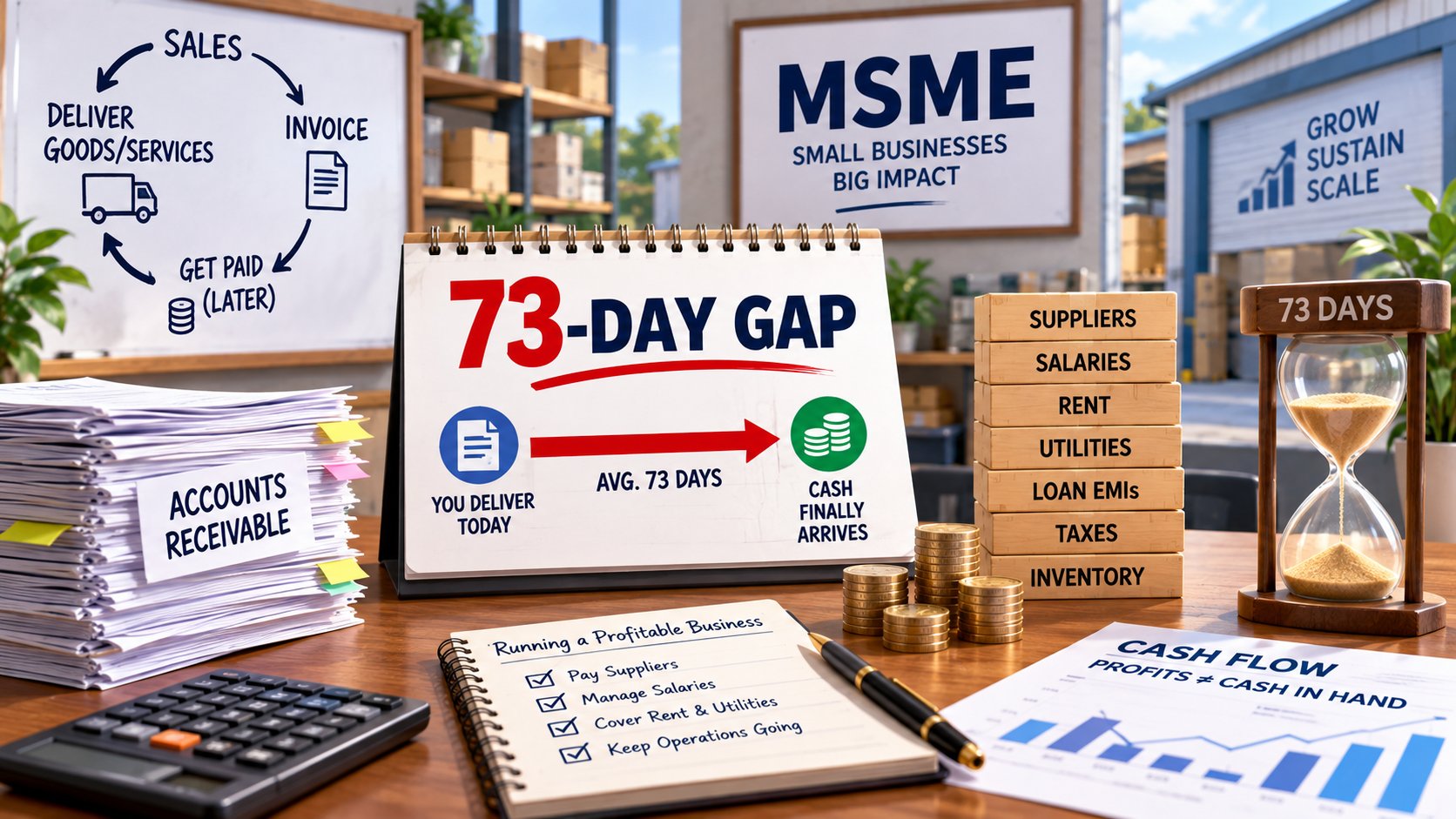
Indian small businesses issue most invoices on terms of 30 days or less, yet collect in 73 days on average. That difference, not weak demand, is what turns a profitable order book into a bank account under pressure.
The order book is full. The margin looks healthy. The chartered accountant confirms a profit. And yet the cash credit account is fully drawn by the twentieth of every month, the supplier is calling, and salaries are being juggled. Nothing in that picture is contradictory. Profit is measured when an invoice is raised. Cash arrives when the buyer chooses to pay, and in India those two events are separated by a gap wide enough to sink a business that is otherwise doing everything right.
What we know, from published data
Four findings anchor everything that follows, and each comes from a named source rather than a trade anecdote.
- The Indian SME Receivables Report 2026, drawn from about 1.1 lakh MSMEs and more than 10 lakh transactions, found a national average invoice payment cycle of 73 days, with Mumbai fastest among metros at 59 days.
- The same study found that 82.6 per cent of invoices are issued with credit terms of zero to 30 days, and that the average firm carries about Rs 3.83 crore in receivables overdue beyond 360 days.
- Through 15 December 2024, micro and small enterprises had filed 2,16,221 delayed-payment applications involving Rs 47,677.28 crore on the MSME Samadhaan portal, according to the Ministry of MSME’s 2024-25 annual report.
- Registrations across the Udyam portal and the Udyam Assist Platform crossed 7.83 crore enterprises by 28 February 2026, up from 0.79 crore in FY22.
The gap you are actually financing
Read the two headline numbers together and the problem becomes concrete. If you grant 30 days and collect in 73, you are lending your buyer 43 days of turnover, every cycle, at your own cost of funds. Nobody signs that loan agreement. It happens silently, one late remittance at a time, and it shows up only as a fully drawn overdraft.
Profit is an opinion. Cash is a fact.
Accounting recognises revenue when the risk in goods passes to the buyer. Your bank balance recognises nothing until money lands. A business can therefore book a record year and still be unable to pay for raw material in March, because the profit is sitting in a debtor ledger and a warehouse rather than in a current account.
This is why a profit and loss account alone is a poor early-warning system. It tells you whether the business model works. It does not tell you whether the business survives the next ninety days. The statement that does that is a rolling cash forecast, and most MSMEs under Rs 50 crore of turnover do not maintain one.
Where the money is actually parked
Trace a rupee through a typical manufacturing unit and the money stops moving at five predictable points. Each one is measurable, which means each one is fixable.
Two problems, and what each one actually needs
Working capital shortage and inventory mismanagement present as the same symptom, an empty bank account, but they respond to different treatments. Diagnosing the wrong one is how businesses end up borrowing more to fund a problem that borrowing cannot solve.
What usually goes wrong
- The limit was fixed on last year’s turnover, not on the current cycle of 100 days or more.
- Long-term assets such as machinery are bought out of short-term funds, permanently shrinking liquidity.
- Excess and non-moving stock quietly absorbs cash that never returns to the account.
- The account is overdrawn frequently, so interest rises and the credit rating slips.
- Vendor lead times bear no relation to the sales plan, so buying happens in panic or in excess.
- A wrong bill of material inflates consumption and hides the true cost of every unit made.
What actually fixes it
- Reassess the cycle honestly, then align the cash credit limit and term loan to it.
- Fund capital expenditure with a term loan repaid over the life of the asset, never from the overdraft.
- Classify stock by value and usage, and set a disposal rule for anything older than 180 days.
- Track drawing power monthly so the limit never depends on a stock statement filed late.
- Build a vendor lead-time tracker and link procurement triggers to the sales forecast.
- Rebuild the bill of material from actual consumption and reconcile it every quarter.
Inventory is a loan you made to yourself
Stock feels safer than cash because it is visible and countable. It is not safer. Every rupee of inventory carries a holding cost of interest, space, insurance, handling and obsolescence, and unlike a receivable it has no due date. The dangerous part is that inventory problems hide inside a healthy-looking balance sheet, since stock sits at cost until somebody finally writes it down.
The practical test is age, not quantity. A warehouse can be full of fast-moving items and be perfectly efficient, or hold a third of its value in lines that have not moved in a year and be quietly insolvent. Run the ageing report before the count, not after it, and the conversation about what to dispose of becomes a numbers discussion rather than an argument.
Why the bank says no when your numbers say yes
Lenders do not see your order book. They see conduct on the account and a monthly stock statement. Those two inputs drive drawing power, which is the amount you may actually withdraw in a given month after applying a margin to stock and eligible debtors. A business can hold a sanctioned limit of Rs 2 crore and still find only Rs 1.4 crore available, because receivables older than 90 days were excluded and the stock statement was filed a fortnight late.
Frequent overdrawing compounds the problem in a way that is invisible until renewal. Each excess drawing is recorded, priced at a penal rate, and read by the credit team as a signal that the limit is being used to plug a structural hole rather than to fund a cycle. The irony is familiar to anyone who has sat through a renewal meeting: the business that most needs a larger limit has usually behaved in the way that makes a larger limit hardest to justify.
The way out is unglamorous and effective. File the stock statement on the same date every month. Exclude disputed and long-overdue debtors yourself before the bank does, so your declared drawing power survives scrutiny. Keep the account within limit even in a tight month, if necessary by deferring a discretionary payment rather than by exceeding the sanction. Twelve months of clean conduct changes the conversation more than any projection.
What the delay is costing you, in rupees
The cost of a stretched receivable is rarely computed, which is why it is tolerated. It is simply the interest on your working capital facility for the extra days the money is out. At an indicative rate of 11 per cent, the 28 extra days between the 45-day statutory ceiling and the 73-day national average carry this price.
The payment clock the law already runs for you
Most MSME owners treat late payment as a commercial fact of life. The statute does not. Section 15 of the MSMED Act caps the agreed credit period at 45 days from acceptance, and at 15 days where there is no written agreement. A contract term longer than 45 days is void to that extent.
Normal
Confirm
Interest runs
Escalate
File formally
Escalating a stuck payment without losing the customer
The classification change that quietly widened the door
Revised investment and turnover thresholds took effect on 1 April 2025, and a large number of mid-sized businesses that had outgrown the old limits are now inside the MSME definition again. That matters for priority sector lending, guarantee cover and tender eligibility, so it is worth checking where your own numbers now fall.
| Category | Investment, earlier | Investment, revised | Turnover, earlier | Turnover, revised |
|---|---|---|---|---|
| Micro | Rs 1 crore | Rs 2.5 crore | Rs 5 crore | Rs 10 crore |
| Small | Rs 10 crore | Rs 25 crore | Rs 50 crore | Rs 100 crore |
| Medium | Rs 50 crore | Rs 125 crore | Rs 250 crore | Rs 500 crore |
| Guarantee cover | Up to Rs 5 crore | Up to Rs 10 crore | Effective 1 April 2025 | CGTMSE backed |
| TReDS threshold | Rs 500 crore turnover | Rs 250 crore turnover | Invoices up to Rs 10 crore | All CPSEs covered |
The formalisation curve behind those thresholds has been steep. Registrations across the Udyam portal and the Udyam Assist Platform have gone from 0.79 crore in FY22 to 7.83 crore by February 2026, which is why buyers, banks and tender portals now check Udyam status as a matter of routine.
Decoder: the banking words behind the pressure
Half the friction in a banking conversation comes from vocabulary. These are the terms that decide how much you can draw and when.
| Term | What it means | What to do about it |
|---|---|---|
| Cash credit limit | The maximum you may borrow on the working capital account. | Have it reassessed when the cycle lengthens, not at renewal only. |
| Drawing power | What you may actually draw this month, based on stock and debtors after margin. | File the stock statement on time. A late filing cuts your own limit. |
| Ad hoc limit | A short temporary increase, usually priced higher. | Use for a known seasonal peak, never as a permanent patch. |
| ABC analysis | Classifying stock so that the high-value minority gets the tightest control. | Review A items weekly, B monthly, C quarterly. |
| Ageing report | How long each stock line or invoice has been sitting. | Set an action rule at 90, 180 and 360 days. |
| FIFO control | Issuing the oldest stock first so nothing silently expires. | Enforce at the store, not in the software alone. |
| Bill of material | The exact input list for one unit of output. | Reconcile against actual consumption every quarter. |
| TReDS | A platform where approved invoices are discounted competitively. | Ask large buyers to onboard. The threshold is now Rs 250 crore turnover. |
| Samadhaan | The portal for filing delayed-payment complaints. | Keep Udyam number, invoice and acceptance proof ready before filing. |
| Section 43B(h) | Tax provision deferring a buyer’s deduction on overdue MSME dues. | Mention it early. It is the clause that moves finance teams. |
Eight controls that release cash without new borrowing
None of these requires a bank sanction, a consultant or software. All of them can begin this month.
What is still unclear
Three things cannot be stated with confidence, and saying so is more useful than filling the gap with a guess.
- The true national stock of delayed payments. Samadhaan captures only cases that are formally filed. Wider estimates reported around Budget 2026 put the figure locked in delayed payments in the region of Rs 8 lakh crore, but that rests on survey-based extrapolation rather than a transaction-level count.
- How far Section 43B(h) has changed behaviour. No published dataset yet isolates the change in average settlement days attributable to the provision, and commentary suggests the corresponding rule will sit in a renumbered section under the Income-tax Act, 2025 from 1 April 2026.
- Whether the wider TReDS mandate reaches smaller suppliers. Lowering the buyer threshold to Rs 250 crore of turnover expands the pool, but onboarding of tier-two and tier-three suppliers is not published at a granular level.
The short version
An MSME rarely fails because customers stopped buying. It fails because the money the customers owe arrives after the money the business owes is due. The gap between 30-day terms and 73-day collections, financed at overdraft rates and topped up with stock nobody has counted in months, is the whole story. Fix the measurement first: cycle days, ageing, drawing power, a rolling forecast. Then fix the structure: a limit that matches the cycle, a term loan for assets, and the statutory clock used rather than ignored. Profit is accounting. Cash flow is survival.
Frequently asked questions
Why does a profitable MSME still run short of cash?
Because profit is recorded when an invoice is raised, while cash arrives only when the buyer pays. With a national average settlement of 73 days against terms of 30 days or less on most invoices, a growing business funds a widening gap out of its own account. The faster it grows, the larger the gap becomes.
What is the 45-day MSME payment rule?
Section 15 of the MSMED Act, 2006 requires a buyer to pay a registered micro or small enterprise within the agreed period, which cannot exceed 45 days from acceptance of goods or services. Where there is no written agreement, the period is 15 days. Any contractual term beyond 45 days is void to that extent.
How much interest can I claim on a delayed payment?
Section 16 of the MSMED Act provides for compound interest with monthly rests at three times the Bank Rate notified by the RBI. At a Bank Rate of 5.50 per cent that works out to 16.5 per cent a year. Because the Bank Rate moves, confirm the applicable rate for the period before raising a debit note.
How do I calculate my working capital requirement?
Add inventory days and receivable days, subtract payable days, and multiply the result by your daily cost of sales. A unit with a 118-day cycle and Rs 2.63 lakh of daily cost of sales needs about Rs 3.10 crore of working capital. Compare that with your sanctioned limit, and the shortfall explains the monthly pressure.
What is the fastest way to reduce inventory without risking stockouts?
Start with an ABC classification so control effort follows value, then run an ageing report and set a disposal rule for anything beyond 180 days. Enforce first-in-first-out at the store. Finally, map vendor lead times against the sales plan so reorder points are driven by demand rather than by habit or bulk discounts.
Is filing on the MSME Samadhaan portal worth it?
It is the statutory route, and the volume shows it is used: 2,16,221 applications involving Rs 47,677.28 crore had been filed through 15 December 2024. The case goes to a facilitation council for conciliation and, failing that, arbitration, with a 90-day disposal window under the Act. Keep the Udyam number, invoice and acceptance proof ready.
Does Section 43B(h) actually help small suppliers get paid?
It changes the buyer’s incentive rather than your legal right. If an amount owed to a micro or small enterprise is overdue and unpaid at year end, the buyer’s deduction for that expense can be deferred to the year of payment, which raises taxable income now. Mentioning it to a finance team is often more effective than a reminder to purchase.
Should I take a bigger loan to solve a cash flow problem?
Only after the cycle has been measured. If the shortfall comes from a genuine 118-day cycle, a correctly structured limit is the answer. If it comes from stock nobody has aged or machinery bought from the overdraft, more borrowing raises the interest burden without fixing the cause. Diagnose first, then restructure the limit and the term loan together.