Multiple PF Member IDs Under One UAN: How the Balance Actually Gets Consolidated
Personal Finance · EPF and Retirement · India, FY 2026-27
Multiple PF Member IDs Under One UAN: How the Balance Actually Gets Consolidated
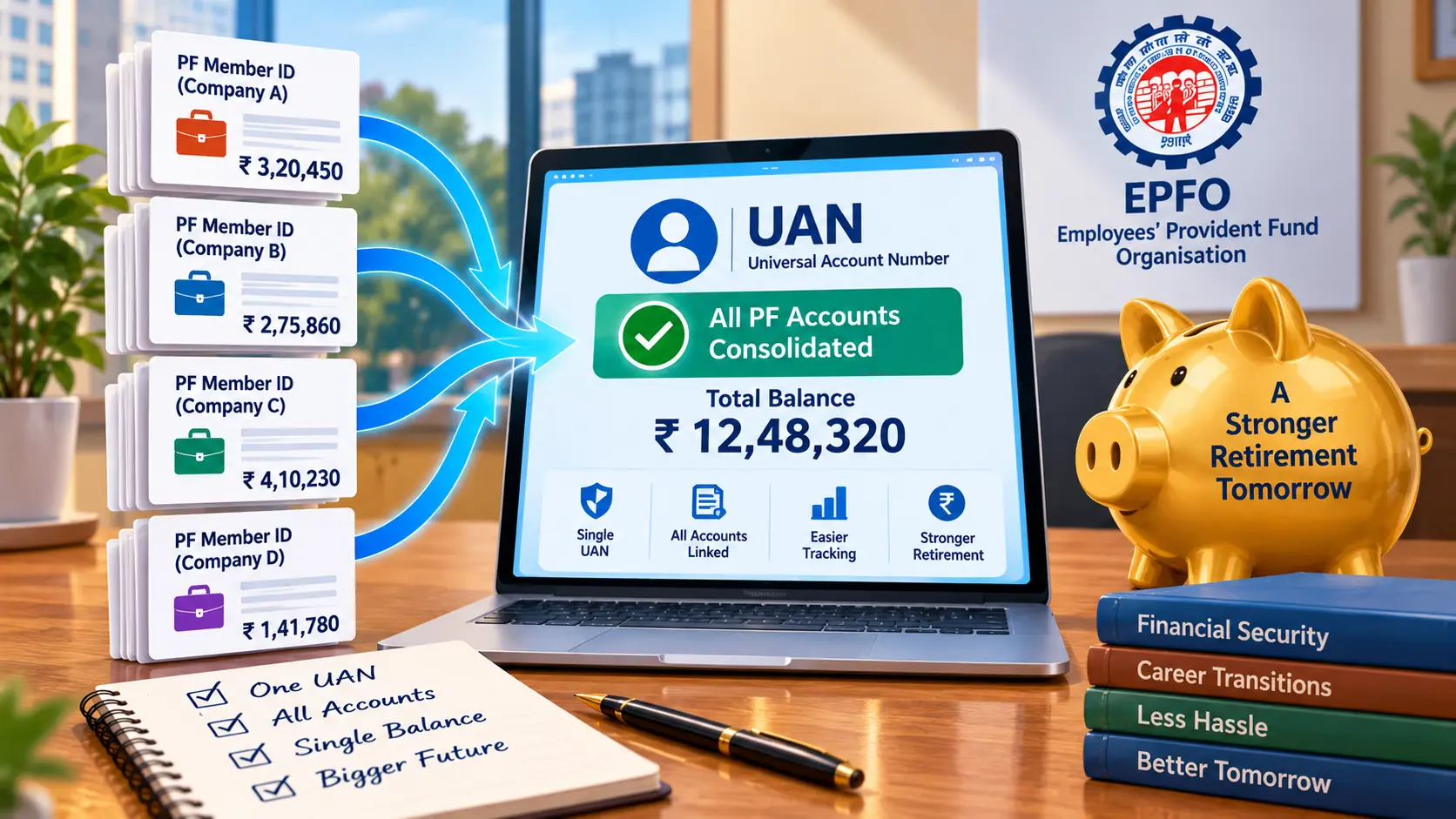
A UAN can carry several EPF Member IDs at once. The money behind them only comes together when a transfer claim is filed and approved, and the clock that penalises delay runs for 36 months.
You changed jobs three times in eight years. Your UAN stayed the same, your passbook shows several accounts stacked one under the other, and the totals never add up to what you think you have saved. Nothing has gone missing. What has happened is that each employer opened a fresh Member ID under the same umbrella number, and those balances sit in separate compartments until somebody asks EPFO to move them.
Quick Summary
A UAN is an identity, not a wallet. It can hold many Member IDs, and holding them is perfectly legal. The balances behind them are brought together by a transfer claim under Form 13, not by deletion or by any merge button. EPFO removed destination-office approval for transfer claims in April 2025, and by then only about 10 per cent of transfer claims still needed employer attestation. An old account stops earning interest 36 months after it goes quiet, which is what makes delay expensive.
What we know, confirmed from official sources
Four things are settled, and they frame everything else in this article.
- EPFO revamped the Form 13 transfer functionality and, by its press release dated 25 April 2025, removed the requirement for approval at the Destination Office. Once the Source Office approves, the previous account moves to the present account.
- The Ministry of Labour and Employment said the change was expected to speed the processing of transfers worth around Rs 90,000 crore annually, with direct benefits for more than 1.25 crore members.
- The Central Board of Trustees recommended 8.25 per cent interest on EPF accumulations for FY 2025-26 at its 239th meeting, and the Finance Ministry ratified it. It is the third consecutive year at that rate.
- An EPF account that receives no contribution for 36 months is treated as inoperative, and EPFO has stated publicly that no interest is paid on such accounts.
The scale of the thing you are dealing with
EPFO is not a small counter you are queueing at. The organisation reported a consolidated corpus of more than Rs 28.34 lakh crore as on March 2025, and in FY 2024-25 it took in contributions of Rs 3,35,628.81 crore, enrolled 1,22,89,244 new members and brought 2,86,894 new establishments under coverage. In the same year it settled 6,01,59,608 claims and redressed 17,33,046 grievances.
That last figure is the one most people have not caught up with. For years the folk wisdom was that a PF transfer meant chasing a former HR manager for a signature. Since the simplified transfer claim application was introduced in January 2025, the Ministry has said only around eight to ten per cent of transfer claims require member and employer attestation at all. If your KYC is clean, the signature problem has mostly stopped existing.
One UAN, several Member IDs: what the words actually mean
A Universal Account Number identifies a person. A Member ID identifies an employment. Every time a new employer enrols you, that employer generates a new Member ID and links it to your existing UAN if you supply it. So a mid-career professional with four employers behind them can legitimately have five Member IDs under one UAN, and none of that is an error.
What confuses people is the word merge. Member IDs are not merged and old accounts are not deleted. The balance in an old Member ID is transferred into the Member ID of your current employment. After the transfer, the old account shows a debit and a nil balance, and it stays on your service history as a record of that employment. That record matters later, because pensionable service under EPS is reckoned from it.
Two different problems, often confused
Multiple Member IDs under one UAN is normal. It is fixed by a transfer claim, and nothing is deactivated. Multiple UANs is not normal, because a member is meant to hold one UAN for life. It is fixed by transferring the balance to the active UAN, after which EPFO deactivates the older one. EPFO also runs a de-linking facility for accounts wrongly or fraudulently linked to a UAN, launched on 18 January 2025, under which more than 55,000 members had de-linked accounts by the end of February 2025.
Why duplicate numbers appear in the first place
Almost every duplicate traces back to a single missing data point at the moment of joining. Either you did not hand over your existing UAN, or your previous employer never filed your Date of Exit in the Electronic Challan cum Return. In the second case the system still believes you are employed at the old establishment, so the new employer’s enrolment produces a fresh number rather than a linked one.
Name and date-of-birth mismatches against Aadhaar do the same thing by a different route. So do contractor and payroll-vendor changes, where the legal employer on record shifts even though your desk does not. The practical consequence is identical: money in a compartment you are not watching.
The six moves that actually consolidate the money
The sequence below is the one that works in practice, and the order is not decorative. Filing a transfer claim before the Date of Exit is on record is the single most common reason a claim comes back rejected.
Written out as instructions, the same route reads like this.
- Log in to the EPFO member portal with your UAN and password, and download the passbook for every Member ID the system shows against you.
- Check that Aadhaar, PAN and bank details are verified under the active UAN. An unapproved KYC line blocks the Aadhaar OTP that the claim needs.
- Open View and then Service History, and look for the Date of Exit against each past employment. A blank there is a stop sign.
- Raise the transfer claim under Online Services, choosing the present employment as the destination and each past Member ID as a source in turn.
- Note the tracking ID for every claim, and check the status weekly rather than daily. Approval at the source office is the step that matters.
- Once the credit shows in the current passbook, download it as evidence. Keep it with your tax papers, because it is proof of continuous service.
The Date of Exit rule that catches most people
You can mark your own exit on the portal, but not immediately. The facility opens only after two months have passed since your previous employer’s last PF contribution, and the date you enter must fall within the month of that last contribution. The update is authenticated by an Aadhaar-linked OTP, and once submitted it cannot be edited again through the same route. If a wrong date is already on record, the correction runs through a joint declaration instead.
How long it takes, and when to start worrying
EPFO’s own position after the April 2025 change is that once the Source Office approves a transfer claim, the balance moves to the destination account instantly, because the second approval layer no longer exists. What still varies is how long the first approval takes, and whether your case falls in the small minority that needs an employer signature.
Normal
Self-audit
Act
Escalate
Formal route
If a claim is rejected rather than delayed, the reason is almost always in the reply text and is usually mechanical: exit date missing, name mismatch, wrong establishment selected, or a claim filed against an account that was already settled. Fix the underlying record and file again rather than filing the same claim a second time.
The arithmetic that makes this worth a Sunday afternoon
The case for consolidating is not tidiness. It is that an account left behind eventually stops compounding, while a transferred balance keeps earning at the declared rate. The table below assumes 8.25 per cent compounded annually for three years, against a balance that has gone inoperative and earns nothing further.
| Balance left behind | One year of interest | Value after 3 years if transferred | Value if it goes inoperative | Three-year gap |
|---|---|---|---|---|
| Rs 50,000 | Rs 4,125 | Rs 63,424 | Rs 50,000 | Rs 13,424 |
| Rs 1,00,000 | Rs 8,250 | Rs 1,26,848 | Rs 1,00,000 | Rs 26,848 |
| Rs 2,50,000 | Rs 20,625 | Rs 3,17,120 | Rs 2,50,000 | Rs 67,120 |
| Rs 5,00,000 | Rs 41,250 | Rs 6,34,240 | Rs 5,00,000 | Rs 1,34,240 |
| Rs 10,00,000 | Rs 82,500 | Rs 12,68,480 | Rs 10,00,000 | Rs 2,68,480 |
Worked example
Rohit left his first employer in March 2022 with Rs 2,40,000 in that Member ID, and never transferred it. Contributions stopped in March 2022, so the account was inoperative from March 2025. Between March 2022 and March 2025 it still earned: at 8.25 per cent compounded, Rs 2,40,000 grows to roughly Rs 3,04,435. From March 2025 the meter stops. Three further years of silence cost him about Rs 81,700 in interest he would otherwise have earned, on top of the tax exposure described below.
The tax reason nobody mentions until it is too late
Under the income-tax rules governing provident fund payments, an EPF withdrawal is exempt once you have completed five years of continuous service, and tax is deducted at source on premature withdrawals above Rs 50,000 where service falls short of five years. The rate is 10 per cent where PAN is furnished, and the maximum marginal rate where it is not.
Here is the part that turns a filing chore into a financial decision: service with a previous employer counts towards the five years, provided the balance was transferred rather than withdrawn. Three years at one company plus three at the next is six years of continuous service if the money moved, and two separate stubs of three years if it did not. Transferring is not merely neater. It is what buys you the exemption.
Decoder: what each term on your passbook means
Most of the confusion in this subject is vocabulary rather than procedure. This is the shortest complete glossary that lets you read your own records.
| What you see | What it means | What to do about it |
|---|---|---|
| UAN | Your permanent identity number with EPFO, meant to be one per person for life. | Keep it active, and quote it at every new joining. |
| Member ID | One employment with one establishment. Several are normal under one UAN. | Transfer the balance of past ones into the current one. |
| Form 13 | The transfer claim itself, revamped by EPFO with effect from 2025. | File it online with Aadhaar OTP once the exit date is recorded. |
| Source Office | The EPFO office holding the old account. | This is now the only office whose approval the claim needs. |
| Destination Office | The office holding your current account. | No approval required here since the April 2025 change. |
| Date of Exit | The last day of your employment as recorded in EPFO’s system. | If blank, use Mark Exit. If wrong, file a joint declaration. |
| Inoperative account | An account with no contribution for 36 months in the specified circumstances. | No interest accrues. Transfer or settle it. |
| De-linking | Removal of an account wrongly linked to your UAN. | Use the facility EPFO opened on 18 January 2025. |
| Tracking ID | The reference generated when a transfer claim is filed. | Quote it in every follow-up and in any grievance. |
| Service history | The record of every establishment, with joining and exit dates. | Read it before filing anything. It is the source of truth. |
For HR and payroll teams: the checks that prevent the problem
Most duplicate numbers are created at onboarding and at exit, by two teams who rarely speak to each other about EPF data. These are the controls that stop it.
What is still unclear
Three things cannot be stated with confidence today, and it is more useful to say so than to guess.
- The full rollout of EPFO 3.0. Reports through mid-2026 indicated that the database migration under the Centralised IT Enabled Services platform had been completed and that features were being released in phases rather than in a single nationwide switch-on. How and when the remaining features reach every region has not been laid out as a firm public calendar.
- Actual turnaround times for transfer claims. EPFO describes the credit as instant once the source office approves, but it does not publish a service-level commitment for how long that approval itself takes. The day ranges in this article are indicative, drawn from common member experience.
- How reliably duplicate UANs are detected automatically. EPFO’s system identifies duplicates during transfer processing and deactivates the older number, but the interval at which that runs is not published. Filing the transfer yourself remains faster than waiting.
The short version
Several Member IDs under one UAN is not a defect and needs no apology. What it needs is a transfer claim for each old Member ID into the current one, filed after the Date of Exit is on record and the KYC is approved. EPFO removed the destination-office approval step in April 2025, and attestation now touches only about one claim in ten. Left alone, an old balance stops earning after 36 months of silence and quietly breaks the five-year continuous-service test that keeps a future withdrawal tax-free. An afternoon of filing is worth more than it looks.
Frequently asked questions
Can multiple PF Member IDs be merged into one UAN, or do they have to be transferred?
They are not merged in the literal sense. Several Member IDs can sit under one UAN permanently, and nothing is deleted. To bring the money together you file a transfer claim under Form 13 for each old Member ID, moving that balance into the Member ID of your current employment. The old account then shows a nil balance but stays in your service history.
What is the difference between having two Member IDs and having two UANs?
Two Member IDs under one UAN is normal and requires only a transfer. Two UANs is a records problem, because a member is meant to hold one UAN for life. The fix is still a transfer of the balance to the account under the active UAN, after which EPFO deactivates the older UAN and links the previous Member ID to the active one.
Does my employer still have to approve a PF transfer claim?
In most cases, no. After the simplified transfer claim application introduced in January 2025, the Ministry of Labour and Employment said only around eight to ten per cent of transfer claims require member and employer attestation. From April 2025 the requirement for approval at the Destination Office was also removed, leaving approval at the Source Office as the single gate.
What happens if my previous employer never updated my Date of Exit?
Your transfer claim will usually fail, because the system still treats that employment as running. You can mark the exit yourself on the member portal under Manage and then Mark Exit, but only once two months have passed since the last PF contribution, and the date must fall in the month of that contribution. It is authenticated by an Aadhaar-linked OTP.
Do I lose money if I leave an old PF account untouched?
You do not lose the principal, which remains yours with no deadline to claim it. What you lose is growth. An account that receives no contribution for 36 months in the specified circumstances is treated as inoperative and no interest is paid on it, so at 8.25 per cent a forgotten Rs 5,00,000 gives up about Rs 41,250 for every year it sits idle.
Does transferring my PF protect me from tax on withdrawal?
It can. EPF withdrawal is exempt after five years of continuous service, and service with a previous employer counts towards those five years provided the balance was transferred rather than withdrawn. Withdraw instead of transferring and the clock restarts, which is how people end up with tax deducted at source on a withdrawal they assumed was exempt.
How do I check how many Member IDs are linked to my UAN?
Log in to the EPFO member portal with your UAN and password and open View, then Service History. It lists every establishment, its Member ID and the joining and exit dates held on record. The passbook view shows the balance sitting in each account. Read both before filing anything, because the service history is what the claim is validated against.
What should I do if my transfer claim has been pending for more than a month?
Check the claim status with your tracking ID first, since a pending attestation looks identical to a stalled claim from the outside. If attestation is with your current employer, ask HR to clear it from the employer interface. Beyond roughly 30 to 45 days, lodge a grievance on EPFiGMS quoting the UAN, the tracking ID and the establishment code.