EPFO Adds 19.29 Lakh New Members in a Single Month — The Surprising Age Group Driving India's Biggest Retirement Fund Growth
India’s workforce is growing fast, and the numbers are finally catching up to prove it. The Employees’ Provident Fund Organisation (EPFO) — the world’s largest social security organisation by membership — has recorded a remarkable milestone: 19.29 lakh new members enrolled in a single month. For context, that’s nearly two million people stepping into the formal employment net within just 30 days. Behind this headline number lies a far more interesting story — one about a specific age group rewriting the future of India’s retirement ecosystem.
What Is EPFO and Why Does This Number Matter
Before unpacking the trend, a quick primer for those unfamiliar. EPFO is the statutory body under the Ministry of Labour and Employment that manages Provident Fund (PF), Pension (EPS), and Insurance (EDLI) benefits for India’s organised workforce. Every salaried employee earning up to ₹15,000 per month in an EPFO-registered establishment is mandatorily enrolled. Both employer and employee contribute 12% of basic wages each month, building a retirement corpus over decades.
When EPFO adds millions of members in a single month, it doesn’t just signal employment growth — it signals formalisation. It means more Indians are moving from informal, unprotected work to structured employment with legally guaranteed retirement savings. In a country where a majority of the working population still operates in the informal economy, each new EPFO member represents a person gaining their first financial safety net.
Breaking Down the 19.29 Lakh Figure
Monthly payroll data released by EPFO offers a layered view of the labour market. The 19.29 lakh figure typically represents net new subscribers — that is, people who enrolled for the first time with EPFO and were not previously part of the system. Some months also include re-enrolled members who rejoined after switching jobs, but the net new additions are the ones that economists and policymakers focus on most closely.
To appreciate the scale, consider that India’s organised sector adds roughly 150 to 200 lakh (15 to 20 million) new EPFO members annually in recent years. A single month touching 19.29 lakh suggests the pace is accelerating, driven by a combination of policy enforcement, employer compliance drives, and — crucially — a surge in youth employment.
The Age Group Nobody Expected to Dominate
Here is where the story gets genuinely surprising. Conventional wisdom assumes that EPFO’s fastest-growing segment would be mid-career professionals in their 30s who are switching to better-paying formal jobs. The data tells a different story.
The 18 to 25 age group consistently accounts for the largest share of new EPFO enrolments — often representing nearly 60% of all net new members added in any given month. In recent payroll data, this cohort of first-time job seekers, fresh graduates, and young workers entering the formal workforce for the very first time has been the single biggest driver of EPFO’s expansion.
This is not a statistical anomaly. It reflects a structural shift in India’s labour market, and it carries profound implications for how we think about retirement savings, financial literacy, and the future of social security in this country.
Why Are So Many Young Indians Joining EPFO?
Several converging forces explain this youth surge.
India’s Demographic Dividend Is Finally Formalising
India has one of the youngest populations in the world, with a median age of approximately 28 years. For years, economists spoke about a “demographic dividend” — the economic benefit of having a large working-age population — but much of this workforce remained informal and unprotected. That is changing. Driven by the growth of manufacturing (especially under the Production Linked Incentive schemes), IT/ITeS expansion, e-commerce logistics, and organised retail, young workers are increasingly landing jobs in registered establishments.
Government Schemes Are Actively Incentivising Youth Employment
Schemes like the Pradhan Mantri Rojgar Protsahan Yojana (PMRPY), and more recently, employment-linked incentive programmes announced in Union Budgets, directly subsidise the employer’s EPF contribution for new hires — especially first-time employees. This makes it financially attractive for businesses to hire young workers and bring them under the EPFO umbrella. When the government pays part of the PF contribution for a new employee’s first three years, employers have a concrete reason to formalise young hires rather than keep them on casual rolls.
Post-Pandemic Formalisation Wave
The COVID-19 pandemic was economically brutal, but it had an unintended structural consequence: it accelerated the shift from informal to formal employment. Many small and medium enterprises that survived the pandemic did so partly by restructuring their workforce and ensuring compliance — including PF registration — to access government relief programmes. Young workers who entered the job market in the post-pandemic recovery phase were therefore more likely to join EPFO-compliant organisations than their counterparts a decade ago.
Digital Onboarding Has Removed Friction
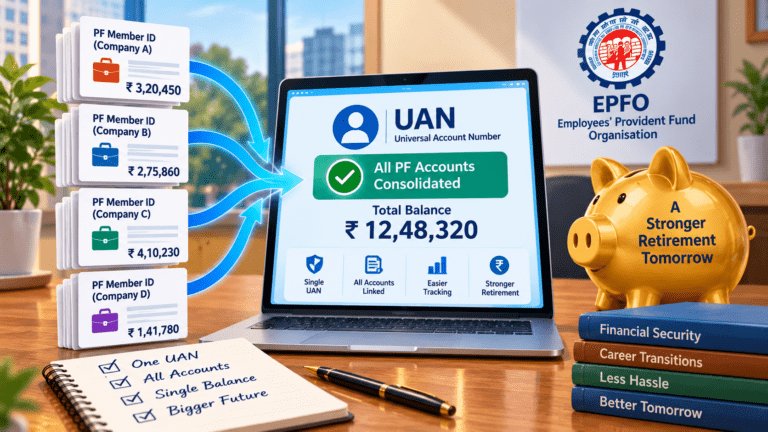
EPFO’s own digital transformation deserves credit. The introduction of auto-claim settlement, UAN (Universal Account Number) portability, Aadhaar-based KYC, and UMANG app access has made EPFO accounts far more accessible and useful for young, mobile-first workers. A 22-year-old in Lucknow starting their first job today can track their PF balance, transfer accounts when switching jobs, and raise grievances entirely through their smartphone. This visibility increases trust in the system and reduces the earlier resistance some young workers had toward formal employment deductions.
What This Means for India’s Retirement Security Landscape
The implications of a youth-dominated enrolment wave are enormous — and they cut both ways.
The Long Runway Advantage
A person who starts contributing to EPF at age 21 and continues until age 58 has a 37-year compounding window. At the current EPF interest rate of 8.25% per annum, even modest monthly contributions grow into substantial corpora over such periods. If India can retain these young members within the formal system throughout their careers — avoiding the problem of premature withdrawals — the country stands to build a genuinely large, self-funded retirement base over the next three to four decades.
The Premature Withdrawal Problem
Here lies the biggest risk to this optimistic picture. EPFO data historically shows that a significant proportion of young members withdraw their PF balances when they change jobs or face financial stress, rather than transferring or retaining the corpus. This behaviour, often driven by low financial literacy and immediate income pressures, erodes the very retirement savings that EPFO is designed to protect. The challenge for policymakers is not just to add 19 lakh members a month — it is to ensure those members stay invested long enough for the system to deliver on its retirement promise.
Gender Representation Is Improving, But Slowly
An encouraging sub-trend within the youth surge is the gradual increase in female enrolments. Women, who have historically been underrepresented in formal employment, now account for a growing share of new EPFO members, particularly in sectors like garments, electronics manufacturing, and services. Closing the gender gap in EPFO coverage would dramatically improve retirement security for women, who are statistically more likely to face economic vulnerability in old age.
State-Wise Patterns: Who Is Leading?
Not all states contribute equally to EPFO’s monthly enrolment numbers. Maharashtra, Tamil Nadu, Karnataka, Delhi/NCR, and Gujarat consistently rank as top contributors, reflecting their concentration of organised sector industries. However, an interesting trend in recent data shows states like Telangana, Rajasthan, and Uttar Pradesh climbing the rankings faster than before, suggesting that industrial formalisation is spreading beyond the traditional manufacturing belts.
For residents of Lucknow and broader Uttar Pradesh, this matters directly. UP has seen growth in sectors like food processing, defence manufacturing (Uttar Pradesh Defence Industrial Corridor), logistics, and organised retail — all of which are EPFO-registered industries. Young workers from Lucknow, Kanpur, Agra, and other UP cities are increasingly part of the national EPFO growth story.
Sector-Wise Breakdown: Where Are the New Members Coming From?
The industries driving new enrolments reveal a great deal about where India’s formal job creation is happening.
- Manufacturing remains the single largest contributor, particularly textiles, auto components, electronics assembly, and food processing, all sectors with large entry-level workforces that tend to skew young.
- Construction and infrastructure, energised by government capital expenditure, has seen increased EPFO compliance, though coverage in this sector remains far below its employment share.
- IT and business process management continue to be strong contributors, especially for the 22 to 28 age bracket with professional degrees.
- Organised retail and e-commerce have emerged as significant and fast-growing sources of new enrolments, with delivery workers, warehouse staff, and retail associates in large chains now covered under EPFO.
- Healthcare and allied services, expanded significantly after the pandemic, are adding young paramedical staff and hospital workers to the EPFO rolls.
EPFO’s Own Evolution: Matching the Needs of a Young Member Base
The organisation itself is not standing still. Recognising that its new members are young, digitally native, and likely to change jobs multiple times, EPFO has been modernising at a pace that few government bodies match.
The Centralised Pension Payment System (CPPS) launched in 2024 allows pension payments without any dependency on a specific bank branch or regional EPFO office — a significant upgrade for portability. The auto-settlement of PF advance claims for medical, education, and housing needs through AI-driven processing reduces the bureaucratic friction that once made EPFO feel distant and unreliable. Plans to upgrade the IT backend with modern claim processing infrastructure aim to bring settlement timelines down dramatically.
These reforms matter because trust is the foundation of voluntary retention. A young worker who finds that their EPFO account is easy to access, their claims are settled quickly, and their UAN follows them across employers is far less likely to withdraw prematurely than one who views the system as opaque and unresponsive.
The Broader Economic Signal
Economists use EPFO payroll data as one of the most reliable high-frequency indicators of formal employment in India. Unlike GDP figures, which are quarterly and often revised, or unemployment surveys, which are annual and methodologically contested, EPFO data is monthly, near real-time, and based on actual financial transactions. When EPFO adds 19.29 lakh new members in a month, it is one of the clearest signals available that India’s formal economy is genuinely expanding.
This has policy implications beyond retirement security. Higher formal employment means more workers paying income tax, more consumer spending with documented incomes, better access to formal credit, and reduced dependence on the informal economy’s often exploitative lending and working conditions. The EPFO number, in other words, is not just a retirement statistic — it is a barometer of India’s economic formalisation progress.
What First-Time EPFO Members Should Know
If you are among the millions who recently joined EPFO for the first time, there are a few things worth knowing immediately.
- Always activate your UAN (Universal Account Number) through the EPFO member portal and link it with your Aadhaar, PAN, and bank account. This ensures seamless transfers and claim processing throughout your career.
- Understand that your EPF account has two components: the Employee Provident Fund (your retirement corpus) and the Employee Pension Scheme (EPS), which will give you a monthly pension after age 58, provided you have 10 or more years of service.
- Resist the urge to withdraw your PF balance when switching jobs. Use the online transfer facility instead. Every rupee you withdraw today costs you many multiples of that amount in retirement corpus because of the compounding you forfeit.
- Nominate a family member as your EDLI beneficiary to ensure your dependants receive insurance cover (up to ₹7 lakh) in the event of your untimely death while in service.
- Use the UMANG app or the EPFO member portal to check your passbook regularly and raise discrepancies early, when they are easiest to correct.
Looking Ahead: Can EPFO Sustain This Growth?
The 19.29 lakh monthly addition is impressive, but sustainability depends on several factors. First, India must continue creating formal sector jobs at scale — something that requires sustained private investment, a supportive regulatory environment, and continued infrastructure spending. Second, EPFO’s own systems must keep pace with the volume of new members; a digital infrastructure breakdown or claims backlog at this scale of enrolment would damage trust severely. Third, financial literacy interventions targeting the 18 to 25 age group must be scaled up aggressively so that the retirement promise embedded in EPFO enrolment is actually realised and not withdrawn away in early career years.
There is also the question of the 90% of India’s workforce that remains outside the EPFO net entirely — the street vendors, farm workers, domestic workers, and small enterprise employees who have no retirement security whatsoever. The formal sector’s growth is necessary but not sufficient; a comprehensive social security expansion to cover informal workers remains one of India’s most important unfinished policy tasks.
Final Thoughts
The headline number — 19.29 lakh new EPFO members in a single month — deserves attention not just as a labour market statistic but as a social security milestone. Behind each of those numbers is a young Indian, most likely in their early 20s, taking their first step into a system designed to protect them decades from now when they are old and no longer earning. Whether that promise is kept depends on the choices they make early in their careers, the reforms EPFO continues to implement, and the policy environment that either supports or undermines formal employment creation.
India is at a pivotal moment. The demographic window that economists have been writing about for 20 years is now, visibly, translating into formal employment gains. The challenge — and the opportunity — is to ensure that the millions joining EPFO every month do not just enter the system but stay in it long enough to experience what it was actually built to deliver: a dignified retirement.