Banking · Fraud prevention · RBI draft, November 2026
RBI’s Stop Switch and Trusted Person Plan: How You Could Control Every Digital Transfer From Your Account
A draft released by the Reserve Bank of India on 23 November 2026 would let bank customers switch payment channels off, set their own limits, freeze all outgoing debits in one tap and ask a trusted person to approve large transfers. These are proposals, open for comment until 14 December. Here is how each control would work, and where its limits lie.
A call claims to be from the police. A link says your electricity will be cut tonight. A relative’s number asks for an urgent transfer. Within minutes, money is gone, and the bank’s answer is that you authorised it. Most digital fraud in India works this way: not by breaking into accounts, but by persuading people to send money themselves.
RBI’s latest draft tries to change the odds. Instead of focusing only on compensation after a fraud, it would give customers controls they can set in advance: which channels work, how much can leave, to whom, and when. For the most vulnerable, it adds a second pair of eyes before large transfers go through. Business Today described the shift as moving “beyond compensation after fraud towards preventing unauthorised transactions in the first place”.
Why RBI Is Moving From Refunds to Prevention
The scale of reported cyber fraud explains the urgency. Figures from the National Cyber Crime Reporting Portal, cited in RBI’s April 2026 discussion paper and summarised by the Risk Management Association of India, show reported cases rising from 2.6 lakh in 2021 to 28 lakh in 2025, and the reported value from ₹551 crore to ₹22,931 crore.
- 28 lakhCyber fraud cases reported in 2025
- ₹22,931 croreValue reported in 2025
- 41.6 timesRise in reported value, 2021 to 2025
- 38 timesGrowth in digital payment volumes over a decade
- 9 Apr 2026RBI discussion paper that preceded the draft
- 0Controls in force yet; all are proposals
National Cyber Crime Reporting Portal figures cited in RBI’s April 2026 discussion paper, as summarised by RMA India. Reported figures, not final unrecovered losses. Bar length scaled to ₹22,931 crore.
Our calculation: reported value divided by reported cases, from the same portal data. Indicative only. Bar length scaled to ₹95,200.
The second chart matters for the design of the new controls. Average losses per case have risen into tens of thousands of rupees. A customer-set cap of, say, ₹25,000 a day would not stop every fraud, but it would limit how much a single scam call can take.
Seven Controls, Explained One by One
Reports describe the package as seven or more safeguards, depending on how they are counted. The ones customers would actually use fall into these groups.
Switch channels off, and back on
Customers could disable one or more digital payment channels, such as UPI, internet banking or IMPS, and re-enable them through physical or digital interfaces, according to Business Standard. While a channel is off, customer-initiated debits through it are blocked. Customers could also set a time window during which chosen channels stay disabled, for example overnight.
Set your own limits
Customers could set or change per-transaction, per-beneficiary and daily aggregate limits for each channel, plus one overall daily limit across all digital channels. These would work alongside the bank’s own limits, not replace them.
Control your cards
Banks would have to let customers switch domestic and international card transactions on or off, and set limits separately for point-of-sale, ATM, online and contactless use. Gift cards and transit prepaid cards are excluded.
Off by default for new channels
Digital payment channels would be disabled by default at onboarding and enabled only with explicit consent and authentication. New cards would work only for contact-based ATM and PoS use in India until the customer changes that. In the first 24 hours after a non-card channel is activated, banks would apply a risk-based ceiling on transfers, which the customer could change only after those 24 hours.
Where you could flip the switches
Banks would have to make the controls and the Stop Switch available through branches, ATMs, internet banking, mobile banking and phone banking, according to Business Standard. That matters for customers who do not use apps, and for anyone whose phone has been compromised or stolen. Banks would also have to notify customers immediately whenever a control is switched on, changed or switched off, and keep tamper-proof logs of every change.
Why the 24-hour rules matter: fraudsters often push victims to open a new channel, register a new UPI app or raise a limit, and then drain the account immediately. Building delay and caps into exactly those moments cuts off a common playbook.
The Stop Switch: An Emergency Brake for Your Account
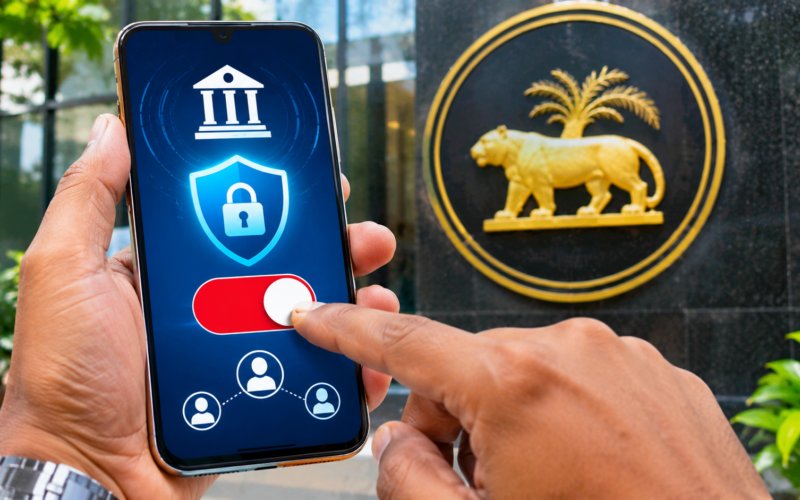
The Stop Switch is the most striking proposal. Activating it would immediately block all future outward debits from the account. While it is on, customers could not initiate debits, create new mandates or standing instructions, or register the account on new third-party UPI apps. Incoming credits would continue.
| Action | Stop Switch on | Channel disabled | Trusted person active |
|---|---|---|---|
| New UPI payment | Blocked | Blocked if UPI is off | Not covered |
| Net banking or IMPS transfer | Blocked | Blocked if that channel is off | Needs approval above threshold |
| New mandate or standing instruction | Blocked | Depends on channel | Not covered |
| Existing EMI or SIP mandate | Continues | Continues | Not covered |
| Incoming credits, such as salary | Continue | Continue | Not affected |
| Bank-initiated recovery of dues | Continues | Continues | Not affected |
| Merchant payments | Blocked | Blocked on that channel | Not covered |
Table compiled from the draft as reported by Business Standard and RMA India. Final rules may differ.
What the Stop Switch cannot do: it does not reverse payments already made, recover money from mule accounts, or guarantee reimbursement, RMA India notes. It stops the bleeding; it does not heal the wound. If you have already been defrauded, report it to your bank and the 1930 cyber helpline immediately, as well as switching it on.
A Second Pair of Eyes: The Trusted Person Mechanism
The Trusted Person Mechanism, or TPM, is designed for people more likely to be targeted, such as elderly customers. It adds an approval step for electronic fund transfers above a threshold the customer chooses.
- 18 plusTrusted person must be an adult with verified ID, mobile and email
- 24 hoursCooling-off before the mechanism activates or changes
- 1 hourWindow for the trusted person to approve each transfer
- 0 accessTrusted person cannot view balances or operate the account
How an approval works
For a transfer above the threshold, the trusted person receives the amount, beneficiary and narration. They have one hour to approve. If they reject it or do not respond, the transfer is rejected. Their mobile number must differ from the customer’s, and the role does not make them a joint holder, nominee or signatory.
What it does not cover
UPI transfers from the linked account, merchant payments on any channel, and recurring payments such as standing instructions, e-mandates and NACH mandates are excluded. This is a significant gap, because UPI is how most small and many medium-sized frauds happen.
Choosing the right trusted person
The ideal trusted person is someone who answers their phone, knows your normal spending, and is calm enough to say no. A child or sibling living elsewhere can work well, since their separate mobile number is a requirement anyway. Avoid choosing anyone who handles your money for you, because the point is independent judgement. And remember the one-hour window: if your trusted person is often unreachable, legitimate payments may fail, so pick a threshold that only catches unusual amounts.
Worked example: a 72-year-old pensioner sets a TPM threshold of ₹20,000 for net banking and IMPS, with her daughter as trusted person. A caller convinces her to send ₹1.5 lakh by IMPS. The daughter receives an alert showing the amount and an unknown beneficiary, and rejects it. Had the pensioner also set a daily UPI limit of ₹10,000, a scammer switching to UPI could take at most ₹10,000 that day. These thresholds are our illustration; RBI does not prescribe amounts.
What Changed From April’s Discussion Paper
The draft is softer in some places than RBI’s April ideas, and more detailed in others. RMA India’s comparison shows which proposals were kept and which were dropped.
| Item | April 2026 paper | November 2026 draft | What it means for you |
|---|---|---|---|
| Payment delay | One-hour delay considered for some transfers | Not retained as a general rule | No automatic wait on transfers |
| Trusted person | Mandatory for some vulnerable groups, with opt-out | Entirely voluntary | You choose whether to use it |
| TPM threshold | ₹50,000 suggested | Set by customer | You pick the amount |
| Annual credit ceiling | ₹25 lakh for some low-turnover accounts | Not retained | No cap on credits |
| Stop Switch | Proposed for consultation | Detailed framework | Likely to be available |
| Bank negligence | Existing liability rules discussed | Expanded definition | More grounds to hold banks liable |
The expanded negligence definition matters. According to RMA India, it covers failures such as not implementing customer-set restrictions or the TPM properly, not sending required alerts, not offering round-the-clock fraud reporting, and bank-side system breaches.
Your Existing Protection If Money Is Taken
None of this replaces RBI’s existing customer liability framework from 2017, which still governs what happens after an unauthorised transaction. Speed of reporting is what matters most.
RBI’s 2017 customer liability circular, for unauthorised transactions due to third-party breach where the customer is not negligent. Zero liability if reported within 3 working days. Bar length scaled to ₹25,000.
Beyond seven working days, liability is decided under the bank’s board-approved policy. Where a customer authorised the payment themselves, as in most scams, these protections usually do not apply, which is precisely the gap the new controls aim to narrow.
The Trade-Off: Safety Costs a Little Convenience
Every control in the draft adds friction. Default-off channels mean a new customer must take an extra step before paying online. A trusted person can delay a genuine urgent transfer by up to an hour. Low limits can block a legitimate large payment, such as a house deposit, until you raise them, and raising them could involve authentication and possibly a cooling-off period.
That friction is deliberate. Scams depend on speed and pressure: the caller insists the money must move now. Controls that slow things down at the riskiest moments give victims time to think and families time to intervene. The draft leaves most choices to the customer, so the right setting depends on how you use your account.
A sensible approach is to keep limits close to your normal daily spending, enable only the channels you use, and raise limits temporarily, and in advance, when you know a large payment is coming.
What to Do Now, Before the Rules Arrive
- Check your bank app: many banks already let you switch international use or online card payments off and set card limits.
- Lower your UPI and IMPS limits to what you actually need each day.
- Turn on transaction alerts by SMS and email, and read them.
- Save the 1930 cyber helpline number and your bank’s 24-hour fraud line.
- For elderly relatives, consider which family member could act as a trusted person once the facility exists.
- If you want to have a say, send comments to RBI before 14 December 2026.
From Authentication Rules to Customer Controls
- RBI directions on authentication for digital payments.
- Two-factor authentication rules take effect.
- Discussion paper on fraud prevention.
- Digital Payment Security Controls Directions.
- Draft on customer controls released.
- Comment deadline; final rules to follow.
What We Know, and What Is Still Unclear
What We Know
- RBI released draft directions on 23 November 2026.
- They propose channel controls, customer limits, a Stop Switch and a voluntary TPM.
- New channels would be off by default and capped in their first 24 hours.
- Comments close on 14 December 2026.
What Is Still Unclear
- When the final rules will take effect.
- Whether UPI will be brought under the trusted person mechanism.
- How the default-off rule will apply to existing customers.
- How quickly banks will build the controls into their apps.
Frequently Asked Questions
What is RBI’s Stop Switch?
A proposed feature that, when activated, immediately blocks all future outward debits from your bank account. Incoming credits and existing mandates continue.
What is the Trusted Person Mechanism?
A voluntary option where a nominated adult must approve electronic transfers above a threshold you set, within one hour. If they reject or do not respond, the transfer fails.
Does the trusted person apply to UPI?
No. Under the draft, UPI transfers, merchant payments and recurring payments are excluded from the mechanism.
Can I set my own UPI limit?
The draft would require banks to let customers set per-transaction, per-beneficiary and daily limits for each digital channel, including UPI.
When will the new RBI digital payment rules come into force?
No date has been set. The draft is open for comments until 14 December 2026, after which RBI will issue final directions.
Will the Stop Switch stop my EMIs?
No. Existing recurring mandates, standing instructions and bank-initiated recovery of dues are excluded from the Stop Switch.
Can the trusted person see my bank balance?
No. They cannot view balances, deposits, investments or insurance, or operate the account. Their role is limited to approving transfers.
What should I do if money is stolen from my account?
Report it to your bank and the 1930 cyber helpline immediately. Under RBI’s 2017 rules, reporting a third-party fraud within 3 working days gives zero liability.
The Short Version
RBI’s draft of 23 November 2026 would let you switch off any digital payment channel, set your own limits per payment, per payee and per day, block channels at chosen hours, and freeze all outgoing debits with a Stop Switch. A voluntary trusted person could be asked to approve large non-UPI transfers within an hour. New channels would start switched off. Comments close on 14 December, and no start date has been fixed. Until then, lower your limits, turn on alerts and report any fraud within three working days.