GST · MSMEs · Coimbatore and Tiruppur, Tamil Nadu, November 2026
GST Arrears Notices Hit Coimbatore’s Micro and Cottage Units: Why Waived Interest Is Being Demanded Again
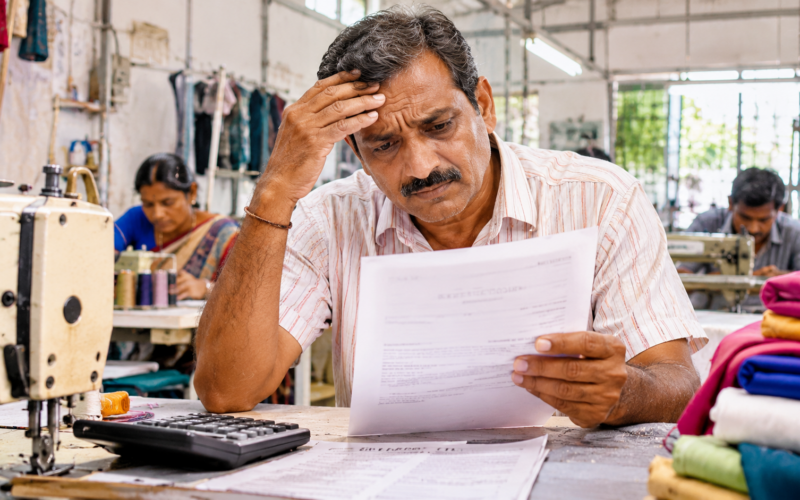
Micro and cottage enterprises in the Coimbatore and Tiruppur belt say the State Commercial Taxes Department is sending them notices for penalty and interest on GST arrears that they understood had been waived under the Centre’s amnesty scheme. Their associations have petitioned the Chief Minister’s cell and plan to meet the Commercial Taxes Minister.
A pump-parts workshop with six employees. A small knitting unit in Tiruppur. A family that makes wet grinder components from a shed behind their home. For many such businesses, the first years of GST were confusing, and mistakes in returns were common. When the Centre announced an amnesty that waived interest and penalty on old demands if the tax was paid, many owners believed the matter was closed.
Now some say it is not. According to The Hindu’s report, republished by A2Z Taxcorp on 25 November 2026, micro and cottage industries in Coimbatore are struggling with notices from the State’s Commercial Taxes Department for penalty and interest on GST arrears that were waived under the Central government’s amnesty schemes. Industry associations say fresh notices are still being issued and want the State to step in.
A Small-Business Belt With a Big Stake
Coimbatore is one of India’s densest clusters of small manufacturing, famous for pumps, motors, castings and textile machinery, with Tiruppur’s knitwear hub next door. The scale of the micro sector explains why a wave of notices is felt so widely.
- 2.59 lakhMSME registrations in Coimbatore, second in Tamil Nadu, per the State’s 2025-26 policy note
- 39.46 lakhMSMEs registered in Tamil Nadu as of 5 August 2024
- 7.95%Tamil Nadu’s share of India’s registered MSMEs, February 2026
- 99.31%Share of India’s registered MSMEs that are micro enterprises
- 7.83 croreEnterprises registered nationally across Udyam platforms, March 2026
- 200Unit owners at CODISSIA’s latest GST awareness session
MSME figures are from the Union MSME Ministry’s reply in Parliament, the Tamil Nadu MSME Department policy note and IBEF’s MSME infographics. The overwhelming share of micro units matters: these are businesses that typically do their own filings or rely on a local accountant, and have the least capacity to fight a tax demand.
Why cottage units feel it most
A large company can absorb a disputed demand, hire a consultant and appeal. A cottage unit usually cannot. Many run on thin margins and tight working capital, and a demand of one or two lakh rupees can equal several months of profit. Owners often rely on a local accountant who files returns for dozens of clients, so a missed form or a wrongly entered figure from 2018 may only surface years later. The association’s point, that “only the micro units are affected more”, reflects that imbalance.
Awareness as a first line of defence
Industry bodies are also trying to prevent the next round of disputes. CODISSIA, the Coimbatore District Small Industries Association, recently held a GST awareness programme attended by nearly 200 unit owners, with its president stressing that keeping MSMEs updated improves compliance and helps them deal with practical problems before they turn into notices.
What the GST Amnesty Actually Promised
The relief the units are relying on is Section 128A of the CGST Act, recommended by the 53rd GST Council meeting and in force from 1 November 2024. It offered a conditional waiver of interest, penalty or both on tax demands raised under Section 73 for FY 2017-18, 2018-19 and 2019-20, provided the full tax demanded was paid.
| Condition | What the scheme required | What it did not cover | Common trap |
|---|---|---|---|
| Period | July 2017 to March 2020 | Demands for FY 2020-21 onward | Assuming all old years qualify |
| Type of demand | Section 73, non-fraud cases | Section 74 fraud or suppression cases; erroneous refunds | Notice originally under Section 74 |
| Tax payment | Full tax demanded by 31 March 2025 | Partial payments | Paying most, not all, of the tax |
| Application | Form GST SPL-01 or SPL-02 by 30 June 2025 | Units that paid but did not apply | Missing the separate application |
| Appeals | Pending appeals withdrawn | Cases kept in appeal | Not withdrawing an appeal |
| Waived amounts | Interest under Section 50 and penalty | Tax itself; already-paid interest is not refunded | Expecting refunds of interest paid |
Conditions as set out in CBIC Circular 238/32/2024-GST, Rule 164 and GST Council material, summarised by Tally, IndiaFilings and Taxguru. Each notice or order needed its own application, and the waiver was granted by the proper officer through an order.
What owners often get wrong: paying the tax was only half the process. Without a separate SPL-01 or SPL-02 application, there was no waiver order, and the interest and penalty demand could stay open in the system. Interest on tax paid late through a delayed return, if it was not part of a Section 73 demand, may also fall outside the scheme.
Why the Notices Keep Coming
The associations’ complaint, as reported, is about process as much as money. The Coimbatore Tiruppur District Micro and Cottage Enterprises Association says the memorandum it submitted to the Chief Minister’s cell was forwarded to Commercial Taxes officials in Coimbatore, yet fresh notices continue to be issued.
Online filing anomalies
The association wants the government to fix anomalies in the online filing process so that units cannot submit wrong claims or documents, even unknowingly. It wants GST filing streamlined and manual verification removed, instead of notices being sent after the fact. Its argument is that small units are being penalised for weaknesses in the system they were made to use.
Old VAT-era demands
A separate issue has been raised by the Federation of Coimbatore Industrial Association, which queried notices sent to micro and small units for arrears under the pre-GST VAT regime. The department replied citing sections of the Central Sales Tax rules, according to the report. A Federation coordinator argues those rules are not valid under the GST regime.
The department has not explained publicly why each notice was issued. Based on how Section 128A works, the usual reasons a demand stays open are: the tax was paid but no SPL-01 or SPL-02 application was filed; an application was filed but the waiver order has not yet been passed; the full tax was not paid by 31 March 2025; the interest relates to tax paid late through returns rather than a Section 73 demand; or the demand comes from pre-GST VAT or CST years. A unit’s own case could involve one, several or none of these.
Our calculation from the rule for non-fraud cases: 10% of the tax or ₹10,000, whichever is higher. Interest is charged separately. Bar length scaled to ₹50,000.
The ₹10,000 floor is why penalties weigh so heavily on the smallest units: on a ₹20,000 shortfall, the penalty alone is half the tax.
The Money at Stake for a Small Unit
GST interest on unpaid tax runs at 18% a year under Section 50(1) of the CGST Act. For a micro unit, that turns a modest shortfall from 2018 into a large demand by 2026.
Our illustrative calculation: tax plus simple interest at 18% a year, before penalty. Under Section 73, penalty is 10% of tax or ₹10,000, whichever is higher, so add ₹10,000 here. Bar length scaled to ₹2.44 lakh.
Worked example: a unit short-paid ₹1 lakh of tax in 2018-19 and received a Section 73 demand. It paid the ₹1 lakh in full by 31 March 2025 and filed SPL-02 on time. If the waiver is granted, it owes nothing more. If the waiver is not recorded and interest is calculated for six years, the department could demand about ₹1,08,000 in interest plus ₹10,000 penalty, more than the original tax. These figures are illustrative and depend on actual dates and amounts.
Tamil Nadu Has Waived Small Dues Before
The associations’ hope for State action has precedent. In 2023, Tamil Nadu enacted the Tamil Nadu Taxes (Settlement of Arrears) Act, known as the Samadhan scheme, covering arrears under 11 State Acts, most from the VAT era.
As announced by the State government and reported by DT Next, Outlook and others. The scheme ran from 16 October 2023 to 15 February 2024. Bar length scaled to 1,40,398.
The State said the scheme addressed pending dues of about ₹25,000 crore, most under the old VAT and other legacy laws. Arrears below ₹50,000 per assessment year, including tax, interest and penalty, were fully waived. Whether a similar approach could be applied to residual GST interest and penalty is a policy question; GST is a shared Central and State tax, so any change may need GST Council involvement.
Relief Already on the Way, but Not for Old Notices
GST law itself is shifting in favour of small taxpayers, though the main changes start in 2027 and are not retrospective. Reports on the reform package, including TaxGst.in and India TV, list several measures due from 1 April 2027.
- ₹10,000Minimum demand before a show-cause notice can be issued
- ₹25,000 to ₹10,000General penalty cut
- ₹1 crore to ₹5 croreProsecution threshold raised
- 0Arrest powers, removed from GST law
Separately, process reforms from 1 November 2026 include simpler registration for small e-commerce sellers and faster refunds. None of these directly cancels existing demands from the 2017 to 2020 period, which is why the Coimbatore units are asking the State for intervention now.
What a Unit Holding a Notice Should Do
- Read the notice carefully: note the tax period, the section it cites, and whether it demands tax, interest, penalty or all three.
- Check the GST portal for your SPL-01 or SPL-02 application and any waiver order issued on it.
- Gather proof that the full tax was paid by 31 March 2025, such as DRC-03 challans or electronic ledger entries.
- Reply within the time given in the notice, attaching the waiver application, order and payment proof.
- If the demand relates to pre-GST VAT or CST years, check whether it was covered by Tamil Nadu’s 2023 Samadhan scheme.
- Contact your industry association, which is collecting cases to present to the department and the Minister.
- If a demand is confirmed wrongly, consult a tax professional about appeal deadlines; do not ignore the notice.
Do not miss the reply window: even if you believe the demand is wrong, an unanswered notice can turn into a confirmed order and recovery proceedings. A short reply with documents is far cheaper than an appeal later.
How the Dispute Built Up
- GST launched; early filing errors common among small units.
- Tamil Nadu’s Samadhan scheme opens for legacy tax arrears, to February 2024.
- Section 128A GST amnesty takes effect.
- Deadline to pay full tax under the amnesty.
- Deadline for SPL-01 and SPL-02 waiver applications.
- Coimbatore associations petition the State over fresh notices.
What We Know, and What Is Still Unclear
What We Know
- Micro and cottage units in Coimbatore report notices for interest and penalty on GST arrears.
- They say these amounts were waived under the Centre’s amnesty.
- Associations have petitioned the Chief Minister’s cell and plan to meet the Minister.
- Section 128A covered Section 73 demands for FY 2017-18 to 2019-20.
What Is Still Unclear
- How many units have received notices and the amounts involved.
- Which years and sections the notices cite.
- Whether the affected units filed waiver applications in time.
- Whether the State will order a review or offer relief.
Frequently Asked Questions
What is the GST amnesty scheme under Section 128A?
A conditional waiver of interest and penalty on Section 73 GST demands for FY 2017-18 to 2019-20, if the full tax was paid by 31 March 2025 and a waiver application was filed.
Why am I getting a GST notice for interest after the amnesty?
Common reasons include not filing SPL-01 or SPL-02, a pending waiver order, interest on late returns not covered by the scheme, or demands from years outside 2017 to 2020.
What was the last date for the GST amnesty scheme?
Tax had to be paid by 31 March 2025 and the waiver application filed by 30 June 2025.
Does the GST amnesty cover Section 74 notices?
No. Section 74 cases involving fraud, wilful misstatement or suppression are excluded, as are demands for erroneous refunds.
What is the interest rate on unpaid GST?
18% a year under Section 50(1) of the CGST Act, calculated from the due date until payment.
What is the penalty under Section 73 of GST?
10% of the tax due or ₹10,000, whichever is higher, in non-fraud cases.
Has Tamil Nadu announced relief for micro units?
Not yet. Associations have petitioned the Chief Minister’s cell and plan to meet the Commercial Taxes Minister.
What should I do if I receive a GST arrears notice?
Reply within the deadline with proof of tax payment and your waiver application or order. Seek professional advice if the demand is confirmed.
The Short Version
Micro and cottage enterprises in Coimbatore and Tiruppur say they are receiving notices from Tamil Nadu’s Commercial Taxes Department for interest and penalty on GST arrears they believed were waived under the Section 128A amnesty, which covered Section 73 demands for 2017 to 2020 if tax was paid by March 2025 and an application filed by June 2025. Associations have petitioned the State and want online filing fixed. No relief has been announced. Units with notices should reply on time, with proof of payment and their waiver application.