Banking · Cards and payments · India, November 2026
RBI’s Card Payment Directions 2026 Replace 25 Old Circulars — What Actually Changes for Debit and Credit Card Users
The Reserve Bank of India has merged 13 years of card rules into one rulebook, effective immediately. Most protections stay the same, from the ₹5,000 contactless limit to tokenisation and card controls, but they are now in one place, with a few details worth knowing.
Every time you tap a card at a shop, save it on a shopping app or switch off international use in your banking app, you are relying on an RBI rule. Until this week, those rules were scattered across 25 circulars, the oldest from September 2011. Banks and fintechs had to piece them together; customers rarely knew they existed.
On 27 November 2026, the RBI issued the Reserve Bank of India (Digital Payments – Card-based Transaction) Directions, 2026, which repeal all 25 and restate the rules in one document. Alongside it came a second consolidation for ATM and point-of-sale cash withdrawals, covering 17 more circulars. Here is what the card rulebook says, what is new and what you should check on your own cards.
Thirteen Years of Rules in One Document
The directions were issued under Section 18 read with Section 10(2) of the Payment and Settlement Systems Act, 2007, and apply to payment system providers and participants, both banks and non-banks. That covers card issuers, card networks, acquirers, payment aggregators and token service providers.
- 22 Sep 2011Date of the oldest repealed circular, on card-present security
- 6 Mar 2024Date of the newest, on credit card network arrangements
- 5Authorised card networks named: Amex, Diners, Mastercard, RuPay and Visa
- 10 lakhActive cards below which issuers are exempt from network choice
- 24×7Availability required for card on and off controls
- 10thDay of each month by which networks file tokenisation reports
Number of circulars by calendar year. Source: list of repealed circulars in the Directions, as reproduced by TaxGuru. Our count.
What the headline does not mean: consolidation is not a fresh set of restrictions. The repealed circulars’ authorisations, approvals and actions remain valid and are treated as granted under the new Directions. For most cardholders, nothing changes overnight. The benefit is that the rules are now easier to find, quote and enforce.
What the 25 Circulars Covered
Grouped by subject, the old circulars tell the story of how Indian card rules evolved: first security, then authentication relaxations for small payments, then the long tokenisation project that ended merchants’ storage of card numbers.
Number of circulars. Our grouping of the 25 titles listed in the Directions, via TaxGuru; some circulars cover more than one topic.
The Rules That Touch Your Wallet
Contactless: ₹5,000 without a PIN, and always optional
Contactless card-present payments up to ₹5,000 per transaction can skip additional authentication, across all merchant categories. Above ₹5,000, the card must be used as a contact card with a PIN. Two details matter for users: issuers may set a lower limit for you, and you can never be forced to pay contactless. The RBI’s language is blunt: customers “cannot be compelled to do a contactless payment”. The relaxation does not apply to ATMs or online payments.
New cards start locked down
At issue or reissue, all physical and virtual cards are enabled only for contact-based use at ATMs and point-of-sale terminals within India. Online, international and contactless use must be switched on by you. You can turn each on or off, and set limits, at any time through the bank’s app, internet banking, ATM or phone banking, and you must get an SMS or email alert when the status changes.
Your card number stays with the bank
Only card issuers and card networks may store actual card data for online payments. Merchants and apps can keep just the last four digits and the issuer’s name for tracking. Instead, saved cards use tokens, unique to the card, the app and the device. Registering a card for a token needs your explicit consent with additional authentication; pre-ticked boxes are not allowed, and tokenisation is free.
| Rule | What it says | Key number | What you can do |
|---|---|---|---|
| Contactless relaxation | No PIN needed for small tap payments | Up to ₹5,000 a transaction | Ask your bank for a lower limit |
| Contact option | You can always insert the card and use PIN | Any amount | Refuse to tap if you prefer |
| Default card settings | Only domestic ATM and PoS use enabled | At every issue or reissue | Switch on online or international use only if needed |
| Card controls | On, off and limits for each channel | Available 24×7 | Turn off international use when not travelling |
| Card data storage | Merchants cannot store full card numbers | Only last 4 digits allowed | Use tokenised saved cards |
| Tokenisation | Explicit consent with authentication | ₹0 charge | View and delete tokens in your bank app |
| Lost card reporting | Several channels must be available | Website, phone, SMS, IVR | Block immediately to limit liability |
Credit Card Users Can Pick Their Network
The directions carry forward the March 2024 rule on credit card networks. Issuers cannot sign agreements with a network that stop them using other networks, and must offer eligible customers a choice of network when issuing a card. Existing cardholders can exercise this choice at their next renewal. Issuers with 10 lakh or fewer active cards are exempt, as are issuers that run their own authorised network.
Network choice matters more than it sounds. Acceptance, international fees, reward partnerships and UPI linking can differ between Visa, Mastercard, RuPay, American Express and Diners. RuPay credit cards, for instance, can be linked to UPI, which some users value for small merchant payments.
Merchant Fees on Debit Cards, Spelled Out
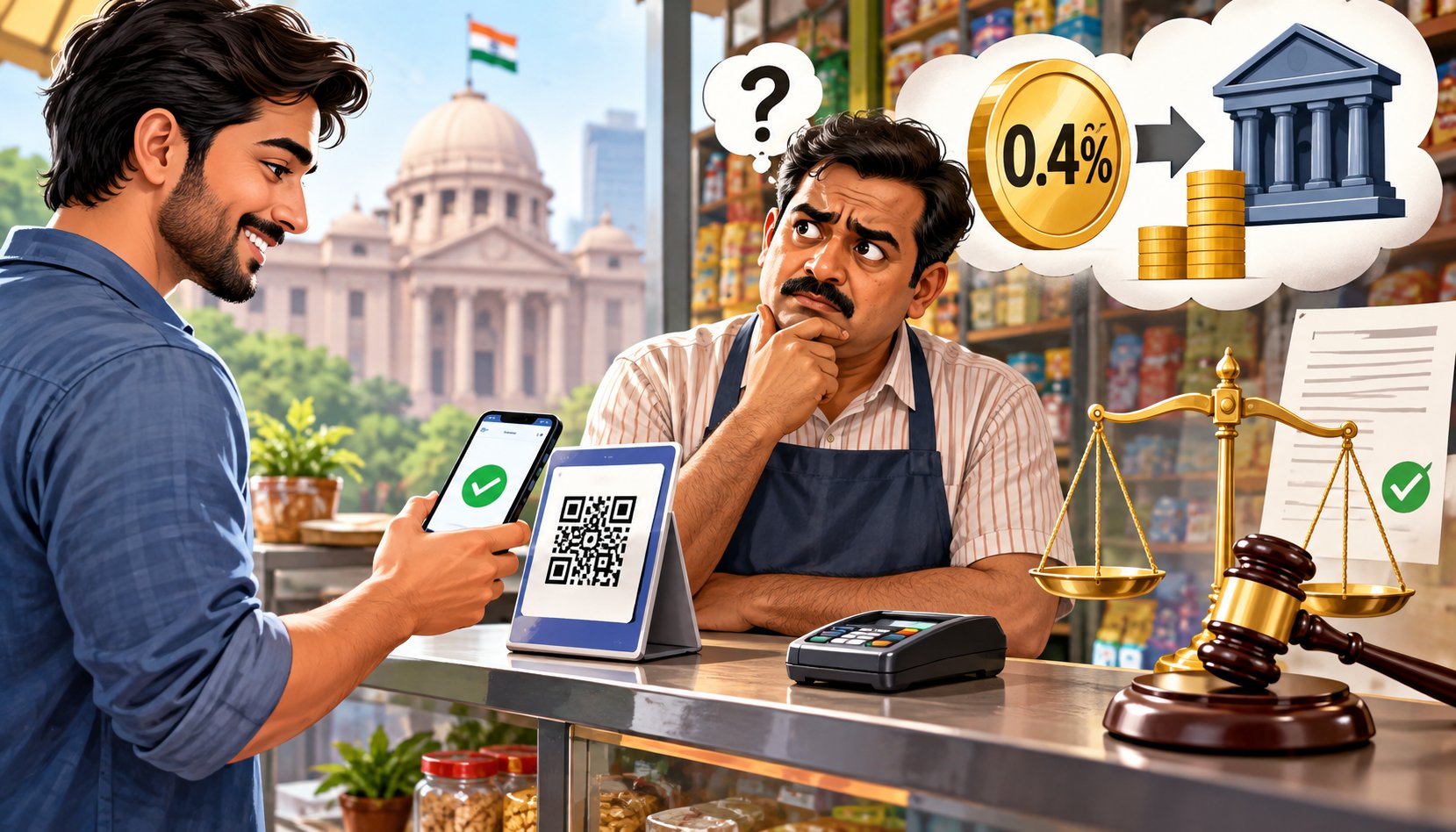
The merchant discount rate, or MDR, is the fee a merchant pays to accept a card. The directions cap debit card MDR by the merchant’s turnover in the previous financial year, with separate caps for card machines and QR codes. Merchants are not allowed to pass MDR on to customers, so a surcharge for paying by debit card is not permitted.
Maximum MDR as a percentage of the transaction. Small merchants have turnover up to ₹20 lakh; per-transaction ceilings of ₹200 for small and ₹1,000 for other merchants also apply. Source: Directions, via TaxGuru.
Worked examples, our own arithmetic. A large electronics store accepts a ₹50,000 debit card payment on its card machine. At the 0.90% cap, the most it can be charged is ₹450, below the ₹1,000 ceiling. On a ₹2 lakh debit card payment, 0.90% would be ₹1,800, but the ceiling limits the fee to ₹1,000.
A small kirana shop with turnover under ₹20 lakh takes a ₹60,000 debit card payment by QR code. At 0.30%, the fee would be ₹180, within the ₹200 cap. In none of these cases can the shop add the fee to the customer’s bill.
The Companion Rulebook for ATM Cash
On the same day, the RBI issued the Cash Withdrawal Transactions through Automated Teller Machines and Point of Sale Terminals Directions, 2026, consolidating 17 circulars. ANI, as reported by The Tribune, listed the main numbers. They restate existing limits rather than introducing new ones.
| Rule | Metro | Non-metro | Notes |
|---|---|---|---|
| Free transactions, own bank ATMs | 5 a month | 5 a month | Financial and non-financial combined |
| Free transactions, other bank ATMs | 3 a month | 5 a month | Counted separately from own-bank ATMs |
| Charge beyond free limit | Up to ₹23 | Up to ₹23 | Plus applicable taxes |
| Failed ATM transactions | Not counted | Not counted | For example no cash or technical failure |
| Cash at shop counters | ₹2,000 a transaction | ₹10,000 a month | Debit cards, eligible PPIs and UPI; fee up to 1% |
Worked example, our own arithmetic. You live in Mumbai and make eight cash withdrawals at other banks’ ATMs in a month. The first three are free. The other five can cost up to ₹23 each, or ₹115, plus 18% GST of ₹20.70, for a total of about ₹135.70. Banks must alert you about how many free transactions you have used and what later ones will cost.
What Banks, Merchants and Fintechs Must Now Follow
Most of the document is aimed at the industry, and some provisions explain why your card behaves the way it does. All credit, debit and prepaid cards must be EMV chip cards, and ATMs and card machines must be EMV compliant and support PIN or biometric authentication. Swiping the magnetic stripe of a chip-and-PIN card is not allowed; any fallback must be flagged to the issuer, and the acquiring bank bears the loss if it fails to comply.
Domestic card payments for goods and services must be acquired by a bank in India and settled only in Indian rupees. Card machines must also meet the RBI’s cyber resilience directions for non-bank payment operators, issued on 5 November 2026.
Tokenisation has its own audit trail
Token service providers can tokenise only their own or affiliated cards, must log every token request, and must be audited at least once a year by a CERT-In empanelled auditor, with copies to the RBI. Card networks file monthly tokenisation reports by the 10th, covering registered cards and transaction volumes by use case. When a card is renewed or replaced, the issuer needs fresh consent before relinking it to merchants.
Corporate cards and phone orders
Commercial cards used for travel bookings can be exempt from additional authentication if the company signs a prescribed undertaking. Mail and telephone order payments made without additional authentication must carry an extra notice in the cardholder’s alerts, so you can spot one you did not make.
Six Things to Check on Your Cards This Week
- Open your bank app and check which channels are on: online, international, contactless. Switch off anything you do not use.
- Set a lower contactless limit than ₹5,000 if you rarely tap for large amounts.
- Review saved card tokens on shopping and food apps, and delete those you no longer use, from the merchant app or your bank app.
- When your credit card is up for renewal, ask whether you can choose a different network.
- Note how to report a lost card through at least two channels, such as the app and a phone number.
- If a shop adds a surcharge for debit card payment, you can refuse; MDR cannot be passed on to customers.
How Card Rules Built Up
- First circular on security for card-present transactions.
- Circular on issuing EMV chip and PIN cards.
- Debit card MDR rationalised.
- First tokenisation circular for card transactions.
- Card controls and default domestic-only settings introduced to enhance security.
- Contactless limit without additional authentication raised to ₹5,000.
- Restriction on storing actual card data by merchants.
- Credit card network choice circular.
- All 25 replaced by the Card-based Transaction Directions, 2026.
Confirmed Facts, Open Questions
What We Know
- The Directions were issued on 27 November 2026 and consolidate 25 circulars.
- They apply to banks and non-bank payment system participants.
- Contactless payments up to ₹5,000 can skip additional authentication.
- Only issuers and networks may store actual card data for online payments.
- Debit card MDR caps range from 0.30% to 0.90%, with per-transaction ceilings.
- Earlier approvals remain valid under a savings clause.
What Is Still Unclear
- The effective date: most reports say immediate effect, while NewsBytes mentions 1 January.
- Whether any provisions differ in substance from the repealed circulars.
- Whether credit card MDR will be addressed separately.
- How strictly the network-choice rule will be enforced at renewal.
- Whether further consolidations, for example on UPI, will follow.
Frequently Asked Questions
What are the RBI Card-based Transaction Directions 2026?
A single set of rules issued on 27 November 2026 that consolidates and repeals 25 earlier RBI circulars on debit, credit and prepaid card payments, covering security, authentication, tokenisation, card controls, network choice and debit card MDR.
What is the contactless card payment limit in India?
₹5,000 per transaction without a PIN or other additional authentication. Above that, the card must be used with contact and PIN. Your bank may set a lower limit.
Can a shop force me to pay by tapping my card?
No. The RBI says customers cannot be compelled to make a contactless payment and can always use the card with a PIN.
Why is my new card not working online or abroad?
New and reissued cards are enabled only for domestic ATM and card machine use. You need to switch on online, international or contactless use through your bank’s app or other channels.
Can merchants store my card details?
No. Only card issuers and networks may store actual card data. Merchants can keep only the last four digits and the issuer name, and use tokens for saved cards.
Is there a charge for card tokenisation?
No. The directions prohibit any charge for tokenisation.
How many free ATM transactions do I get?
Five a month at your own bank’s ATMs, and at other banks’ ATMs three a month in metro cities and five in non-metro areas. Beyond that, banks can charge up to ₹23 per transaction plus taxes.
Can I choose my credit card network?
Yes, eligible customers must be offered a choice at issue, and existing cardholders at their next renewal, unless the issuer has 10 lakh or fewer active cards or runs its own network.
The Short Version
The RBI has replaced 25 card circulars, dating from 2011 to 2024, with a single rulebook effective from 27 November 2026, alongside a separate ATM rulebook covering 17 circulars. For users, the rules mostly stay the same but are easier to find: ₹5,000 contactless without a PIN and never compulsory, new cards locked to domestic contact use, no merchant storage of card numbers, free tokenisation, capped debit card MDR that cannot be passed on, and five free own-bank ATM withdrawals a month. Check your card controls and saved tokens now.