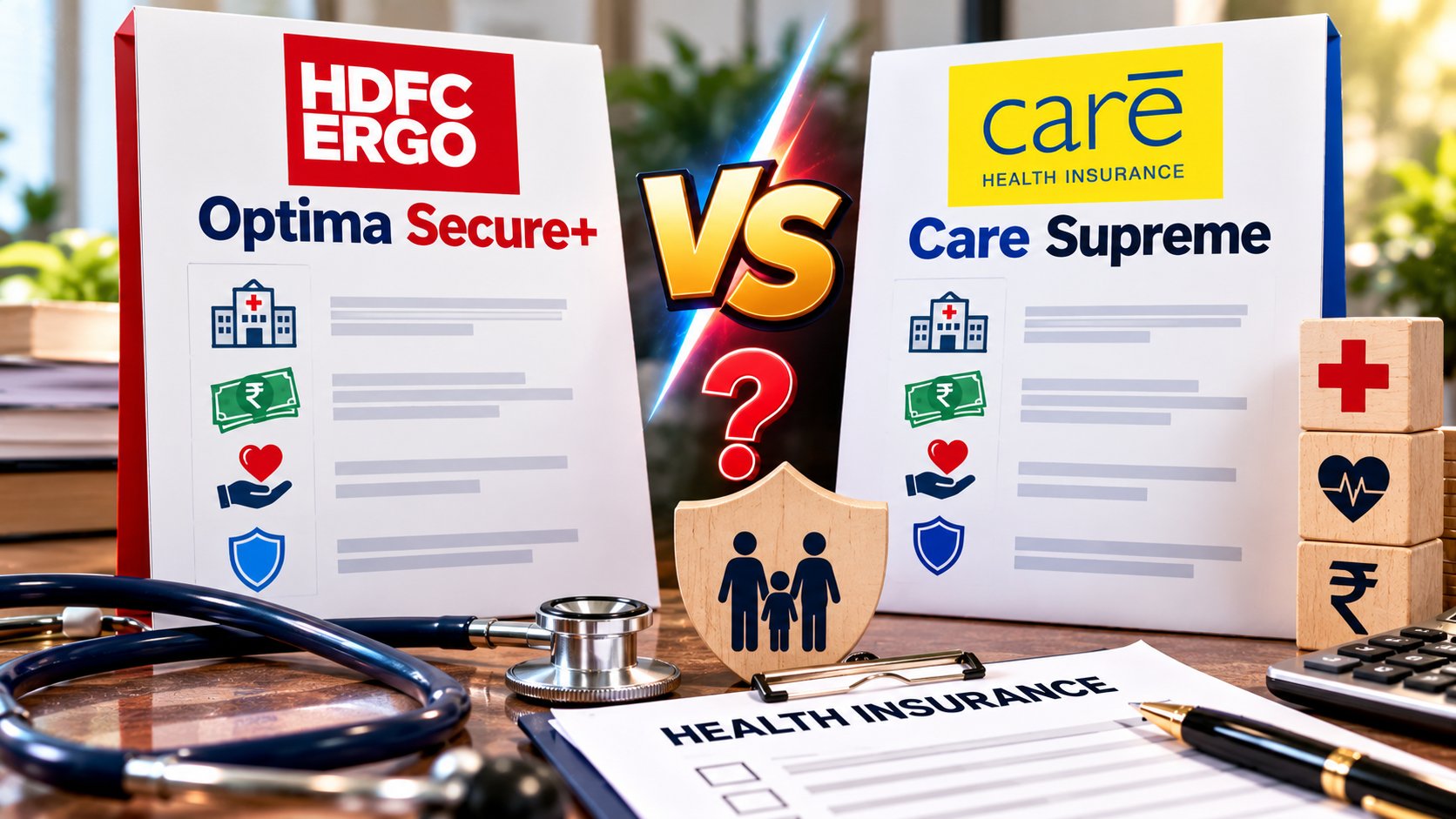
Health Insurance · Plan Comparison · India 2026
HDFC ERGO Optima Secure+ vs Care Supreme: Which Health Plan Should You Buy — and Who Should Pick the Other?
Both are no-room-rent-cap, no-co-pay plans with unlimited restore and 3-year pre-existing disease waits. Optima Secure+ grows cover faster without add-ons; Care Supreme starts cheaper and has no upper entry age.
You have shortlisted two names that keep appearing at the top of comparison lists. Both promise no room rent limit, no co-payment and unlimited restoration of cover. On a quick scan they look nearly identical, and the premiums for a young couple are within a few hundred rupees of each other. So which one is actually better for you?
The answer depends on three things the brochures do not put side by side: how fast your cover grows, which benefits are built in versus sold as add-ons, and who is allowed to buy. We compared both plans on those points, using the latest published features and insurer data.
How Fast Does Your Cover Grow?
This is where the two plans differ most. Optima Secure+ gives you twice the base sum insured from the first day through its Secure benefit. Then its Infinite benefit adds 100% of the base sum insured at every renewal, with no upper limit and whether or not you claim, according to Ditto. A ₹10 lakh base becomes ₹20 lakh on day one, ₹30 lakh in year two and about ₹1.2 crore by year eleven.
Care Supreme’s built-in cumulative bonus is slower: 50% of the sum insured a year, capped at 100%. To match Optima Secure+, you need an add-on. Cumulative Bonus Super adds 100% a year up to a 500% cap, and Cumulative Bonus Booster adds 100% a year with no cap, Ditto reports. Both add to the premium.
What Comes Built In, and What You Pay Extra For
Both plans remove the three restrictions that cause most claim disputes: room rent caps, co-payments and disease-wise sub-limits. Beyond that, Optima Secure+ bundles more into the base price, while Care Supreme keeps the base lean and sells extras as add-ons.
| Feature | Optima Secure+ | Care Supreme | Edge |
|---|---|---|---|
| Sum insured | ₹10 lakh to ₹2 crore | ₹5 lakh to ₹1 crore | Depends on need |
| Day-1 cover boost | 2x via Secure benefit | None | Optima Secure+ |
| Yearly bonus | +100% of base, no cap | +50% to 100%; more via add-on | Optima Secure+ |
| Restore | Unlimited, built in | Unlimited, built in | Tie |
| Non-medical items | 68 items via Protect benefit, built in | 68 items via Claim Shield add-on; 140+ via Claim Shield Plus | Optima Secure+ |
| Health check-up | Built in after first renewal | Add-on | Optima Secure+ |
| Maternity | Parenthood add-on, from about ₹14,000 | Not available | Optima Secure+ |
| Adult entry age | 18 to 60 | 18, no upper limit | Care Supreme |
| Air ambulance | Not listed in base summary | Add-on, up to ₹5 lakh a year | Care Supreme |
| OPD consultations | Optima Wellbeing add-on, select cities | Care OPD add-on, 8 visits at ₹500 each | Similar |
The consumables question
Gloves, syringes, PPE kits and similar items are usually excluded from health claims, and they can add thousands of rupees to a hospital bill. Optima Secure+ covers 68 such items as standard. With Care Supreme, you need Claim Shield for the same 68-item list, or Claim Shield Plus for a broader 140-plus list. If you buy Care Supreme, add one of these.
Waiting Periods and Pre-Existing Diseases
Both plans have the same standard waits, so the difference lies in how you can shorten them. This matters most if you already have diabetes, hypertension or a similar condition.
Optima Secure+ offers the ABCD Chronic Care add-on, which cuts the wait to 30 days for asthma, blood pressure, cholesterol and type 2 diabetes. Care Supreme’s Instant Cover does the same for hypertension, diabetes, cholesterol and asthma, and Instant Cover Plus extends it to obesity, COPD and coronary artery disease. Care Supreme also has a general PED reduction add-on that lowers the wait to one or two years for any declared condition.
What You Will Actually Pay
Premium examples from Ditto give a sense of cost, though they are not perfectly matched. The Optima Secure+ figures exclude add-ons, while the Care Supreme figures include Ditto’s recommended add-ons, and the ages differ slightly. Both are for Delhi and ₹15 lakh cover.
For young buyers, premiums are close. The real difference is what you get for that money. Care Supreme’s quoted price already includes add-ons, so its base price is lower, but adding a high bonus add-on to match Optima Secure+’s cover growth would raise it further.
Discounts worth asking about
Optima Secure+ lists up to 21% for first-time buyers based on claims experience, up to 18% on claim-free renewals, a 5% lifetime discount for buyers aged 35 or under, 6% to 8% for multi-year policies and 5% for buying online, according to Ditto. Care Supreme offers 7.5% off the second year’s premium for a 2-year policy and a further 10% off the third for a 3-year policy, plus a wellness add-on worth up to 30% off renewals.
The Insurer Behind the Plan
A policy is only as good as the claim experience. Ditto’s data for FY 2022 to 2025 shows both insurers above the industry average on claim settlement, but a large gap in complaints. Neither figure tells you how a specific claim will go, but complaint rates are a useful signal of friction.
Care Health’s incurred claim ratio of 58.68% is well below the industry’s 81.88%, meaning it paid out a smaller share of premiums as claims. A low ratio can reflect pricing and a growing book of younger customers, but Ditto notes it is also a reason to read policy terms carefully.
Check your own hospitals, not the network total
Network size is easy to compare and easy to misread. HDFC ERGO lists more than 13,000 network hospitals and Care Health more than 11,400, according to Ditto, but what matters is whether the two or three hospitals you would actually use are on each insurer’s cashless list. Search each insurer’s network by your pin code before buying. If your preferred hospital is missing, you can still claim by reimbursement, but you will have to pay the bill first and wait for settlement, which is harder in an emergency.
Switching, Porting and the Long Game
A health policy is a long relationship, and the plan you buy at 30 may need to serve you at 55. That makes renewability and portability as important as this year’s features. Both plans are renewable for life, and Indian rules let you move between insurers without losing the waiting periods you have already served.
Porting from one plan to the other
IRDAI’s portability rules let you carry credit for completed waiting periods to a new insurer, up to the sum insured you held. So if you have served two of the three years of pre-existing disease wait on one plan, you should have one year left on the new plan, for the same cover. Any extra sum insured you buy at the switch usually starts fresh waiting periods. Bonuses earned with your old insurer generally do not carry over in full, so switching after years of accumulated bonus can cost you cover.
The five-year moratorium
IRDAI’s 2024 health insurance master circular reduced the moratorium period to five years of continuous cover. After 60 months, an insurer cannot contest a claim on grounds of non-disclosure or misrepresentation, except in cases of established fraud. Staying with one plan, or porting without a break, protects that clock. It is another reason to choose carefully the first time, rather than switching every year for a cheaper quote.
What people often get wrong at renewal is allowing the policy to lapse by a few days. Most insurers allow a short grace period to renew, but claims during the lapse are not covered, and a break in continuity can reset benefits. Set an auto-renewal or reminder well before the due date.
Six Questions to Put to the Insurer Before You Pay
Comparison tables and broker summaries are useful, but the policy wording decides claims. These questions turn the differences above into answers you can check.
Which One Should You Take?
Choose Optima Secure+ if
- You are 60 or younger and want maximum cover growth without paying for bonus add-ons.
- You want consumables and a yearly health check-up included as standard.
- You plan a family and may want the Parenthood maternity add-on.
- A low complaint rate matters more to you than the lowest premium.
Choose Care Supreme if
- You are buying for someone above 60, since there is no upper entry age.
- You need cover below ₹10 lakh, starting from ₹5 lakh.
- You have a pre-existing condition outside the four chronic ones and want to cut the wait to 1 or 2 years.
- You prefer a lean base plan and choose only the add-ons you need.
- Decide your base sum insured from today’s hospital costs in your city, not from future bonuses.
- Check entry-age eligibility for every family member before comparing prices.
- List your must-have benefits, such as maternity, consumables or chronic disease cover, and price the add-ons each plan needs.
- Get quotes for the same members, city and sum insured from both insurers on the same day.
- Read the policy wording on bonus, restore and exclusions before paying.
Frequently Asked Questions
Which is better, Optima Secure+ or Care Supreme?
Neither is better for everyone. Optima Secure+ offers faster built-in cover growth, consumables cover and a health check-up as standard, for adults up to 60. Care Supreme has no upper entry age, starts at ₹5 lakh and lets you add only the features you need.
What is the Secure benefit in Optima Secure+?
It doubles your base sum insured from the first day of the policy. A ₹10 lakh base gives ₹20 lakh of cover from day one.
What is the Infinite benefit in Optima Secure+?
It adds 100% of the base sum insured at every renewal, with no ceiling, regardless of claims, according to Ditto. On a ₹10 lakh base, total cover reaches about ₹1.2 crore after ten years.
Does Care Supreme have a room rent limit?
No. Care Supreme has no room rent cap, no co-payment and no disease-wise sub-limits. Optima Secure+ also has no room rent cap or co-payment.
What is the pre-existing disease waiting period in Care Supreme and Optima Secure+?
Both have a 3-year PED waiting period. Each offers an add-on that cuts it to 30 days for common chronic conditions, and Care Supreme also offers a general reduction to 1 or 2 years.
Can senior citizens buy Optima Secure+?
Adults can enter Optima Secure+ between ages 18 and 60, according to Ditto. For parents above 60, Care Supreme, which has no upper entry age, is an option to consider.
Does Care Supreme cover maternity?
No. Ditto’s review says maternity is not available in Care Supreme, even as an add-on. Optima Secure+ offers maternity through its Parenthood add-on.
Which insurer has the better claim settlement ratio?
Ditto reports a 96.71% average for HDFC ERGO and 93.13% for Care Health over FY22 to FY25, both above the 91.22% industry average. HDFC ERGO also had far fewer complaints per 10,000 claims.
The Short Version
Optima Secure+ and Care Supreme share the essentials: no room rent cap, no co-pay, unlimited restore and a 3-year pre-existing disease wait. Optima Secure+ wins on built-in value, with 2x cover from day one, a yearly 100% bonus with no cap, consumables cover and a health check-up included, plus a maternity add-on and a lower complaint rate. Care Supreme wins on access, with no upper entry age, cover from ₹5 lakh and flexible pre-existing disease add-ons. Buy for your family’s ages and needs first, then compare like-for-like quotes.