India's Mutual Fund AUM Crosses ₹73.73 Lakh Crore in FY26 — But Why Did Equity Volatility Still Hold It Back?
India’s mutual fund industry has just written one of its most remarkable chapters. As of the close of FY26, the total Assets Under Management (AUM) of the Indian mutual fund sector crossed the historic ₹73.73 lakh crore mark — a number that would have seemed almost fantastical just five years ago. The Association of Mutual Funds in India (AMFI) data confirms this milestone, cementing India’s position as one of the fastest-growing mutual fund markets in the world. Yet, beneath the headline, a more nuanced story is unfolding — one that reveals how equity market volatility quietly acted as a ceiling on what could have been an even more spectacular number.
The Journey to ₹73.73 Lakh Crore
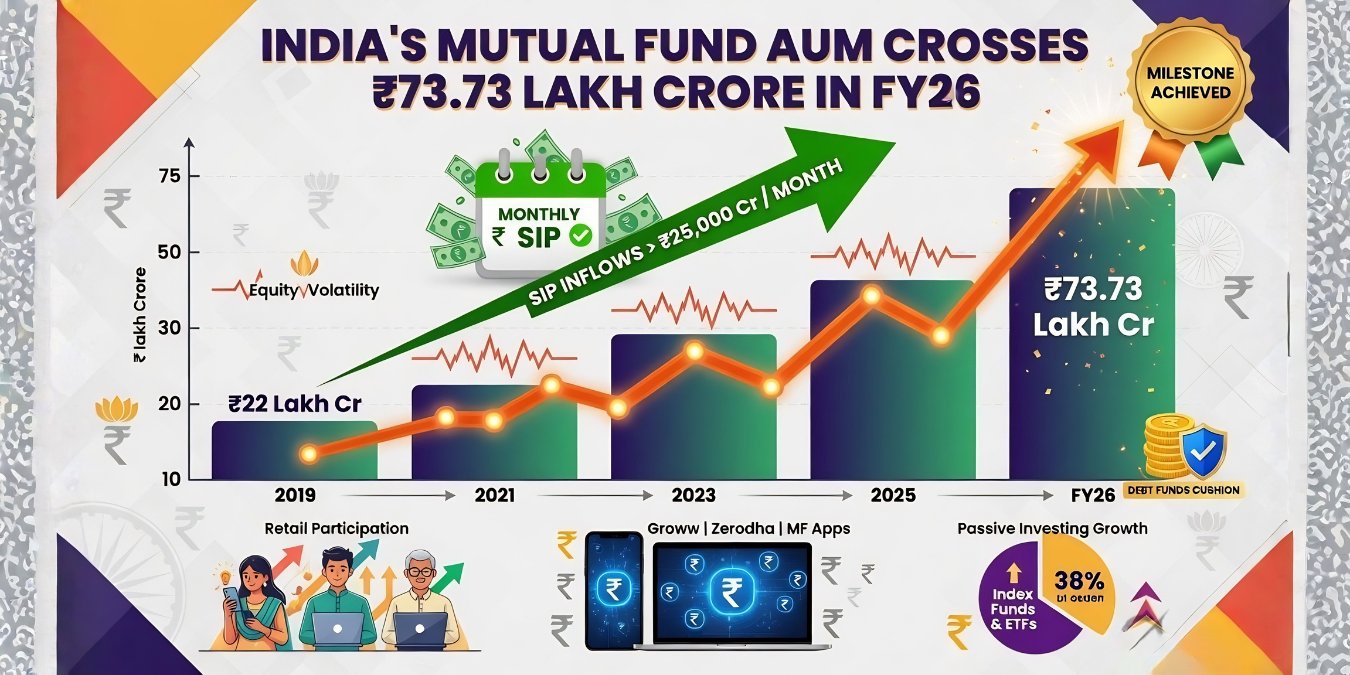
To truly appreciate this milestone, you need context. India’s mutual fund AUM stood at roughly ₹22 lakh crore in 2019. In less than seven years, that number has more than tripled. The growth has been powered by a confluence of forces: the digitization of financial services, the meteoric rise of SIP (Systematic Investment Plan) culture, increasing financial literacy among Tier-2 and Tier-3 city investors, and a regulatory environment that has consistently prioritized investor protection.
AMFI data shows that monthly SIP inflows consistently stayed above ₹25,000 crore through much of FY26, a staggering testimony to the behavioral shift among Indian retail investors. The number of SIP accounts crossed 10 crore (100 million), a milestone that would have been unthinkable in 2015 when the concept of a SIP was still foreign to most middle-class households. The penetration of mutual funds into the Indian savings ecosystem is now structural, not cyclical — and that distinction matters enormously for long-term AUM sustainability.
What Drove the AUM Surge?
Several tailwinds converged to push AUM to this landmark figure. Debt fund inflows saw a notable revival, particularly in categories like liquid funds, short-duration funds, and corporate bond funds, as institutional investors sought relatively stable returns in an uncertain rate environment. Hybrid funds also performed strongly, attracting investors who wanted equity participation without the full brunt of market swings.
The role of technology cannot be overstated. Platforms like Zerodha Coin, Groww, Paytm Money, and MFCentral made investing frictionless for an entire generation of first-time investors. Direct plan adoption grew meaningfully, reducing expense ratios and improving net returns for informed investors — which in turn reinforced trust in the product category. The SEBI’s consistent regulatory oversight, including categorization norms, expense ratio caps, and stringent disclosure requirements, has given institutional credibility to the ecosystem that now supports this massive AUM base.
Passive investing, long dominated by index-skeptic active fund managers, also came into its own in FY26. Index funds and ETFs saw record inflows, particularly Nifty 50, Nifty Next 50, and sectoral ETFs. Retail investors, burned by underperforming active funds in volatile years, increasingly gravitated toward low-cost index strategies. This shift not only broadened the AUM base but also diversified the investor profile of the industry.
The Equity Volatility Problem
Here is where the story gets complicated. Despite the overall AUM crossing ₹73.73 lakh crore, equity-oriented fund AUM growth in FY26 was noticeably uneven. The Indian equity markets experienced significant turbulence through the year, driven by a combination of global and domestic factors — including geopolitical tensions, foreign institutional investor (FII) outflows triggered by a strengthening US dollar, concerns around corporate earnings growth deceleration, and periodic fears of a slowdown in domestic consumption.
The Nifty 50 and Sensex, while resilient in the long arc, went through multiple phases of correction in FY26. The mid-cap and small-cap indices, which had seen parabolic runs in FY24 and early FY25, faced sharper drawdowns. This had a direct and measurable impact on equity fund AUM — not because investors necessarily redeemed in panic (SIP stoppage rates remained relatively low), but because mark-to-market losses reduced the net asset value of equity fund portfolios. When the market falls 10-15%, the AUM of equity funds falls with it, irrespective of fresh inflows. This is a fundamental but often misunderstood dynamic.
SEBI’s own data and fund house quarterly commentary pointed to a trend of lump-sum equity inflows slowing significantly during market correction phases in FY26. While SIP investors largely stayed the course — a behavioral victory for India’s financial literacy campaigns — the high-ticket lump-sum investors, typically HNIs and corporate treasuries, adopted a wait-and-watch posture. This behavioral bifurcation is critical: it means the AUM growth engine in equity funds was running on retail SIP fuel alone for large parts of the year, without the booster of large lump-sum deployments.
The Mark-to-Market Effect: A Technical Explanation
For readers unfamiliar with how AUM is calculated, it’s important to understand that mutual fund AUM is not just a tally of money invested — it reflects the current market value of all assets held by a fund. When equity prices fall, the market value of those holdings falls, and AUM declines even if no investor has pulled out a single rupee. Conversely, when markets rally, AUM can rise dramatically without a single new investor entering the fold.
This mark-to-market mechanics means that equity volatility directly suppresses AUM in real time. In FY26, during correction phases — particularly the October-December 2025 period when global risk-off sentiment was pronounced — the equity AUM portion of the overall mutual fund industry saw meaningful erosion. Debt and hybrid fund AUM provided a cushion, but the headline AUM growth was constrained relative to the pace of SIP inflow accumulation. Had equity markets sustained the bullish trajectory of FY24, analysts estimate India’s mutual fund AUM could have comfortably crossed ₹80 lakh crore by end of FY26. The gap between ₹73.73 lakh crore and that aspirational ₹80 lakh crore is, in large part, the cost of equity volatility.
FII Flows and the Domestic-Foreign Tug of War
Another dimension that held back equity AUM growth in FY26 was the persistent FII selling seen across multiple quarters. Foreign institutional investors, responding to a high US Federal Reserve rate environment and a global reallocation toward US treasuries and dollar-denominated assets, were net sellers in Indian equities for extended periods. This FII outflow pressure weighed on large-cap indices and particularly affected sectors like IT, financial services, and consumer discretionary that had heavy foreign ownership.
Domestic institutional investors (DIIs), largely powered by mutual fund SIP money, did their part as buyers — and this is a genuinely remarkable development in India’s market maturity. The DII buying, funded substantially by SIP inflows, acted as a stabilizing counterforce to FII selling. There were multiple sessions and months in FY26 where DII net buying exceeded FII net selling, preventing deeper market corrections. Yet, this equilibrium also meant that markets traded in a narrow, choppy range for long periods rather than sustaining directional rallies — which kept equity fund returns muted and suppressed AUM growth momentum.
The SIP Stalwart: Why Retail Investors Deserve Credit
If there is one unambiguous hero in India’s FY26 mutual fund story, it is the SIP investor. Despite corrections, despite market uncertainty, despite media narratives about global recession fears and geopolitical instability, SIP inflows remained remarkably resilient. Monthly SIP contributions staying above ₹25,000 crore is not just a statistic — it represents tens of millions of Indians making a deliberate, disciplined financial decision every single month.
This behavioral resilience has real structural implications. It tells fund managers and market regulators that India has built a genuinely sticky investor base. Unlike previous cycles where retail investors would flood into equity funds during bull markets and flee during corrections, the SIP framework has created an averaging mechanism that smoothens both investor behavior and market impact. Financial advisors, AMFI’s investor education campaigns, SEBI’s push for registered investment advisors, and fintech platforms educating users about the power of rupee-cost averaging — all of these have collectively engineered a more mature investor ecosystem than India had even a decade ago.
Debt Fund Renaissance and Its Role in the ₹73.73 Lakh Crore Number
While equity volatility was a headwind, the debt fund segment quietly had one of its better years in FY26. As interest rate expectations in India evolved — with the Reserve Bank of India navigating a delicate balance between growth support and inflation management — debt fund categories saw renewed institutional interest. Liquid funds, overnight funds, and money market funds absorbed large corporate treasury allocations, particularly from mid-sized corporates managing short-term cash surpluses.
The post-indexation benefit era for debt funds has changed the tax calculus, but the fundamental utility of debt funds for portfolio stability, capital preservation, and liquidity management remains intact. FY26 saw several fund houses innovating in the target maturity fund space, offering investors predictable duration and yield visibility — a product that resonated particularly well with conservative investors in their 50s and 60s looking for FD alternatives with better post-tax returns.
NFO Activity and Sectoral Fund Launches
FY26 was also notable for the volume and variety of New Fund Offer (NFO) activity. Fund houses launched an array of thematic and sectoral funds targeting emerging investment themes — manufacturing, infrastructure, defence, AI and technology, and green energy among them. These NFOs generated significant buzz and attracted lump-sum investments, particularly from HNIs and tech-savvy retail investors looking for targeted exposure.
However, SEBI’s increasing scrutiny of NFO launches, particularly for thematic funds with concentrated risk profiles, added a layer of regulatory friction that slowed some launches. SEBI’s push for fund houses to ensure adequate differentiation between new offerings and existing schemes in their portfolio was a positive step for investor protection, even if it momentarily tempered the NFO pipeline’s contribution to AUM growth.
Geographic and Demographic Diversification
One of the most encouraging structural trends in FY26 was the continued geographic diversification of mutual fund investors. Historically, mutual fund participation was concentrated in the top 30 cities — what AMFI categorizes as B30 (Beyond Top 30) cities only contributing a modest share of AUM. That picture has been changing. Digital distribution, the rise of regional language investment content on YouTube and social media, and the expansion of MFD (Mutual Fund Distributor) networks into smaller towns have collectively driven B30 city AUM growth at a rate faster than the national average.
Demographically, younger investors — Gen Z and millennials — are entering the mutual fund ecosystem earlier in their financial lives than any previous generation. Many begin their investment journey at 21-22, often through index funds or ELSS (Equity Linked Savings Scheme) for tax benefits, and gradually build a more diversified portfolio. This demographic cohort will be the backbone of India’s mutual fund AUM growth for the next two decades, and their long investment horizons make them structurally less sensitive to short-term equity volatility.
What FY27 Looks Like From Here
The trajectory for FY27 appears cautiously optimistic. If equity markets stabilize and resume a moderate upward trend driven by earnings recovery, GST revenue strength, and continued infrastructure spending by the government, equity fund AUM should see a meaningful re-rating. A potential US Federal Reserve rate cut cycle — which could trigger FII flows back into emerging markets including India — would be a significant positive catalyst.
SIP inflows are expected to maintain their trajectory above ₹25,000 crore monthly, and industry experts project that the total mutual fund AUM could cross ₹85-90 lakh crore by end of FY27 if market conditions cooperate. The key wildcard remains global macro risk — a US recession, an escalation in geopolitical conflicts affecting commodity prices, or a sharp rupee depreciation could all act as headwinds to this projection.
SEBI’s continued regulatory evolution — including its work on simplifying the KYC process, expanding the reach of Mutual Fund Lite regulations for passive fund-only AMCs, and strengthening grievance redressal mechanisms — will be important enablers. Regulation that builds investor trust is ultimately regulation that builds AUM.
What This Milestone Means for India’s Financial Future
The ₹73.73 lakh crore AUM milestone is more than a number. It represents the coming of age of India’s retail investor class, the maturation of its financial regulatory architecture, and the beginning of a structural shift in how Indian households manage their savings. For decades, Indian households parked their savings overwhelmingly in fixed deposits, gold, and real estate. The shift toward financial assets — and specifically toward mutual funds as the gateway financial product — represents a generational transformation in financial behavior.
India’s household financial savings rate, as a proportion of GDP, has the potential to increase materially as mutual fund penetration deepens. This has profound implications for capital market depth, corporate funding availability, and long-term economic productivity. When retail money flows into equity markets through mutual funds, it supports price discovery, reduces cost of capital for corporations, and builds a long-duration ownership base that is less prone to panic than speculative foreign capital.
The equity volatility of FY26 was a reminder that the journey will not always be smooth. Markets will correct. Global headwinds will periodically rattle portfolios. Fund returns will disappoint in some years. But the infrastructure that India has built — the SIP mechanism, the regulatory framework, the digital distribution ecosystem, the investor education initiatives — is robust enough to weather these cycles and emerge stronger. The ₹73.73 lakh crore is not a ceiling. It is a foundation.