Why Did Sensex Shed 429 Points Minutes After the RBI Hiked Rates for the First Time Since 2023?
India’s market today is a story of two forces pulling in opposite directions: resilient domestic growth and earnings on one side, and global risk, crude oil pressure, and foreign selling on the other. On Tuesday, 09-06-2026, the latest market read suggests Indian equities are still finding support in banking, pharma, and selected large caps, while IT, metals, and rate-sensitive pockets remain more vulnerable to macro shocks and valuation resets.
The big question for investors is not whether India is still a long-term structural story, but whether this is now a stock-picker’s market rather than a blanket-rally market. The evidence from recent sessions, RBI’s June policy, and sector rotation suggests exactly that.
Indian market overview
The broad tone across Indian stock market trends is mixed but constructive for quality names. The BSE Sensex has been trading around the mid-74,000 zone, while the NSE Nifty 50 has been hovering around the 23,000–23,100 area in recent market data, reflecting caution after a period of profit booking and global uncertainty. Bank Nifty has held relatively stronger, and the latest breakout in banking stocks shows that financials remain the market’s main leadership engine in 2026.
Investor sentiment is best described as selective risk-taking. Domestic institutional support continues to cushion broad weakness, but FII flows, crude prices, and geopolitical headlines are still driving intraday volatility and short-term index swings. In practical terms, this means large-cap leadership matters more than ever, and momentum is likely to remain sector-specific rather than universal.
What the market is saying
- Benchmarks are not in a panic phase, but they are no longer in a broad-euphoria phase either.
- Banking and financials are still attracting money because credit growth, earnings resilience, and policy stability support the theme.
- IT has looked weaker in the near term, especially when global growth fears and Nasdaq volatility rise together.
- Pharma, select utilities, and defensives are benefiting from rotation into earnings visibility and lower beta.
Key economic drivers
India’s macro backdrop remains strong enough to support equities over time, but the near-term mix is less comfortable than it was a few months ago. FY26 GDP growth came in at 7.7%, a very strong number by global standards, yet the RBI has already cut FY27 growth expectations to 6.6% because it sees risks from West Asia tensions, oil prices, weather uncertainty, and supply disruptions. That means the earnings environment is still healthy, but the growth rate may moderate from peak momentum.
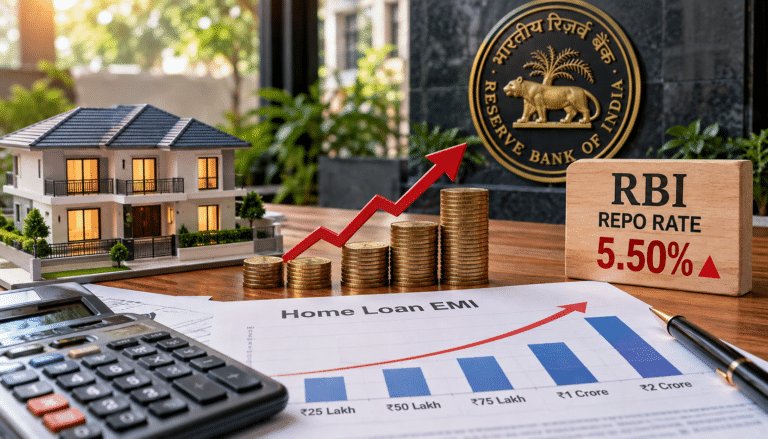
CPI inflation is also a crucial market variable. RBI now projects CPI inflation for FY27 at 5.1%, above its earlier estimate, which matters because higher inflation can delay rate cuts and keep valuation multiples under pressure. The repo rate has been left unchanged at 5.25% with a neutral stance, which supports stability but does not yet deliver a fresh rate-cut tailwind to the market.
Unemployment data adds another layer. India’s unemployment rate rose to 5.2% in April 2026 from 5.1% in March, which is not a crisis signal, but it does show that labour market improvement is uneven, especially in rural areas. For equities, that usually means consumption strength will be uneven too, with premium consumption doing better than mass-market discretionary in some pockets.
Why these macro numbers matter to stocks
- Higher GDP supports earnings growth for banks, industrials, autos, and consumer-facing companies.
- Higher CPI inflation can compress valuation multiples, especially for expensive growth stocks.
- A held repo rate keeps borrowing costs stable, which is positive for banks and rate-sensitive sectors, but the absence of a cut limits immediate re-rating.
- A slightly higher unemployment rate can weigh on rural demand, FMCG volume growth, and discretionary spending in lower-income segments.
NIFTY today in detail
Here is the point-wise market read for Nifty on 09-06-2026, based on the latest market structure and recent price action context.
- Nifty is trading in a consolidation phase after a strong multi-month move, which means breakouts now need fresh triggers rather than just momentum carry-over.
- Financials are providing the strongest support, especially private banks and select NBFCs, while banking remains the cleanest index leadership theme.
- IT is under pressure because global tech sentiment has weakened and US risk-off moves spill into Indian software names.
- Metals remain sensitive to China demand expectations, global growth commentary, and commodity price swings, making them more volatile than benchmark names.
- FMCG and consumer stocks are behaving like defensives, but volume growth needs strong consumption support to outperform in a sustained way.
- Pharma continues to act as a defensive growth pocket, helped by export stability and earnings visibility.
- Midcaps and smallcaps remain more vulnerable to valuation resets and risk-off flows, even when large caps stay stable.
- Breadth is improving only when financials and defensives rise together; otherwise rallies look narrow and fragile.
- The market is rewarding earnings certainty far more than narrative stocks.
- Traders should watch whether Nifty can hold above key support zones after global cues and crude oil headlines settle.
Sensex and Nifty 50 trends
The BSE Sensex and NSE Nifty 50 continue to move broadly in the same direction, but their behaviour is not identical. Sensex, with its heavier weight in large private financials, energy, and select industrial names, often reflects blue-chip resilience, while Nifty’s broader composition can show faster reactions to IT, FMCG, and bank moves.
In June 2026, the market has shown that banking can lift both indices, but weakness in heavyweights like IT or consumer names can still cap gains quickly. That is why the current trend is better described as “defensive leadership with selective risk appetite” rather than a full-broadening bull run.
Sensex vs Nifty 50, June 2026
Latest news highlights
The most important market-moving news today is a combination of policy, macro, and global risk factors. RBI kept the repo rate unchanged at 5.25%, retained a neutral stance, and trimmed FY27 GDP growth to 6.6% while raising CPI inflation expectations to 5.1%. This is a cautious message: growth remains respectable, but the central bank is clearly not ready to ease aggressively.
Another key development is the continuing pressure from West Asia tensions and crude oil volatility, which matter heavily for an oil-importing economy like India. On top of that, a weaker global tech backdrop has been hurting Indian IT sentiment, especially after sharp declines in Nasdaq-linked risk appetite.
Immediate market impact
- Banking stocks gain relative strength because stable rates support visibility in margins and credit growth.
- NBFCs can move sharply on any policy support or lower bond-yield expectations, but they remain sensitive to risk sentiment.
- IT stocks can underperform when the Nasdaq and S&P 500 turn risk-off, because export demand and valuation multiples both come under pressure.
- Oil-related inflation risk hurts India’s macro comfort and can limit upside in rate-sensitive names.
- Defensive sectors such as pharma and FMCG get a relative bid when investors want earnings stability.
Foreign indices influence
Global markets still matter a lot for Indian stock market trends. When the Nasdaq weakens sharply, Indian IT stocks usually feel the pain; when the Dow and S&P 500 sell off on rate fears, Indian risk appetite often softens too. Asian indices such as Nikkei 225, Hang Seng, and KOSPI also shape opening sentiment in India, especially during sessions dominated by crude or geopolitical headlines.
Foreign indices that matter most
- S&P 500: Shapes global risk sentiment and valuation comfort.
- Nasdaq Composite: Highly relevant for Indian IT and growth stocks.
- Dow Jones Industrial Average: Reflects broader US macro confidence and industrial sentiment.
- Nikkei 225: Important for Asia-wide risk mood and manufacturing-linked sentiment.
- Hang Seng Index: Useful for China-growth and Asian risk appetite signals.
- KOSPI: Often a fast indicator of risk-off behaviour in Asian technology names.
- FTSE 100: Matters indirectly through global asset allocation and commodity-linked flows.
Top stocks to watch
Below is a practical 2026-oriented watchlist built from current leadership, sector triggers, and relative earnings strength. This is not a guaranteed “buy list,” but a structured list of top NSE/BSE stocks that many market participants are tracking because they combine visibility, liquidity, and sector support.
Stock recommendations for today
- HDFC Bank: Best for stability, earnings visibility, and market leadership.
- ICICI Bank: Best for investors wanting a strong private bank with solid execution.
- SBI: Best for investors who want PSU banking participation with index support.
- Sun Pharma: Best for defensive growth when global risk is elevated.
- ITC: Best for dividend-oriented investors who want lower volatility.
- L&T: Best for India capex and infra themes.
- Bharti Airtel: Best for telecom growth and tariff-cycle upside.
- Reliance Industries: Best for diversified large-cap exposure.
- Kotak Mahindra Bank: Best for quality defensiveness in financials.
- Bajaj Finance: Best for aggressive growth investors who can handle valuation swings.
Top gainers and losers
The latest NSE top movers show that healthcare, utilities, pharma, and selected industrial names are outperforming, while IT, consumer finance, autos, and some financials are under pressure. This is a classic sign of a market rotating away from extended high-beta names and toward earnings durability.
Top 10 gainers
| Stock | Move | Short analysis |
|---|---|---|
| Max Healthcare | +2.44% | Hospitals remain in favour because demand visibility and operating leverage support earnings . |
| Power Grid | +1.94% | Utility income and defensive positioning keep it attractive in uncertain markets . |
| Nestle India | +1.80% | FMCG defensiveness is helping, especially when investors seek safety and consistency . |
| Apollo Hospitals | +1.55% | Healthcare leadership continues on premium demand and capacity expansion . |
| Tech Mahindra | +1.30% | A tactical rebound, though the IT sector still needs stronger global cues . |
| ITC | +0.93% | Defensive cash flows and dividend appeal support the stock . |
| Sun Pharma | +0.82% | Pharma continues to attract buyers in a risk-aware market . |
| Dr Reddy’s | +0.66% | Export pharma remains one of the cleaner earnings stories . |
| BEL | +0.61% | Defence spending and order visibility continue to support the counter . |
| Bharti Airtel | +0.43% | Telecom remains a quality large-cap theme with improving cash flow . |
Top 10 losers
Sector performance India 2026
Sector performance in 2026 is being driven less by broad liquidity and more by earnings quality, policy stability, and external sensitivity. Banking and healthcare have been among the stronger pockets, while IT and metals have reacted more sharply to global uncertainty and crude-linked risk appetite. Consumer goods are mixed: premium names hold better than mass consumption plays because wage and rural-demand trends are uneven.
Diversified portfolio ideas
A sensible 2026 portfolio should not chase only the hottest theme. The best approach is a mix of compounders, defensives, and one or two cyclical bets so that you can participate in upside without taking blind macro risk. The exact mix should depend on whether you are conservative, balanced, or aggressive.
Conservative mix
- 35% large private banks and PSU bank leaders, because the financial sector is still the clearest macro beneficiary.
- 25% pharma and healthcare, because they add stability when global volatility rises.
- 20% FMCG and dividend payers like ITC, because they reduce drawdown risk.
- 20% infra and telecom, because they offer growth without extreme speculation.
Pros: lower volatility, easier to hold in weak markets, good earnings visibility. Cons: may lag in a sharp momentum rally.
Balanced mix
- 30% banks.
- 20% consumer and defensives.
- 20% infra/capex.
- 15% pharma.
- 15% selective IT or market leaders.
Pros: good blend of growth and resilience. Cons: can underperform if one sector remains weak for long.
Aggressive mix
- 35% financials and NBFCs.
- 20% infra, industrials, and defence.
- 15% telecom.
- 15% midcap growth names.
- 15% event-driven opportunities.
Pros: higher upside if earnings improve. Cons: larger drawdowns if crude rises or foreign flows worsen.
Final Thought
The most important insight in today’s Indian stock market trends is that the market is still healthy, but it is no longer forgiving of sloppy stock selection. Strong GDP growth, stable repo rates, and a resilient domestic economy are keeping the long-term India story intact, yet inflation risks, crude oil pressure, and global risk-off moves are preventing a broad, easy rally.
For Tuesday, 09-06-2026, the clearest message is simple: follow earnings, respect valuations, and focus on sectors with policy support and cash-flow strength. In this environment, BSE Sensex and NSE Nifty 50 may move sideways in bursts, but Bank Nifty, quality banks, pharma leaders, infrastructure names, and selected blue chips are likely to remain the most reliable way to capture the next leg of the Indian market story.