Sensex at 78,094 and Nifty 50 at 24,383 (03 August 2026)— Can the Hormuz Breakthrough and RBI Repo Rate Verdict Ignite the Next Leg Up?
Your exclusive Dalal Street briefing for Monday, 3 August 2026 — fresh index levels, Bank Nifty trend, India GDP growth, CPI inflation, RBI monetary policy, top NSE/BSE stocks, gainers and losers, and sector performance India 2026.
Something unusual happened to the Indian stock market in July 2026. While South Korea’s Kospi suffered its worst month since the 1997 Asian financial crisis, while global semiconductor names were violently de-rated, and while Brent crude swung from 71 dollars to above 100 dollars and back inside four weeks, the BSE Sensex and NSE Nifty 50 quietly closed higher for a second consecutive month.
Not spectacularly higher. Just higher. And in a month like July 2026, boring was beautiful.
So here is the question every Indian investor is asking as the opening bell approaches on Monday, 3 August 2026: was that calm a sign of genuine strength, or simply the eye of a storm that is about to move over Mumbai?
This complete analysis breaks down the latest market news, the index arithmetic, the macro plumbing, the earnings scoreboard, and the actionable ideas that matter for the week starting today. Read it as a market prediction India briefing you would normally pay for.
⚡ The 60-Second Market Briefing: Where We Stand Right Now
| 📊 Indicator | 📌 Latest Level | 🔺🔻 Change | 🧭 What It Signals |
|---|---|---|---|
| BSE Sensex | 78,094.64 | +166.49 pts (+0.21%) | Third straight up-session; back above 78,000 |
| NSE Nifty 50 | 24,383.60 | +66.45 pts (+0.27%) | Above 20-DMA and 50-DMA, below 200-DMA |
| Nifty Bank | 57,264.85 | +117.35 pts (+0.21%) | Rangebound; awaiting RBI trigger |
| Nifty Midcap 100 | Up 1.81% for the week | Positive | Broader participation returning |
| Nifty Smallcap 100 | Up 2.53% for the week | Positive | Risk appetite improving |
| India VIX | 11.755 | Down 16.22% for the week | Lowest weekly close since January 2026 |
| Rupee (USD/INR) | 95.38 | Up 1.21% for the week | Strongest weekly gain in over a month |
| Brent Crude | 87.93 dollars a barrel | Down 9.14% for the week | Still up 20.5% for July |
| Repo Rate | 5.25% | Unchanged since December 2025 | MPC verdict due Wednesday |
| CPI Inflation (June) | 4.38% | Up from 3.93% in May | 18-month high, above the 4% target |
| GDP Growth (Q4 FY26) | 7.8% | FY26 full year at 7.7% | Fastest major economy |
| GST Collections (July) | Rs 2.11 lakh crore | Up 15.4% YoY | Fastest growth in 14 months |
The one-line takeaway: India is entering August 2026 with strong domestic macros, a cooling fear gauge, returning foreign money, and one enormous unresolved variable sitting on the table — crude oil.
🇮🇳 Indian Market Overview: What Actually Happened on Friday, and Why It Matters Today
🔔 The Closing Bell Scorecard
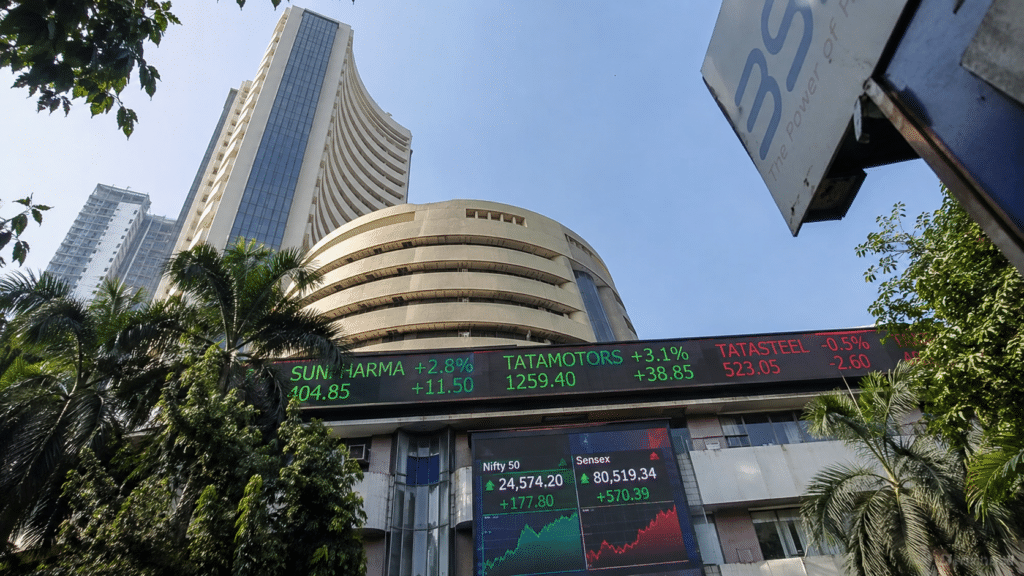
Indian benchmark indices extended gains for a third straight session on Friday, 31 July 2026. The Sensex advanced 166.49 points to close at 78,094.64, up 0.21 per cent. The Nifty 50 gained 66.45 points to settle at 24,383.60, up 0.27 per cent. The Nifty Bank index rose 117.35 points to 57,264.85, also up 0.21 per cent.
The heavy lifting came from a narrow but powerful group. Bajaj Finance surged 8.32 per cent to Rs 1,141.20 after a blockbuster June-quarter print. Bajaj Finserv followed with a 6.27 per cent jump to Rs 2,029.10. Mahindra and Mahindra added roughly 3.5 per cent on strong results and a commercial vehicle consolidation announcement. Jio Financial Services climbed 3.85 per cent to Rs 256.46.
Pulling in the opposite direction: Tata Consultancy Services fell 2.72 per cent to Rs 2,365.60, Eternal dropped 2.64 per cent to Rs 302.45, and Max Healthcare slipped 2.34 per cent to Rs 1,098.50. Infosys shed roughly 2.16 per cent as traders booked profits after a ferocious month for Indian IT.
📅 The Weekly and Monthly Picture
For the week of 27 to 31 July, the Nifty 50 rallied 518 points, or 2.17 per cent — its biggest weekly gain since April 2026. The Sensex added 1,616 points, or 2.11 per cent. Both indices completely erased the previous week’s sharp decline, which had dragged the Nifty to a low of 23,606.
For the month of July 2026, the Nifty gained around 2.2 per cent and the Sensex around 2.1 per cent, a second consecutive monthly advance. The Sensex touched an intra-month high of 78,664.92. Notably, Indian benchmarks outperformed most Asian peers as well as the S&P 500 and Nasdaq for the month — a rare and telling piece of relative-strength data.
🧠 Investor Sentiment: Three Signals Worth Reading
Signal one — fear has collapsed. India VIX crashed 16.22 per cent during the week to 11.755, its lowest weekly close since January 2026. A VIX sustained below 12 historically supports range expansion to the upside rather than sharp drawdowns.
Signal two — foreign money has turned. Foreign portfolio investors were net buyers of Indian equities in July for the first time since February 2026, investing Rs 15,412 crore. Domestic institutions added roughly Rs 32,839 crore in the same month. In the final week alone, FIIs bought shares worth around Rs 5,950 crore and DIIs added Rs 5,388 crore — combined institutional inflows of over Rs 11,300 crore in five sessions.
Signal three — breadth is healing but not euphoric. More than 120 stocks touched fresh 52-week highs on Friday, including Torrent Pharma, Divi’s Labs, TVS Motor, Bajaj Auto, Titan, Apollo Hospitals, Nykaa and Nestle. Yet over half of BSE 500 constituents gained less than 1 per cent through July. Translation: this is a selective market, not a blanket rally.
💬 What the Strategists Are Saying
Siddhartha Khemka of Motilal Oswal Financial Services expects Indian equities to trade with a positive bias, supported by healthy domestic macros and a strong Q1 FY27 earnings season. Vinod Nair of Geojit Investments has flagged that the durability of the recovery depends on easing global uncertainty, stability in crude prices, and earnings growth broadening beyond a handful of sectors. V K Vijayakumar, also of Geojit, has argued that extreme volatility in Korea and Taiwan combined with concentration risk in the global chip trade is actively pushing foreign portfolio investors toward more stable markets like India.
That last point may be the single most important structural idea in this entire briefing.
🎯 NIFTY Today in Detail: Ten Points Every Trader Should Know Before the Open
- Closing level: Nifty 50 finished at 24,383.60 on Friday, up 0.27 per cent, after opening 44 points higher at 24,361 and touching an intraday high of 24,429.
- Moving averages reclaimed: The index is now trading above its 20-day moving average (around 24,130) and 50-day moving average (around 23,903) for consecutive sessions — a structural improvement.
- The wall ahead: The 200-day moving average sits near 24,779. This is the single most important level for the medium-term trend. A decisive weekly close above it changes the character of the market.
- Momentum indicators: The weekly RSI has printed a positive crossover at around 52. MACD remains above its signal line, though still below the zero line, and the histogram has produced green bars for a seventh consecutive week — a slow, grinding improvement in bullish momentum.
- Immediate support: 24,300, followed by the 24,200 to 24,100 band.
- Critical support: 24,000. This is where maximum Put open interest is concentrated. A sustained close below flips the near-term bias bearish.
- Disaster line: 23,800. A breach here would likely trigger a fresh bout of trend-following selling.
- Immediate resistance: 24,500, then 24,600. This is where maximum Call open interest sits, meaning option writers will defend it.
- Target zone on breakout: 24,800 to 25,000 becomes achievable only on follow-through buying above 24,600.
- Expected trading range for 3 to 7 August: roughly 24,000 to 24,800, with the RBI policy on Wednesday as the likely range-breaker in either direction.
Bank Nifty levels for today: Support at 57,000, then 56,800. Resistance at 57,500, then the 57,800 to 58,000 supply zone. The index opened at 57,225 on Friday, hit 57,411, and closed at 57,264 — a compressed range that typically resolves violently after a policy event.
📊 BSE Sensex vs NSE Nifty 50: July 2026 Trend Compared in Detail
Both benchmarks tell a similar story, but the small divergences reveal where the money actually went.
| 🔍 Parameter | 🟠 BSE Sensex | 🔵 NSE Nifty 50 | 💡 Interpretation |
|---|---|---|---|
| Close on 31 July 2026 | 78,094.64 | 24,383.60 | Both reclaimed key psychological zones |
| Monthly gain (July) | Around 2.1% | Around 2.2% | Nifty marginally ahead on broader composition |
| Consecutive monthly gains | 2 | 2 | Recovery trend intact |
| Intra-month high | 78,664.92 | Around 24,530 | Neither made a new all-time high |
| Intra-month low (mid-July slide) | Around 76,059 | 23,606 | The July drawdown was roughly 3% to 4% |
| Weekly gain (27–31 July) | +1,616 pts (+2.11%) | +518 pts (+2.17%) | Best week since April 2026 |
| Best single session | 29 July, up 889 pts | 29 July, above 24,250 | IT-led rebound day |
| Biggest index driver (month) | HCL Technologies | HCL Technologies (+25.67%) | AI deal-led re-rating |
| Biggest index drag (month) | HDFC Bank (-6.24%) | Dr. Reddy’s Labs (-15.40%) | Banking pause, pharma stock-specific |
| Number of constituents | 30 | 50 | Sensex more concentrated, more heavyweight-sensitive |
| Position vs 200-DMA | Below | Below (200-DMA near 24,779) | Medium-term trend not yet confirmed bullish |
| Sector tilt that helped | IT, Auto, Consumer Durables | IT, Auto, Realty, Media | Cyclical and tech rotation |
| Sector tilt that hurt | Banking, FMCG | Banking, FMCG, PSU Bank | Defensives and lenders underperformed |
The insight most readers will miss: the Sensex and Nifty gained almost identically in July, but the composition of that gain was radically different from June. In June, banking led. In July, banking indices closed modestly lower while IT surged over 17 per cent. That is a textbook sector rotation, and it tells you the market is chasing earnings momentum rather than macro themes.
🏦 Key Economic Drivers: The Macro Engine Behind the Market Movement
📈 India GDP Growth — Still the World’s Fastest Big Economy
India’s economy expanded 7.8 per cent in Q4 FY26 (January to March 2026), comfortably beating both economist forecasts of 7.0 to 7.3 per cent and the Reserve Bank’s own projection. The National Statistical Office revised full-year FY26 growth upward to 7.7 per cent.
The composition was encouraging. Trade, hotels, transport and communication services grew 12.5 per cent, the fastest in twelve quarters. Investment activity, construction and improved agricultural output all contributed.
Looking forward, the RBI is expected to retain a growth projection of around 6.6 per cent for FY27. SBI Research is more optimistic, expecting Q1 FY27 growth to exceed 7 per cent. The Q1 FY27 GDP print lands at the end of August and is the next big macro event after this week’s policy.
Market implication: strong nominal GDP growth supports corporate revenue growth, government tax collections and, ultimately, index earnings per share. This is the floor under Indian valuations.
🔥 CPI Inflation Trends India — The Number That Changed the Conversation
Retail inflation accelerated to 4.38 per cent in June 2026 from 3.93 per cent in May, the highest reading in 18 months and the third consecutive month of acceleration. It also pushed headline inflation back above the RBI’s 4 per cent target.
Breaking it down:
- Food inflation (CFPI): 5.32 per cent, up from 4.78 per cent
- Rural inflation: 4.74 per cent | Urban inflation: 3.92 per cent
- Transport: 4.31 per cent, rebounding after petrol and diesel price hikes
- Housing: a benign 2.10 per cent
- Vegetable shocks: ginger up 50.41 per cent, tomatoes up 31.92 per cent
- Relief items: potatoes at minus 20.34 per cent, peas at minus 9.67 per cent
The forecasts matter more than the print. ICRA expects July CPI to harden to roughly 4.6 per cent. SBI Mutual Fund’s chief economist expects inflation to cross 5 per cent by August or September and approach 6 per cent by December. Capital Economics has gone further, projecting a peak near 6 per cent and forecasting 75 basis points of rate hikes by early 2027.
Market implication: the inflation-trends-India narrative has flipped from tailwind to headwind. Rate-sensitive sectors — banks, NBFCs, real estate, autos — carry more risk here than the consensus admits.
🏛️ RBI Repo Rates and Monetary Policy — Wednesday Is the Week’s Main Event
The Monetary Policy Committee, chaired by Governor Sanjay Malhotra, meets from 3 to 5 August 2026, with the decision announced on Wednesday, 5 August at 10:00 AM IST.
Current policy settings:
- Repo rate: 5.25 per cent (unchanged since the 25 bps cut in December 2025)
- Stance: neutral
- Cumulative easing: 100 basis points delivered since February 2025
A Reuters poll of 72 economists found 68 expecting no change, four expecting a 25 basis point hike, and none expecting a cut. SBI Research also expects status quo, pointing to inflation likely staying above 5 per cent for two quarters alongside growth above 7 per cent.
Watch these three things far more closely than the rate itself:
- The inflation projection. The RBI is expected to retain around 5.1 per cent for FY27. Any upward revision is a negative surprise for bonds and banks.
- Any language on the stance. A shift from neutral toward hawkish would hit rate-sensitives hard.
- Liquidity measures. A CRR reduction or liquidity infusion would be a strong positive for banking and NBFC counters even without a rate cut.
👷 Unemployment Data — The Uncomfortable Number Beneath the Growth Story
The Periodic Labour Force Survey monthly bulletin for June 2026 showed the overall unemployment rate steady at 5.5 per cent, unchanged from May and from June 2025.
- Rural unemployment eased to 5.0 per cent from 5.1 per cent
- Urban unemployment rose to 6.6 per cent from 6.4 per cent, though below the 7.1 per cent of June 2025
- Labour force participation rate: 54.4 per cent | Worker population ratio: 51.4 per cent
- Female LFPR: 32.7 per cent, up 0.7 percentage points year on year
- Youth unemployment (ages 15 to 29): 16.2 per cent — the highest since the monthly series began in April 2025
That last figure is the crack in the wall. Youth labour force participation has fallen to 40.3 per cent from 42.7 per cent over fifteen months. For consumption-facing sectors — FMCG, entry-level autos, consumer durables, retail lending — this is the quiet variable to watch through FY27.
💰 The Supporting Macro Cast
GST collections for July 2026 came in at Rs 2.11 lakh crore, up 15.4 per cent year on year — the fastest growth in 14 months and the second Rs 2-lakh-crore month this fiscal. Import-linked revenue jumped 28.8 per cent to Rs 66,511 crore. Net collections rose 15.8 per cent to Rs 1.81 lakh crore. Cumulative April-July collections stand at Rs 8.43 lakh crore, up 10.1 per cent.
PMI data: flash estimates showed Manufacturing PMI easing to 53.9 in July from 54.2, and Services PMI dropping more sharply to 53.1 from 57.4. Final readings arrive on 3 and 5 August. Both remain in expansion, but the services deceleration deserves attention.
Monsoon: the 2026 southwest monsoon remains a genuine concern, running roughly 15 to 16 per cent below the long period average into late July, with over half of India’s districts deficient and El Niño conditions strengthening. July itself closed near normal after a strong 21 to 24 July spell, but the seasonal shortfall persists. This is the primary upside risk to food inflation in Q3 FY27.
External buffers: India’s foreign exchange reserves stood at 682.24 billion dollars after a second straight weekly gain of 6.12 billion dollars. SBI Research estimated capital inflows of around 35 billion dollars in July.
📰 Latest Market News Highlights and Their Immediate Impact
1. Trump cancels planned strikes on Iran; Hormuz deal parameters announced. Early on Sunday, 2 August, the US President called off a planned attack on Iranian targets, including potential energy infrastructure, following a request from Tehran and regional neighbours, and indicated agreement on parameters that would include a complete opening of the Strait of Hormuz.
Immediate impact: This is the single biggest variable for Monday’s open. If the framework holds, expect crude to gap lower, aviation, paints, chemicals, tyres, logistics and OMC counters to rally, the rupee to firm further, and upstream oil producers such as ONGC and Oil India to underperform. Nifty could challenge 24,500 quickly.
2. RBI Monetary Policy Committee meets from today, decision Wednesday. The three-day meeting begins 3 August with the announcement on 5 August.
Immediate impact: Expect Bank Nifty to trade in a compressed range through Tuesday. Positioning ahead of policy usually caps upside. The real move comes Wednesday morning.
3. Record GST collections and record auto dispatches over the weekend. Maruti Suzuki reported total July sales of 241,421 units with domestic sales at an all-time high of 200,123. Tata Motors sold 62,611 passenger vehicles domestically, up 58.4 per cent year on year, with EV wholesales crossing 15,000 for the first time. Mahindra sold 60,048 domestic SUVs, with total automotive sales of 103,860, up 26 per cent. Hyundai recorded its highest-ever monthly total of 75,360 units, up 25.4 per cent.
Immediate impact: Nifty Auto should open firm. Watch Maruti, Tata Motors, M&M, Hyundai, TVS and Bajaj Auto for the first hour of trade.
4. SEBI’s Closing Auction Session goes live today for F&O stocks. From 3 August 2026, continuous trading in stocks with derivatives contracts halts at 3:15 PM, and the official closing price is discovered through a dedicated auction window rather than the last 30-minute VWAP.
Immediate impact: This is a structural change every trader must internalise today. Expect unusual price behaviour in the final 15 minutes, wider spreads initially, and potential dislocations in index-linked strategies. Do not place careless market orders near the close.
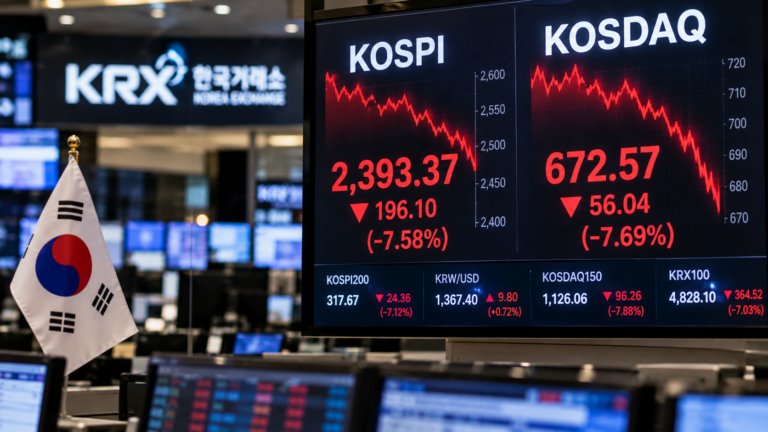
5. Global AI trade unwinds violently, then snaps back. South Korea’s Kospi fell roughly 25 per cent across July — its worst month since 1997 — before surging 17.9 per cent on Friday alone in its best single day on record. Samsung Electronics and SK Hynix each jumped close to 30 per cent in that session.
Immediate impact: This dislocation is precisely why foreign money rotated toward India. Indian IT was the direct beneficiary, with Nifty IT up 17.13 per cent for the month.
6. Bajaj Finance delivers a standout Q1 FY27. Consolidated profit rose 27 to 28 per cent year on year to around Rs 5,986 to 6,081 crore. Assets under management grew 23.9 per cent to Rs 5.47 lakh crore. Net interest income rose 23 per cent to Rs 12,571 crore. New loans booked climbed 20 per cent to 16.13 million. Return on equity crossed 20 per cent.
Immediate impact: Multiple brokerages raised targets. The stock gained 11.09 per cent for the week and anchored the entire NBFC complex.
7. A heavyweight earnings week ahead — 660 companies reporting. State Bank of India, Bharti Airtel, LIC, Titan, ONGC, Power Grid, Hero MotoCorp, Hindalco, DLF, Lupin, Britannia, Godrej Consumer, Marico, Pidilite, Biocon, Aurobindo Pharma, Cummins India, Apollo Tyres, Nykaa, PB Fintech, UPL and Power Finance Corporation are among those scheduled.
Immediate impact: Stock-specific volatility will dominate index moves for much of the week. SBI’s numbers will set the tone for the entire PSU banking basket.
8. Astra Microwave wins a Rs 2,205 crore HAL order. The five-year contract for the indigenous Uttam AESA radar programme is among the company’s largest ever.
Immediate impact: The stock jumped over 10 per cent. Defence electronics sentiment improves, though the sector saw rotation out during the week as the geopolitical premium faded.
9. A busy primary market week. Seven IPOs worth close to Rs 3,500 crore open, including LEAP India at Rs 2,480 crore and Ardee Industries at Rs 425.86 crore, with 11 companies listing including Manipal Health Enterprises and Juniper Green Energy.
Immediate impact: Primary market absorption competes with secondary market liquidity. Watch for mild pressure on small and midcap counters mid-week.
10. US bond yields at multi-year highs. The US 30-year Treasury yield spiked to its highest since 2007 at around 5.25 per cent, while the 10-year topped 4.7 per cent.
Immediate impact: Elevated global yields are the quiet constraint on emerging market valuations. If yields keep climbing, the FII inflow thesis weakens regardless of how good India’s domestic story looks.
🌍 Foreign Indices That Influenced Indian Markets
Global cues did the heavy lifting for Friday’s Indian close, and they will shape Monday’s open. Here is the board as Indian traders left it.
| 🌐 Index | 🌏 Region | 📉 Last Close | 🔺 Move | 🇮🇳 Influence on Indian Markets |
|---|---|---|---|---|
| Dow Jones Industrial Average | USA | 52,485.03 | +0.53% | Fourth straight winning month; supports risk appetite |
| S&P 500 | USA | 7,489.72 | +0.70% | Benchmark for global equity risk premium |
| Nasdaq Composite | USA | 25,373.85 | +1.00% | Direct read-through to Indian IT sentiment |
| Nikkei 225 | Japan | 64,362.02 | +4.03% | BOJ held at 1%; yen moves affect EM carry flows |
| Kospi | South Korea | 6,595.45 | +17.9% | Record day after a 25% monthly crash; the FII rotation source |
| Taiwan Taiex | Taiwan | 43,119.75 | +8.0% | Chip-cycle proxy; competes with India for EM allocations |
| Hang Seng | Hong Kong | Around 25,858 | Flat | China risk appetite gauge |
| CSI 300 | Mainland China | 4,588.20 | +0.85% | EM allocation competitor |
| S&P/ASX 200 | Australia | 8,976.80 | +0.10% | Commodity and metals read-through |
| FTSE 100 | UK | Around 10,868 | Mildly lower | Global cyclicals sentiment |
| DAX | Germany | 25,629.24 | +0.07% | European industrial demand proxy |
| CAC 40 | France | 8,509.64 | +0.28% | European luxury and consumption signal |
| STOXX 600 | Europe | Record high | Positive | Broad European risk-on confirmation |
| GIFT Nifty | Singapore/GIFT City | Around 24,387 | Flat to mildly lower | The most direct pre-open indicator for the Nifty |
Why these indices matter to your portfolio: the Nasdaq and Kospi combination is currently the most important pair for Indian investors. When global AI and semiconductor trades unwind, capital does not simply exit equities — it rotates. In July 2026 it rotated into Indian software services and Indian large caps precisely because they were not part of the crowded chip trade. That rotation is the mechanical reason Nifty IT rose over 17 per cent.
The counterweight is the US bond market. With the 30-year yield near 2007 levels, the discount rate applied to all risk assets globally is rising. Watch Friday’s US non-farm payrolls report closely.
🏆 Top 10 Stocks to Watch on NSE and BSE for 2026
These are ideas built around identifiable catalysts, earnings momentum and sector triggers visible in the current data. They are analysis, not personalised recommendations — please verify live P/E, PEG and dividend yield on the NSE or BSE website before acting, and match any position to your own risk profile.
| # | 🏢 Stock | 🏭 Sector | 🧲 Core Rationale | 💹 Valuation Lens | 💵 Yield Angle | ⚡ 2026 Sector Trigger |
|---|---|---|---|---|---|---|
| 1 | Bajaj Finance | NBFC | Q1 FY27 PAT up 27–28%, AUM up 23.9% to Rs 5.47 lakh crore, ROE above 20% | Premium NBFC multiple, freshly re-rated on the beat | Low; a growth-compounder, not an income stock | Festive credit demand, RBI liquidity easing |
| 2 | HCL Technologies | IT Services | Top Nifty gainer in July, up 25.67%, on a 1.14 billion dollar AI deal with a Fortune Global 50 client | Trades at a discount to the largest peer historically | Among the better dividend payers in large-cap IT | Global AI services re-allocation |
| 3 | Mahindra & Mahindra | Automobiles | 60,048 domestic SUVs in July, total auto sales up 26%, CV consolidation underway | Conglomerate multiple; SUV franchise carries the premium | Moderate, steadily rising payout | SUV cycle, tractor demand, EV portfolio |
| 4 | Maruti Suzuki | Automobiles | Record domestic month at 200,123 units; first time above two lakh at home | Historically among the more reasonable large-cap auto multiples | Consistent, conservative payout | Festive season, hybrid and compact SUV cycle |
| 5 | State Bank of India | PSU Banking | Largest lender; Q1 FY27 results this week; PSU bank valuations lagged in July | Typically the cheapest large lender on book value | One of the higher-yielding Nifty large caps | Credit growth, RBI liquidity, capex cycle |
| 6 | Bharti Airtel | Telecom | Reporting this week; ARPU expansion and steady subscriber mix | Premium to peers, justified by cash flow strength | Modest but improving | Tariff repair, 5G monetisation, data growth |
| 7 | Cholamandalam Investment | Vehicle Finance | Direct beneficiary of record auto dispatches; consistent asset quality | Premium NBFC multiple on growth consistency | Low; reinvestment story | Rate cuts, festive vehicle finance demand |
| 8 | Ashok Leyland | Commercial Vehicles | Three consecutive record years; MHCV share above 30%; Switch Mobility now profitable | Cyclical multiple; sensitive to freight cycle | Attractive relative to auto peers | Infrastructure capex, government bus programmes |
| 9 | Samvardhana Motherson | Auto Ancillary | Global footprint; lower crude reduces raw material costs; export optionality | Trades on a global-ancillary multiple, not a domestic one | Low | Softer crude, tariff-linked export openings |
| 10 | GAIL (India) | Gas Utility | Q1 profit and merger approval delivered; Hormuz normalisation improves LNG economics | Among the lower-multiple large-cap utilities | Traditionally one of the stronger yields in the index | Gas transmission volumes, petrochemical margins |
🔎 The Logic Behind This Basket, Point by Point
- Three auto names, deliberately. July’s dispatch data was not incremental; it was record-setting across Maruti, Tata Motors, M&M and Hyundai simultaneously. When four of five majors post records in the same month, that is a demand cycle, not a base effect.
- Two financiers, positioned for the RBI. Bajaj Finance and Cholamandalam both benefit disproportionately from any liquidity easing. If Wednesday brings a CRR cut, these move first.
- One IT name, not four. Nifty IT rose 17.13 per cent in a single month. That is a re-rating, not a fundamental re-acceleration. HCL Tech carries a genuine deal catalyst; much of the rest of the sector rallied on flows alone.
- One PSU bank as the contrarian slot. Banking indices were the only major sectors to close July lower. Mean reversion in banks, ahead of SBI’s results, is the cleanest contrarian setup on the board.
- One utility as ballast. GAIL offers yield support and a direct positive read from any Hormuz de-escalation.
📊 Top 10 Gainers and Top 10 Losers (Session of 31 July 2026)
🟢 Top 10 Gainers
| # | Stock | Gain | Short Analysis |
|---|---|---|---|
| 1 | Astra Microwave | +12.8% | Won a Rs 2,205 crore HAL contract for the indigenous Uttam AESA radar programme, its largest order class |
| 2 | Hyundai Motor India | +7.0% (touched +10%) | Reaffirmed FY27 volume growth guidance of 8–10% despite a weak quarter; volume surged to over 31 lakh shares |
| 3 | Bajaj Finance | +8.32% | Q1 PAT up 27–28%, NII up 23%, ROE above 20%; multiple brokerages raised targets |
| 4 | Netweb Technologies | +7.4% | Strong Q1 FY27 earnings with a sharp volume spike |
| 5 | Balkrishna Industries | +7.4% | Approved a Rs 4 per share dividend alongside results |
| 6 | Bajaj Finserv | +6.27% | Consolidated net profit up 12% to Rs 3,132 crore; total income up around 19% |
| 7 | Torrent Pharma | +5.11% | Hit a fresh 52-week high on sustained institutional accumulation |
| 8 | Inox Wind | +4.37% | Renewable capex momentum and order book optimism |
| 9 | GAIL (India) | Around +4% | Q1 profit delivery plus merger approval |
| 10 | Jio Financial Services | +3.85% | Broad-based NBFC buying; up 10.54% for the week on digital-finance expansion optimism |
🔴 Top 10 Losers
| # | Stock | Loss | Short Analysis |
|---|---|---|---|
| 1 | Tata Consultancy Services | -2.72% | Biggest index drag; profit-booking after a 16.45% monthly run, plus global AI-competition concerns |
| 2 | Eternal | -2.64% | Stock-specific selling despite a positive tape; gave back part of a 14.30% monthly gain |
| 3 | Max Healthcare | -2.34% | Profit-booking even as the broader Pharma index closed higher |
| 4 | Infosys | -2.16% | Mild profit-taking after a 9.93% weekly rebound from the guidance-cut selloff |
| 5 | Wipro | -1.38% | Sector-wide IT unwinding on the last day of a very strong month |
| 6 | Tech Mahindra | Lower | Cooled off after a 17.56% monthly surge |
| 7 | LTIMindtree | Lower | Same profit-booking dynamic across mid-tier IT |
| 8 | Tata Consumer Products | Lower | Dragged by the Nifty FMCG index, which fell 1.05% |
| 9 | Nifty FMCG basket broadly | -1.05% (index) | Rotation out of defensives into cyclicals and financials |
| 10 | Consumer Durables basket | -0.44% (index) | Profit-booking after a 10.19% monthly gain, the second-best sector of July |
Pattern recognition: every single major loser was a winner earlier in the month. This was rotation and profit-booking, not distribution. That distinction matters enormously for how you interpret Monday’s tape.
🏭 Sector Performance India 2026: The Full July Scoreboard
| 🏷️ Sector Index | 📍 Close (31 July 2026) | 📈 July Return | 🧾 Earnings and Trigger Read |
|---|---|---|---|
| Nifty IT | 30,708.90 | +17.13% 🥇 | Best month since July 2020; global AI-trade unwind redirected foreign flows into Indian software services |
| Nifty Consumer Durables | 40,072.15 | +10.19% 🥈 | Summer demand plus a softer rate outlook; premiumisation intact |
| Nifty Media | 1,618.65 | +9.48% 🥉 | Low-base recovery and advertising revenue improvement |
| Nifty Auto | 28,744.15 | +9.03% | Record July dispatches; M&M, Bajaj Auto, TVS all strong; softer crude helps margins |
| Nifty Realty | 901.45 | +9.02% | Rate-cut hopes and healthy pre-sales; highly leveraged to RBI |
| Nifty Pharma | 26,534.80 | +4.98% | Torrent and Divi’s at 52-week highs, offset by a 15.4% fall in Dr. Reddy’s |
| Nifty Healthcare | 16,755.50 | +4.01% | Hospital occupancy strong; Max Healthcare saw stock-specific profit-booking |
| Nifty Oil & Gas | 11,247.70 | +1.99% | Crude volatility cut both ways; upstream gained then gave it back |
| Nifty Metal | 12,719.00 | +1.77% | Improving global outlook; Tata Steel Q1 PAT rose 12% to Rs 2,318 crore |
| Nifty FMCG | 49,121.20 | +0.93% | Weakest defensive; HUL price hikes signal cost pressure, not pricing power |
| Nifty Financial Services | 26,594.05 | +0.24% | Saved only by the Bajaj twins in the final week |
| Nifty Bank | 57,264.85 | Marginally lower | Paused after leading June; HDFC Bank fell 6.24%, Axis Bank fell 8.63% |
| Nifty Private Bank | 27,522.65 | Lower | Deposit competition and NIM compression concerns |
| Nifty PSU Bank | 8,367.20 | Lower | Awaiting SBI results as the sector’s next catalyst |
🥊 IT vs Banking vs Pharma vs Consumer Goods — Head to Head
Information Technology was the runaway winner, but understand why. This was not a demand upgrade. Infosys had cut guidance only weeks earlier. The 17 per cent surge was a flow event driven by global investors fleeing concentration risk in AI and semiconductor names. HCL Technologies was the honourable exception with a genuine 1.14 billion dollar AI contract. Treat the sector as re-rated, not re-accelerated.
Banking was the surprising laggard, with all three banking indices closing July lower. Two forces are at work: profit-booking after June’s leadership, and legitimate concern that a rising inflation path removes the rate-cut optionality that had been priced into lender valuations. Bank Nifty spent the month trapped between roughly 57,000 and 58,000.
Pharma and Healthcare delivered a solid, quiet 4 to 5 per cent. The dispersion was extreme though — Torrent Pharma and Divi’s Labs at 52-week highs, while Dr. Reddy’s Laboratories fell 15.4 per cent to become the month’s worst Nifty performer. This is a stock-picker’s sector in 2026, not an index-buyer’s.
Consumer Goods split cleanly in two. Consumer Durables gained 10.19 per cent on premiumisation and rate-cut hopes. FMCG managed under 1 per cent. When Hindustan Unilever raises prices on Surf Excel and Vim, it confirms input-cost pressure feeding through, and it makes volume growth harder in a market where youth unemployment sits at 16.2 per cent.
The honest conclusion on sector performance India 2026: cyclicals and technology are being rewarded, defensives and lenders are being ignored. That relationship reverses the moment crude spikes again or the RBI turns hawkish.
✅ Stock Recommendations for Today: Actionable Points for 3 August 2026
- Do not chase the open. If the Hormuz de-escalation headline is confirmed, expect a gap-up. Gaps into resistance at 24,500 on policy week frequently fade. Let the first 45 minutes establish the range.
- Auto is the highest-conviction opening trade. Record July dispatches across Maruti, Tata Motors, M&M and Hyundai were released over the weekend and are not yet fully in the price. Nifty Auto already rose 9.03 per cent in July, so use intraday dips rather than market orders.
- Keep banking positions light until Wednesday morning. Bank Nifty between 57,000 and 57,800 is a coin toss ahead of the MPC. The asymmetry favours waiting. If the RBI signals liquidity easing, there will be an entire day to buy after the announcement.
- Avoid upstream oil producers until crude direction is confirmed. ONGC fell 3.95 per cent last week purely on crude retreating from 90 dollars. Hormuz reopening compounds that pressure. Oil India carries the same risk.
- Buy quality dips in vehicle finance. Cholamandalam and Jio Financial both benefit from record auto sales and any rate relief. Accumulate on weakness rather than strength.
- Trim, do not exit, extended IT positions. After a 17.13 per cent monthly move, the risk-reward has narrowed. HCL Technologies and TCS remain the structurally better holds; mid-tier IT is where the froth sits.
- Watch SBI results as the PSU banking trigger. The entire PSU bank basket has lagged. A strong print resets the narrative for the sector.
- Respect the new closing mechanism. With SEBI’s Closing Auction Session live from today, avoid market orders after 3:15 PM in F&O stocks until you have observed how the auction behaves.
- Use 24,000 as your portfolio-level stop reference. A weekly close below 24,000 changes the structural picture. Above it, dips remain buyable.
- Keep 15 to 20 per cent in cash through Wednesday. Policy weeks reward liquidity. If the MPC surprises hawkishly, you will want firepower, not regret.
🎒 A Diversified Portfolio for Every Risk Appetite
🛡️ Conservative Portfolio (Capital Preservation Focus)
Suggested tilt: 40% large-cap equity | 25% debt or liquid funds | 20% gold and silver | 15% dividend-yield and utility names
What goes in: SBI, GAIL, Power Grid, Bharti Airtel, HCL Technologies, plus a broad Nifty 50 index fund.
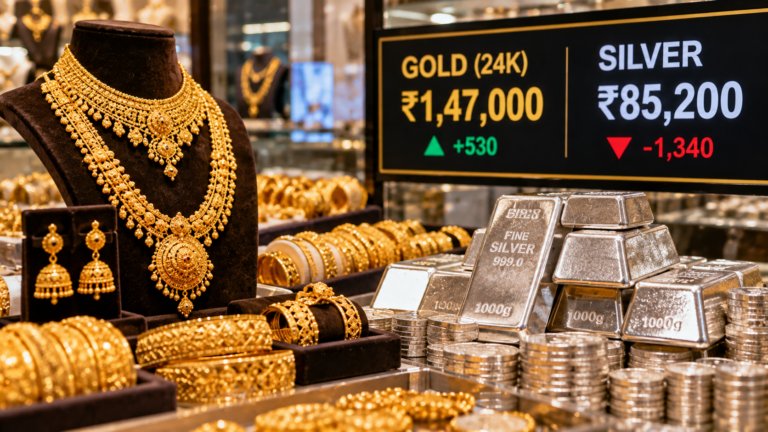
Pros: Lower drawdown in a rising-inflation environment. Yield support cushions volatility. Gold gained 1.02 per cent and silver 3.17 per cent on MCX in July, providing genuine diversification.
Cons: You will underperform badly in a sharp risk-on rally. Utilities and telecom lag when cyclicals lead.
Recent earnings driver: GAIL delivered Q1 profit growth plus merger approval. Bharti Airtel reports this week. Power Grid reports this week.
⚖️ Balanced Portfolio (Growth with Guardrails)
Suggested tilt: 55% large cap | 20% quality midcap | 15% debt | 10% gold
What goes in: Bajaj Finance, M&M, Maruti Suzuki, HCL Technologies, SBI, Titan, Cholamandalam, Torrent Pharma.
Pros: Captures the auto and financial earnings cycle while retaining defensive ballast. Nifty Midcap 100 rose 1.81 per cent last week with improving breadth.
Cons: Higher exposure to rate-sensitive names means a hawkish RBI hurts. Auto is already up 9.03 per cent in a month.
Recent earnings driver: Bajaj Finance Q1 PAT up 27 to 28 per cent with AUM at Rs 5.47 lakh crore. M&M posted strong results and announced CV consolidation. Titan reports this week.
🚀 Aggressive Portfolio (High Conviction, High Volatility)
Suggested tilt: 45% high-beta large cap | 35% midcap and smallcap | 15% thematic (defence, renewables, capital goods) | 5% cash
What goes in: Jio Financial, Ashok Leyland, Samvardhana Motherson, Astra Microwave, Inox Wind, Netweb Technologies, Balkrishna Industries, plus a smallcap index fund.
Pros: Nifty Smallcap 100 gained 2.53 per cent last week and 2.5 per cent in July, outperforming large caps. Order-book-driven names like Astra Microwave carry multi-year revenue visibility.
Cons: Brutal drawdowns when volatility returns. India VIX at 11.755 is near the lower end of its range, and low volatility does not persist indefinitely.
Recent earnings driver: Astra Microwave won a Rs 2,205 crore HAL order. Netweb posted strong Q1 FY27 numbers. Ashok Leyland and Motherson report Q1 FY27 shortly.
⚠️ Four Risks That Could Break This Setup
- Crude reversal. Brent swung from 71.80 dollars to 100.69 dollars inside three weeks in July. Any collapse in the Hormuz framework sends it straight back above 90 dollars, and India’s entire inflation, currency and margin arithmetic changes overnight.
- A hawkish RBI. Consensus expects a hold. Four of 72 economists expect a hike. If the MPC raises its inflation projection meaningfully above 5.1 per cent, rate-sensitive sectors correct hard.
- Monsoon shortfall. A seasonal deficit of 15 to 16 per cent with El Niño strengthening is a live threat to food inflation and rural consumption in Q3 FY27.
- Rising global yields. With the US 30-year near its highest since 2007, the global discount rate is climbing. Sustained yield pressure eventually overwhelms the FII rotation-into-India narrative.
❓ Frequently Asked Questions
Q: What is the Nifty 50 target for August 2026? The expected range for the week of 3 to 7 August is roughly 24,000 to 24,800. The 200-day moving average near 24,779 is the key hurdle. A sustained close above 24,800 opens the path toward 25,000.
Q: Will the RBI cut the repo rate on 5 August 2026? Extremely unlikely. Of 72 economists polled, 68 expect the repo rate to stay at 5.25 per cent, four expect a hike, and none expect a cut. Focus on the commentary and any liquidity measures rather than the headline rate.
Q: Which sector performed best in India in July 2026? Nifty IT, up 17.13 per cent, its best month since July 2020, driven by global capital rotating out of the crowded AI and semiconductor trade.
Q: Are FIIs buying Indian stocks again? Yes. Foreign portfolio investors turned net buyers in July 2026 for the first time since February, investing Rs 15,412 crore, while domestic institutions added roughly Rs 32,839 crore.
Q: Why did Bank Nifty underperform in July? Banking indices paused after leading June’s rally, and rising CPI inflation removed much of the rate-cut optionality embedded in lender valuations. HDFC Bank fell 6.24 per cent and Axis Bank fell 8.63 per cent for the month.
Q: What changed in market trading hours from 3 August 2026? SEBI’s Closing Auction Session is now live for stocks with F&O contracts. Continuous trading in those stocks stops at 3:15 PM and the closing price is determined through a dedicated auction rather than the last 30-minute VWAP.
🧭 Final Thought: The Market Is Rewarding Boredom, and That Is the Story
Let us restate what the data actually shows, because the headline numbers understate how unusual July 2026 really was.
India’s benchmarks rose roughly 2 per cent in a month when the Kospi fell about 25 per cent, when Brent crude swung more than 40 per cent from trough to peak, and when the US 30-year Treasury yield touched levels not seen since 2007. The Nifty ended July at 24,383.60, the Sensex at 78,094.64, and both outperformed the S&P 500 and Nasdaq. That relative-strength data point is the most valuable insight in this entire briefing, and it is not being widely discussed.
The reason is structural, not sentimental. When global capital discovered that the AI and semiconductor trade had become dangerously concentrated, it did not go to cash. It went looking for a large, liquid, diversified equity market with 7.7 per cent GDP growth, Rs 2.11 lakh crore in monthly GST collections, a stabilising currency at 95.38, and valuations that had not been bid to extremes. That market was India. Rs 15,412 crore of FPI inflow in July was the first monthly net buying since February.
But three numbers keep this from being a victory lap.
CPI inflation at 4.38 per cent is an 18-month high, and credible forecasters see it approaching 6 per cent by December. Youth unemployment at 16.2 per cent is the highest in the monthly PLFS series, and it sits underneath every consumption thesis in this article. And the monsoon, running 15 to 16 per cent below normal with El Niño strengthening, is a food-inflation risk that no amount of foreign inflow can hedge.
So here is the honest framing for the week ahead. The technical picture has improved materially — above the 20-DMA and 50-DMA, VIX at 11.755, MACD histogram green for a seventh week. The earnings picture is genuinely strong, with Bajaj Finance posting 27 to 28 per cent profit growth and four automakers posting record July dispatches simultaneously. The macro picture is split: growth is excellent, inflation is deteriorating.
That means the honest expectation is not a breakout. It is a grind. Support at 24,000, resistance at 24,779, and a market that rewards patience, position sizing and stock selection far more than conviction and leverage.
Watch Wednesday at 10:00 AM. Watch crude. Watch SBI’s results. And watch the last fifteen minutes of trading today, because the closing bell itself now works differently.
The market that survived July 2026 without drama has earned the benefit of the doubt. It has not yet earned complacency.
📌 Disclaimer
This article is intended for informational and educational purposes only and does not constitute investment, financial, legal or tax advice. It is not a personalised recommendation, and the author is not a registered investment adviser. All figures are drawn from publicly reported market data as of the close of 31 July 2026 and may change without notice. Index levels, prices, valuation multiples and dividend yields should be independently verified on the NSE India, BSE India, RBI and MoSPI official platforms before any investment decision. Equity markets carry substantial risk, including the risk of capital loss. Past performance is not indicative of future results. Please consult a SEBI-registered financial adviser who understands your personal circumstances, time horizon and risk tolerance before investing.