How Much Salary Do You Need for a ₹50 Lakh Home Loan — and Why the 50% EMI Rule Fails
Finance Guide · Home Loans · India, August 2026
How Much Salary Do You Need for a ₹50 Lakh Home Loan — and Why the 50% EMI Rule Fails
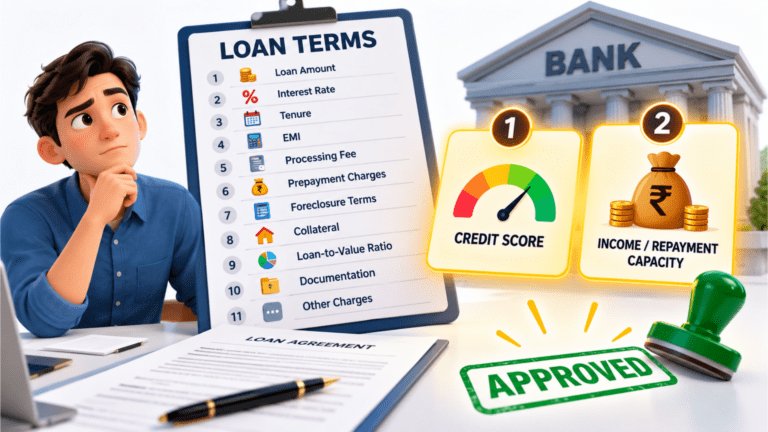
You have seen the chart. Loan amounts down one side, EMIs in the middle, and a salary figure in orange telling you exactly what you need to earn. It circulates every few weeks on WhatsApp and LinkedIn, and it is close enough to right that it is worth checking properly. The two places it goes soft are the two that cost real money: the arithmetic behind the EMI column, and the assumption that half your take-home pay is an acceptable amount to hand a bank.
Quick Summary
On a ₹50 lakh home loan at 8.5% per annum over 20 years, the EMI is ₹43,391. Lenders usually sanction it against take-home pay of around ₹86,800, because most credit policies allow total EMIs up to 50% of net income. That is the ceiling, not the target. At a safer 40% you need about ₹1,08,500 a month; at 30%, roughly ₹1,44,600. The loan costs ₹54.14 lakh in interest over the tenure.
What the lending market actually looks like right now
Home loans are the largest and steadiest block of retail credit in India. CRIF HighMark’s How India Lends report put the home loan portfolio outstanding at ₹44.4 lakh crore as of March 2026, growing 9.4% year on year, which is slower than gold loans at 50.4% and personal loans at 12.9% but on a far bigger base.
Pricing sits at the bottom of a long easing cycle. The Monetary Policy Committee held the repo rate at 5.25% on 5 August 2026 in a unanimous vote, raising its FY27 growth projection to 6.7% and trimming the inflation estimate to 5.0%. Because banks must link floating retail loans to an external benchmark, that repo level reaches home loan rates within a quarter.
That band matters for reading any salary chart. Rate pages in August 2026 show floating home loans starting near 7.10% for credit scores above 800 at some public sector banks, with most salaried applicants landing between 7.65% and 8.50%. A chart built on 8.50% assumes a borrower at the weaker end of the range, which makes it cautious rather than misleading.
Take-home is not salary, and the gap widens as you earn more
Every eligibility calculation in Indian retail lending runs on net take-home pay, not the cost-to-company number in your offer letter. Between the two sit the employee provident fund contribution, professional tax, and tax deducted at source. Most published charts assume take-home is roughly 70% to 76% of gross, which is a fair convention for mid-range salaries.
The convention breaks at the top. Because tax is charged at slab rates, someone earning ₹5 lakh a month loses a larger proportion to TDS than someone on ₹60,000. Anyone reading across from a gross salary column at the high end of a chart is likely over-estimating their eligibility. Work backwards from your own payslip and ignore the gross column.
Illustrative deduction stack at a 28% gap between gross and net. Your own ratio depends on your basic pay split, EPF opt-in, regime choice and city.
The lender’s version of this test is FOIR, the fixed obligation to income ratio: the share of net monthly income committed to all EMIs including the proposed one. Bands typically run 40% to 50% below ₹50,000 of monthly income, 50% to 55% in the middle, and up to 65% above ₹1.5 lakh. These are each lender’s own credit policy, not regulation, which is why two banks reading the same payslip sanction different amounts.
The salary you need, at three different definitions of safe
Here is the chart rebuilt, with the EMI recomputed from first principles and the salary shown at three thresholds instead of one. Every EMI is on a 20-year tenure at 8.5% per annum. The 50% column is what most lenders approve. The 40% column is what a household with other goals can carry. The 30% column leaves genuine room for investing.
| Loan amount | EMI, 20 yr | Take-home at 50% | Take-home at 40% | Take-home at 30% | Total interest |
|---|---|---|---|---|---|
| ₹20 lakh | ₹17,356 | ₹35,000 | ₹43,000 | ₹58,000 | ₹21.66 lakh |
| ₹30 lakh | ₹26,035 | ₹52,000 | ₹65,000 | ₹87,000 | ₹32.48 lakh |
| ₹40 lakh | ₹34,713 | ₹69,000 | ₹87,000 | ₹1,16,000 | ₹43.31 lakh |
| ₹50 lakh | ₹43,391 | ₹87,000 | ₹1,08,000 | ₹1,45,000 | ₹54.14 lakh |
| ₹60 lakh | ₹52,069 | ₹1,04,000 | ₹1,30,000 | ₹1,74,000 | ₹64.97 lakh |
| ₹75 lakh | ₹65,087 | ₹1,30,000 | ₹1,63,000 | ₹2,17,000 | ₹81.21 lakh |
| ₹1 crore | ₹86,782 | ₹1,74,000 | ₹2,17,000 | ₹2,89,000 | ₹1.08 crore |
| ₹1.25 crore | ₹1,08,478 | ₹2,17,000 | ₹2,71,000 | ₹3,62,000 | ₹1.35 crore |
| ₹1.5 crore | ₹1,30,173 | ₹2,60,000 | ₹3,25,000 | ₹4,34,000 | ₹1.62 crore |
| ₹2 crore | ₹1,73,565 | ₹3,47,000 | ₹4,34,000 | ₹5,79,000 | ₹2.17 crore |
EMI and interest computed on a standard reducing-balance formula at 8.5% p.a. for 240 months. Salary columns rounded to the nearest ₹1,000 and stated as monthly take-home, not gross. Assumes no other running EMIs.
Worked example: reading one row properly
Take the ₹50 lakh row. The monthly rate is 8.5 divided by 1,200, or 0.0070833. Over 240 months the standard formula gives an EMI of ₹43,391. Double it for ₹86,782, the take-home at which a 50% FOIR test just clears. Divide by 0.4 instead and you get ₹1,08,478. That gap is not a rounding detail. It is what decides whether the loan is comfortable or merely approved.
The version most people actually need: salary first, loan second
Buyers rarely start with a loan amount. They start with a payslip and want to know what it buys. This table inverts the first one: for a given take-home pay with no existing EMIs, it shows the loan a 20-year tenure at 8.5% supports at each threshold.
| Monthly take-home | Loan at 30% EMI | Loan at 40% EMI | Loan at 50% EMI |
|---|---|---|---|
| ₹40,000 | ₹13.8 lakh | ₹18.4 lakh | ₹23.0 lakh |
| ₹60,000 | ₹20.7 lakh | ₹27.7 lakh | ₹34.6 lakh |
| ₹75,000 | ₹25.9 lakh | ₹34.6 lakh | ₹43.2 lakh |
| ₹1,00,000 | ₹34.6 lakh | ₹46.1 lakh | ₹57.6 lakh |
| ₹1,25,000 | ₹43.2 lakh | ₹57.6 lakh | ₹72.0 lakh |
| ₹1,50,000 | ₹51.9 lakh | ₹69.1 lakh | ₹86.4 lakh |
| ₹2,00,000 | ₹69.1 lakh | ₹92.2 lakh | ₹1.15 crore |
| ₹2,50,000 | ₹86.4 lakh | ₹1.15 crore | ₹1.44 crore |
Loan supported by the stated EMI share, at 8.5% p.a. for 20 years, before the loan-to-value cap is applied. The final sanction is the lower of this figure and the LTV limit on the property.
One caution. This table answers the income question only. Lenders apply a second, independent test on the property, and the sanction is the smaller of the two. Someone earning ₹2.5 lakh who qualifies on income for ₹1.44 crore is still capped at 75% of value if the flat is above ₹75 lakh.
Why viral charts and their own stated rate often disagree
Worth doing on any chart you are handed: divide one EMI by its loan amount and see what rate it implies. The widely shared version of this table quotes 8.50% at the top and an EMI of ₹17,013 on ₹20 lakh. Run that backwards and the implied rate is about 8.23%, not 8.50%. At the stated rate the EMI is ₹17,356.
The gap looks trivial, at ₹343 a month. It is not. On the ₹2 crore row the understatement is ₹3,429 a month, which is ₹8.23 lakh across a 20-year tenure. And because every EMI in that column is a flat 850.65 rupees per lakh borrowed, the same proportional error runs down the whole table.
What people actually get wrong
Two opposite errors partly cancel each other. The EMIs are computed at a rate below the one advertised, understating the instalment. But 8.50% is at the top of what a decent salaried profile is offered in August 2026. A borrower who negotiates 7.75% pays ₹821 per lakh instead of ₹851, more than offsetting the gap. The chart is a reasonable worst case, not a quote.
Where your EMI-to-income ratio should actually sit
The 50% figure is not invented. It is the level beyond which lenders rarely underwrite a mortgage, and Knight Frank uses the same line in its Affordability Index. But a threshold describing when a bank stops lending is a poor guide to when a household should stop borrowing.
Comfortable
Workable
Tight
Stretched
Fragile
City-level data shows how differently that threshold bites depending on where you buy. Knight Frank India’s Affordability Index for the first half of 2026 measures the share of average household income needed to service the EMI on an average local unit, and only two of the eight markets it tracks sit above 50%.
What the first year of a ₹50 lakh EMI actually buys you
Here is the fact that reframes the whole affordability question. On a ₹50 lakh loan at 8.5% over 20 years, you pay ₹5,20,693 in the first twelve months. Of that, ₹99,511 reduces what you owe and ₹4,21,182 is interest. Just over 19 paise in the rupee is buying you equity in the house.
This is not a flaw in the product. Interest is charged on the outstanding balance, which is at its largest on day one, so the split is necessarily front-loaded. But it explains why the early years feel like they are going nowhere, and why prepayment is enormously more powerful early than late.
The prepayment arithmetic, done properly
Put ₹5 lakh into that loan in month 24 and keep the EMI unchanged, and you finish 3 years 9 months early and avoid ₹14.57 lakh of interest, cutting the bill from ₹54.14 lakh to ₹39.57 lakh. Under the Reserve Bank of India (Pre-payment Charges on Loans) Directions, 2025, floating-rate home loans to individuals sanctioned or renewed from 1 January 2026 carry no prepayment charges. Make the same payment in year 15 and the saving collapses.
The money the salary chart never shows you
A salary table answers the monthly question and is silent on the upfront one, which is where first-time buyers get caught. The Reserve Bank caps loan-to-value at 90% up to ₹30 lakh, 80% from ₹30 lakh to ₹75 lakh, and 75% above that. Crucially, stamp duty and registration are excluded from the property value in that calculation, so they come from your own pocket on top of the down payment.
Work it through on the ₹50 lakh loan. At an 80% LTV that implies a property of about ₹62.5 lakh and a down payment of ₹12.5 lakh. Add stamp duty at 6%, registration at 1%, a processing fee with GST, legal and technical valuation, and mortgage deed charges, and the real cash requirement before you get the keys is closer to ₹17.3 lakh, roughly 1.4 times the down payment alone.
| Upfront item | Basis | On a ₹62.5 lakh property | Negotiable? |
|---|---|---|---|
| Down payment | 20% at the ₹30 to 75 lakh LTV band | ₹12,50,000 | No, but a larger one cuts your rate |
| Stamp duty | 4% to 8% of value, state-specific | ₹3,75,000 at 6% | No; several states discount for women buyers |
| Registration | Around 1%, often capped | ₹62,500 | No |
| Processing fee | 0.25% to 1% of loan, plus 18% GST | ₹20,650 at 0.35% | Yes, frequently waived |
| MODT / mortgage deed | 0.1% to 0.5% of loan, state-specific | ₹10,000 at 0.2% | No |
| Legal and valuation | Flat fee | ₹7,500 | Sometimes bundled into the fee |
| Total cash needed | Before any furnishing or move-in cost | ₹17,25,650 | Budget 1.4x the down payment |
Illustrative for a ₹62.5 lakh property with a ₹50 lakh loan. Stamp duty and registration rates vary materially by state and change with state budgets. Verify current rates for your state before budgeting.
Five ways to raise eligibility without raising your salary
If the table says your income supports less than you need, the salary is only one of five inputs. These are ordered by how much they move the sanction relative to what they cost you.
The tenure decision, priced honestly
Lengthening the tenure is the most commonly recommended way to make an EMI fit, and the most commonly under-explained. It works, and it is expensive.
₹61,993
₹49,237
₹43,391
₹40,261
₹38,446
The pattern is worth naming. Each extra five years buys less EMI relief and adds a steady slab of interest. Between 25 and 30 years the EMI falls by only ₹1,815 while total interest rises ₹17.6 lakh. A long tenure works only if you treat the low EMI as a floor and prepay above it.
The tax relief that only exists if you opt out of the default
The new tax regime is the default, and under it a borrower with a self-occupied property gets no interest deduction and no principal deduction. Almost every housing tax benefit written about in India exists only under the old regime, which must be actively chosen.
Under the old regime, interest is deductible up to ₹2 lakh a year on a self-occupied property, and principal up to ₹1.5 lakh within the shared 80C basket. In the 30% bracket the full interest claim is worth about ₹62,400 of tax including cess. The Income-tax Act, 2025 came into force on 1 April 2026 and renumbers these provisions. Sections 80EE and 80EEA are closed to fresh loans and should be ignored in any 2026 calculation.
Before you assume the deduction, check three things
The claim requires that you are both an owner and a borrower, that construction completed within five years from the end of the financial year the loan was taken, and that you repaid from your own income. Adding a non-earning spouse as co-borrower gives them nothing to claim. Run both regimes every year rather than assuming the deductions win.
The terms on your sanction letter, translated
| Term | What it actually means | What to do about it |
|---|---|---|
| FOIR | Share of net income committed to all EMIs including the new one. Set by each lender, commonly 40% to 55%. | Compute your own before applying; close small loans to widen it. |
| LTV | Loan as a share of property value. Capped at 90%, 80% and 75% across three value bands. | Remember duty and registration sit outside this figure. |
| EBLR / RLLR | The external benchmark, usually the repo rate, that your floating rate is linked to. Resets at least quarterly for banks. | Check your statement after every policy move. |
| Spread | The margin added to the benchmark, set at sanction from your profile. Generally sticky for the life of the loan. | Negotiate hard once; improving your score later rarely reprices it automatically. |
| Key Facts Statement | A standardised pre-sanction disclosure carrying the all-in APR and full fee schedule. | This is the document to compare lenders on, not the advertised rate. |
| Sanction vs disbursement | Sanction is approval in principle. Disbursement is money released, after property and legal clearance. | Never commit to a builder timeline on a sanction letter alone. |
| Pre-EMI | Interest-only payments during construction, before full EMI begins. | Pleasant now, but nothing is repaid; ask for full EMI if you can carry it. |
| Reset | The point at which the benchmark change flows into your loan. | You must be offered the choice of EMI change, tenure change, or a switch to fixed. |
| MODT | Memorandum of deposit of title deed, the registered charge over the property. | A one-time state-specific cost of roughly 0.1% to 0.5% of the loan. |
| Part-payment | A lump sum against principal, mid-tenure. | Free on eligible floating-rate loans from 1 January 2026; ask to keep the EMI and cut the tenure. |
What to do before you apply
- Take your figure from a payslip, not the offer letter, and base every calculation on it.
- Fix the EMI ceiling first, then derive the loan. Choosing the property first and fitting an EMI to it is how households end up at 55%.
- Add up the cash needed before possession: down payment, duty, registration, fees, move-in. Budget 1.4 times the down payment.
- Check your credit report six to twelve months out and time-box rate shopping to a few weeks so hard enquiries cluster.
- Compare on the Key Facts Statement: the APR, the spread, the reset frequency and the part-payment terms, not the headline rate.
Frequently asked questions
How much salary do I need for a ₹50 lakh home loan?
At 8.5% per annum over 20 years the EMI is ₹43,391. Most lenders sanction it against a monthly take-home of roughly ₹86,800, since FOIR bands allow total EMIs up to about half of net income. For the loan to sit comfortably alongside savings, ₹1,08,500 is a better target. Use take-home, not gross, and subtract existing EMIs first.
Is 50% of salary a safe EMI, or should it be 30% or 40%?
Fifty per cent is a lender’s underwriting ceiling, not a household budget. Below 30% almost nothing else in your finances has to change. Between 30% and 40% is sound for a stable salary with an emergency fund. Between 40% and 50% the loan is approved but investing becomes whatever is left over. Above 50% you are relying on nothing going wrong for two decades.
Does the bank look at gross salary or take-home salary?
Take-home. Eligibility is assessed on net monthly income after provident fund, professional tax and TDS. Gross columns in salary charts assume take-home is around 70% to 76% of gross, which holds for mid-range salaries but overstates eligibility at high incomes, where slab-rate tax takes a bigger bite.
What is the current home loan interest rate in India in August 2026?
The repo rate has been held at 5.25% since December 2025, most recently on 5 August 2026. Floating home loans start near 7.10% for the strongest profiles at some public sector banks, with most salaried borrowers offered between roughly 7.65% and 8.50%. State Bank of India published 7.25% to 8.45% in August 2026.
Why does my EMI differ from the one in the salary chart?
Three common reasons. The chart may compute at a rate different from the one it advertises, as the circulating version does. Your sanctioned rate reflects your own profile and loan-to-value. And your tenure may not be 20 years, since it is capped by retirement age. Recompute from your sanction letter.
How much money do I need upfront beyond the down payment?
More than most buyers plan for. Stamp duty and registration sit outside the property value used for the loan-to-value cap, so they come entirely out of pocket. On a ₹62.5 lakh property with a ₹50 lakh loan, the down payment is ₹12.5 lakh but total cash needed is closer to ₹17.3 lakh.
Should I take a 30-year tenure to reduce my EMI?
Only with a plan to prepay. On a ₹50 lakh loan at 8.5%, moving from 20 to 30 years cuts the EMI by ₹4,945 a month and adds ₹34.3 lakh to the interest bill. It keeps monthly commitments flexible, provided you treat the lower EMI as a minimum and pay above it.
Can I add a co-applicant to increase my home loan eligibility?
Yes, and it is usually the most effective lever. An earning spouse, parent or adult child can be added, pooling incomes for the FOIR test. If they are also a co-owner and repay from their own income, they can independently claim the housing deductions under the old regime. A non-earning co-borrower cannot claim anything.
Are there prepayment charges on a home loan in 2026?
Not on floating-rate home loans to individuals for non-business purposes, sanctioned or renewed on or after 1 January 2026. The Reserve Bank of India (Pre-payment Charges on Loans) Directions, 2025 consolidated this across banks, co-operative banks and NBFCs. Fixed-rate loans may still attract charges, so check the Key Facts Statement.
Does a home loan reduce my tax under the new regime?
For a self-occupied property, no. The new regime is the default and offers no interest or principal deduction. The ₹2 lakh interest deduction and the ₹1.5 lakh principal deduction exist only under the old regime, which must be actively opted into. Run both on your own numbers each year before deciding.
The short version
A ₹50 lakh home loan at 8.5% for 20 years costs ₹43,391 a month and ₹54.14 lakh in interest. Banks lend it against a take-home of about ₹86,800, but that leaves nothing for anything else, so ₹1,08,500 is the honest requirement and ₹1,44,600 the comfortable one. Check any chart’s arithmetic against its stated rate, budget 1.4 times the down payment in upfront cash, and treat the sanction as a ceiling rather than a recommendation.