₹69,000 Minimum Pay and Higher HRA: The 5 Key NC-JCM Demands to the 8th Pay Commission, and What They Assume
- ₹18,000Minimum basic pay now, 7th CPC
- ₹69,000Minimum basic pay sought by NC-JCM
- 2.577th CPC fitment factor
- 3.833Fitment factor sought by NC-JCM
Government jobs · 8th Pay Commission · November 2026
₹69,000 Minimum Pay and Higher HRA: The 5 Key NC-JCM Demands to the 8th Pay Commission, and What They Assume
The staff side of the National Council (JCM) wants the entry-level basic pay of central government employees almost quadrupled, along with higher HRA, 6% increments and a return to the Old Pension Scheme. None of it is approved; the commission’s report is due by May 2027.
If you are a central government employee at Level 1, your basic pay today starts at ₹18,000. The union side of the government’s own consultative body now says it should be ₹69,000. Headlines also promise “₹15,768 more HRA”. Both numbers are real, but they come from different places and rest on different assumptions, and neither is a government decision. This article sets out the five demands that matter most, what each would mean for a payslip, and how far the process still has to go.
The five demands, at a glance
- Minimum pay and fitment factorEntry basic pay up from ₹18,000, using a 3.833 multiplier on current pay.₹69,000
- Higher HRA slabs40% for X cities, 35% for Y and 30% for Z, against 30%, 20% and 10% now.40 / 35 / 30%
- Bigger annual incrementsDouble the yearly increment rate, plus at least five promotions in 30 years.3% to 6%
- Old Pension SchemeScrap NPS and UPS; pension at 67% of last basic pay, revised every five years.67% pension
- Five-member family unitCount parents in the family used to calculate minimum wages, up from three units.3 to 5 units
Indian PSU and SA News reported the memorandum, submitted by the drafting committee of the NC-JCM staff side on 14 April 2026. It also seeks leave encashment of up to 600 days, a ₹10,000 monthly risk and hardship allowance, ₹2 crore ex-gratia for death on duty and Children Education Allowance up to post-graduation.
Demand 1: why ₹69,000, and how it compares
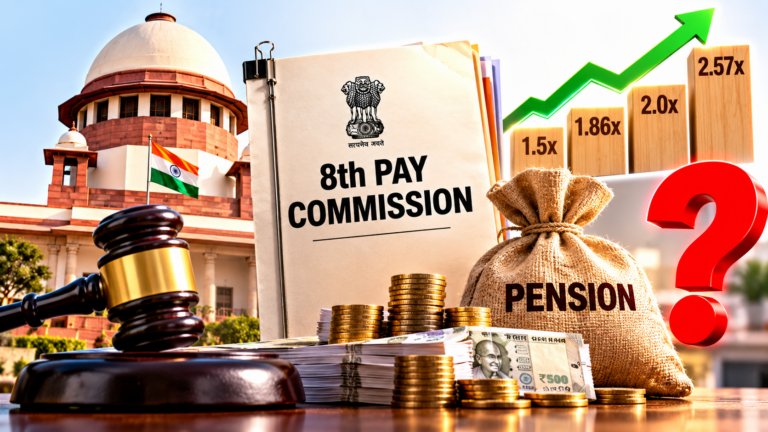
The fitment factor is the multiplier applied to current basic pay to get new basic pay. The 7th Pay Commission used 2.57, taking the minimum from ₹7,000 to ₹18,000. NC-JCM’s 3.833 applied to ₹18,000 gives about ₹69,000. It is the highest of three main proposals tracked by Upstox in November 2026.
₹ per month at Level 1. Source: Upstox, 11 November 2026. IRTSA proposes graded factors from 2.92 at Level 1 to 4.38 at the top levels.
The demand is also built on a broader family definition. The minimum wage formula used by pay commissions counts how many consumption units a worker supports. NC-JCM wants five units, including parents, instead of three, which raises the cost-of-living base and therefore the minimum pay it argues for.
What it would mean higher up the scale
| Pay level (entry basic now) | At 2.57 (7th CPC factor) | MSA at 3.61 | NC-JCM at 3.833 | Increase over current at 3.833 |
|---|---|---|---|---|
| Level 1 (₹18,000) | ₹46,300 | ₹65,000 | ₹69,000 | ₹51,000 |
| Level 6 (₹35,400) | ₹91,000 | ₹1,27,800 | ₹1,35,700 | ₹1,00,300 |
| Level 18 (₹2,50,000) | ₹6,42,500 | ₹9,02,500 | ₹9,58,300 | ₹7,08,300 |
| Level 5 (₹29,200) | ₹75,044 | ₹1,05,412 | ₹1,11,924 | ₹82,724 |
| Level 7 (₹44,900) | ₹1,15,393 | ₹1,62,089 | ₹1,72,102 | ₹1,27,202 |
Levels 1, 6 and 18 are from Upstox’s pay-matrix projection. Levels 5 and 7 and the increase column are our calculations, multiplying entry basic by each factor. NC-JCM has also proposed merging 18 levels into fewer scales, so its actual figures for some levels may differ.
Demand 2: decoding the “₹15,768 more HRA” headline
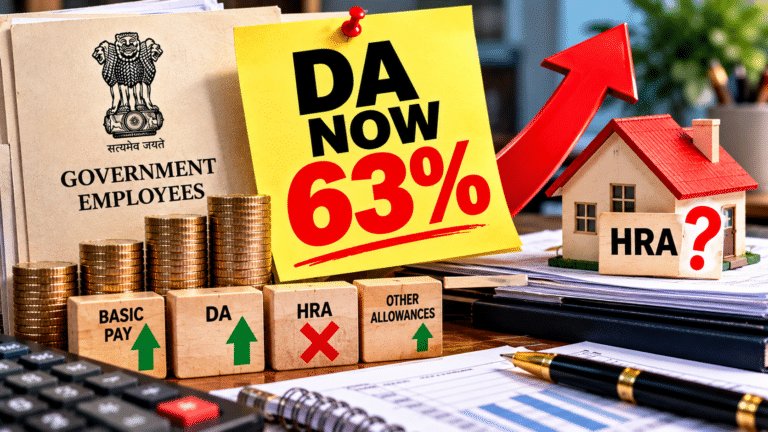
House Rent Allowance is a percentage of basic pay that depends on city class. Since dearness allowance crossed 50%, the rates under the 7th CPC have been 30% for X cities, 20% for Y and 10% for Z, according to Indian Pay Calculator. NC-JCM wants 40%, 35% and 30%, with city classes reviewed every five years.
What people get wrong: the ₹15,768 figure is not NC-JCM’s number. It comes from a Haribhoomi calculation published on 8 September 2026 for a Level 5 employee in an X city, which assumed a fitment factor of just 2.1 and applied the proposed 40% HRA. Basic of ₹29,200 at 2.1 becomes ₹61,320; 40% of that is ₹24,528, against today’s ₹8,760, a rise of ₹15,768. Under NC-JCM’s own 3.833 factor the increase would be far larger.
₹ per month, at entry basic pay. Lower scenario: fitment 2.1 with 40% HRA, per Haribhoomi. Higher scenario: NC-JCM’s 3.833 with 40% HRA, our calculation. Both compare with current 30% HRA.
HRA by city class if NC-JCM’s full package were adopted
| Level | Basic at 3.833 | X city at 40% | Y city at 35% | Z city at 30% |
|---|---|---|---|---|
| Level 1 | ₹68,994 | ₹27,598 | ₹24,148 | ₹20,698 |
| Level 2 | ₹76,277 | ₹30,511 | ₹26,697 | ₹22,883 |
| Level 4 | ₹97,742 | ₹39,097 | ₹34,210 | ₹29,323 |
| Level 5 | ₹1,11,924 | ₹44,770 | ₹39,173 | ₹33,577 |
| Level 6 | ₹1,35,688 | ₹54,275 | ₹47,491 | ₹40,706 |
| Level 7 | ₹1,72,102 | ₹68,841 | ₹60,236 | ₹51,631 |
All figures in this table are our calculations at entry basic pay, rounding to the nearest rupee. They show the upper bound of what the union side has asked for, not a forecast.
Demand 3: a 6% increment, and why it compounds
Central employees now get an annual increment of 3% of basic pay. NC-JCM wants 6%, citing inflation, plus at least five promotions or financial upgrades over 30 years of service.
Worked example: 10 years at 3% versus 6%. Start at ₹69,000. A 3% increment adds ₹2,070 in year one; 6% adds ₹4,140. Compounded over 10 years with no promotions, basic pay reaches about ₹92,730 at 3% and about ₹1,23,568 at 6%. The gap of about ₹30,838 a month would also lift every allowance calculated as a percentage of basic, including DA and HRA. Our calculation.
₹ per month, compounded, ignoring promotions and DA. Our calculation.
Demands 4 and 5: pensions and the family unit
The pension demand may be the hardest politically. NC-JCM wants the National Pension System and the Unified Pension Scheme scrapped and the Old Pension Scheme restored for staff recruited after 1 January 2004, with pension at 67% of last basic pay, family pension at 50%, revisions every five years and commuted pension restored after 11 years instead of 15. “There cannot be two sets of employees,” the memorandum argued, as quoted by Indian PSU.
The government’s terms of reference, approved by the Cabinet on 28 October 2025, ask the commission to consider “the unfunded cost of non-contributory pension schemes” and fiscal prudence, The Week reported. That framing makes a full return to the Old Pension Scheme a steep ask.
- 50 lakhCentral government employees covered, per the Cabinet
- 69 lakhPensioners covered by the 8th CPC
- 18 monthsTime given to the commission to report
- 600 daysLeave encashment sought, with unlimited accumulation
- ₹10,000Monthly risk and hardship allowance sought
- ₹2 croreEx-gratia sought for death on duty
Why the family unit matters: pay commissions have traditionally set the minimum wage from the needs of a family of three consumption units. Expanding that to five, including dependent parents, would raise the calculated minimum need and is a key plank of the ₹69,000 argument.
Demands versus outcomes: a lesson from the last commission
Staff-side demands are an opening position, and the final award has historically been well below them. Before the 7th Pay Commission, the staff side sought a minimum pay of ₹26,000 and a fitment factor of about 3.68, as widely reported at the time. The commission recommended ₹18,000 and a factor of 2.57, which the government accepted. Unions protested, but the award stood.
That history does not predict the 8th CPC’s numbers, but it shows why a demand of 3.833 is best read as the upper end of a negotiating range. The more useful signal will come from the commission’s own consultations, any interim reports it chooses to issue, and the government’s fiscal statements over the next year.
How a demand becomes a payslip
The process has four stages. Unions, associations and ministries submit memoranda; the commission holds consultations and studies pay data, including private-sector and public-sector benchmarks; it submits its report to the government; and the Cabinet decides what to accept, often with changes, before the Finance Ministry notifies the new pay rules. Only at the last stage do salaries, allowances and arrears actually change.
Other asks in the memorandum
Beyond the headline five, the memorandum asks for gratuity of one month’s wages per year with no ceiling, 45 days of paternity leave, 240 days of maternity leave without a two-child limit, 60 days of parent care leave, group insurance of ₹1 crore for Group C staff and ₹1.5 crore for Group B, and cashless medical treatment for employees and retirees, according to SA News and Indian PSU.
From Cabinet nod to your payslip: the timeline
- 7th CPC pay takes effect; minimum ₹18,000
- Cabinet approves 8th CPC terms of reference
- Commission constituted with 3 members
- Likely effective date cited by the minister, with arrears
- NC-JCM staff side submits memorandum
- ₹15,768 HRA estimate published, at 2.1 fitment
- 3 fitment proposals compared: 2.92, 3.61, 3.833
- Report due, about 18 months after constitution
Information and Broadcasting Minister Ashwini Vaishnaw said in October 2025 that the new pay “mostly” should be effective from 1 January 2026, The Week reported. If that holds, employees would receive arrears from that date once the government accepts and notifies the recommendations, which most projections put in the second half of 2027.
What employees should keep in mind
- Demands are proposals, not approved pay: none is notified
- Three fitment factors are in play: 2.92, 3.61 and 3.833
- ₹15,768 assumes a 2.1 factor, not NC-JCM’s 3.833
- Current HRA stays at 30%, 20% and 10% until a decision
- DA continues under the 7th CPC until new pay is notified
- Arrears may run from 1 January 2026 if that date is confirmed
- OPS restoration for post-2004 recruits is the hardest ask
- Beware paid “calculators” promising exact new salaries
8th Pay Commission questions employees are asking
What minimum pay has NC-JCM demanded from the 8th Pay Commission?
₹69,000 a month, up from ₹18,000, using a fitment factor of 3.833. This is a staff-side demand, not an approved figure.
What HRA rates has NC-JCM proposed?
40% of basic pay for X-class cities, 35% for Y and 30% for Z, compared with 30%, 20% and 10% under the 7th CPC.
Where does the ₹15,768 HRA increase figure come from?
It is a Haribhoomi estimate for a Level 5 employee in an X city, assuming a fitment factor of 2.1 and 40% HRA, compared with current HRA of ₹8,760.
When will the 8th Pay Commission report be submitted?
The commission has 18 months from its constitution in October 2025, so its report is expected by around May 2027.
From when will the 8th Pay Commission be effective?
Minister Ashwini Vaishnaw said it should mostly be from 1 January 2026, which would mean arrears, but the date has not been formally notified.
What fitment factor do other unions want?
IRTSA proposes graded factors from 2.92 to 4.38, the Ministerial Staff Association 3.61, and NC-JCM, Bharat Pensioners Samaj and FNPO about 3.83.
Will the Old Pension Scheme be restored under the 8th Pay Commission?
NC-JCM has demanded it, but the government’s terms of reference ask the commission to consider the unfunded cost of non-contributory pensions. No decision has been made.
How many employees and pensioners will the 8th CPC cover?
About 50 lakh central government employees and 69 lakh pensioners, according to the Cabinet announcement.
The short version
NC-JCM’s staff side wants the 8th Pay Commission to set minimum basic pay at ₹69,000, using a 3.833 fitment factor, raise HRA to 40%, 35% and 30%, double increments to 6%, count a family as five units and restore the Old Pension Scheme. The widely shared ₹15,768 HRA gain comes from a separate media estimate at a 2.1 factor; NC-JCM’s own numbers would imply more. All of it remains a wish list. The commission reports by about May 2027, other unions want lower factors, and the government’s own brief stresses fiscal prudence.